
The theory of the kinked demand curve is that
a. although the firm sells a differentiated product, too many competitors exist to make it
worthwhile speculating on responses to the firm’s behavior.
b. freedom of entry will reduce profits to zero.
c. a firm’s competitors will follow it in a price decrease but not follow it in a price
increase.
d. firms are all seeking the position of joint profit maximization.
A roller coaster operator produces thrill-packed rides using electricity and a roller
coaster. For the roller coaster operator, electricity is
a. an opportunity cost.
b. a variable cost.
c. a fixed cost.
d. a sunk cost.
Real GDP is the dollar value of all goods and services produced in an economy.
a. True

b. False
Which of the following is an example of an externality?
a. Drug abuse affecting David’s health.
b. Sara taking a break from work.
c. A transaction between two parties, affecting them alone.
d. Tom’s smoking affecting his roommate’s health.
A non-policy reason for the reduction in the natural rate of unemployment is the
a. expansionary nature of monetary policy.
b. aging of the U.S. labor force.
c. decline in interest rates.
d. growing federal budget surplus.
Since the end of World War II, the economy of the United States has been more
influenced by stabilization policy. One of the undesirable side effects of this has been
that the economy now has a greater tendency to suffer from
a. more severe recessions and depressions.
b. higher levels of unemployment and lower rates of employment growth.
c. lower rates of growth in real and nominal GDP.
d. more persistent periods of inflation.
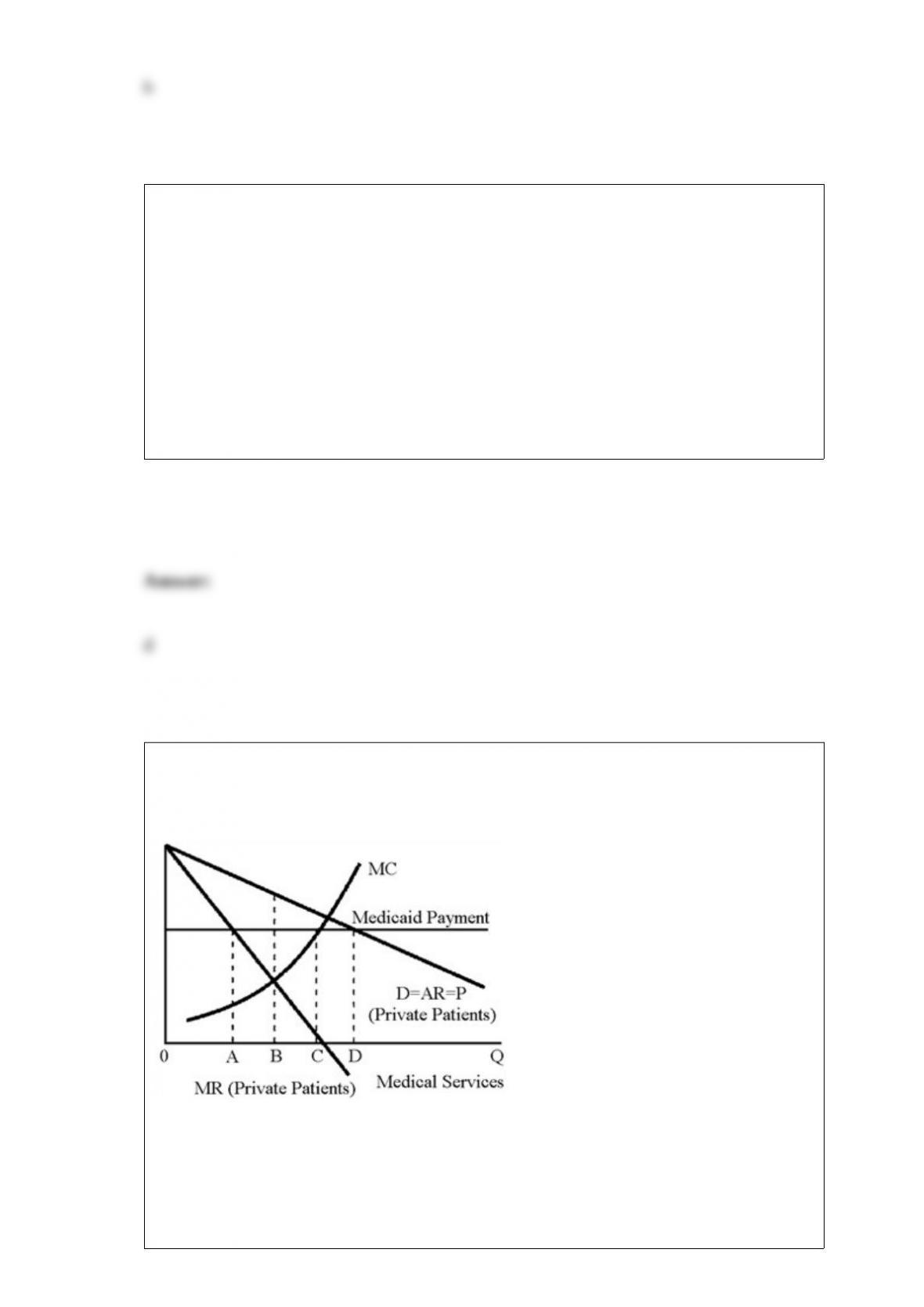
Figure 11-4
Physicians have two types of patients: private patients who pay directly or with
insurance, and Medicaid patients whose care is paid for by the state. Physicians must
lower prices to attract more private patients, but they can add unlimited Medicaid
patients at a constant price. The situation facing Dr. Casey is depicted in Figure 11-4.
Units of medical service (say, number of patients x number of visits) are measured on

the horizontal axis. How many units of medical service will Dr. Casey deliver to
Medicaid patients?
a. OA
b. AC
c. OC
d. OD
Since it spent over $3.6 trillion in 2010, opportunity cost was not an issue for the U.S.
government.
a. True
b. False
In 2007, the value of the U.S. dollar
a. increased relative to the euro.
b. decreased relative to the euro.
c. remained stable relative to the euro.
d. was equal to the value of the euro.

High profits in some risky industries attract additional entrepreneurs to those industries.
a. True
b. False
The demand curve for a factor is that part of the MRP where marginal product is
a. rising.
b. falling.
c. positive.
d. negative.

If the price level rises, what will happen to the demand for reserves?
a. It will shift outward.
b. It will shift inward.
c. It will remain unchanged.
d. It depends on what happens to interest rates.
In 2012, what percentage of total income in the U.S. was earned by the poorest fifth of
all U.S. households?
a. 1.5%
b. 1.8%
c. 2.0%
d. 3.2%
In the short run the firm has at least one fixed input.
a. True
b. False
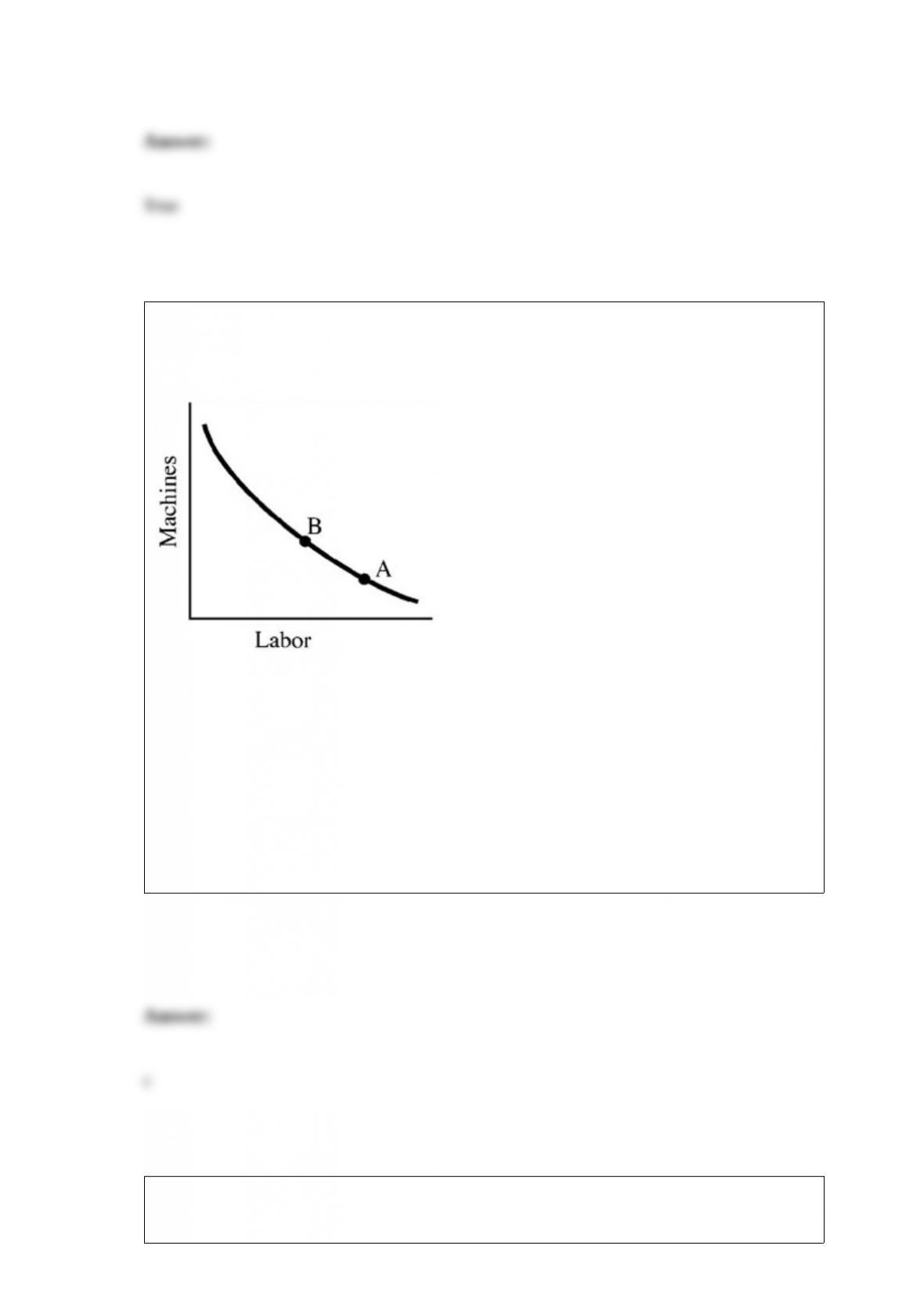
Figure 7-15
For a firm at equilibrium, at point A in Figure 7-15
a. the price of labor is high relative to the price of machines.
b. the MPP of labor is greater than the MPP of machines.
c. the MPP of labor is less than at point B.
d. output is higher than at point B.
One effect of having access to cheap foreign goods can be to raise workers’ real wages.

a. True
b. False
Entrepreneurs differ from managers because
a. they use innovation to gain advantage over their competitors.
b. managers use established managing styles; entrepreneurs do not.
c. entrepreneurs tend to take more risk than managers.
d. All of the above are correct.
The market structure that is associated with big business in developed economies is
a. perfect competition.
b. monopolistic competition.
c. monopoly.
d. oligopoly.

Marginal social cost is made up of marginal private cost and incidental cost.
a. True
b. False
Supply can shift due to changes in price.
a. True
b. False
Consumption functions would shift downward if
a. disposable incomes fall.
b. disposable incomes rise.
c. price levels fall.
d. price levels rise.
Specialization is a major obstacle to international trade.
a. True
b. False
Karl Marx was critical of markets on the grounds that they are not efficient.
a. True
b. False
Input proportions are usually fixed by technological conditions alone.

a. True
b. False
Businesses will want to borrow more funds as the real rate of interest decreases.
a. True
b. False
When a tax is imposed on an item, it can generally be said that the incidence of the tax
is
a. entirely on the buyer.
b. entirely on the seller.
c. on both the buyer and seller.
d. not determined in this manner.

If demand increases, the equilibrium price and equilibrium quantity will both fall,
everything else being equal.
a. True
b. False
The Phillips curve shows the relationship between the rate of inflation and the rate of
growth of real GDP.
a. True
b. False
Which of the following statements is correct?
a. In the short run, interest rate differentials have the greatest impact on exchange rates.
b. In the medium run, differences in growth rates of aggregate demand have the greatest
impact on exchange rates.

c. In the long run, price and inflation differentials have the greatest impact on exchange
rates.
d. All of the above are correct.
What is a key criterion involved in deciding a natural monopoly?
a. Size of the firm relative to its competitors.
b. Size of the firm relative to the total market demand for a product.
c. Magnitude of profits generated by the company.
d. A firm’s ability to adapt to market changes.
As a generalization, it can be said that
a. aggregate demand shifts to the right every year, but aggregate supply rarely does.
b. aggregate supply shifts to the right every year, but aggregate demand rarely does.
c. both aggregate demand and aggregate supply shift to the right each year.
d. neither aggregate demand nor aggregate supply curve shifts to the right each year.

Which of the following was an argument for using fiscal policy in situations like the
Great Recession?
a. Congress can act quickly.
b. The size of a recessionary gap may require the use of both fiscal and monetary
policy.
c. Once the federal funds rate is reduced to zero, monetary policy is less effective.
d. all of the above
If Wisconsin cheddar cheese sells for $3.00 per pound in the United States and for
27.90 pesos in Mexico, what is the exchange rate between the dollar and the peso
(assuming PPP holds)?
a. $1 = 2.79 pesos
b. $1 = 7.90 pesos
c. $1 = 9.30 pesos
d. $1 = 27.90 pesos
If firms are experiencing falling inventories, one can expect that firms will cut
production.
a. True
b. False
What is the difference between the short run and the long run as economists define the
two?
Explain the concept of efficiency as it relates to taxation.
Profits or losses must be temporary for perfectly competitive firms. Why?
Differentiate between the current account balance and the capital account balance.
What are the factors that contribute to productivity growth in the market economy and
which of them is considered most important?
How do modern markets differ from other economic systems in their capacity to
produce “growth miracles”?
What are the reasons that are usually given to justify regulation?
If the MRP per dollar is greater for labor than that for tools, a producer should spend
more money on labor than originally planned and less on tools. How long can he
continue this switch in spending? Why?
After the Arab oil embargoes, there was concern about the impact of higher gas prices
on the low-income worker. The government imposed price controls on oil to protect the
poor from this situation. Explain the inefficiency of this price ceiling and how taxes,
rather than prices, could be used to solve the problem.
Compare and contrast the U.S. economic record prior to 1940 and after 1950. How do
the two time periods differ? What best explains the differences according to a
macroeconomist?
The essential logic behind international trade is not different from that underlying trade
among different states. Why, then, do we study international trade as a special subject?
What are some of the possible ways in which we could reduce the natural rate of
unemployment?
Are national forests public goods? Explain.
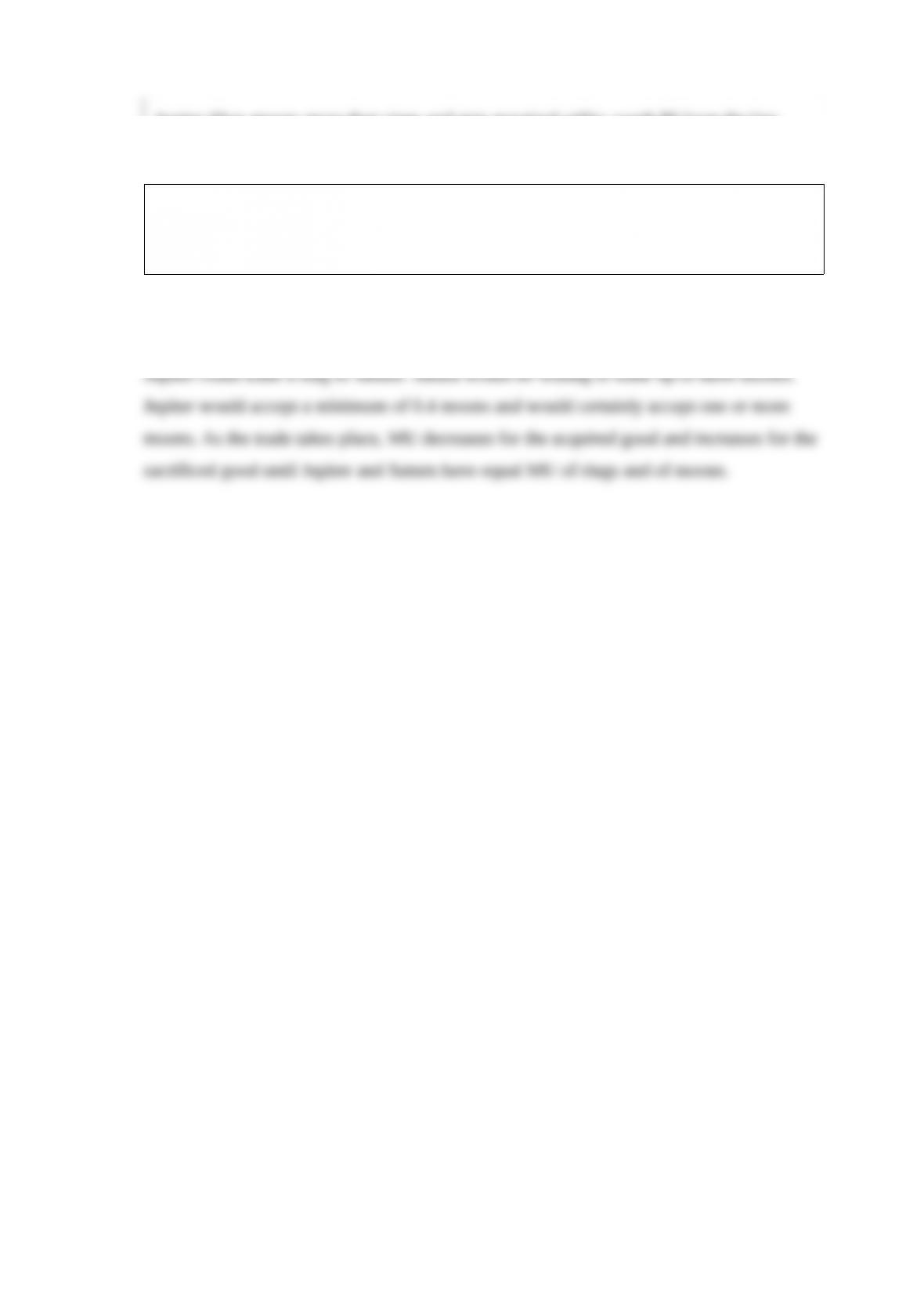
You have five hours left to study for two exams tomorrow. The relationship between
hours of study and test scores is as follows:
Use the rule for determining optimal purchases to allocate your time, where each point
is one “util” of utility.
Jupiter likes moons more than rings and gets marginal utility worth $5 from the last
moon, and $2 from the last ring. Saturn prefers rings, getting MU = $3 from the last
ring and $1 from moons. Describe a trade that would increase efficiency.