A Nash Equilibrium in a game is that outcome in which:
A) each player is doing the best he or she can given the other player’s action.
B) the players’ profits are equal.
C) the players’ earn the highest profits possible.
D) neither player plays his or her dominant strategy.
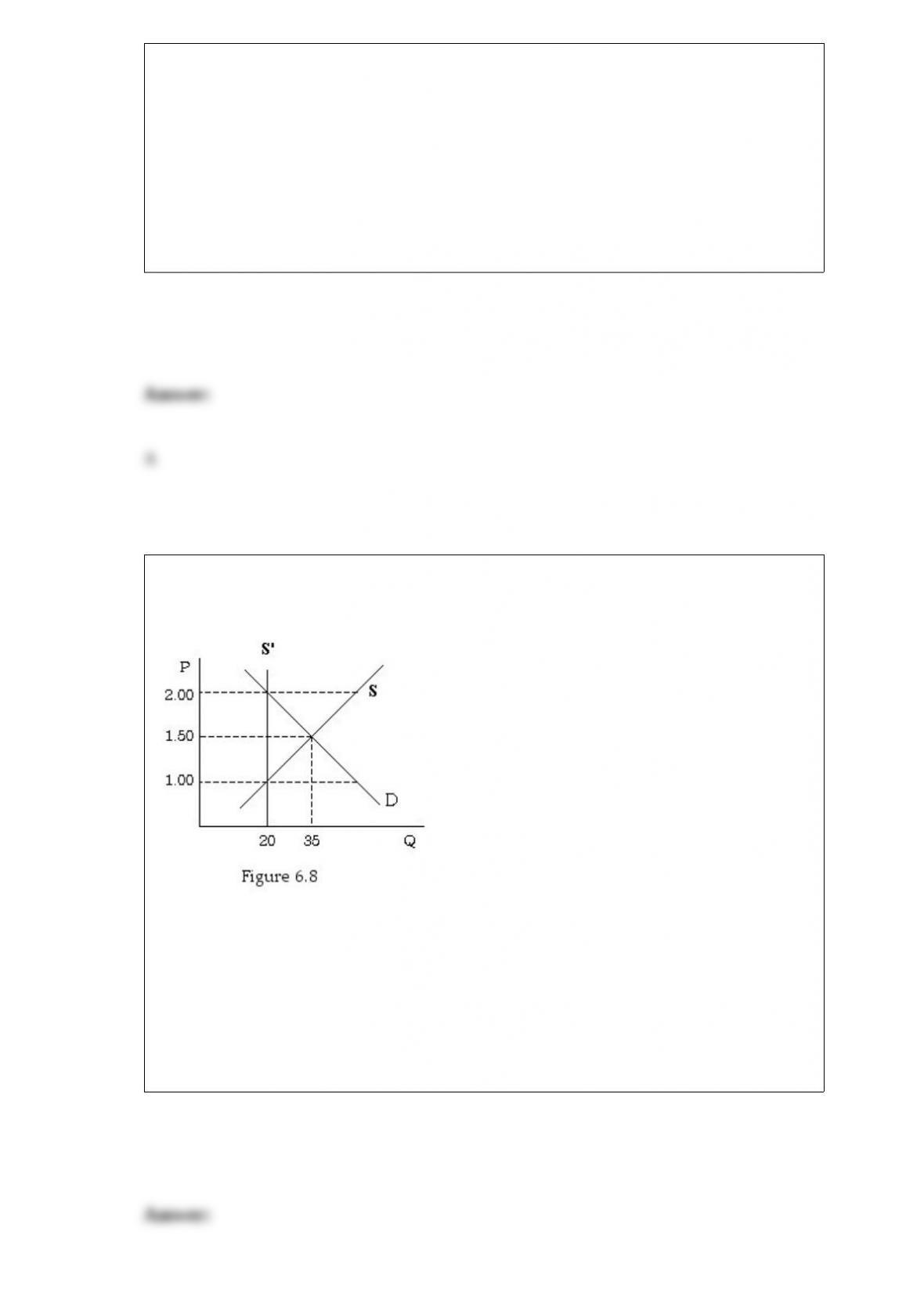
Figure 6.8 shows the market for taxicab services in a small town. If the government
limits taxicab services to 20 per day, the price per mile traveled will be:
A) $1.00.
B) $1.50.
C) $2.00.
D) It is impossible to determine.
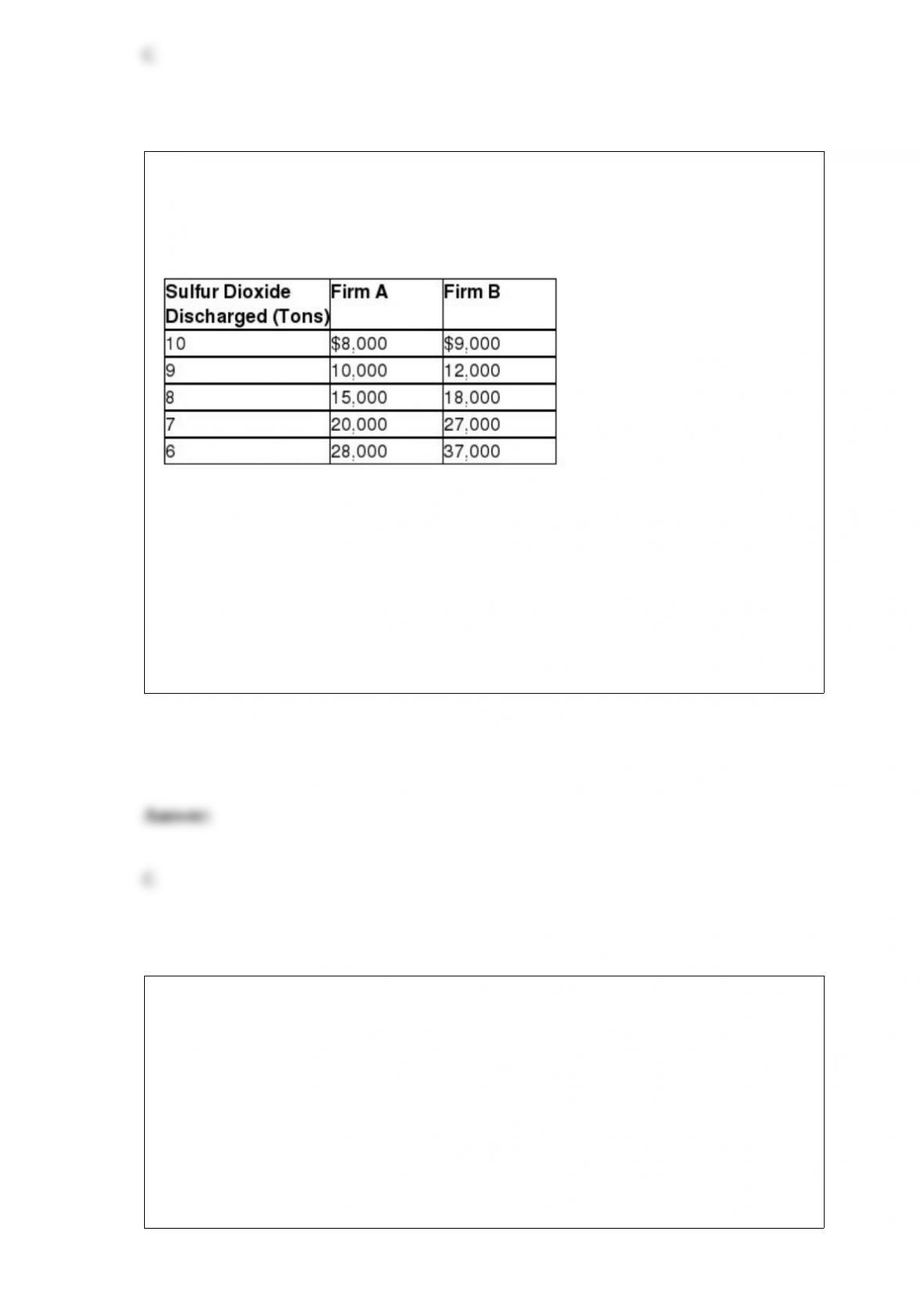
Table 16.3 shows the production cost for two utilities at different levels of sulfur
dioxide emissions. Assume that the government issued 8 marketable pollution permits
to each firm. If Firm B would like to purchase one permit to be able to discharge nine
tons of sulfur dioxide, what is Firm B’s willingness to pay?
Table 16.3
A) $2,000
B) $5,000
C) $6,000
D) $9,000
In the final two decades of the twentieth century, per capita income in sub-Saharan
Africa:
A) increased by approximately 35 percent.
B) remained relatively unchanged.
C) decreased by approximately 6 percent.
D) increased by more than 75 percent.
A firm doubled all its inputs and experienced a 50% increase in output. If all input
prices remain unchanged, the firm’s long-run average cost exhibits:
A) economies of scale at the current output level.
B) diseconomies of scale at the current output level.
C) a constant long-run average cost at the current output level.
D) diminishing marginal returns at the current output level.
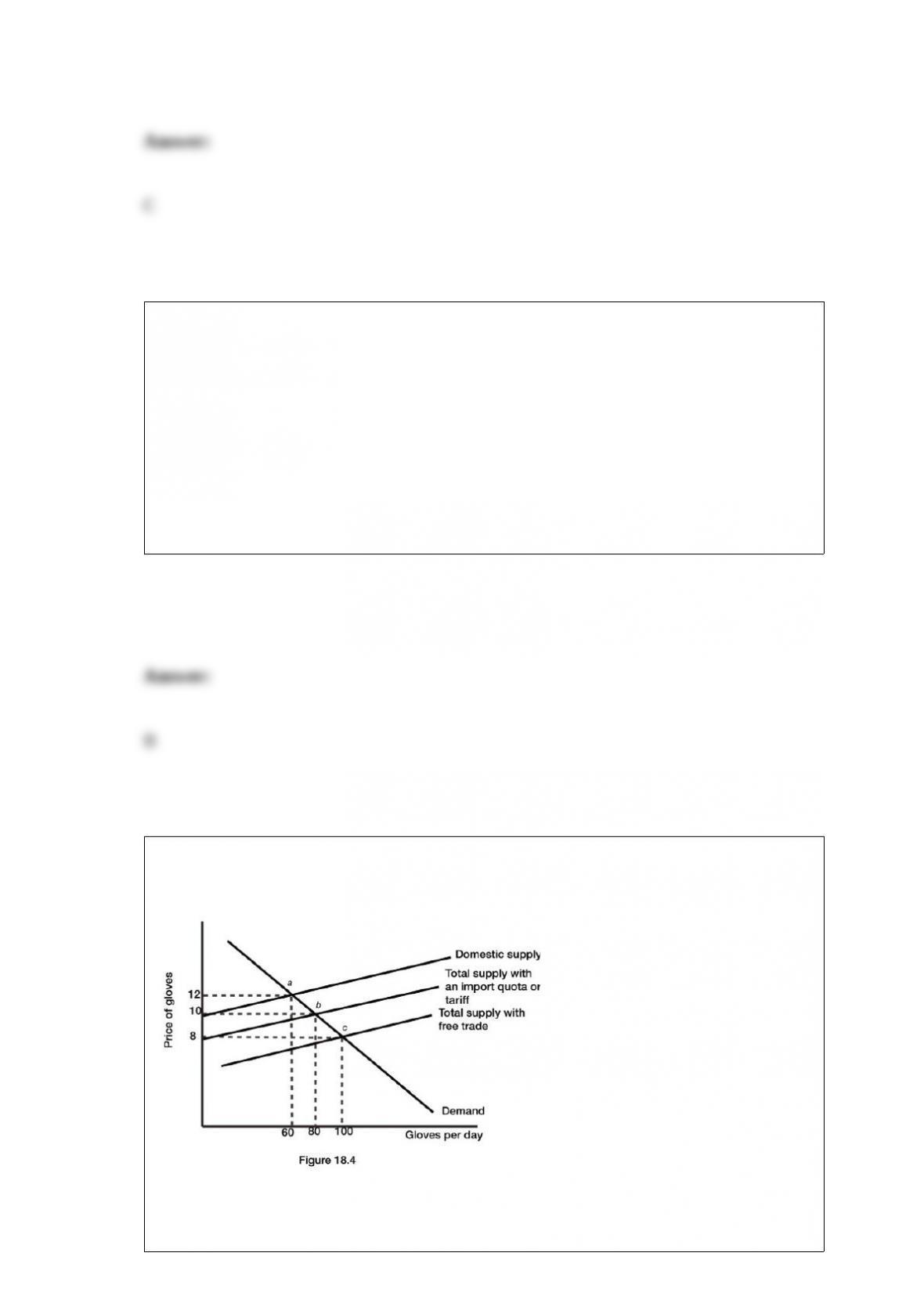
Refer to Figure 18.4. With free trade, how many gloves are produced domestically in
Duckland?
A) 100

B) 80
C) 60
D) 0
The short-run average total cost curve is U-shaped because average fixed costs
________ and average variable costs ________ eventually as quantity produced
increases.
A) increase; increase
B) increase; decrease
C) decrease; increase
D) decrease; decrease
Which of the following is an example of predatory pricing?
A) In order to buy Microsoft Windows, you must also purchase Internet Explorer.
B) Bus rides are cheaper for senior citizens than for other people.
C) Prices are set low enough to drive other firms out of a market.
D) Prices are set just high enough to prevent other firms from entering the market.
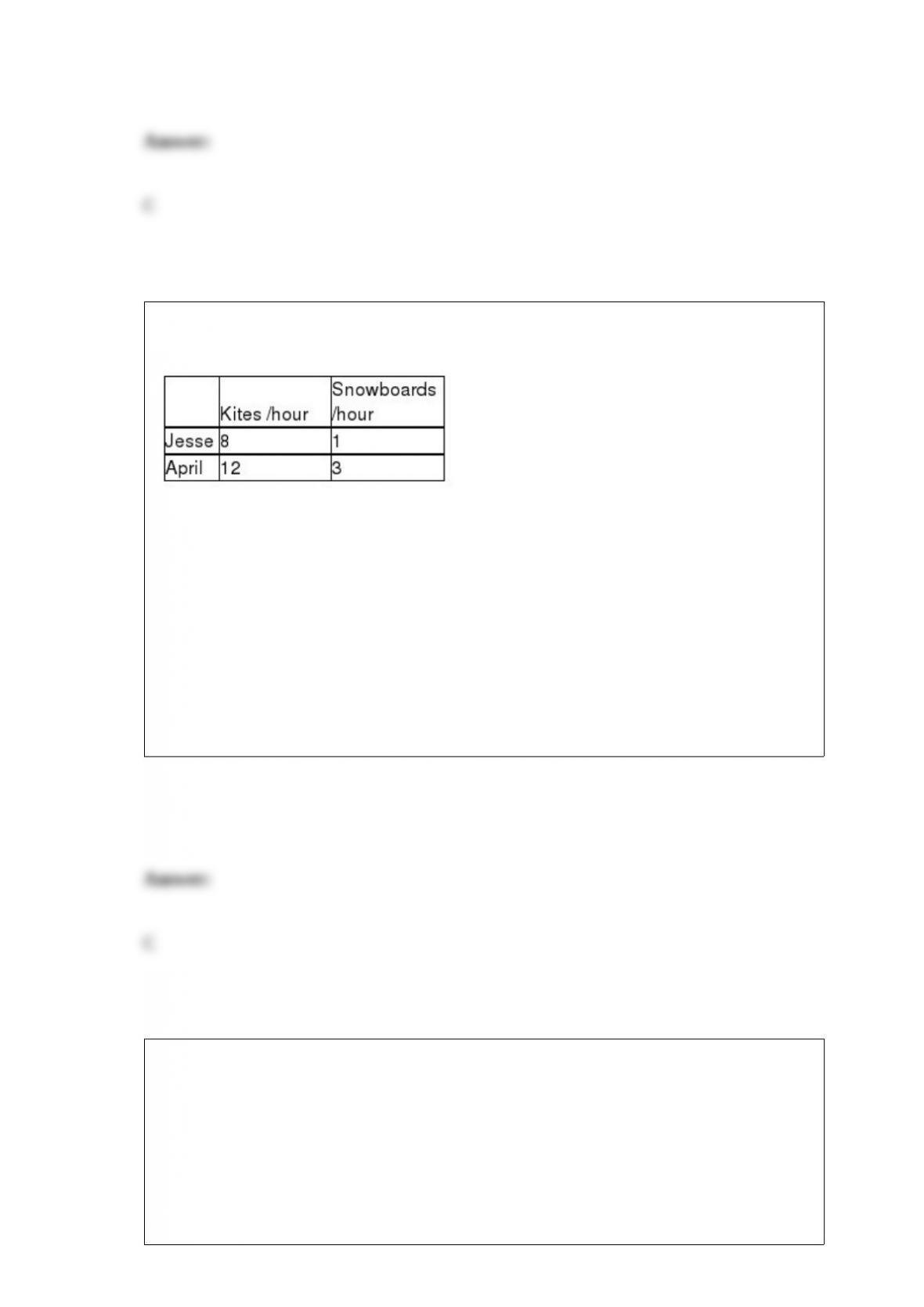
Consider two individuals, Jesse and April, who hand paint kites and snowboards. Table
3.1 shows how much of each good Jesse and April can paint in one hour.
Table 3.1
Jesse’s opportunity cost of painting one snowboard is painting:
A) 1/8 of a kite.
B) 1.5 kites.
C) 8 kites.
D) 12 kites.
To maximize profit, a monopolistically competitive firm will produce where:
A) marginal revenue exceeds price.
B) price is less than marginal cost.
C) price equals average total cost.

D) marginal revenue equals marginal cost.
When one firm sells its pollution permit to another:
A) the total amount of pollution generated rises.
B) both firms benefit.
C) the government determines the price of the permit.
D) all of the above
The Sherman Act of 1890:
A) prohibited selling products at “unreasonably low prices” with the intent of reducing
competition.
B) outlawed tying contracts.
C) outlawed stock-purchase mergers that would substantially reduce competition.
D) made it illegal to monopolize a market.

According to the Application, which of the following is the result of the falling prices of
wool worldwide?
A) lower demand for wool.
B) higher demand for synthetic fibers.
C) higher demand for wool.
D) lower quantity supplied of wool.
If an insecure monopolist needs to determine what strategy will be best to prevent a
second firm from entering the market, what could be the key variable to use when
determining the best strategy?
A) minimum entry quantity
B) minimum exit quantity
C) maximum entry quantity
D) maximum exit quantity

Which of the following explains the differences in earnings by race?
A) differences in productivity
B) racial discrimination
C) differences in education and work experience
D) all of the above
If real salaries increase but nominal salaries do not, this means that:
A) the purchasing power of money has decreased.
B) prices have not changed.
C) prices have risen.
D) prices have fallen.
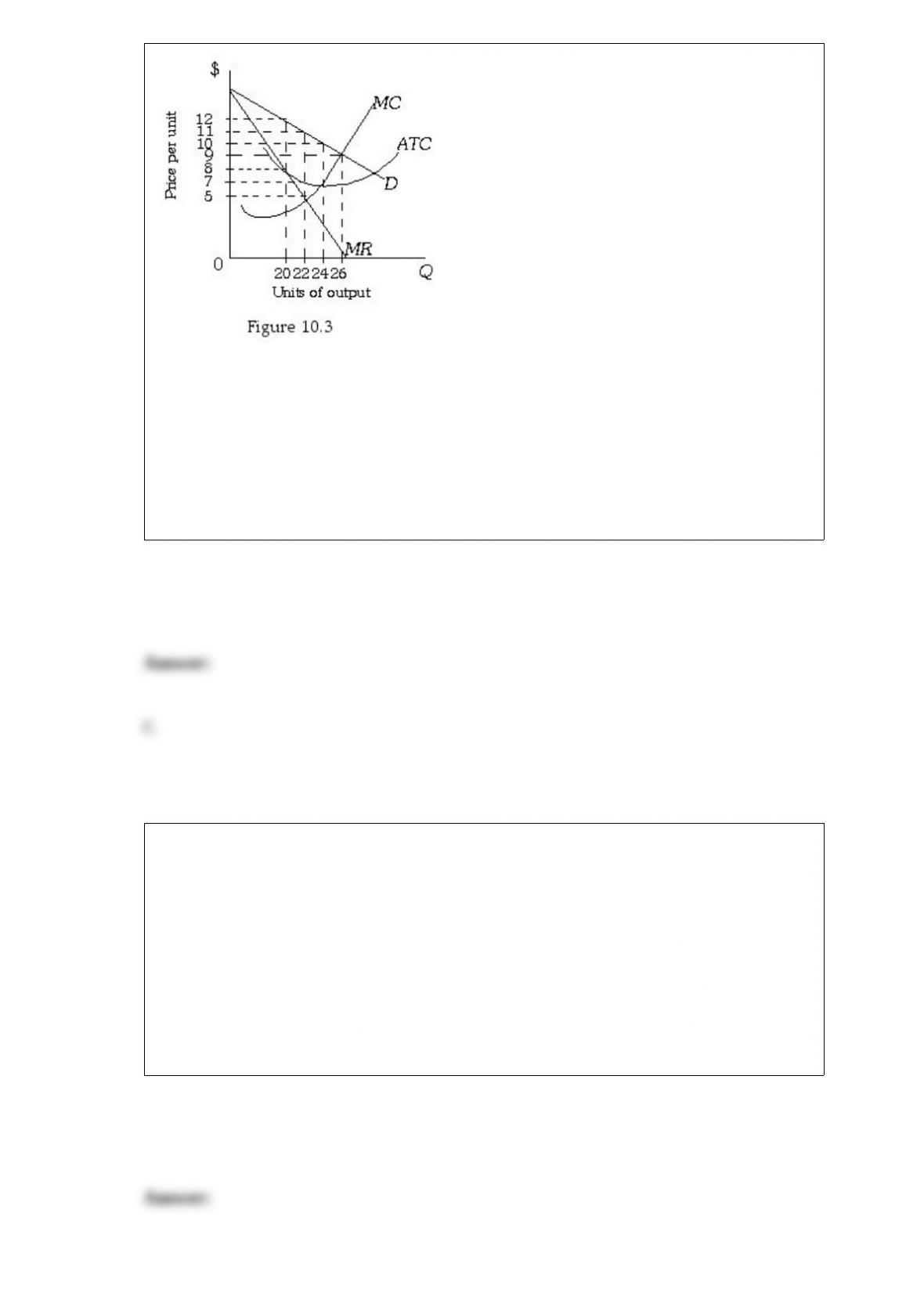
Refer to Figure 10.3. If this firm is producing the profit-maximizing quantity and
selling it at the profit-maximizing price, the firm’s profit will be:
A) $80.
B) $84.
C) $88.
D) $132.
Arranging matching charitable contributions will ________ the free-rider problem and
lead to a ________ level of contribution to the public good.
A) increase; smaller
B) increase; larger
C) reduce; smaller
D) reduce; larger
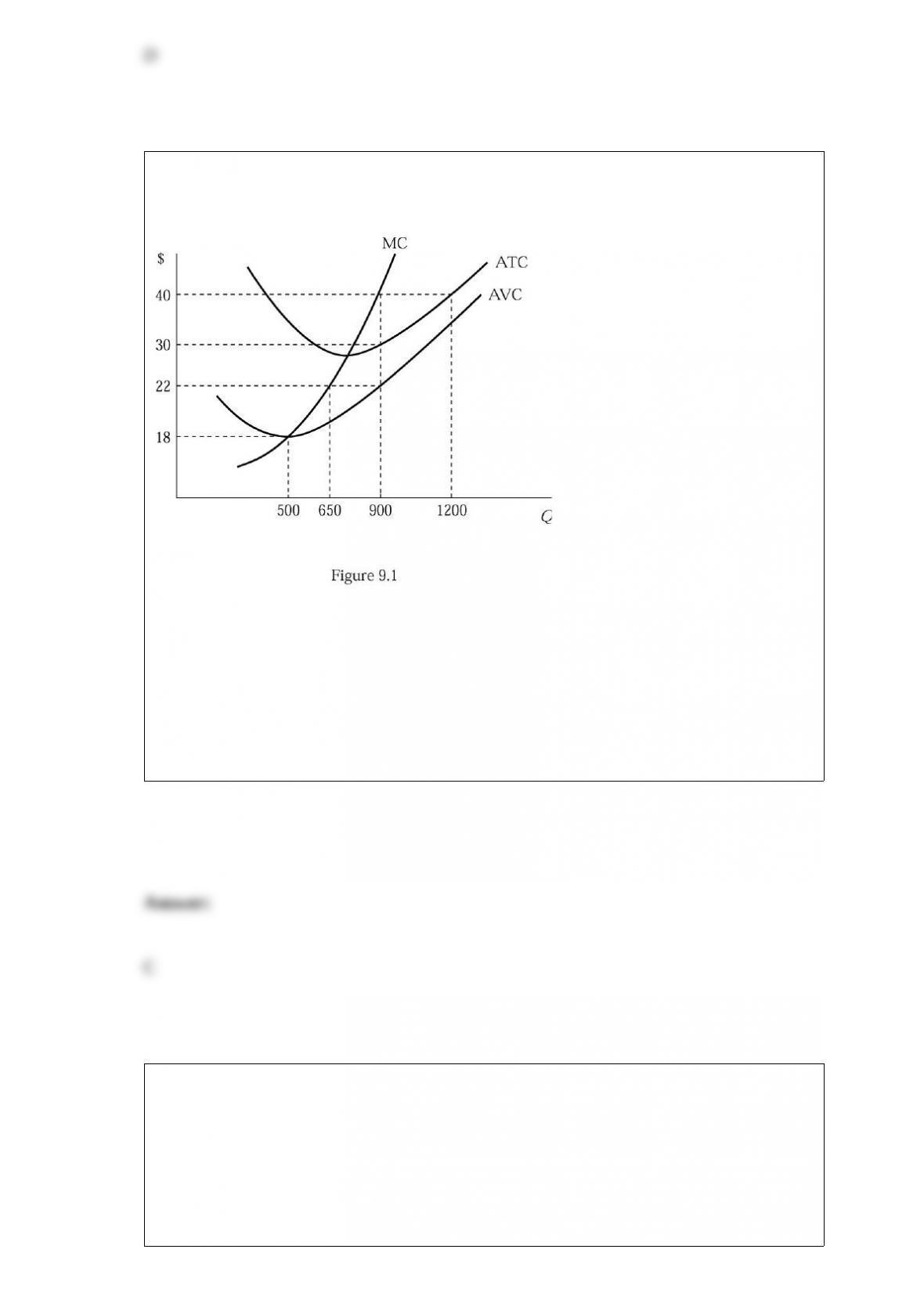
Figure 9.1 shows the cost structure of a firm in a perfectly competitive market. If the
market price is $40, the firm’s profit maximizing output level is:
A) 500.
B) 650.
C) 900.
D) 1,200.
Suppose four firms in the airline industry have gotten together and formed a cartel.
Which of the following is true?
A) The firms will set a price that is equal to minimum average total cost.
B) The firms will produce where the marginal cost curve intersects the average total
cost curve.

C) The firms will produce where marginal cost is equal to marginal revenue.
D) The firms will set a price equal to marginal revenue.
Raising the minimum wage would:
A) help some workers while hurting others.
B) help all workers and hurt all firms.
C) hurt all workers and help some consumers.
D) help workers and help consumers.
Suppose that in a month the price of oranges increases from $.75 to $1. At the same
time, the quantity of oranges demanded decreases from 100 to 80. The price elasticity
of demand for oranges (calculated using the initial value formula) is:
A) 0.75.
B) 0.6.
C) 0.25.
D) 20.

Recall the Application. In the 1997 collective bargaining agreement for NBA players,
the largest salary gains went to:
A) all players equally.
B) those players with salaries farthest below the median salary.
C) those players with salaries farthest above the median salary.
D) those players with salaries closest to the median salary.
Additional Application
The 2005-2006 Florida citrus harvest has been tallied and is over $1 billion. This is the
highest dollar amount since the 1999-2000 season. This year’s production was 3%
greater than last year, which was dramatically reduced due to three hurricanes that
struck the state last year. While the overall production increase was relatively small, the
prices for all types of citrus increased significantly. On the wholesale level oranges
alone realized a 56% price increase over the previous year after experiencing a 1.3%
decrease from last year. One explanation of this increase was Hurricane Wilma striking
Florida in October 2005 and causing a reduction in this year’s supply of citrus. The
higher citrus prices this year resulted in a 38% increase in revenues to growers over the
previous year.
How can the increased revenues to the citrus producers be explained? The law of
demand states if the price increases, the quantity demanded decreases. The concept of
price elasticity of demand explains that the percentage decrease in quantity demanded

may be greater than or less than the percentage increase in price. Is the demand for
citrus elastic or inelastic?
“States citrus crop tops $1 billion for first time in six years.” September 22, 2006.
palmbeachpost.com. Retrieved October 3, 2006, from http://www.palmbeachpost.com
Using a supply and demand graph, how would you explain the cause of the price
increase of Florida oranges in the 2005-2006 season?
A) an increase in demand
B) an increase in supply
C) a decrease in demand
D) a decrease in supply
People acting in their own self-interest is the basis of the:
A) principle of supply and demand.
B) principle of voluntary exchange.
C) real-nominal principle.
D) principle of scarcity.

If workers have better information about their own ability to work than employers do,
which of the following situations is present?
A) unemployment
B) asymmetric information
C) discrimination
D) moral hazard
A duopoly pricing strategy results in a(n) ________ profitable outcome than cartel
pricing.
A) less
B) more
C) equally
D) indeterminate
If short-run economic profits are greater than zero for firms in a monopolistically
competitive market, in the long run we expect:
A) entry barriers to prevent competing firms from entering this market.
B) the demand curve for firms in the market to shift to the right.
C) competing firms to enter the market and sell similar products.
D) profits to increase.
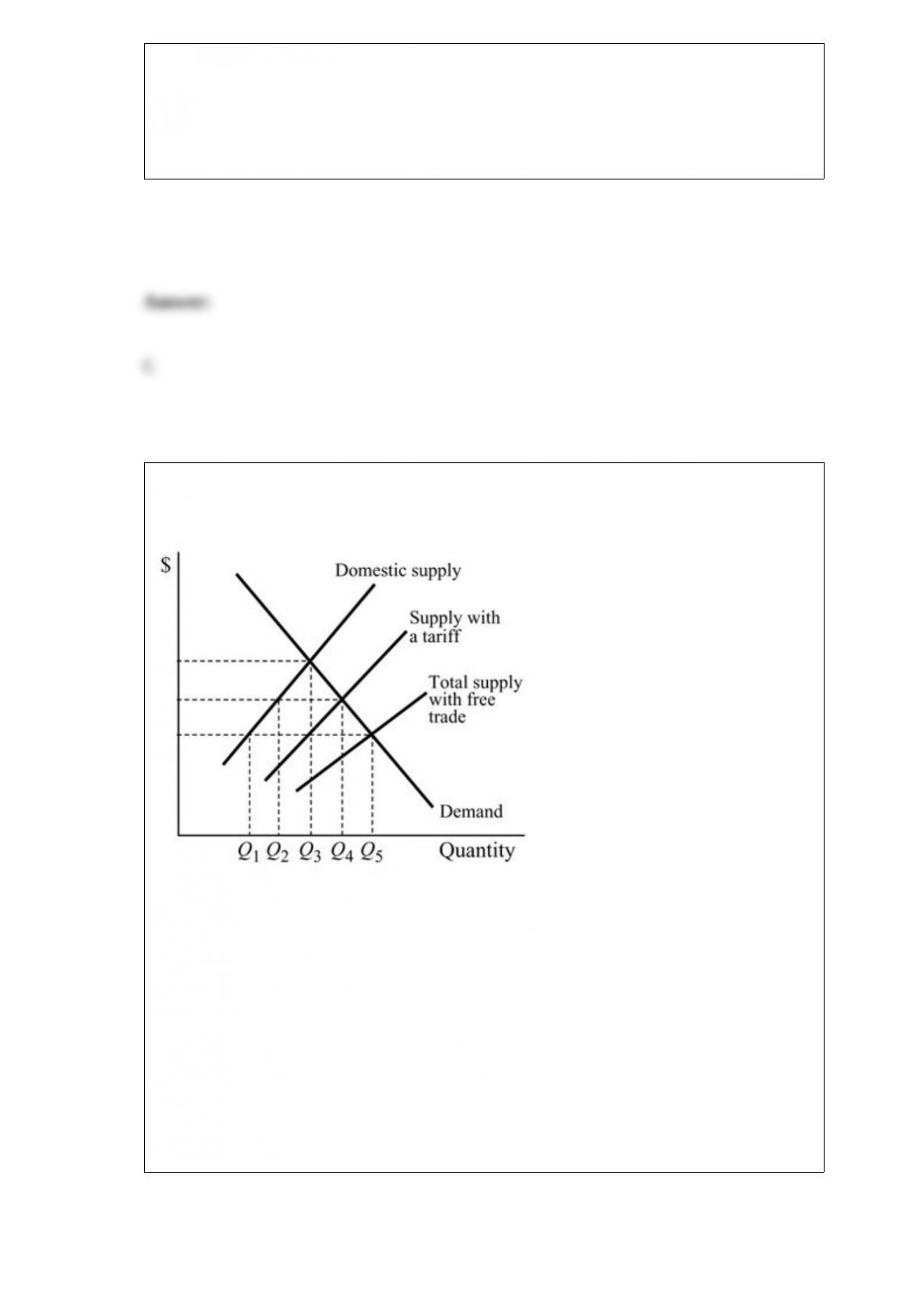
Figure 18.5
In Figure 18.5, compared to free trade, the tariff causes domestic production of the good
to:
A) increase by Q2-Q1.
B) decrease by Q2-Q1.
C) increase by Q5-Q4.
D) decrease by Q5-Q4.

Suppose air bags make people feel safer and hence they drive more recklessly. This is
an example of:
A) moral hazard.
B) adverse selection.
C) asymmetric information.
D) a lemon market.
Which of the following is NOT a characteristic of a perfectly competitive market?
A) a large number of firms in a market
B) selling a standardized product
C) substantial barriers to entry
D) an individual firm having no control over price

An example of a good that is rival in consumption is:
A) a radio program.
B) a copy of an economics textbook.
C) an economics web page.
D) a poster of famous economists.
People who apply for loans know more about their ability to repay the loan than the
lenders do. This is an example of:
A) asymmetric information.
B) public information.
C) a negative externality.
D) a community rating.