
The IS curve plots the relationship between the interest rate and ______ that arises in
the market for ______.
A) national income; goods and services
B) the price level; goods and services
C) national income; money
D) the price level; money
All of the following are important macroeconomic variablesexcept:
A) real GDP.
B) the unemployment rate.
C) the marginal rate of substitution.
D) the inflation rate.
Macroeconomics is:
A) based on microeconomic foundations.
B) completely separate from microeconomics.

C) explicitly based on microeconomic behavior.
D) a subsidiary branch of microeconomics.
If total consumption (measured in billions of current dollars) equals $3,657,
consumption of durable goods is $480, and consumption of nondurable goods is $1,194,
then consumption of services is:
A) $1,674.
B) $2,463.
C) $2,083.
D) $1,983.
A change in income in the IS“LM model for a fixed price
A) represents a shift in the aggregate demand curve.
B) represents a movement along the aggregate demand curve.
C) has the same effect on the aggregate demand curve as a change in income in the
IS“LM model resulting from a change in the price level.
D) does not represent a change in the aggregate demand curve.

According to classical theory, national income depends on ______, while Keynes
proposed that ______ determined the level of national income.
A) aggregate demand; aggregate supply
B) aggregate supply; aggregate demand
C) monetary policy; fiscal policy
D) fiscal policy; monetary policy
A depreciation of the real exchange rate in a small open economy could be the result of:
A) a domestic tax cut.
B) an increase in government spending.
C) a decrease in the world interest rate.
D) the expiration of an investment tax-credit provision.

The Keynesian-cross analysis assumes planned investment:
A) is fixed and so does the IS analysis.
B) depends on the interest rate and so does the IS analysis.
C) is fixed, whereas the IS analysis assumes it depends on the interest rate.
D) depends on expenditure and so does the IS analysis.
If the demand for real money balances is proportional to real income, velocity will:
A) increase as income increases.
B) increase as income decreases.
C) vary directly with the interest rate.
D) remain constant.
Exhibit: Policies Influence Real Exchange Rate
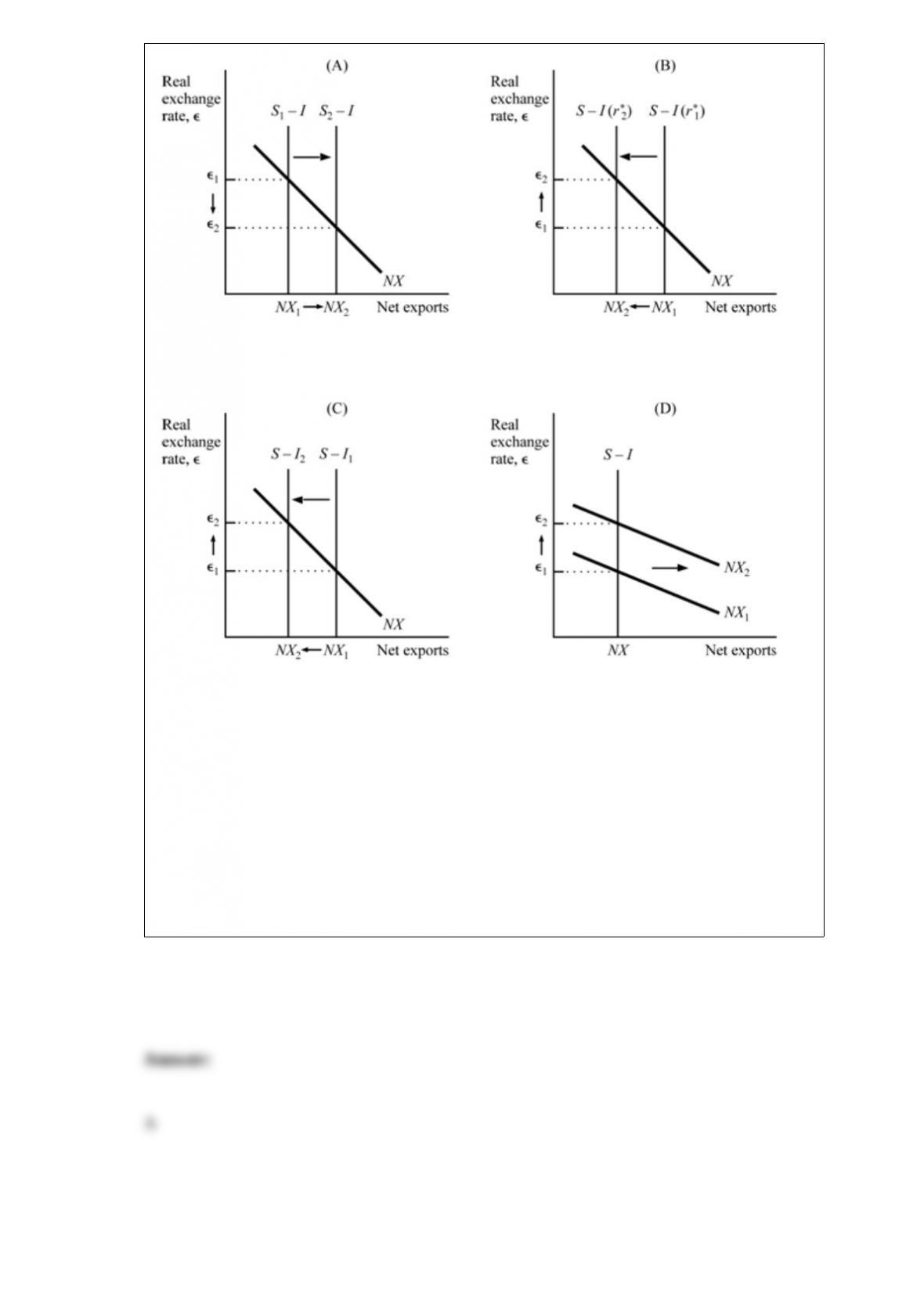
(Exhibit: Policies Influence Real Exchange Rate) Which of the panels illustrates the
impact on the real exchange rate of an increase in household saving?
A) (A)
B) (B)
C) (C)
D) (D)
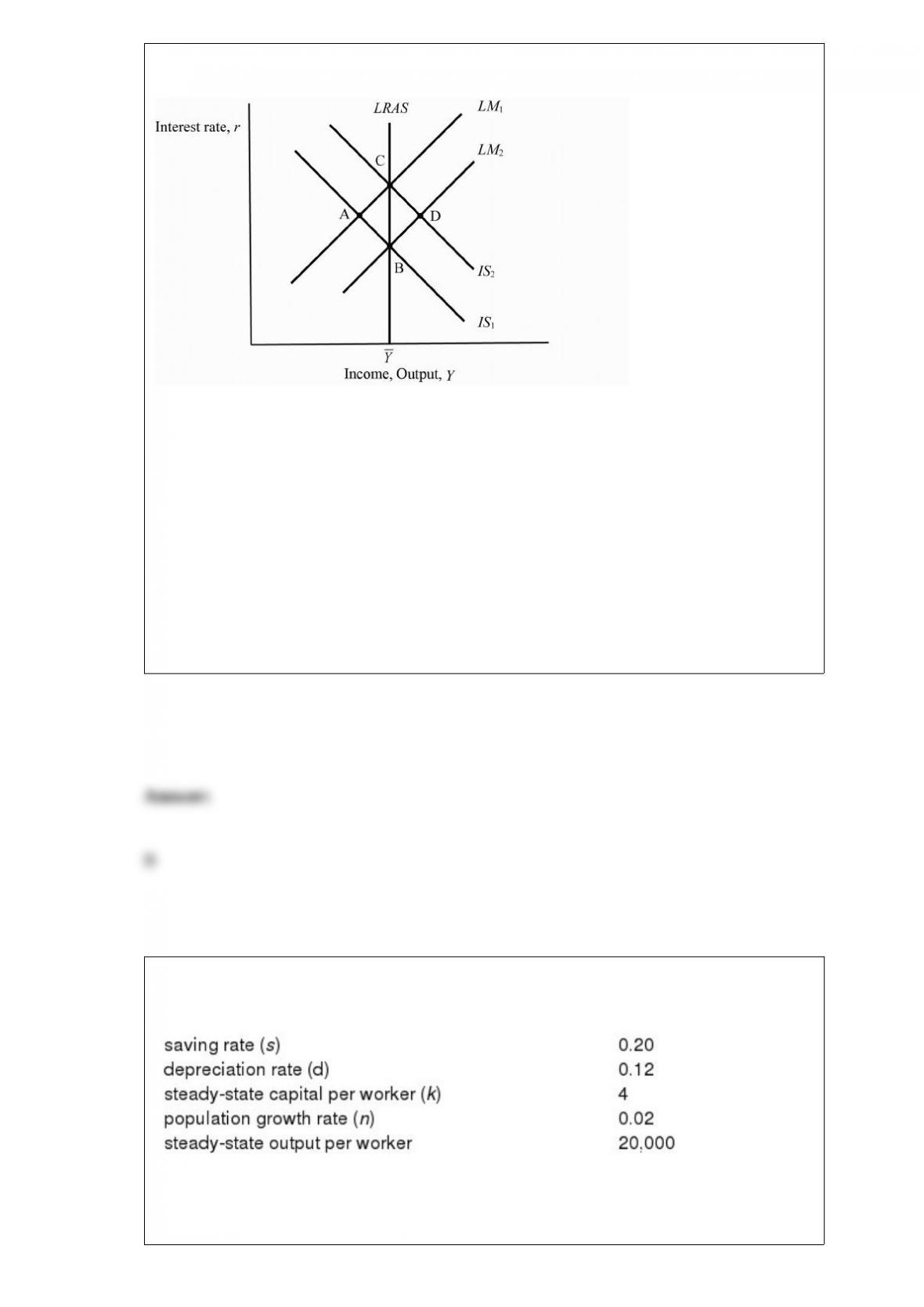
Exhibit: Short Run to Long Run
(Exhibit: Short Run to Long Run) Based on the graph, if the economy starts from a
short-term equilibrium at A, then the long-run equilibrium will be at ____ with a _____
price level.
A) B; higher
B) B; lower
C) C; higher
D) C; lower
The economy of Alpha can be described by the Solow growth model. The following are
some characteristics of the Alpha economy:
a. What is the steady-state growth rate of output per worker in Alpha?
b. What is the steady-state growth rate of total output in Alpha?
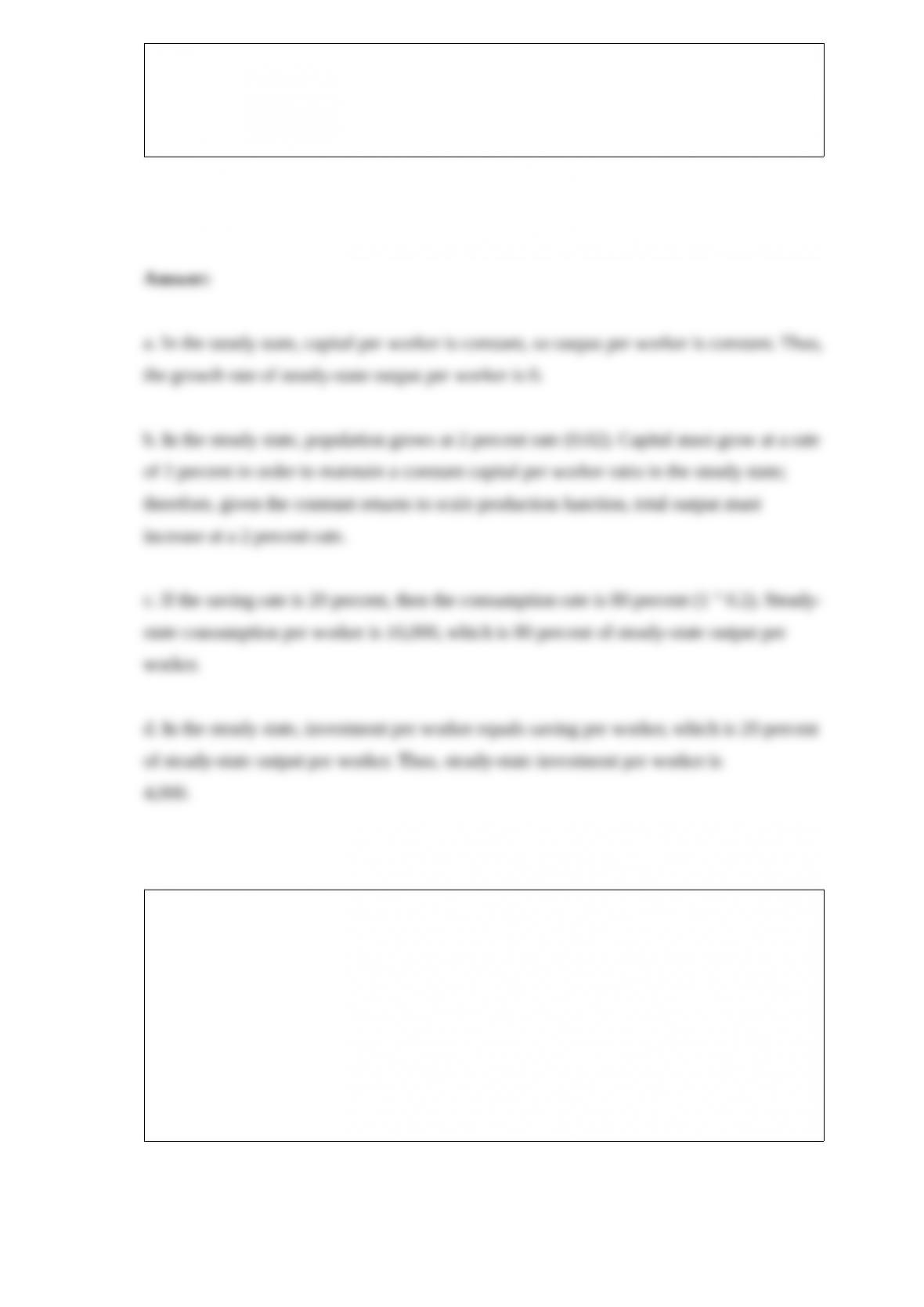
c. What is the level of steady-state consumption per worker in Alpha?
d. What is the steady-state level of investment per worker in Alpha?
In a small open economy, if consumers shift their preference toward Japanese cars, then
net exports:
A) fall and the real exchange rate falls.
B) fall but the real exchange rate remains unchanged.
C) remain unchanged but the real exchange rate falls.
D) and the real exchange rate remains unchanged.

The IS and LM curves together generally determine:
A) income only.
B) the interest rate only.
C) both income and the interest rate.
D) income, the interest rate, and the price level.
John Maynard Keynes believed that the average propensity to consume:
A) was constant.
B) increased as income increased.
C) decreased as income increased.
D) was less than the marginal propensity to consume.

The Golden Rule level of capital accumulation is the steady state with the highest level
of:
A) output per worker.
B) capital per worker.
C) savings per worker.
D) consumption per worker.
One reason for unemployment is that:
A) it takes time to match workers and jobs.
B) all jobs are identical.
C) the labor market is always in equilibrium.
D) a laid-off worker can immediately find a new job at the market wage.
According to the Lucas critique, when economists evaluate alternative policies they
must take into consideration:
A) how the policies will affect expectations and behavior.
B) whether the policy will offset the impact of automatic stabilizers.

C) the stage of the political business cycle in which the policy is to be implemented.
D) the length of the inside lags associated with the policies.
If a U.S. corporation sells a product in Canada and uses the proceeds to purchase a
product manufactured in Canada, then U.S. net exports ______ and net capital outflows
______.
A) increase; increase
B) decrease; decrease
C) do not change; do not change
D) do not change; increase
In a simple model of the supply and demand for pizza, when aggregate income
increases, the price of pizza ______ and the quantity purchased ______.
A) increases; decreases
B) increases; increases
C) decreases; increases
D) decreases; decreases

In a classical model with fixed factors of production and flexible prices, the amount of
consumption spending depends on _____ , the amount of investment spending depends
on _____, and the amount of government spending is determined _____.
A) the interest rate; disposable income; by tax revenue
B) the real wage; the real rental price of capital; by factor prices
C) labor’s share of output; capital’s share of output; by the interest rate
D) disposable income; the interest rate; exogenously
The life-cycle hypothesis and the permanent-income hypothesis both assume that
consumers seek to:
A) increase consumption during expansions.
B) minimize consumption during recessions.
C) increase consumption during retirement
D) smooth consumption over their lifetimes.

Assume that an economy has the usual type of Phillips curve except that the natural rate
of unemployment in an economy is given by an average of the unemployment rates in
the last two years. Then, there is:
A) a long-run tradeoff between inflation and unemployment.
B) no long-run tradeoff between inflation and unemployment.
C) no short-run tradeoff between inflation and unemployment.
D) a sacrifice ratio that is large but not infinite.
In a small open economy with a floating exchange rate, a rise in government spending
in the new short-run equilibrium:
A) chokes off investment, but not by as much as the new government spending.
B) chokes off an amount of investment just equal to the new government spending.
C) attracts foreign capital, thus raising the exchange rate and reducing net exports, but
not by as much as the new government spending.
D) attracts foreign capital, thus raising the exchange rate and reducing net exports by an
amount just equal to the new government spending.
If consumers correctly anticipate their future incomes:
A) the saving rate will be high when consumers anticipate a boom.
B) the saving rate will be low when consumers anticipate a boom.
C) the saving rate will be low when consumers anticipate a recession.
D) they will be disappointed because future income can never be correctly forecasted.
The central banks of two nearly identical countries, Fixland and Flexland, desire low
inflation and low unemployment. There is a similar short-run tradeoff between
unemployment and unexpected inflation in both countries. Private agents in both
Fixland and Flexland form expectations rationally and understand the incentives that
central banks may have to renege on low-inflation policies. Initially, the rates of
inflation and unemployment are the same in both countries. The central bank of Fixland
makes a credible announcement that it will operate according to a low-inflation rule.
The central bank of Flexland announces that it plans to follow a low-inflation policy,
but retains the right to deviate from this policy at its discretion.
a. In which country would you expect the rate of inflation to be lower?
b. In which country would you expect the unemployment rate to be lower?
In the neoclassical model with fixed income, if there is a decrease in government
spending with no change in taxes, then public saving ______ and private saving
______.
A) increases; increases.
B) increases; does not change
C) decreases; increases
D) decreases; does not change
Devoting resources to avoiding the costs of expected inflation leads to:
A) eliminating the costs of expected inflation.
B) fewer relative price changes.
C) economic inefficiency.
D) a decrease in the transaction velocity of money.

The dynamic model of aggregate demand and aggregate supply assumes that people
form expectations of inflation based on:
A) forecasts optimally using all available information.
B) recently observed inflation.
C) the central bank’s inflation target.
D) the difference between the nominal and real interest rate.
To the extent that failure to appreciate the implications of the decline in house prices on
the financial system contributed to the financial crisis of 2008″2009, blame for this
mistake lies with:
A) mortgage brokers.
B) investment banks.
C) homebuyers.
D) regulators.
In a small open economy with a floating exchange rate, an effective policy to increase
equilibrium output is to:
A) increase government spending.
B) increase taxes.
C) increase the money supply.
D) decrease the money supply.
When outsiders have a greater role than do insiders in the wage-bargaining process, the
negotiated wage is likely to be ______ the equilibrium wage.
A) much greater than
B) much less than
C) much closer to
D) about twice