
Inefficient resource allocation is a major problem with monopolies.
a. True
b. False
The cost of a hospital stay has been going down slowly.
a. True
b. False
A fall in the price of a competing product will produce an outward shift in the demand
curve for most products.
a. True
b. False

The consensus among researchers is that union workers earn 15 percent more than
otherwise identical nonunion workers. This means unions have probably raised wages
a. exactly 15 percent.
b. less than 15 percent.
c. at least 15 percent.
d. more or less than 15 percent, but one cannot tell exactly.
An IOU held by a bank, and signed by a customer is a liability.
a. True
b. False
Figure 1-1

A vertical line has a slope of
a. infinity.
b. zero.
c. undefined.
d. 1,000.
Suppose that one could determine the amount of income that is pure economic rent. If a
law were passed which taxed 50 percent of that rent, what would happen to the amount
of work that people perform?
a. It would increase as people seek higher income.
b. It would be unchanged.
c. It would decrease as people suffer a loss of income.
d. It would increase for some and decrease for others.

The concept of aggregate supply refers to a
a. fixed number of output.
b. list of products demanded.
c. schedule of output.
d. schedule of production costs.
Many experts believe that the major determinant of exchange rates in the short run is
relative
a. price levels.
b. income levels.
c. money supplies.
d. interest rates.
Which of the following scenarios could be an example of increasing marginal utility?
a. A father buying three game CDs for his son.
b. A shopkeeper selling the tenth unit of hamburger.

c. A philatelist buying an additional stamp for collection.
d. A consumer buying an additional unit of apple.
The story of innovation battles among firms is analogous to the story of armaments
races among countries.
a. True
b. False
A monopoly may breed inefficiency by reducing competition and restricting production.
a. True
b. False

A natural monopoly would benefit by being broken into many smaller firms.
a. True
b. False
Deregulation of the airline and trucking industries was followed by the creation of
many new firms.
a. True
b. False
A country has a comparative advantage over another in the production of gadgets if it
can produce
a. more gadgets than can the other country.
b. more gadgets than can any other country.
c. gadgets more efficiently than it can produce any other good.
d. gadgets at lower opportunity cost than can the other country.

When used in a professional or technical sense, the law of supply and demand refers to
a. some vague influences on economic affairs.
b. the fact that prices go up when commodities are scarce.
c. the market forces that show how prices and quantities are determined.
d. the controls that regulate the amount of scarce goods that each consumer can
purchase.
When equilibrium GDP is below potential GDP, jobs are plentiful and unemployment is
low.
a. True
b. False
According to economists, how does an increase in the inflation rate affect the
consumption function?

a. It shifts the function upward.
b. It shifts the function downward.
c. It causes movement upward along the function.
d. It causes movement downward along the function.
e. It has no predictable effect on the function.
A country has an absolute advantage over another in the production of widgets if it can
produce
a. widgets using smaller quantities of resources than can the other country.
b. more widgets than can the other country.
c. widgets more efficiently than can the other country.
d. widgets at a lower opportunity cost than can the other country.
A perfectly competitive firm has a horizontal demand curve because it can sell as much
as it wants at the market price.
a. True
b. False
In some markets, demand can be approximated by
Q = 50 − 5P + 10Y
where Q is quantity, P price per unit, and Y = buyers’ income. Supply can be
approximated by
Q = −5 + 10P.
a. If Y = 20, what is equilibrium price and output?
b. If Y rises to 25, what is the new equilibrium price and output?

Under a system of financial penalties for polluters:
a. Firms could pollute all they wanted to.
b. Firms would have to pay a tax for each unit of pollution created.
c. Firms would be encouraged to pollute less.
d. All of the above are correct.
An oligopoly using a maximin strategy must believe that the losses from
underestimating a competitor’s skill are worse than those from overestimating it.
a. True
b. False
Which elements of GDP were affected by the financial crisis and the lack of available
credit?
a. consumption and business investment only

b. consumption and government spending only
c. consumption, business investment and government spending only
d. consumption, business investment, government spending and imports/exports
Capitalism and free enterprise are common, and the United States
a. has just begun to move in that direction after years of central planning.
b. has gone further in that direction than almost any other country.
c. is becoming more “free,” but is not as capitalistic as many others.
d. is considering a major change to “free up” its economy as many others have.
e. is leading the move toward greater central planning and control.
Figure 5-17
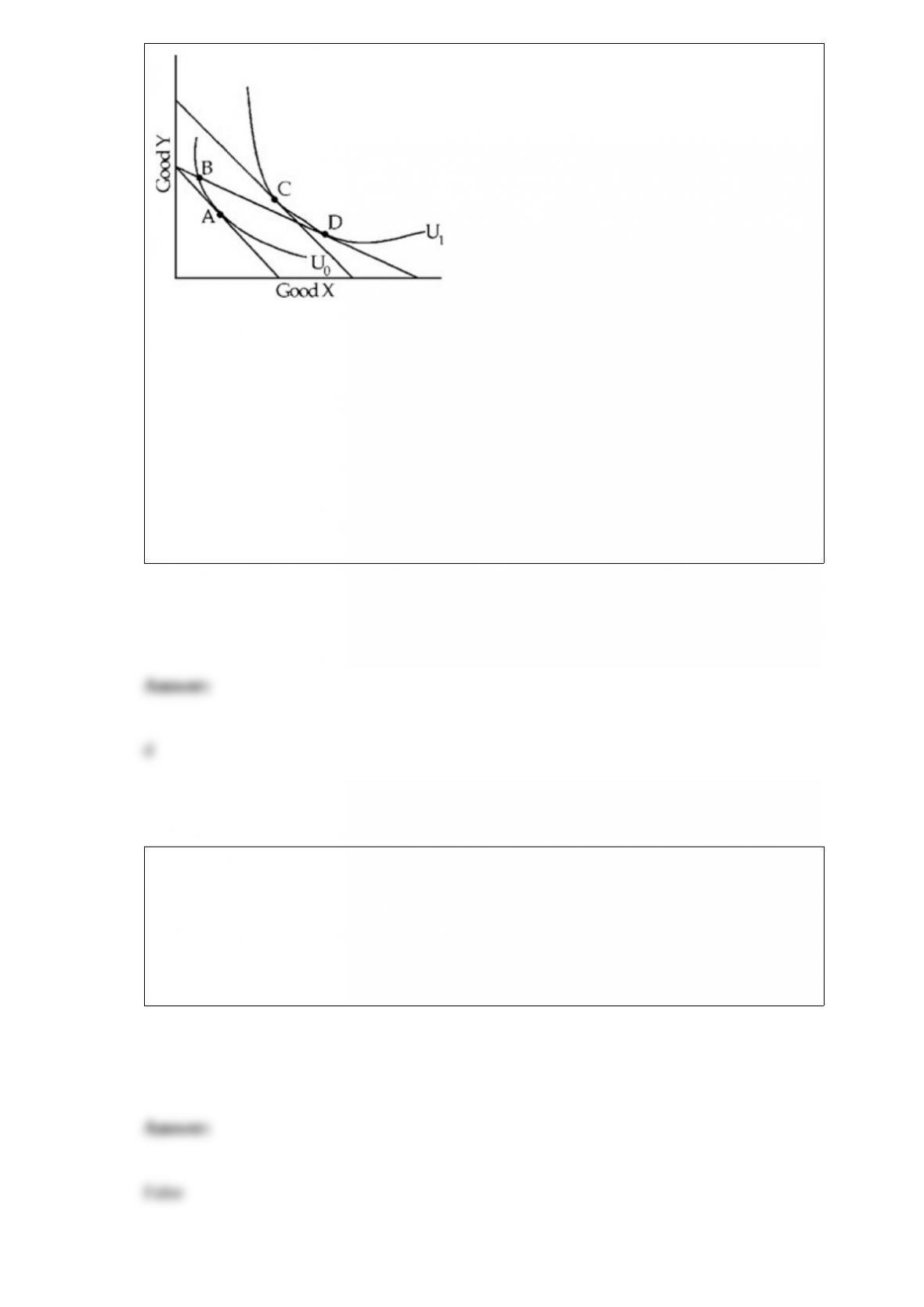
In Figure 5-17, which of the marked points would an economist use to help him
construct a single demand curve for X?
a. A and B
b. C and D
c. A and C
d. A and D
Productivity growth rates in the United States have remained fairly constant from 1948
to 2000.
a. True
b. False
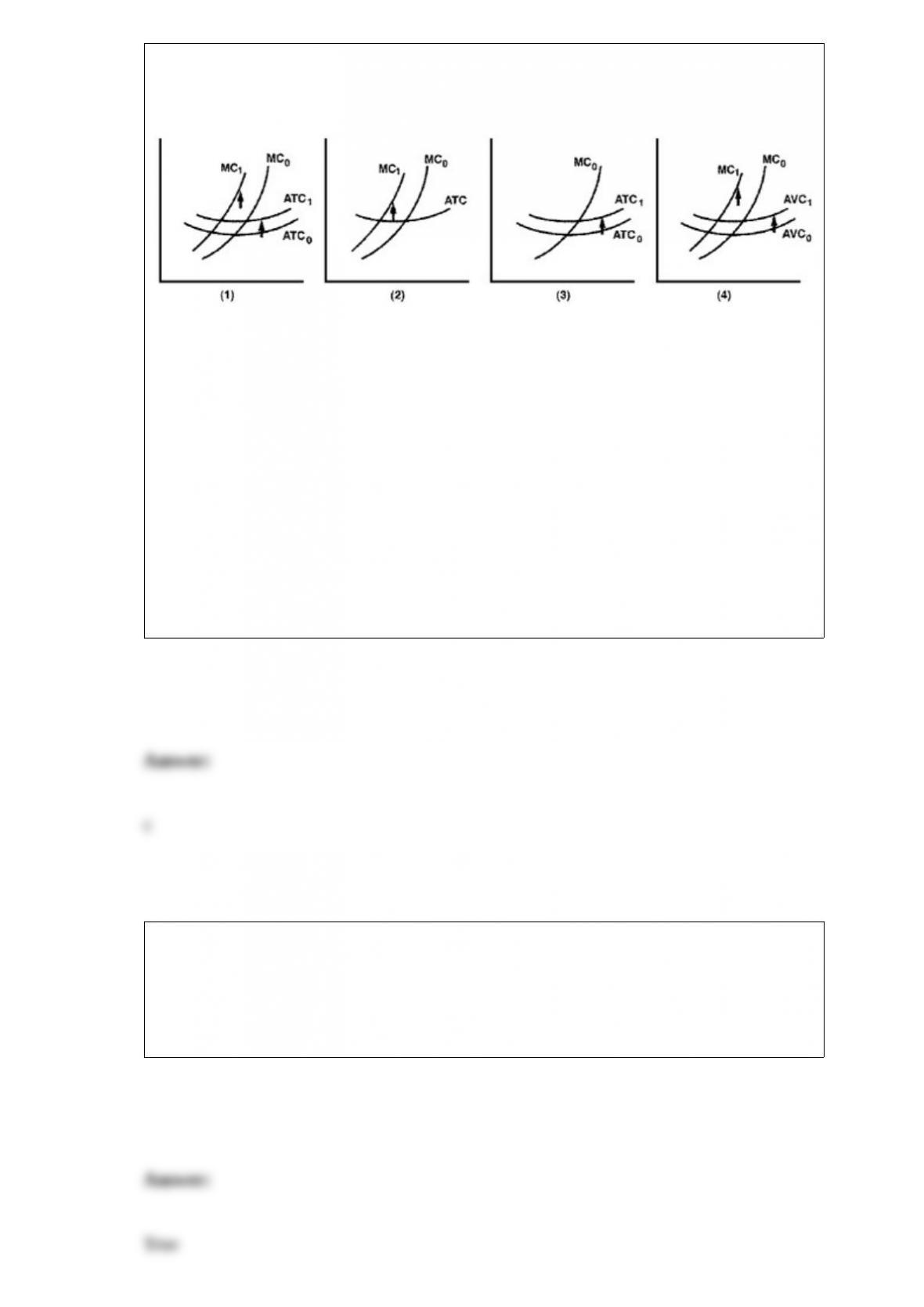
Figure 7-4
Following a rash of airplane bombs, the airlines have been forced to increase security at
a cost of $30 million per year. The number of inspectors and machines does not vary
with the number of passengers-the airlines must have sufficient staff available to handle
the full-capacity load. Which graph in Figure 7-4 best illustrates the impact of the
security expenditures?
a. 1
b. 2
c. 3
d. 4
Spending on newly constructed homes is part of the investment component of GDP.
a. True
b. False

In the short run, perfectly competitive firms can
a. make an economic profit.
b. take a loss.
c. break even.
d. All of the above are correct.
What matters most in determining efficient distribution of production over the world is
a. absolute advantage.
b. efficiency.
c. the stock of resources.
d. comparative advantage.