
A decrease in the price level will shift the money demand curve to the ________,
causing the nominal interest rate to ________.
A) right; increase
B) right; decrease
C) left; increase
D) left; decrease
Suppose the economy is initially in equilibrium where real GDP equals potential GDP
and the inflation rate is at the target rate. Other things equal, a housing boom will cause
aggregate expenditures to increase, which will result in a new, short-run equilibrium. To
return GDP to its potential level, the inflation rate will adjust. With adaptive
expectations, this moves the economy to another new short-run equilibrium point. Since
the housing boom is temporary, the end of the housing boom will move the economy to
yet another new equilibrium point. From this point, since expectations are adaptive, the
economy will experience ________ as it moves back to long-run equilibrium
A) a decrease in aggregate demand and an increase in the inflation rate
B) an increase in aggregate supply and an increase in the inflation rate
C) a decrease in aggregate demand and a decrease in the inflation rate
D) an increase in aggregate supply and a decrease in the inflation rate

For each of the following changes, explain what will happen to the expected marginal
product of capital curve or the user cost of capital curve, and what will happen to the
desired capital stock:
a. The real price of capital goods increases.
b. The depreciation rate increases.
c. The corporate income tax rate decreases.
d. The real interest rate decreases.
e. Expected future output decreases.
The part of the balance of payments that records a country’s net exports, net investment
income, and net transfers is the
A) capital account.
B) current account.
C) financial account.

D) statistical discrepancy account.
According to the quantity theory of money, if the money supply grows at 25% and the
inflation rate is 20%, the growth in real GDP is
A) 0.8%.
B) 1.25%.
C) 5%.
D) 45%.
An increase in the inflation rate will lead to a ________ nominal interest rate, which
will ________ the debt-to-GDP ratio.
A) higher; raise
B) higher; reduce
C) lower; raise
D) lower; reduce

Suppose y = Ak1/4, the capital-labor ratio is $40,000 per worker, the level of total factor
productivity is 800, 70% of the population works, and there are 70 million workers.
Real GDP per worker is
A) $5,000.00.
B) $7919.60.
C) $11,313.71.
D) $14,142.14.
The oil shock of 2007-2008 saw the price of oil rising from less than $60 a barrel in
March 2007 to over $145 a barrel in July 2008, and decreasing again to just over $30 a
barrel in December 2008. Assuming the economy was at potential GDP prior to the oil
shock, the decrease in the price of oil, such as what occurred between July 2008 and
December 2008, acts as a positive supply shock, resulting in
A) a movement up along the Phillips curve.
B) a movement down along the Phillips curve.
C) an upward shift of the Phillips curve.
D) a downward shift of the Phillips curve.
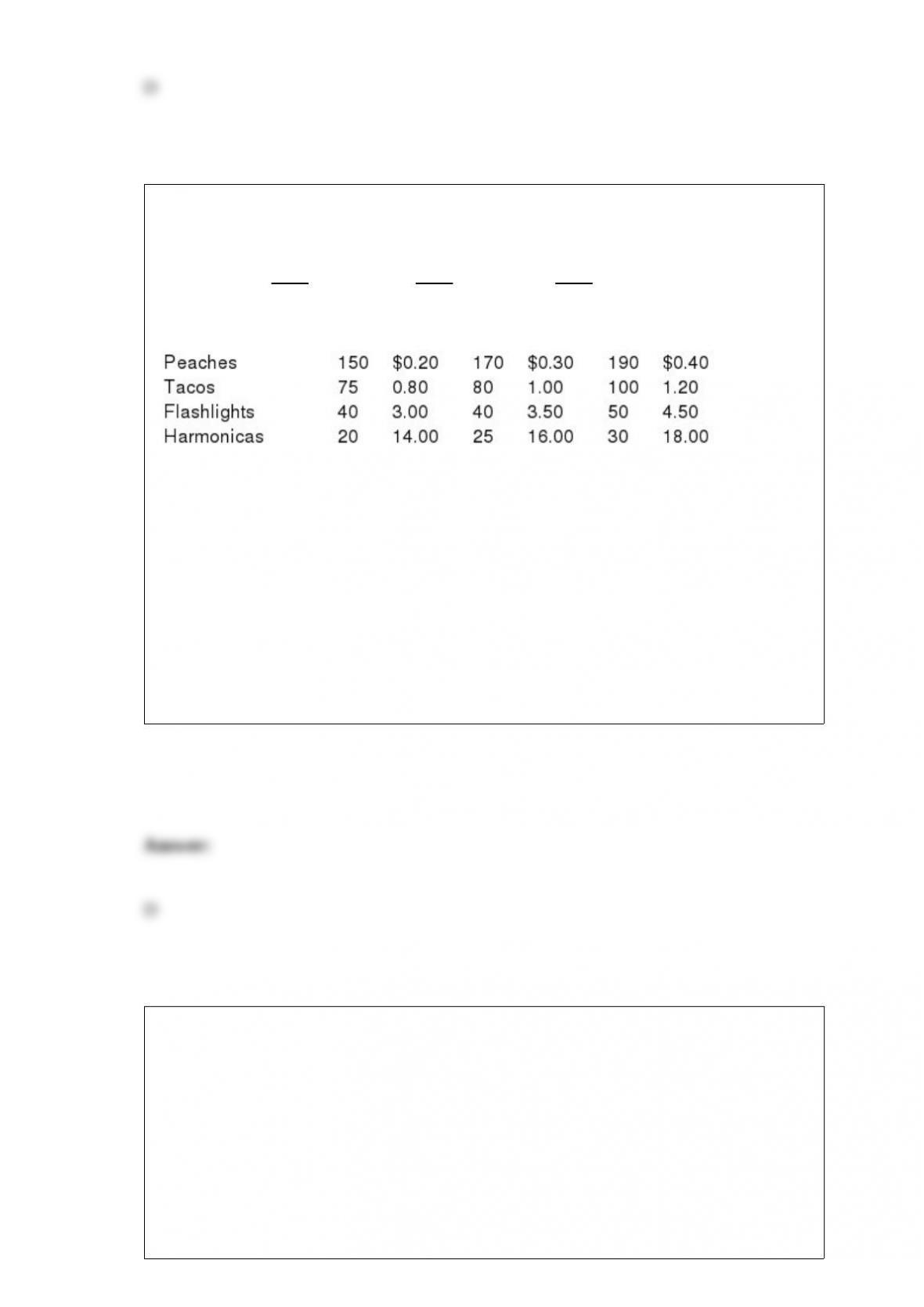
Table 2.3
2007 2010 2013
Quantity Price Quantity Price Quantity Price
Table 3 gives quantities and prices for each good produced in a simple economy in
2007, 2010, and 2013.
Refer to Table 2.3. Assume that 2010 is the base year. The GDP deflator for 2013 is
A) 67.1
B) 84.5
C) 100
D) 118.3
The Cobb-Douglas production function represents real GDP as a function of all of the
following variables except
A) capital.
B) labor.
C) the price level.
D) total factor productivity.
The Bureau of Economic Analysis releases its first estimate of GDP for a particular
quarter about a month after the quarter has ended, and continues to release revised GDP
estimates for that quarter for
A) three additional months.
B) the next 15 months.
C) three years.
D) more than three years.
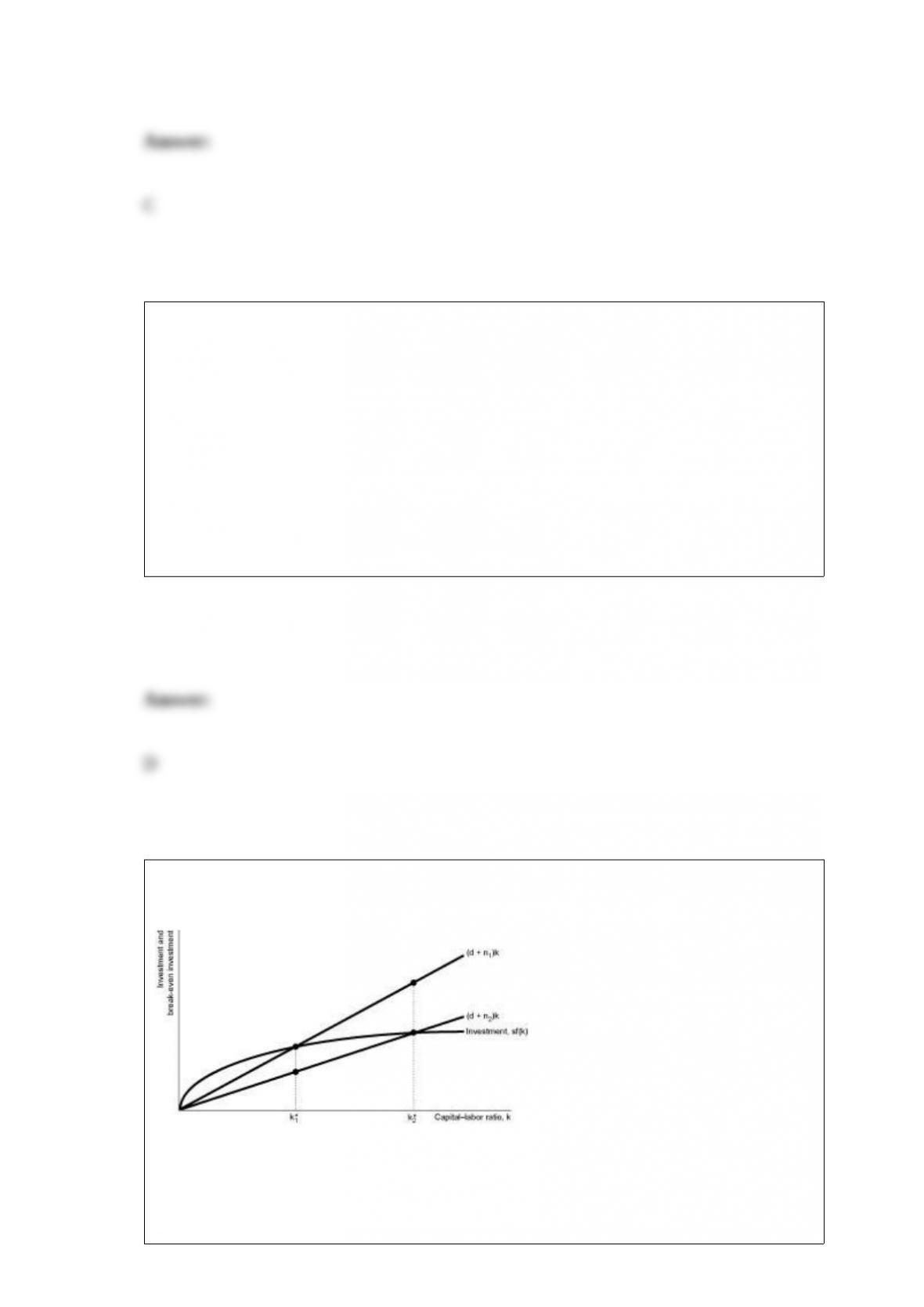
Figure 6.2
Refer to Figure 6.2. Suppose the economy is originally in steady state at k*1. All else
equal, if the labor force growth rate decreases,
A) break-even investment will shift from (d + n1)k to (d + n2)k, and the capital-labor
ratio will move from k*1 to k*2.
B) break-even investment will shift from (d + n1)k to (d + n2)k, and the capital-labor
ratio will remain at k*1.
C) break-even investment will shift from (d + n2)k to (d + n1)k, and the capital-labor
ratio will move from k*1 to k*2.
D) break-even investment will shift from (d + n2)k to (d + n1)k, and the capital-labor
ratio will remain at k*1.
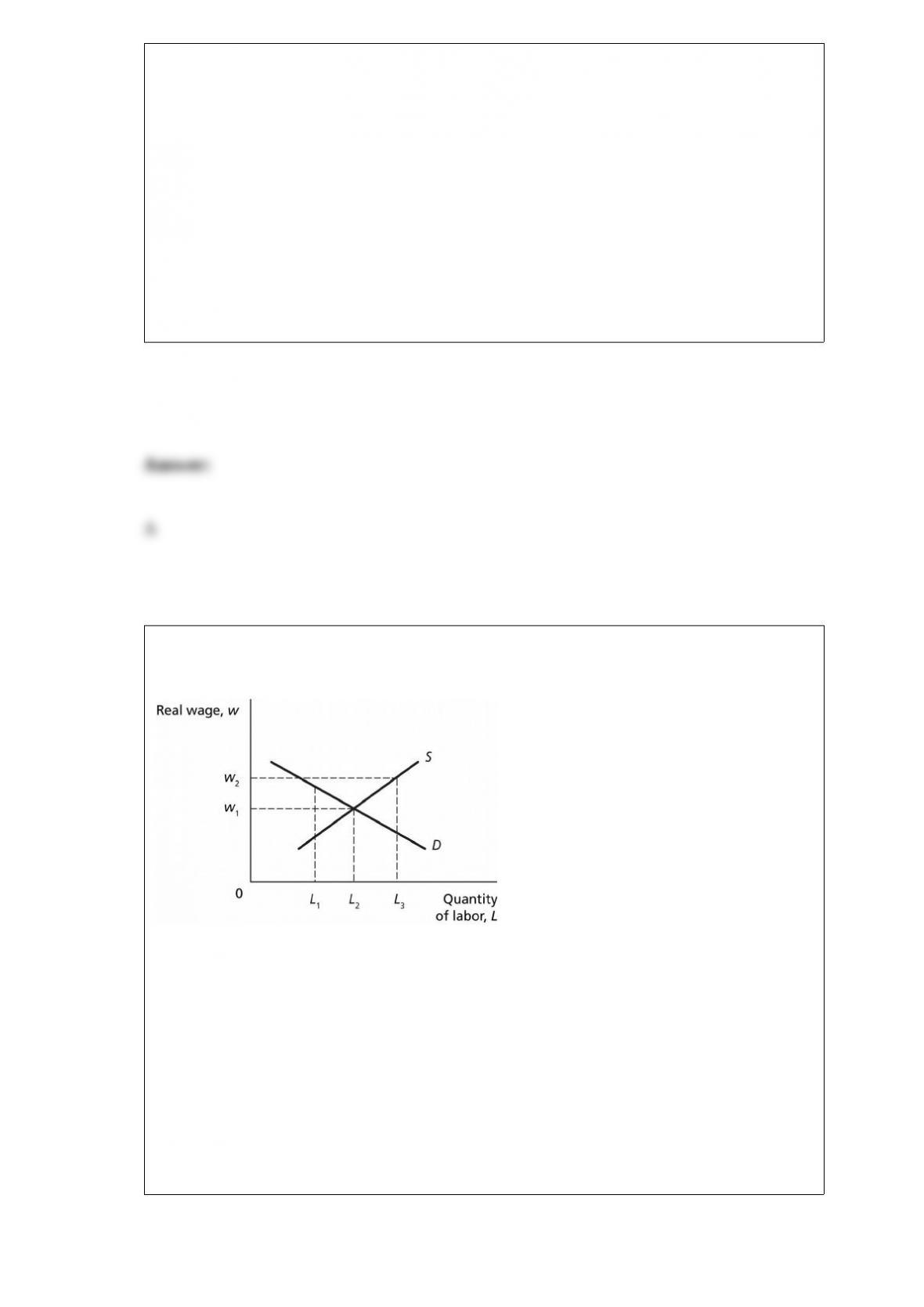
Figure 8.5
Refer to Figure 8.5. Equilibrium in this market is represented by a real wage of
________ and quantity of labor ________.
A) w1; L1
B) w1; L2
C) w2; L1
D) w2; L3

When the Fed makes an open market ________, the target short-term nominal interest
rate will increase, which will ________ GDP.
A) purchase; increase
B) purchase; decrease
C) sale; increase
D) sale; decrease
The openness of the U.S. economy has
A) increased over time.
B) decreased over time.
C) remained fairly consistent over time.
D) decreased over the past 30 years, following a 50 year increase.

Negative demand shocks have a tendency to ________ real GDP relative to potential
GDP and ________ the inflation rate.
A) increase; increase
B) increase; decrease
C) decrease; increase
D) decrease; decrease
If exchange rates are floating, an expansionary fiscal policy in the United States will
cause the dollar to ________ relative to other currencies and cause net capital outflows
to ________.
A) appreciate; increase
B) appreciate; decrease
C) depreciate; increase
D) depreciate; decrease
Which of the following has the lowest present value?
A) $1,000 received in 3 years if the current interest rate is 4%

B) $1,500 received in 5 years if the current interest rate is 6%
C) $2,000 received in 6 years if the current interest rate is 11%
D) $3,000 received in 10 years if the current interest rate is 13%
If the Fed set and achieved a goal of zero unemployment,
A) the inflation rate would increase.
B) real GDP would equal potential GDP.
C) they would have an easier time achieving the goal of price stability.
D) the natural rate of unemployment would be negative.
Suppose that the production function for the economy is: Y = AK1/4L3/4. Assume that
real GDP is $8,000 billion, capital stock is $32,000 billion, and the labor supply is 120
million (or 0.120 billion) workers. An increase in the capital stock of $1 billion will
increase real GDP by
A) $0.03125 billion.
B) $0.0625 billion.
C) $0.25 billion.

D) $1 billion.
Suppose the current exchange rate between the Japanese yen and the U.S. dollar is 80
yen = $1. Suppose you can buy more goods in the United States with $10 than you can
in Japan with 800 yen. Japan’s GDP in dollars will be
A) greater if the current exchange rate, rather than the purchasing power parity
exchange rate, is used to convert yen to dollars.
B) less if the current exchange rate, rather than the purchasing power parity exchange
rate, is used to convert yen to dollars.
C) the same whether the current exchange rate or the purchasing power parity exchange
rate is used to convert yen to dollars.
D) more accurate if the current exchange rate, rather than the purchasing power parity
exchange rate, is used to convert yen to dollars.
Figure 10.9
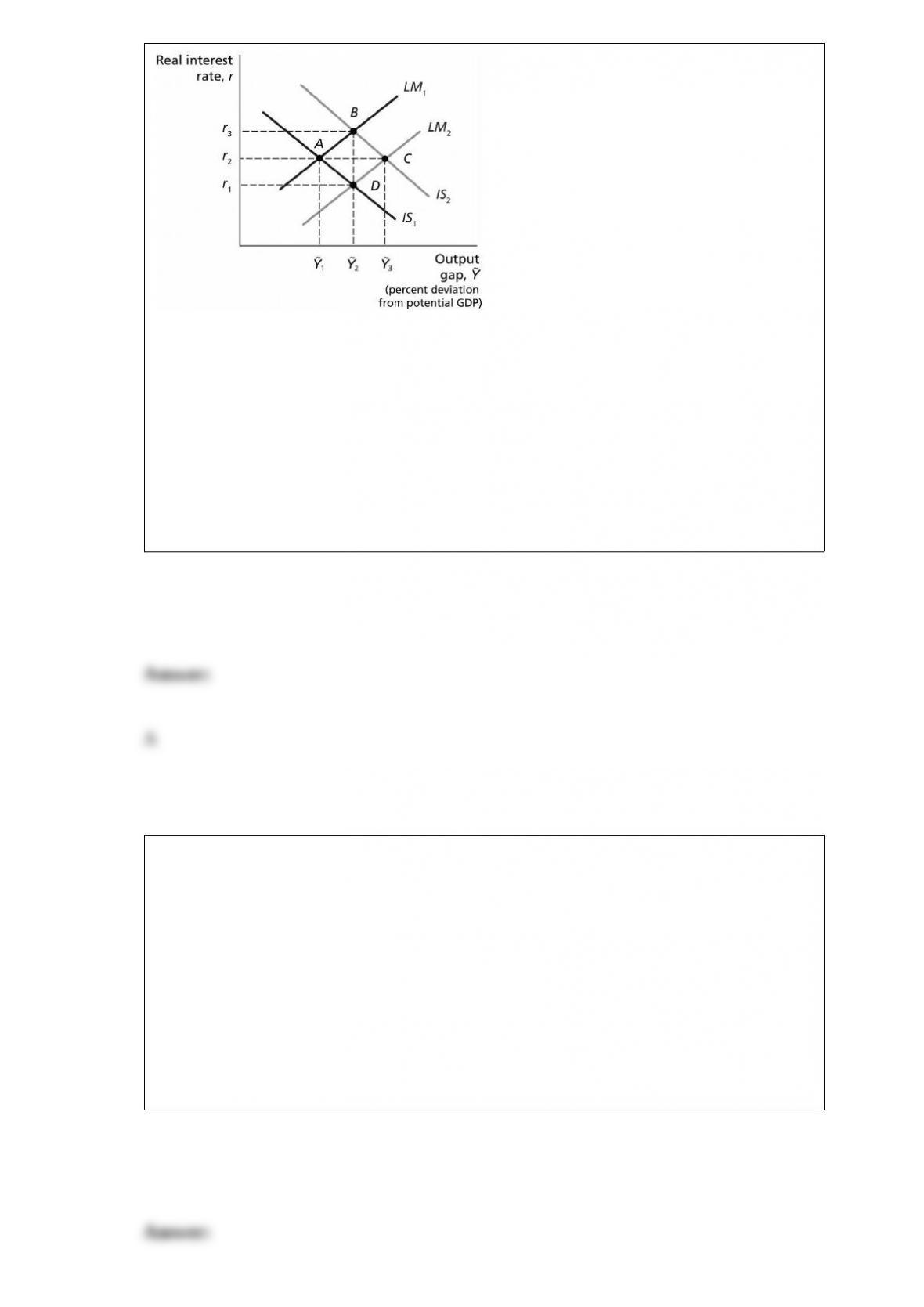
Refer to Figure 10.9. Other things equal, a positive demand shock is best represented
as a change in equilibrium from
A) point A to point B.
B) point A to point D.
C) point C to point B.
D) point C to point D.
Suppose you borrow $2,000 for one year and at the end of the year you repay the
$2,000 plus $110 of interest. If the expected inflation rate was 2.2% at the time you
took out the loan, what was the real interest rate you paid?
A) 2.2%
B) 3.3%
C) 5.5%
D) 7.7%

Holding other factors constant, building an on-line job database to help workers find
jobs would likely
A) reduce cyclical unemployment and the natural rate of unemployment.
B) reduce structural unemployment and the natural rate of unemployment.
C) reduce frictional unemployment and the natural rate of unemployment.
D) increase the natural rate of unemployment.
If you were building a macroeconomic model that explores the effect of the aging
population on the needed expenditure for Social Security and Medicare, the exogenous
variable(s) would be the
A) aging population.
B) needed expenditure on Social Security.
C) needed expenditure on Medicare.
D) needed expenditure on both Social Security and Medicare.
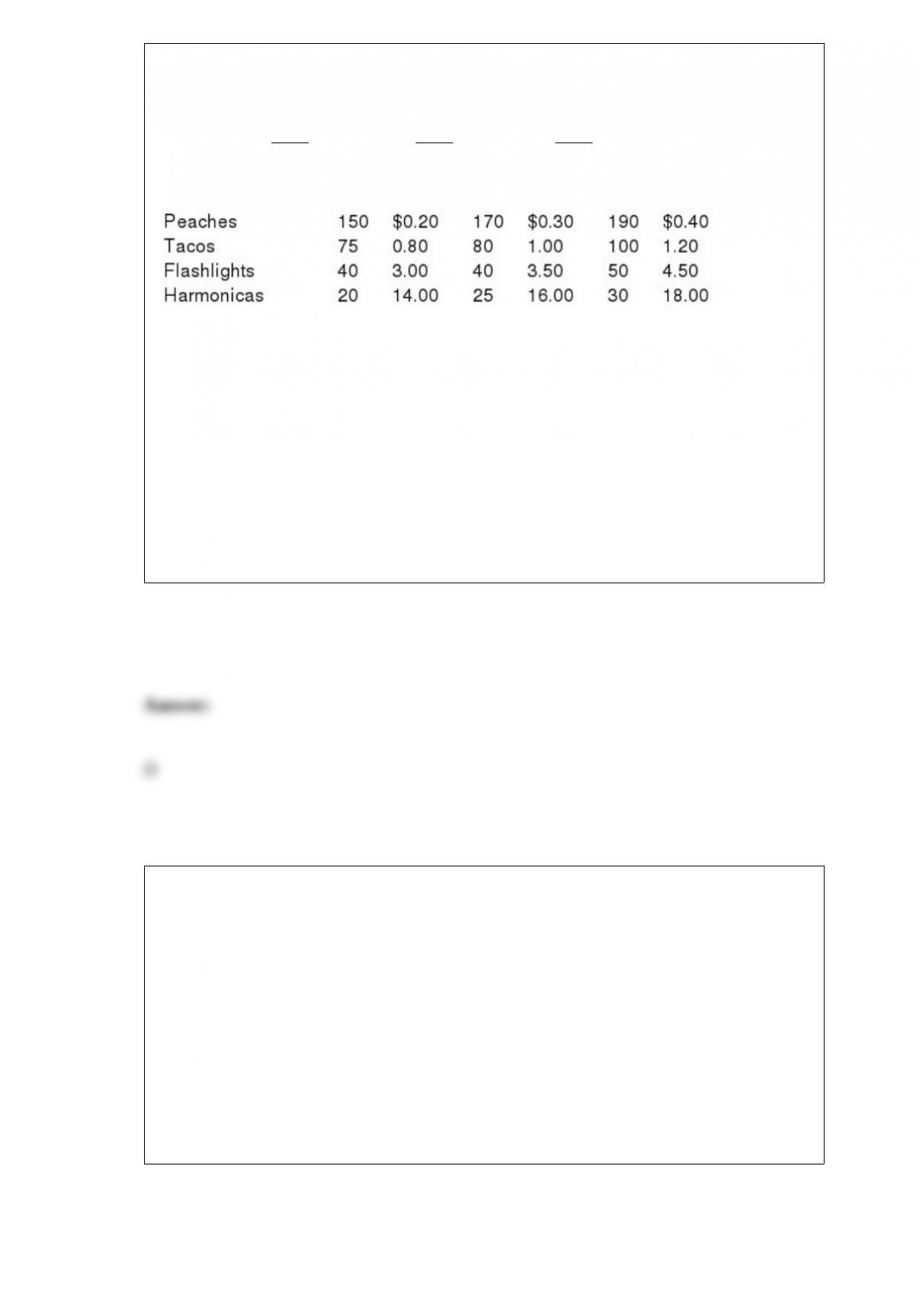
Table 2.3
2007 2010 2013
Quantity Price Quantity Price Quantity Price
Table 3 gives quantities and prices for each good produced in a simple economy in
2007, 2010, and 2013.
Refer to Table 2.3. Nominal GDP in 2013 is
A) $568.00.
B) $794.00.
C) $812.00.
D) $961.00.
Balanced growth paths can differ across countries due to differences in saving rates,
labor force growth rates, and the rates of labor-augmenting technological change. These
differences are likely to result in differences in ________, a common measure of the
standard of living.
A) happiness
B) life expectancy
C) income distribution
D) real GDP per capita
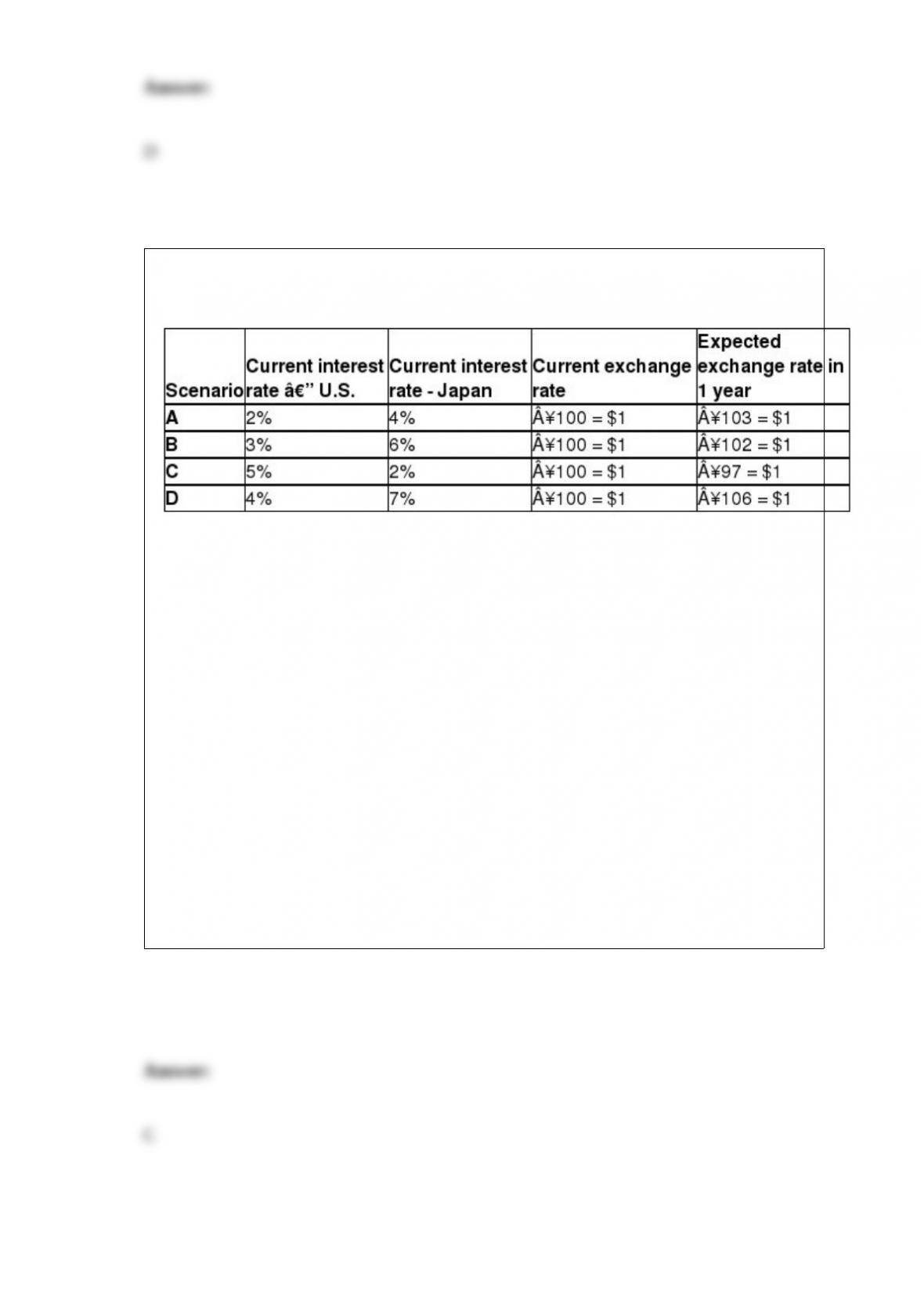
Table 4.2
Suppose that you intend to invest $10,000 in one-year government bonds. You are
looking for the highest return on your investment and do not care whether you
invest in the United States or Japan, but as U.S. resident, you want your
investment return to be in U.S. dollars. The Table lists 4 scenarios, each showing
the current interest rate for one-year government bonds in the United States and
Japan, the current exchange rate between the dollar and the yen, and the expected
exchange rate in one year. Other than the interest rates, you assume the bonds
from each country to be identical.
Refer to Table 4.2. With which scenario will you be indifferent about investing in either
U.S. or Japanese bonds?
A) A
B) B
C) C
D) D
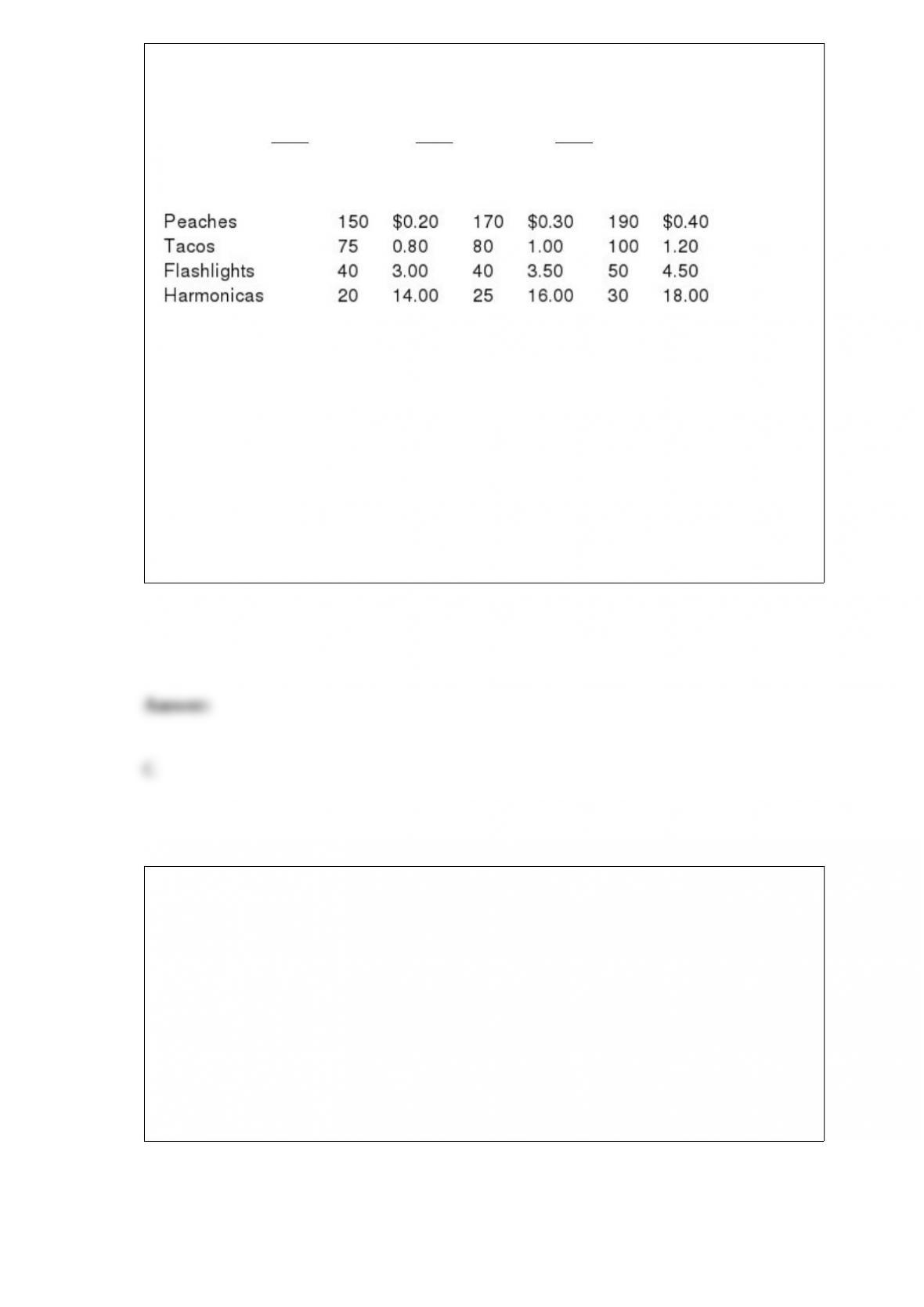
Table 2.3
2007 2010 2013
Quantity Price Quantity Price Quantity Price
Table 3 gives quantities and prices for each good produced in a simple economy in
2007, 2010, and 2013.
Refer to Table 2.3. Assume that 2010 is the base year. Real GDP in 2013 is
A) $688.00.
B) $794.00.
C) $812.00.
D) $961.00.
If the federal government tries to make fiscal policy sustainable by increasing taxes on
wages, the opportunity cost of leisure will ________ and will result in ________
potential GDP.
A) increase; lower
B) decrease; higher
C) decrease; lower
D) increase; higher

The goals of monetary policy tend to be interrelated. For example, when the Fed
pursues the goal of ________, this helps to achieve the goal of ________.
A) high employment; price stability
B) interest rate stability; financial market stability
C) rapid economic growth; low inflation
D) interest rate stability; a balanced budget
In the Cobb-Douglas production function Y = AK3/4L1/4,
A) capital is a more expensive input than labor.
B) capital is more plentiful than labor.
C) diminishing returns to capital are three times greater than are diminishing returns to
labor.
D) capital has a larger share in national income than does labor.