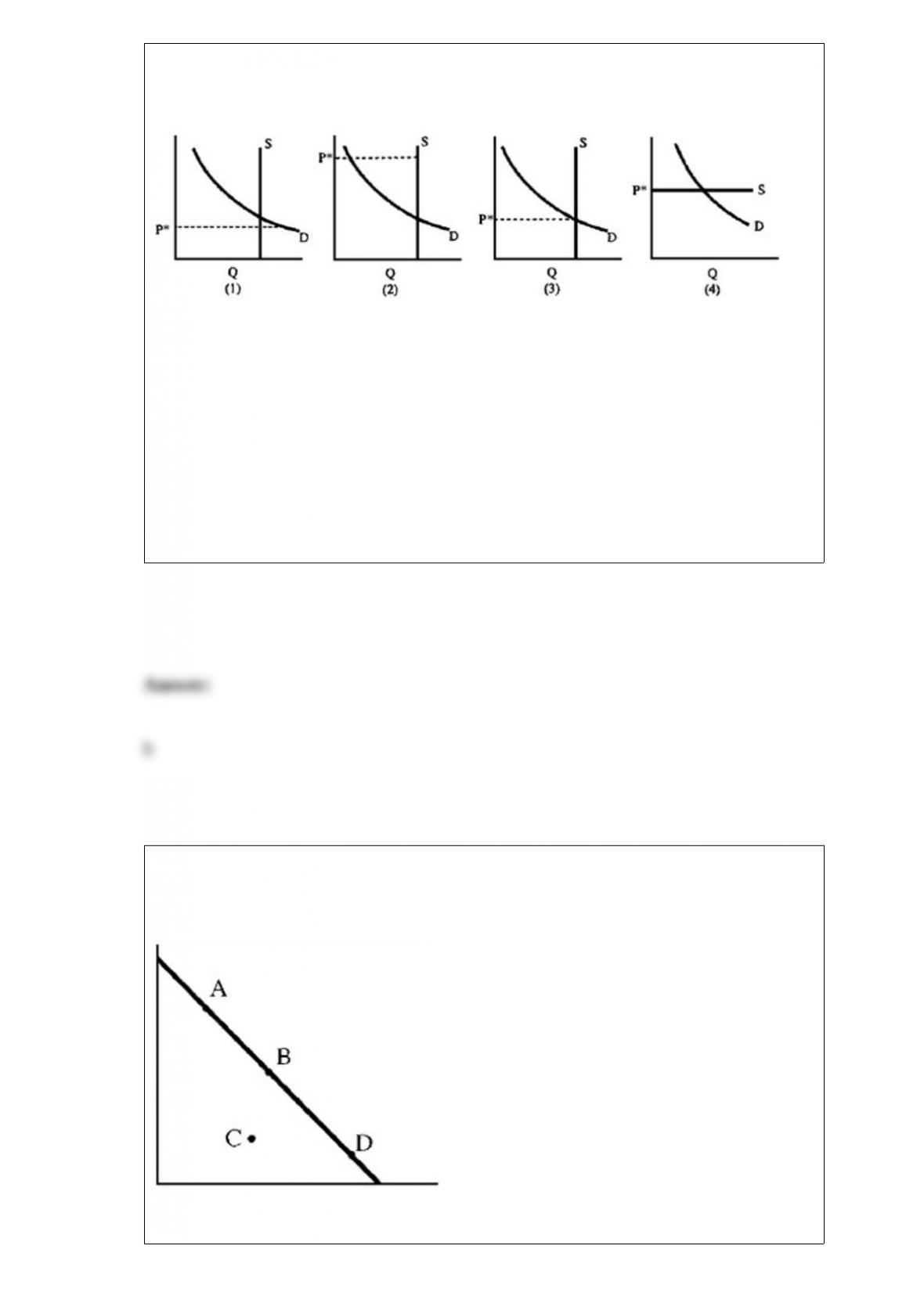
Figure 4-20
If there are empty seats at the university basketball game when the price per ticket is
P*, then this situation can best be represented by which graph in Figure 4-20?
a. 1
b. 2
c. 3
d. 4
Figure 5-10
In the indifference curve pictured in Figure 5-10, which of the following is clearly true?

a. B is preferred to D.
b. B is preferred to C.
c. A is preferred to B.
d. C is preferred to D.
The marginal productivity principle has relevance only in a capitalist economy, and not
in a socialist system.
a. True
b. False
The difference between the cost of production on a piece of land less the cost of
production on marginal land is called
a. usury.
b. profit.
c. rent.
d. interest.

If the price level does not fall or only falls very slowly, then the result will be a
prolonged period of
a. inflation whenever supply increases.
b. production below potential GDP.
c. production above potential GDP.
d. rapid price increases when demand changes.
When income taxes are included in the basic macroeconomic model, the value of the
a. inflationary effect is increased.
b. multiplier is increased.
c. multiplier is decreased.
d. expenditure function is increased.

Money is an imperfect store of value when
a. the rate of inflation is high.
b. the unemployment rate is high.
c. gold prices are falling.
d. businesses are failing due to bankruptcy.
Workers in country A receive an increase in wages of 10 percent at the same time the
inflation rate in country A is 8 percent. Workers in country B receive an increase in
wages of 3 percent and the inflation rate in country B is 1 percent. In which country are
workers better off?
a. Country A because their real wages rise by 18 percent.
b. Country A because their real wages rise by 10 percent.
c. Country B because the inflation rate is lower.
d. Neither country because the increase in real wages is the same.
The inflationary effect of an expansionary monetary policy depends on the slope of the
aggregate supply curve.

a. True
b. False
The real minimum wage has increased significantly over the last 40 years.
a. True
b. False
A consumer will consume the combination of goods at the crossing point of a budget
line and indifference curve.
a. True
b. False
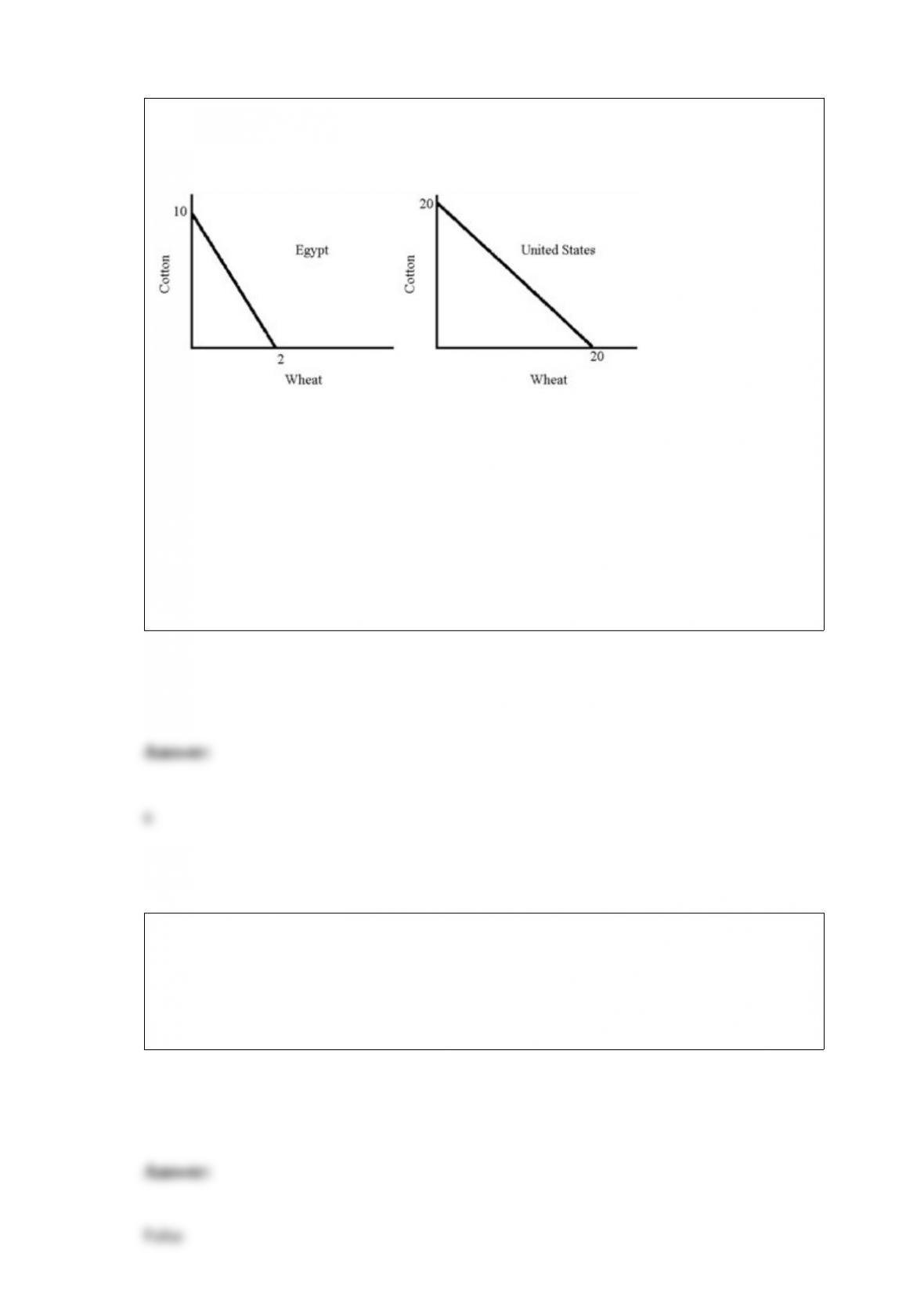
Figure 22-4
In Figure 22-4, the opportunity cost of a unit of wheat in terms of cotton is
a. 1 for the United States; 5 for Egypt.
b. 20 for the United States; 2 for Egypt.
c. 1 for the United States; 2 for Egypt.
d. 20 for the United States; 10 for Egypt.
The laws of supply and demand did not apply to elephant tusks.
a. True
b. False

Productivity levels in rich countries are:
a. higher than in poor countries
b. lower than in poor countries
c. about the same as in poor countries
d. not related to those in poor countries
The human capital model assumes that
a. education is a productive investment that raises total output.
b. education does not change potential productivity, but it does save resources by
reducing sorting costs for employers.
c. the educational system is a very expensive process to legitimize the intergenerational
transmission of privileged status.
d. such factors as the love of learning should be included in the analysis.
The law of demand states that as the price
a. increases, total quantity demanded will increase.

b. decreases, total quantity demanded will decrease.
c. increases, total quantity demanded will decrease.
d. increases, total quantity demanded will stay the same.
A society which is inside its production possibilities frontier is efficient.
a. True
b. False
Large income differences will be eradicated if the market mechanism is working well.
a. True
b. False

Inefficient allocation of resources occurs when
a. no one can be made better off without having someone else give up something.
b. it is possible to make some people better off without making others worse off.
c. society is operating at a point high on the production possibilities frontier.
d. society is operating at a point low on the production possibilities frontier.
Lines, ration coupons, and black markets are symptoms of a
a. price floor.
b. price ceiling.
c. free market.
d. barter economy.
If inflation rises more quickly in the United States than in France, U.S. exports to
France should rise.
a. True

b. False
The U.S. income tax system is progressive.
a. True
b. False
The observed change in the reserves of copper, lead, and zinc between 1960 and 1990
was most likely caused by
a. low prices discouraging exploration for new reserves.
b. a slowdown in demand growth.
c. high prices that stimulated exploration.
d. the discovery of substitutes.

Marginal revenue product is essentially the additional revenue generating from selling
one additional unit of output.
a. True
b. False
Which of the following observations concerning GDP calculations is true?
a. Goods and services produced by governments are valued at market price.
b. Inventories are treated as if they are yet to be sold.
c. Goods produced but not sold during the year are counted in that year’s GDP.
d. Goods that firms add to their inventories do not count in the GDP.
A perfectly competitive firm is a price
a. giver.
b. taker.
c. maker.
d. leader.
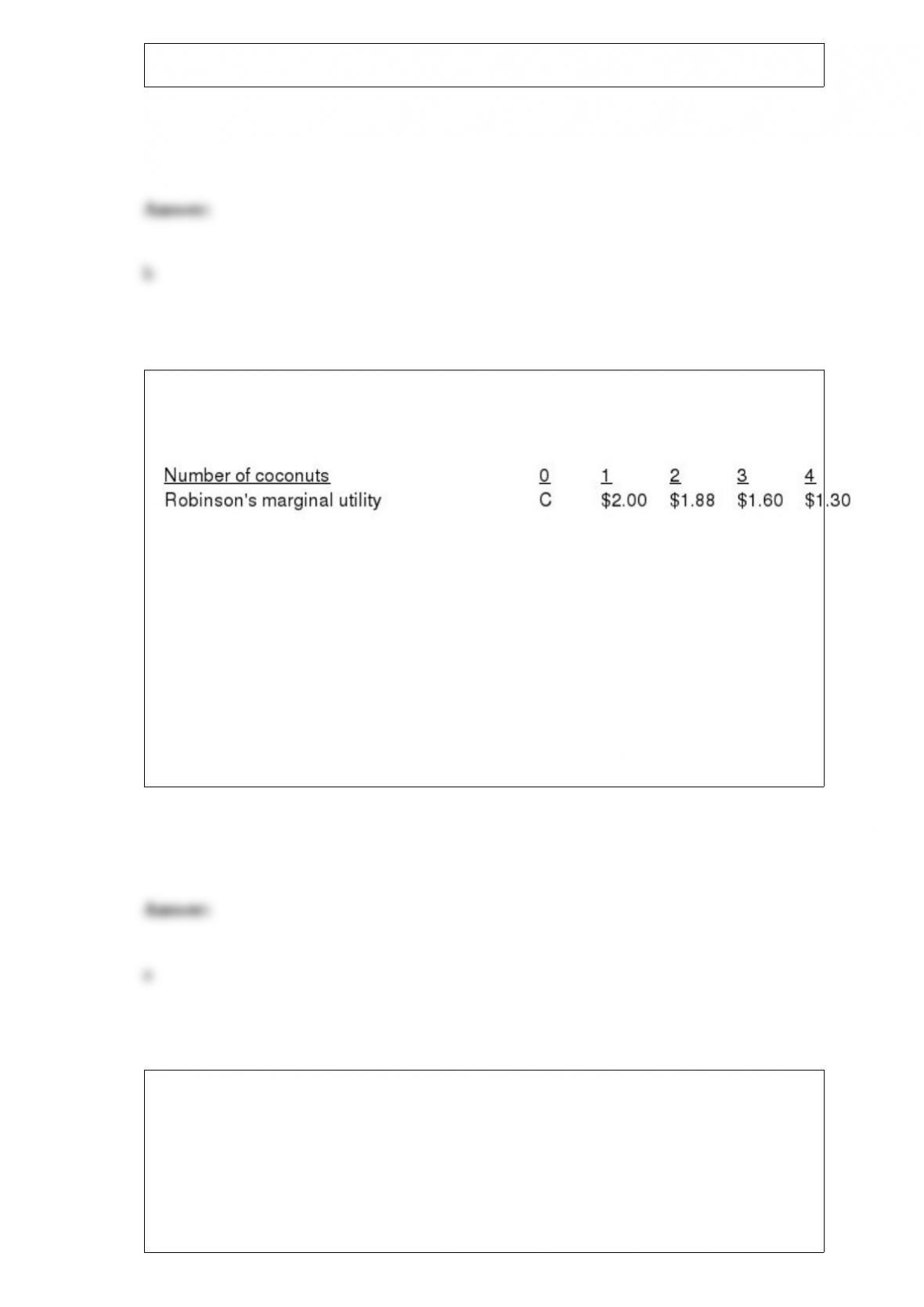
Table 5-1B
If the marginal utility to Juan of sleeping an extra hour (from 8 a.m. to 9 a.m.) is
negative,
a. Juan is better off getting up at 8 a.m.
b. Juan is better off getting up at 9 a.m.
c. Juan’s total utility from sleeping must be negative.
d. Juan’s average utility from every hour he sleeps must be negative.
If income tax rates are increased in an attempt to balance the federal budget, we should
expect to see
a. an increase in consumption and a decrease in GDP.
b. an increase in consumption and an increase in GDP.

c. a decrease in consumption and a decrease in GDP.
d. a decrease in consumption and an increase in GDP.
Generally, economists agree that the economic outlook for the U.S. is seriously
challenged.
a. True
b. False
When comparing the costs of inflation to society, it is important to distinguish between
a. low versus high rates of inflation.
b. expected versus unexpected inflation.
c. high price levels and low price levels.
d. real versus nominal inflation.

If production involves constant opportunity cost, the production possibilities curve
a. is “bowed inward.”
b. is a straight line.
c. is “bowed outward.”
d. is a wavy line.
e. has an unpredictable shape.
Money that is backed solely by a government decree is referred to as fiat money.
a. True
b. False