
NotAlligator Briefcases estimates that its total cost of producing vinyl bags is TC = 65
+ 9 / Q + 5Q2. At 3 units of output, NotAlligator’s marginal cost is:
a. $113.
b. $29.
c. $27.
d. $119.
e. $9.
Betty spends all her income on cheese and crackers. She finds that the marginal utility
of cheese is 10 and the marginal utility of crackers is 15. The price of cheese is $5 per
unit, and the price of crackers is $3 per unit. At this point, Betty:
a. is maximizing her utility subject to her budget constraint.
b. should consume more cheese and fewer crackers.
c. should consume more crackers and less cheese.
d. should consume more crackers and more cheese.
e. should switch her consumption over to other goods that she likes better.
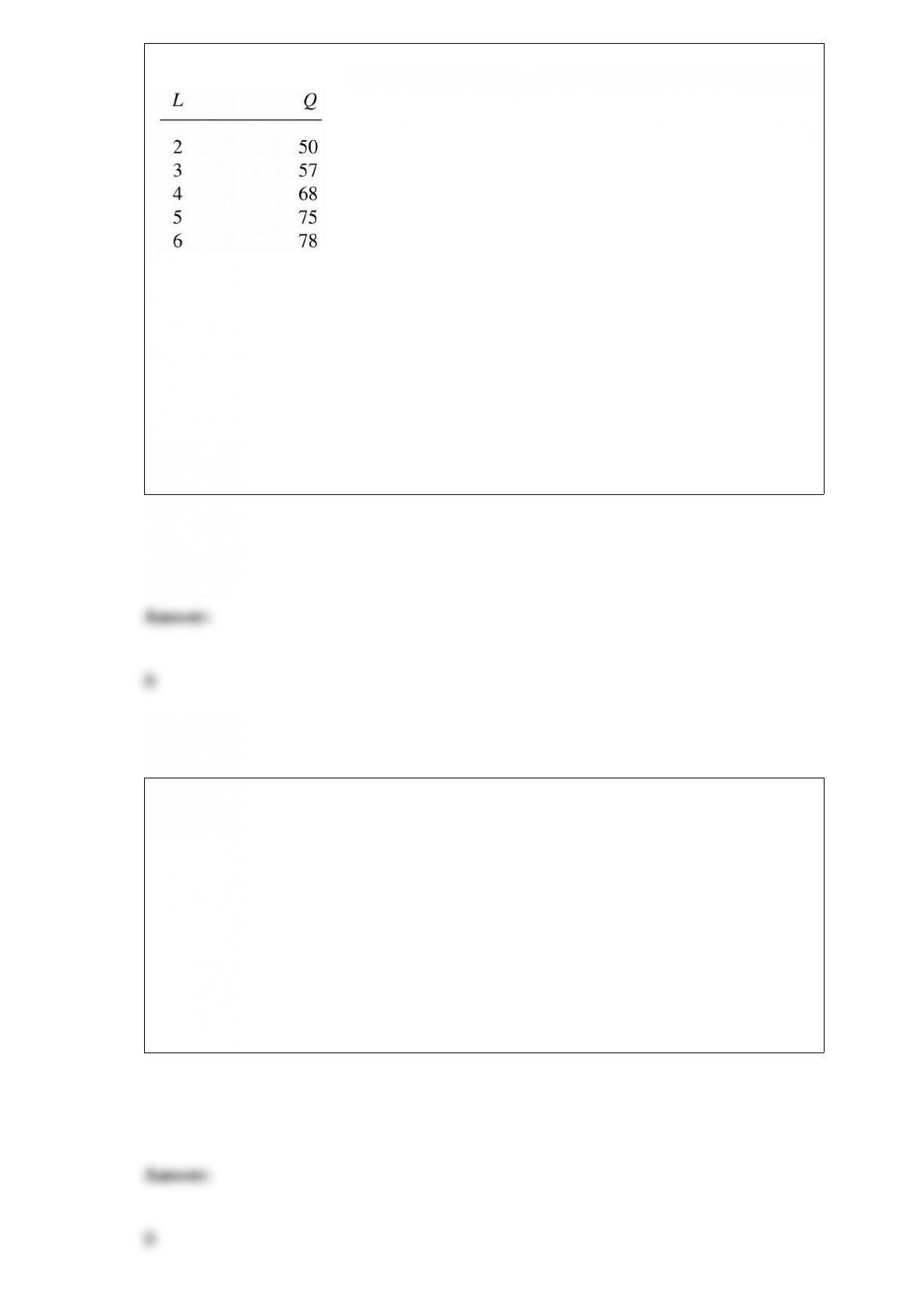
In the following table, the marginal product of labor at L = 4 is:
a. 7.
b. 11.
c. 17.
d. 16.
e. 6.
If Y = U(X)W(X), then dY/dX is:
a. U dW/dX ” W dU/dX.
b. U dW/dX + W dU/dX.
c. (W dW/dX) / (U dU/dX).
d. (U dW/dX)(W dU/dX).
e. W dW/dX + U dU/dX.

Duopolists A and B face the following demand curves: QA = 100 ” 2PA + 2PB and QB =
100 ” 2PB + 2PA. If both firms have zero marginal cost, what are the profit-maximizing
prices and quantities?
a. PA = 100, QA = 60, PB = 80, QB = 140.
b. PA = 25, QA = 100, PB = 25, QB = 100.
c. PA = 50, QA = 80, PB = 40, QB = 120.
d. PA = 50, QA = 100, PB = 50, QB = 100.
e. PA = 60, QA = 60, PB = 40, QB = 140.
What is the optimal bid for a descending-price auction if the bidder’s reservation price
is 8, the lowest possible bid is 2, and there are three bidders?
a. 2.
b. 6.
c. 7.
d. 8.
e. None of the above.

The demand for space heaters is Q = 250 ” P + 2COOL, where COOL is the absolute
value of the difference between the average overnight low temperature and 40°F.
Assume that the average overnight low is 0°F. When the price of space heaters is P =
$30, the price elasticity of demand is:
a. “0.1.
b. “1.0.
c. “0.66.
d. “1.5.
e. “6.6.
Suppose Al is currently consuming four movies and four concerts per month. If his
utility function is given by U = 15M0.5C, where M represents the number of movies
seen and C represents the number of concerts attended, what is Al’s total utility equal
to?
a. 15.
b. 30.
c. 120.
d. 240.
e. 960.

The principal”agent problem occurs as a result of:
a. the absence of a contract between managers and owners.
b. the separation of ownership from management.
c. the difficulty of identifying the principal agent with whom to negotiate.
d. competition between managers at various levels.
e. none of the above.
If Y = 3X / (3X + X 2), then dY/dX is:
a. [(3 + 2X)3X + 3(3X + X 2)] / (3X + X 2)2.
b. (3 + 2X)3X / (3X + X2)2.
c. “3 / (3 + X)2.
d. [(3 + 2X) ” 3(3X + X 2)] / (3X + X 2)2.
e. (3 + 2X)3X / (3X + X2).

If the demand increases for the product of a constant-cost industry:
a. long-run output goes up, but long-run price may go up or down.
b. short-run output goes up, but long-run output may go up or down.
c. short-run price goes up, but long-run price remains constant.
d. long-run output goes up, but short-run price remains constant.
e. long-run price goes up, but short-run price may go up or down.
If John produces joint products A and B and refuses to sell all the A he produces, then:
a. A is a high-demand good.
b. A is a low-demand good.
c. A is a high-cost good.
d. A is a low-cost good.
e. John is definitely not profit maximizing.
If a representative firm with total cost given by TC = 20 + 20q + 5q2 operates in a
competitive industry where the short-run market demand and supply curves are given
by QD = 1,400 ” 40P and QS = “400 + 20P, the number of firms operating in the short

run will be:
a. 100.
b. 140.
c. 200.
d. 280.
e. 240.
Indifference curves describe:
a. various consumer income levels.
b. alternative market prices for goods and services.
c. the quantities of a good or service that people are willing and able to buy at
alternative prices.
d. producer production levels at alternative market prices.
e. consumer preferences.
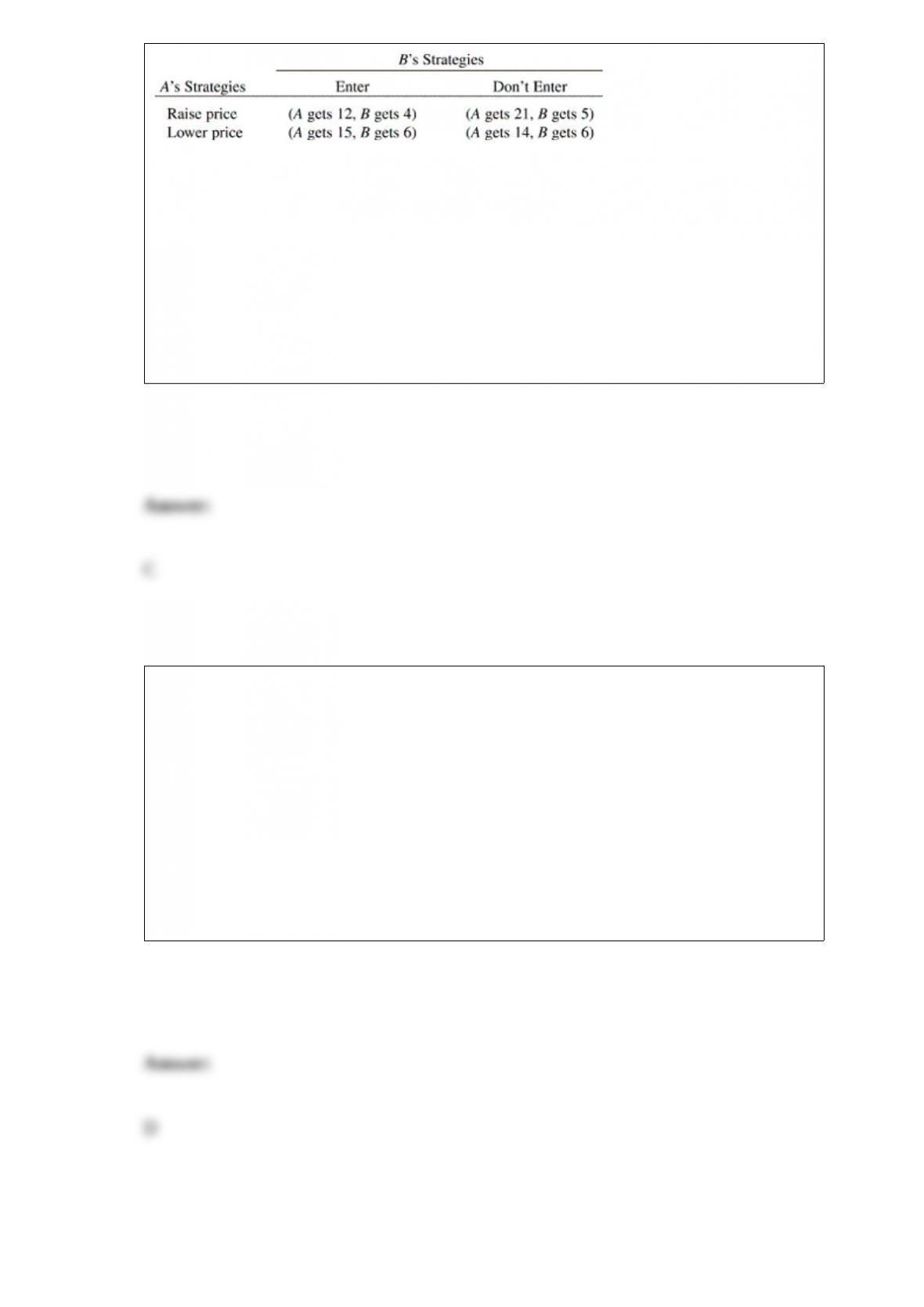
How many Nash equilibria are there in this payoff matrix?
a. 0
b. 1
c. 2
d. 3
e. 4
The price leadership strategy is most appropriate when a market is:
a. perfectly competitive.
b. monopolistic.
c. monopolistic competitive.
d. oligopolistic.
e. all of the above.

Points along an indifference curve represent bundles of goods that:
a. cost the same amount to buy.
b. consumers don”t like very much.
c. decline in marginal utility.
d. deliver equal utility.
e. cannot be compared.
A market where there are only a few sellers is known as:
a. perfectly competitive.
b. monopolistically competitive.
c. oligopolistic.
d. monopolistic.
e. cartelized.
If an activity produces an external economy, then there will be too:
a. much of the activity undertaken by private parties from a social viewpoint.

b. little of the activity undertaken by private parties from a social viewpoint.
c. much of the activity undertaken by government from a private viewpoint.
d. much of the activity undertaken by private parties from a private viewpoint.
e. much of the activity undertaken by government from a social viewpoint.
Information on the quantities that would be purchased at different prices, holding all
other factors constant, in a given time period from a group of firms is shown in a:
a. firm demand curve.
b. market demand curve.
c. firm demand schedule.
d. market supply schedule.
e. firm supply curve.
Hedge Fun is a landscaping firm that specializes in topiary. Last year, the firm had 30
employees and served 120 customers. This year, it had 35 employees and served 135
customers. The average product of labor is at a maximum when the number of
customers is:

a. less then 120.
b. equal to 120.
c. between 120 and 135.
d. equal to 135.
e. greater than 135.
The marginal rate of technical substitution between two inputs:
a. shows the rate at which one input can be traded for another, holding output constant.
b. shows the efficient combination of inputs.
c. increases as we move down an isoquant.
d. shows the rate at which output can be increased by using more of both inputs.
e. shows the rate at which output decreases when using less of one of the inputs.
A cartel is:
a. the name for firms in any oligopoly market.
b. a collusive organization.

c. an oligopolist that competes with other oligopolists.
d. a group of firms using price leadership.
e. a group of firms using preemptive strategies.
Firms can avoid or limit the asset substitution problem by:
a. funding with equity.
b. establishing a reputation for protecting creditors.
c. insuring bondholders against risk.
d. applying to the government for insurance for bondholders.
e. a, b, and c.
Getting to a Nash equilibrium requires:
a. each knowing the opponent’s payoffs and cooperation.
b. knowing the opponent’s payoffs but not cooperation.
c. cooperation but not knowing the opponent’s payoffs.

d. neither cooperation nor knowing the opponent’s payoffs.
e. either cooperation or knowing the opponent’s payoffs, depending on the game.
If the demand increases for the product of a decreasing-cost industry:
a. short-run price goes up, but long-run price falls.
b. long-run output goes up, but long-run price may go up or down.
c. short-run output goes up, but long-run output may go up or down.
d. long-run output goes up, but short-run price remains constant.
e. long-run price goes up, but short-run price may go up or down.
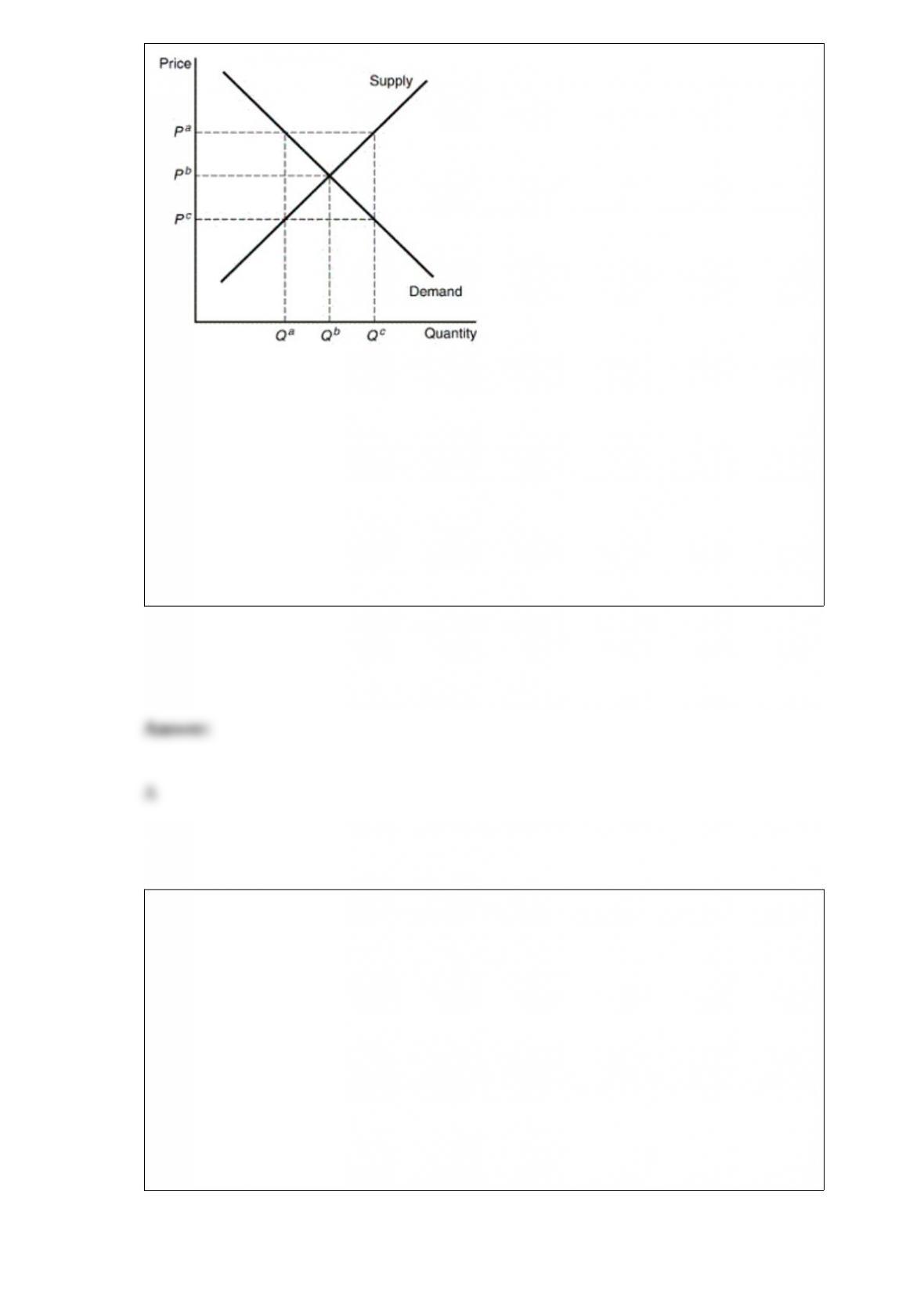
In the following figure, there will be an excess supply at any price:
a. above Pb.
b. below Pb.
c. other than Pb.
d. below Pa.
e. above Pc.
Paul’s Pizza Parlor bakes pizza pies according to Q = 3L ” 0.3L2. If labor costs $6 and
pizza sells for $10, the optimal amount of labor is:
a. 6
b. 5
c. 4
d. 3
e. 2

A manager has a utility function U = C 0.5 if she doesn”t work hard and U = C 0.5 ” 1 if
she does. Expected profit will increase from 1,500 to 1,600 if she works hard. The
manager receives compensation C equal to 81 plus a portion x of any profit in excess of
1,500. What is the value of x that will make the manager indifferent between shirking
and working hard?
a. 0.09.
b. 0.105.
c. 0.19.
d. 0.242.
e. None of the above.
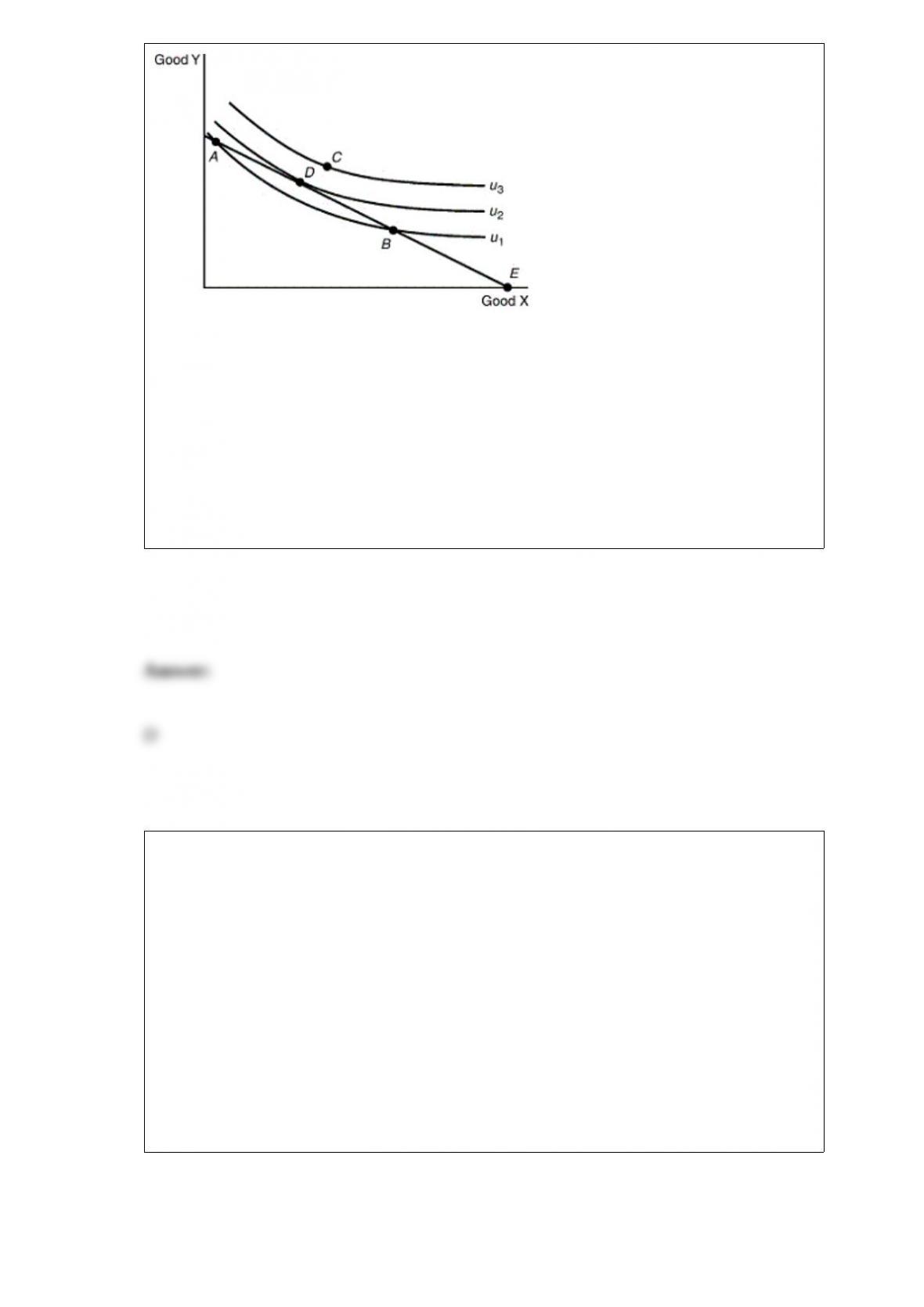
Mary’s indifference map and budget constraint for goods X and Y are shown below. If
Mary spends all her money on X and Y, which bundle will she choose to maximize her
utility?
a. A.
b. B.
c. C.
d. D.
e. E.
Which of the following is the best example of adverse selection?
a. Smokers are more likely to obtain health insurance.
b. Safe drivers tend to get auto insurance.
c. All drivers are required to have auto insurance if they are to register their cars legally
in Connecticut.
d. Both healthy and unhealthy people tend to buy life insurance.
e. Given the existence of government-funded flood insurance, people continue to build
homes in floodplains.