
A significant cost of economic growth is
a. increased consumer satisfaction.
b. higher levels of per capita output.
c. increased leisure time.
d. environmental pollution.
e. economies of scale.
U.S. antitrust laws and their enforcement
a. reflect the principle that free markets cannot remain competitive.
b. have led to government price setting in many industries.
c. attempt to maintain the status quo.
d. have led to the elimination of market concentration in the United States.
e. affect business judgment when courses of action are being considered.
The Phillips curve illustrates the relationship between
a. the interest rate and the money supply.

b. the interest rate and the level of investment.
c. aggregate demand and aggregate supply.
d. output and income.
e. inflation and unemployment.
An input whose quantity is unaffected as output rises or falls is a(n) ________ input.
a. irrelevant
b. dominant
c. fixed
d. independent
e. superior
The following questions are based on the following aggregate supply”aggregate
demand diagram:
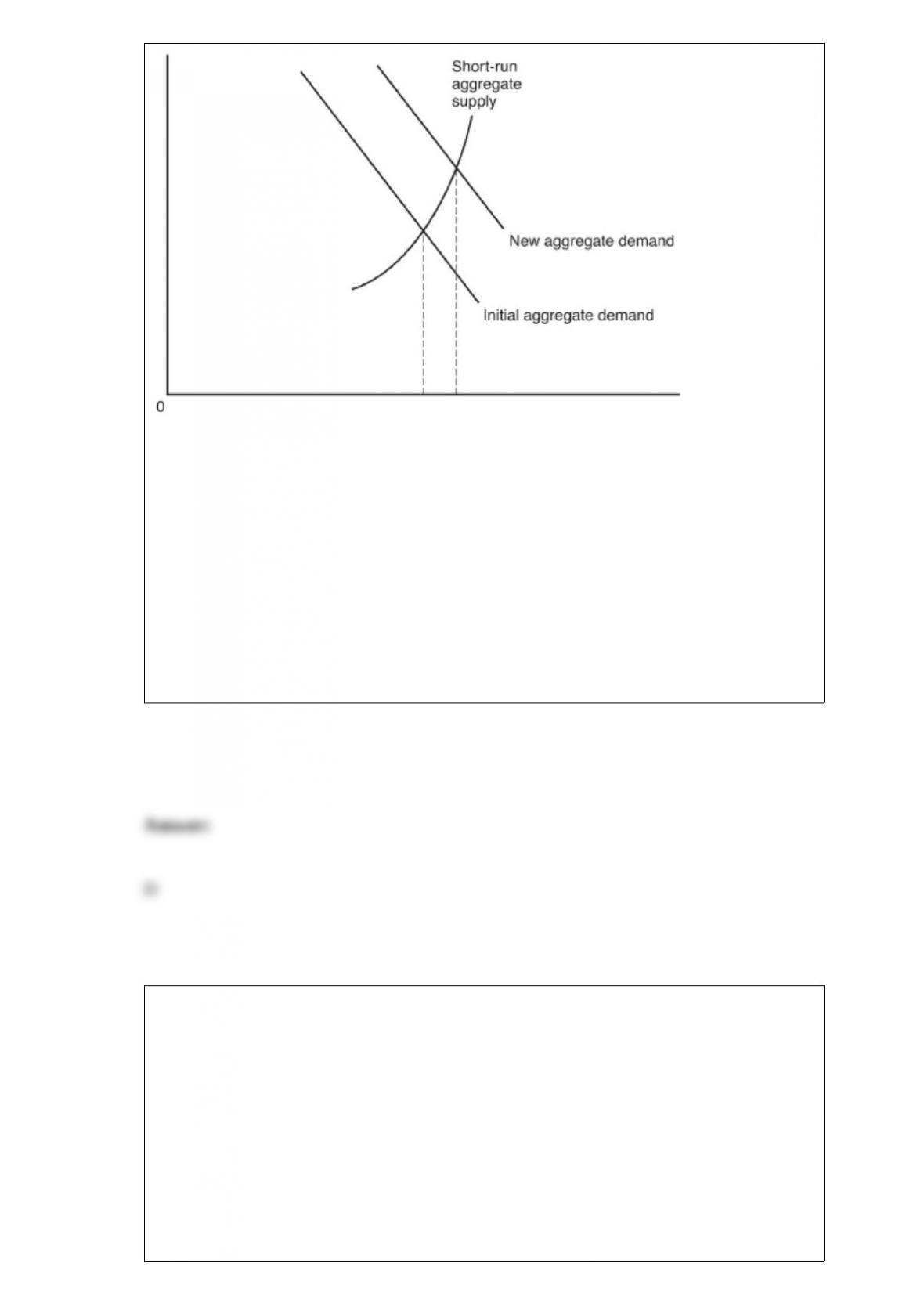
The vertical axis shows
a. the money supply.
b. total real output.
c. the unemployment rate.
d. the price level.
e. wage rates.
The distinction between variable and fixed inputs
a. can be made only in the long run.
b. can be made by calculating the difference between an input’s marginal product and its
average product.
c. is based on the time period under consideration.
d. is that variable inputs are not subject to the law of diminishing returns.

e. reflects the difference between human and nonhuman inputs.
Costs are clearly minimized for a given level of output as long as the firm
a. uses inputs that do not exhibit declining productivity.
b. pays the same price for all of its inputs.
c. is not able to increase output by substituting a dollar’s worth of input A for a dollar’s
worth of input B, or vice versa.
d. can increase output without increasing its cost.
e. equates the marginal products of both inputs A and B.
Which of the following policy tools will have the greatest effect on bank reserves?
a. maintaining the existing legal reserve ratio
b. advising Congress on budget policy
c. decreasing the discount rate
d. encouraging banks to be more cautious
e. buying U.S. government securities

If equilibrium GDP exceeds potential GDP
a. potential output is much greater than actual output.
b. the economy is in a recession.
c. price levels are falling.
d. actual spending is too low.
e. an inflationary gap exists.
The following questions are based on the following graph:
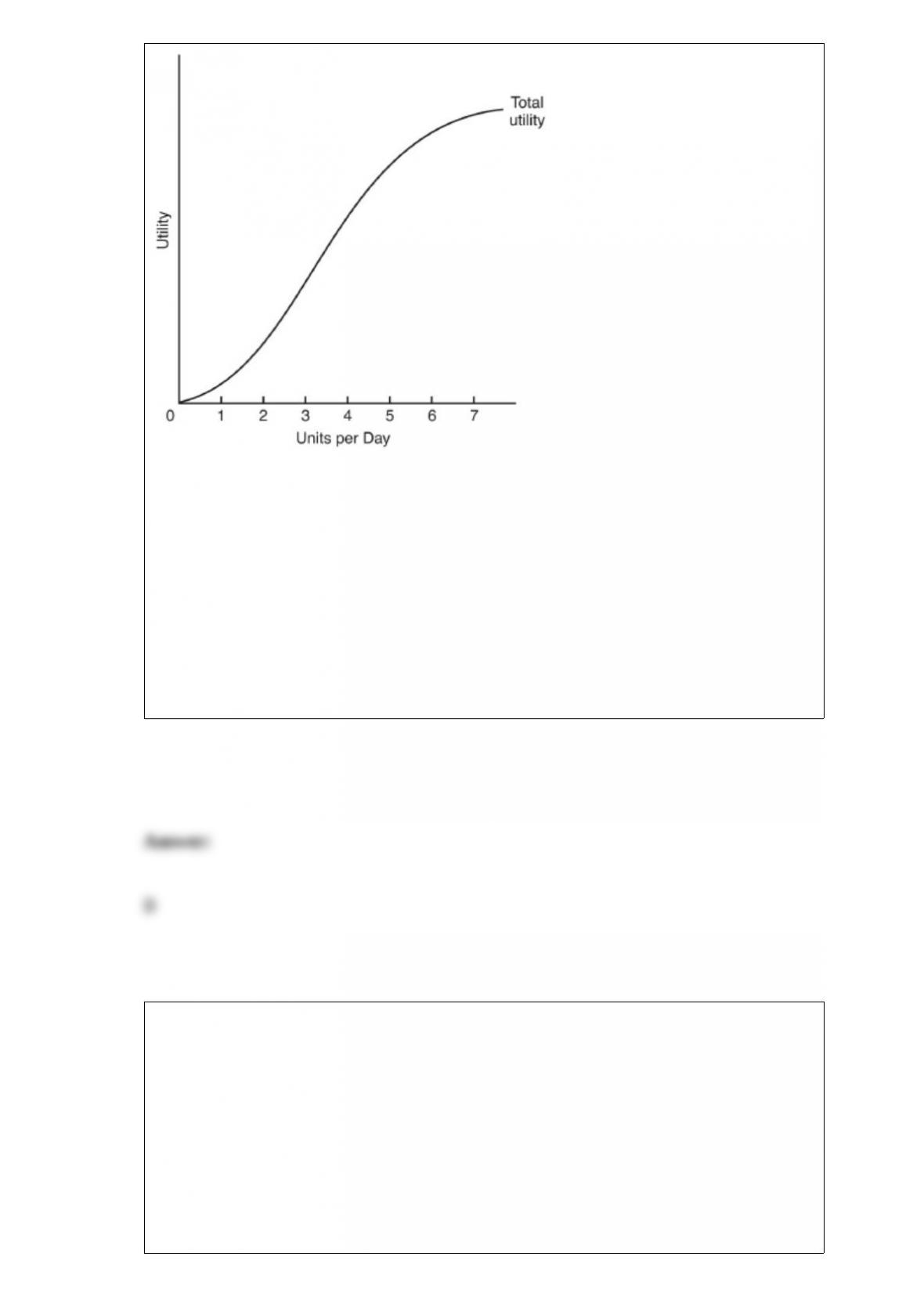
As consumption is increased from
5 to 7 units, marginal utility is
a. rising.
b. falling.
c. constant.
d. zero.
e. negative.
Marx called that part of labor’s productivity appropriated by employers
a. surplus value.
b. capital.
c. interest.
d. the value of the marginal product.
e. excess capacity.

The Clayton Act outlawed
a. horizontal mergers.
b. unjustified price discrimination.
c. the rule of reason.
d. deceptive advertising.
e. “cutthroat” competition.
A husband and wife both work during the week and decide that on Saturday morning
the inside of the house must be cleaned and the yard must be mowed and weeded. If it
takes the husband four hours to clean the house and three hours to do the yard work,
and the wife can do either in two hours
a. the husband has a comparative advantage in yard work.
b. the husband has a comparative advantage in cleaning.
c. the wife has a comparative advantage in both tasks.
d. there would be no gain from specialization since the wife is better at both tasks.
e. the husband has the comparative advantage in both tasks.

Which of the following best represents an economic cost to society for decreasing the
levels of pollution?
a. Decreases in pollution levels result in a decreased mortality rate.
b. The recreational value of our environment is increased with reduced pollution.
c. Reducing pollution frequently increases the life span of capital goods and leads to
decreased maintenance costs.
d. Programs to reduce pollution often lead to firms’ closing plants and putting people
out of work.
e. Recycling solid wastes has reduced communities’ garbage collection costs.
The rate of real per capita GDP growth in the United States
a. has consistently exceeded that of every other major nation except Japan.
b. steadily increased by 4 percent during each decade from 1870 to 1970.
c. has not been affected by changes in labor force productivity.
d. has averaged about 2 percent per year over the last century.
e. has averaged in excess of 5 percent per year in the decades since World War II.
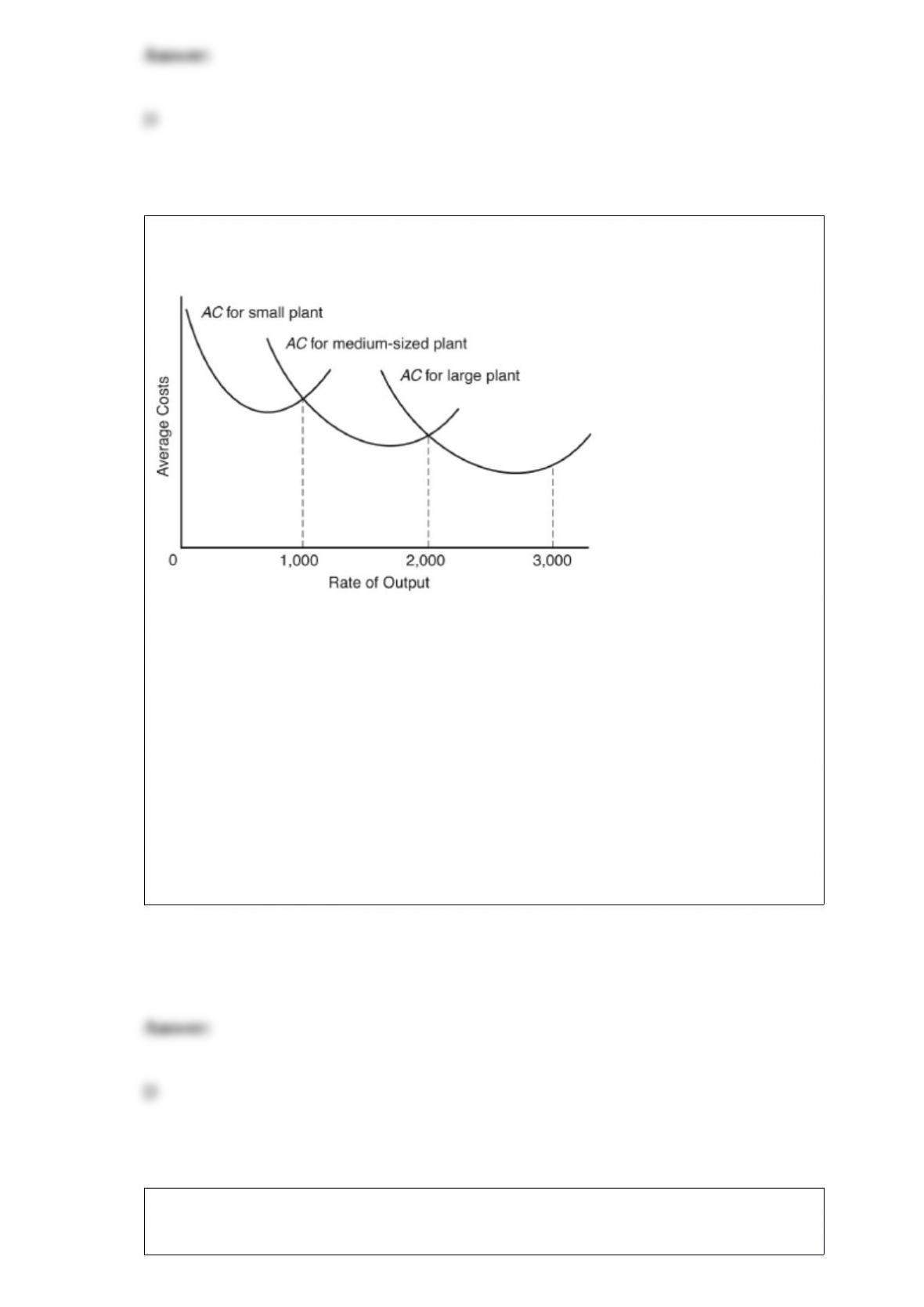
The following questions are based on the following diagram of the average cost curves
for three different-sized plants:
If the firm is still in the planning stages of plant construction, it should choose the
a. small plant if it expects an output rate below 3,000 units per day.
b. large plant regardless of output because it has the lowest per unit costs.
c. medium-sized plant because it would give the firm the most flexibility, allowing it to
produce any output between 0 and 3,000.
d. small plant if it expects an output rate below 1,000 per day.
e. medium-sized plant because it has the advantage of increasing economies of scale.
An excess of government revenues over expenditures

a. is most appropriate during a severe recession.
b. is called a surplus.
c. causes the national debt to grow larger.
d. has been the norm in the U.S. economy since 1980.
e. leads to a decline in national saving.
A basic economic problem encountered when evaluating some of the more recent
environmental initiatives, such as proposals designed to halt global warming or reduce
acid rain, is that
a. economic growth will be increased in the developing countries at the expense of
growth in developed countries.
b. since environmental changes are not affected by human production or consumption,
these policies have no impact on the problem.
c. the cost of these environmental initiatives may exceed the estimated value of the
benefits.
d. since all such proposals are demonstrated to be effective, there is no means to decide
which approach is best.
e. most efforts to control pollution result in the creation of a new form of pollution; for
example, reducing atmospheric pollution increases water pollution.

The strategy used by the cattle ranchers in response to price ceilings imposed on beef
by the Nixon administration was ineffective in the long run because of
a. shifting consumer demands in favor of horsemeat.
b. an unprecedented grain surplus.
c. the limited time in which to market a perishable product.
d. a surprising lack of consumer responsiveness to lower prices.
e. the increasing foreign demand for U.S. beef.
If the long-run response of this industry to a shift in the demand schedule to Demand1 is
to increase supply out to Supply1, then compared to its initial position, a typical firm in
long-run equilibrium
a. makes more profit.
b. reduces its long-run average cost.
c. finds its marginal cost higher.
d. finds its average cost unchanged.
e. finds that the price for its product has risen.

Which of the following best describes the effect of the Trigger Price Mechanisms
(TPM) on the U.S. steel industry?
a. The TPM virtually eradicated foreign competition.
b. It gave the U.S. industry a decided international competitive edge.
c. Although sales of imported steel continued to rise, the TPM gave the U.S. industry a
chance to adjust.
d. As a result of the TPM, U.S. steel producers could no longer compete successfully
against European markets.
e. It ensured that U.S. steel firms could count on a fixed share of the U.S. steel market.
The source of the largest share of research and development funds in the United States
is
a. the federal government.
b. universities and colleges.
c. industry.
d. nonprofit foundations.
e. the stock market.

A firm typically undertakes a project when the
a. firm has enough money to spend on the project.
b. interest rate exceeds the profit rate.
c. interest rates are rising.
d. rate of return exceeds the interest rate at which it can borrow.
e. project’s rate of return is greater than zero.
The Laffer curve
a. shows the relationship between sales taxes and income taxes in the United States.
b. indicates that tax revenues are greatest when marginal tax rates are greatest.
c. relates the size of the government debt to the level of national output.
d. shows an inverse relationship between tax revenues and government spending.
e. has been used to demonstrate that a decline in the marginal tax rate may cause a rise
in total tax revenue.
The following questions are based on the following diagram:
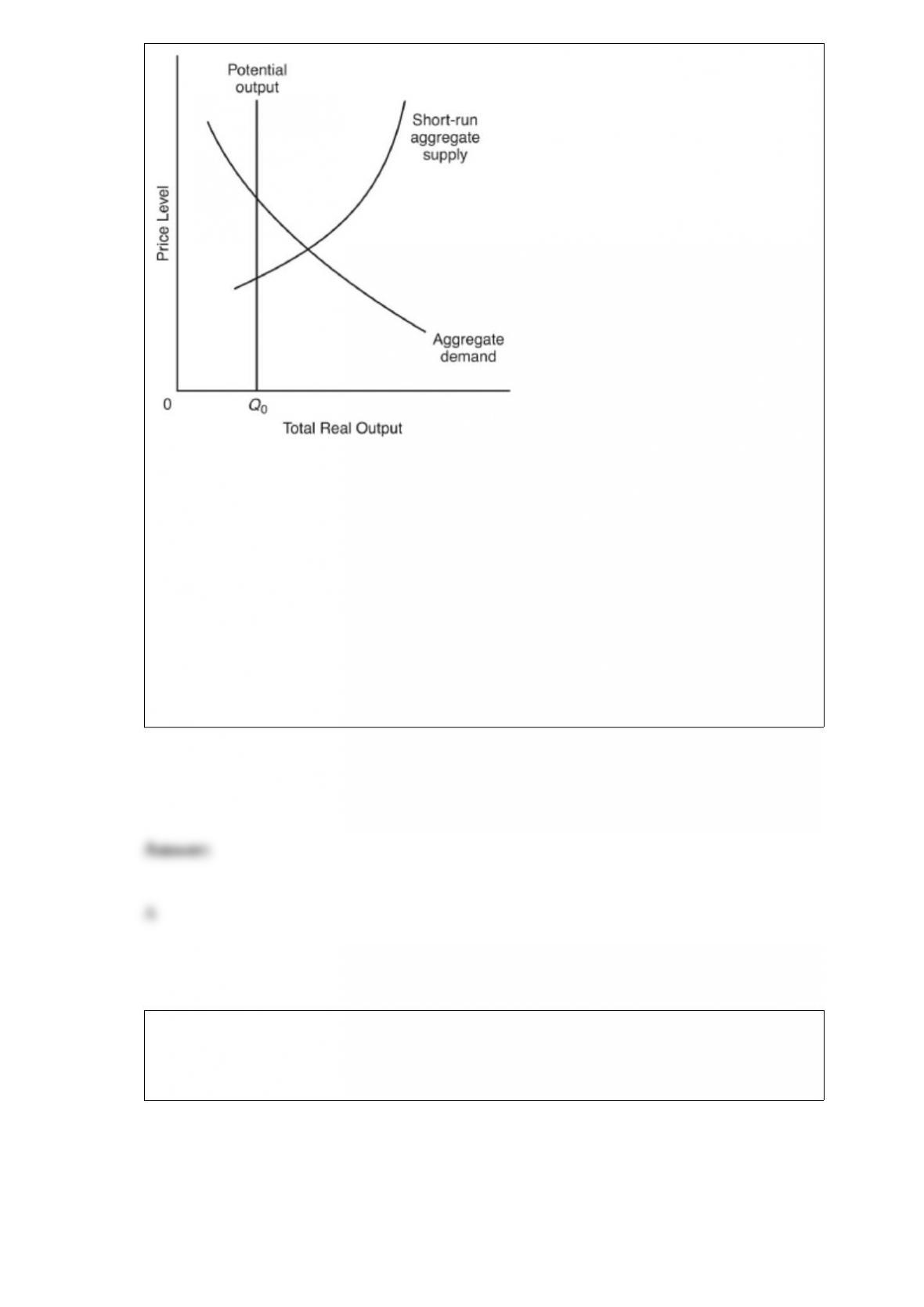
Which of the following events would correct the condition shown?
a. a decrease in private sector spending
b. an increase in the money supply by the government
c. an increase in government spending accompanied by a tax cut
d. a decrease in potential output because of a natural disaster
e. a decrease in the price level through the imposition of wage and price controls
The following questions are based on the following table, which illustrates for a given
level of wheat production the ratio of marginal products for different combinations of
land and labor:
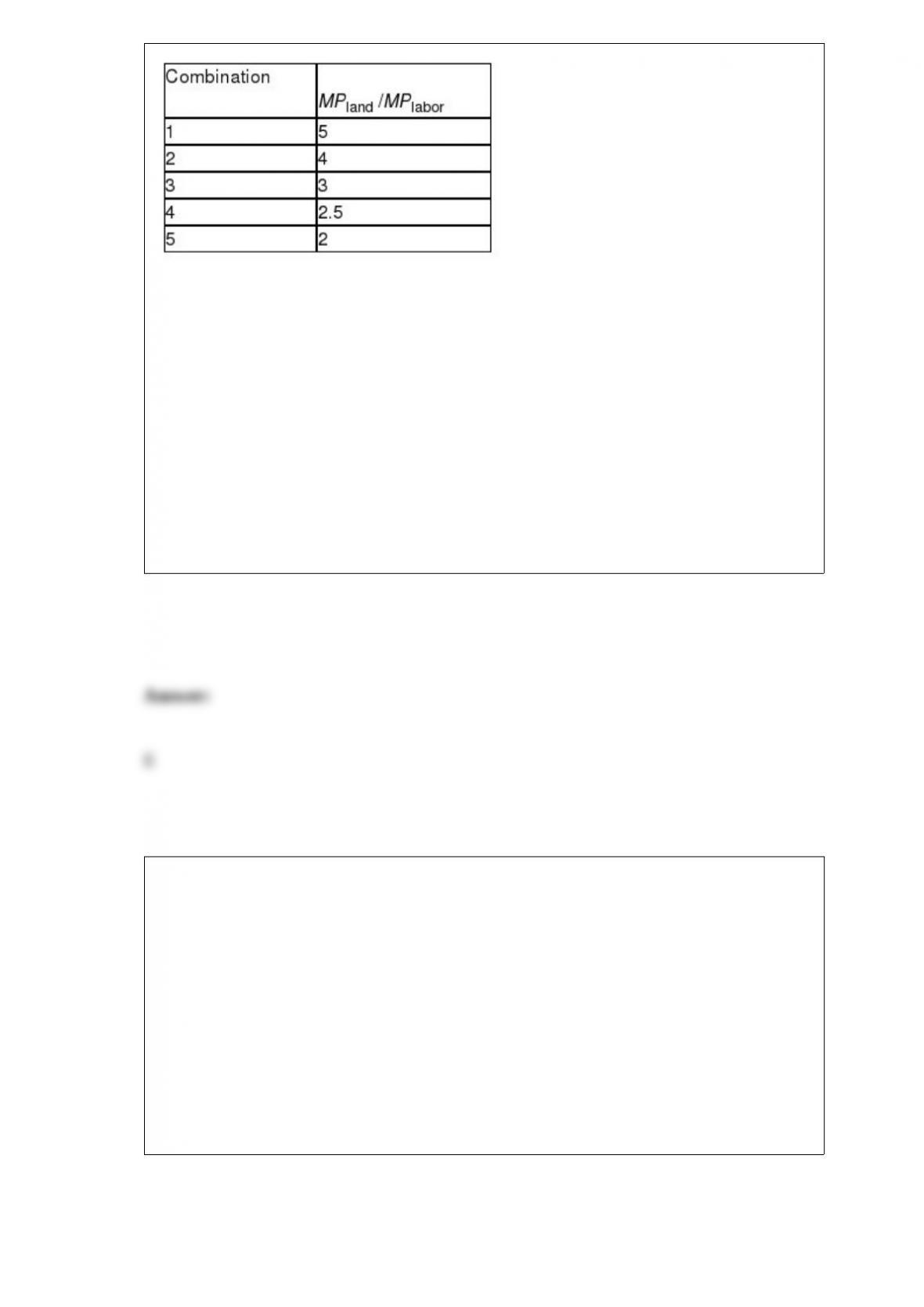
If the price of land falls to $4 per unit and the firm wishes to hold output constant, it
should choose combination
a. 1.
b. 2.
c. 3.
d. 4.
e. 5.
During the summer months, it is not unusual for both the price and the quantity
consumed of gasoline to rise. These conditions reflect a(n)
a. violation of the law of demand.
b. shift to the left of the supply curve.
c. increase in demand.
d. condition of deficient demand.
e. surplus.

One would expect the crude quantity theory of money to best predict the effect of an
increase in the money supply during periods
a. of pronounced recession.
b. when the velocity of the circulation of money is falling.
c. of rapid growth in real output.
d. of high unemployment.
e. of full employment.
Some economists include time or savings deposits in the money supply because
a. these deposits can be readily transformed into cash.
b. these deposits can be used as collateral for loans.
c. the value of time deposits is measured in dollars.
d. there is no difference between the various types of bank deposits.
e. savings and loan institutions have the same status as commercial banks.

Unlike the negative income tax proposal, which was an income transfer proposal,
Social Security is a popular program because it
a. is an insurance system and not an income transfer program.
b. does not require a large bureaucracy to administer.
c. deals with the symptoms rather than the causes of old age.
d. applies to everybody; young workers who pay the taxes to support those currently
receiving payments will someday be elderly and expect to receive the transfers
themselves.
e. provides training for retired individuals who want to work part-time.