
1) given an open economy with high capital mobility and floating exchange rates,
suppose an expansionary fiscal policy is implemented to combat recession. the initial
and secondary effects of the policy
a.cause aggregate demand to increase, thus strengthening the policy’s expansionary
effect on real output
b.cause aggregate demand to decrease, thus eliminating the policy’s expansionary effect
on real output
c.have conflicting effects on aggregate demand, thus weakening the policy’s
expansionary effect on real output
d.have conflicting effects on aggregate demand, thus strengthening the policy’s
expansionary effect on real output
2) in u.s. trade law, which measure permits the levying of restrictions on fairly traded
imports that harm or threaten to harm american manufacturers?
a.antidumping duty
b.countervailing duty
c.national security clause
d.escape clause
3) if the exchange rate between swiss francs and british pounds is 5 francs per pound,
then the number of pounds that can be obtained for 200 francs equals:
a.20 pounds
b.40 pounds
c.60 pounds
d.80 pounds
4) studies have shown that there is an inverse relationship between
a.local competition and regional competition
b.regional competition and global competition
c.level of trade barriers and economic growth
d.level of education and communications infrastructure

5) david hume’s price-adjustment mechanism supported the mercantilist view that a
nation could maintain a trade surplus indefinitely.
a.true
b.false
6) given an open economy with high capital mobility and floating exchange rates,
suppose an expansionary monetary policy is implemented to combat recession. the
initial and secondary effects of the policy have conflicting effects on aggregate demand,
thus weakening the policy’s expansionary effect.
a.true
b.false
7) the strongest political pressure for a trade policy that results in higher protectionism
comes from:
a.domestic workers lobbying for import restrictions
b.domestic workers lobbying for export restrictions
c.domestic consumers lobbying for export restrictions
d.domestic consumers lobbying for import restrictions
8) concerning international dumping, many economists argue that “fair value” should be
based on
a.average variable cost
b.average fixed cost
c.marginal cost
d.total cost
9) domestic content legislation applied to autos would tend to:
a.support wage levels of american autoworkers
b.lower auto prices for american autoworkers
c.encourage american automakers to locate production overseas
d.increase profits of american auto companies
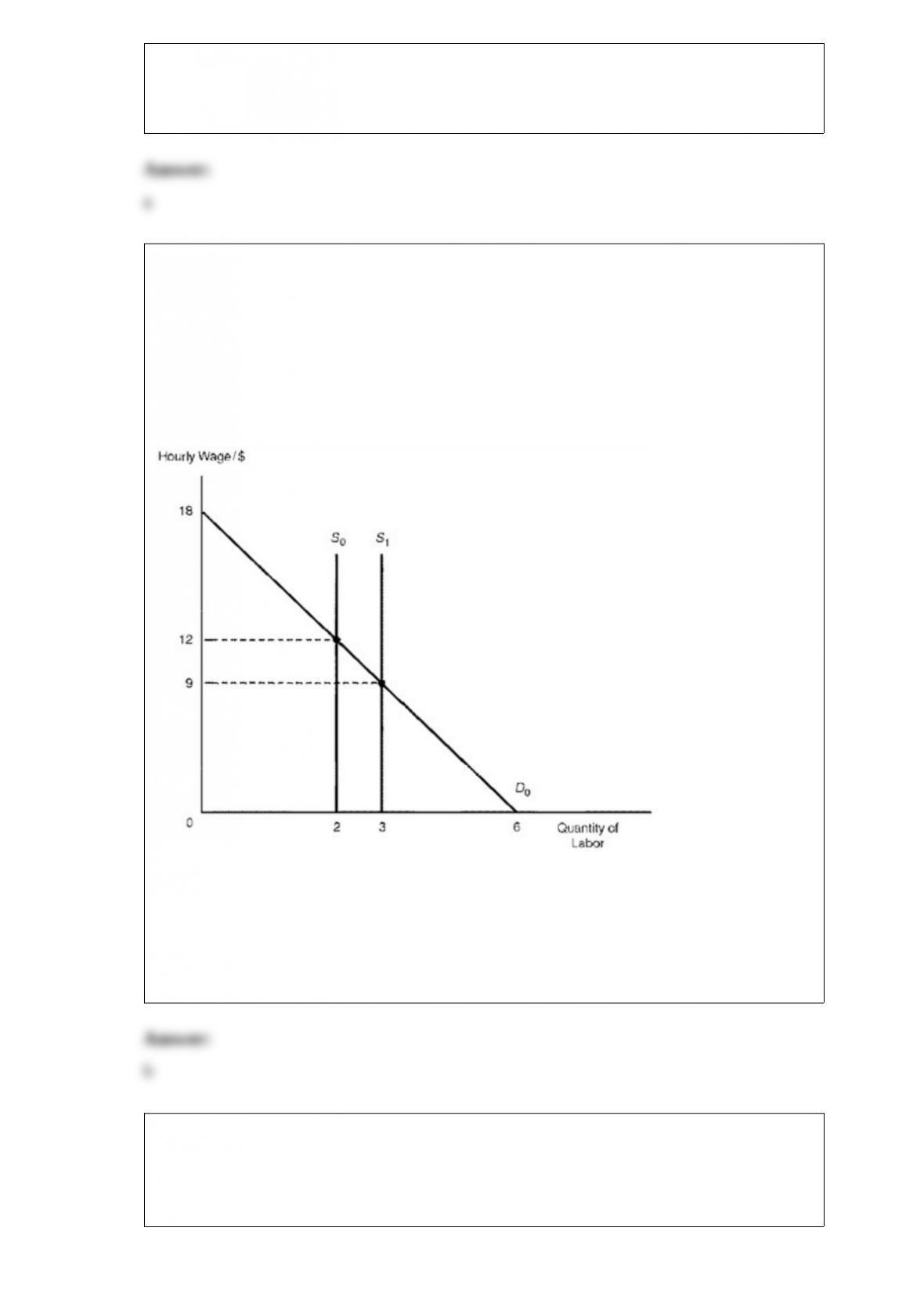
10) figure 9.2 represents the u.s. labor market. assume that labor and capital are the only
factors of production. also assume the initial supply schedule of labor is denoted by s0
and consists entirely of native u.s. workers. the demand schedule of labor is denoted by
d0.
figure 9.2. u.s. labor market
consider figure 9.2. at labor market equilibrium, the payment to u.s. capital owners
equals:
a.$3
b.$6
c.$9
d.$12
11) horizontal integration would occur if general motors sets up a subsidiary in mexico
to produce automobiles identical to those that it produces in the united states.
a.true
b.false

12) multinational corporations often locate manufacturing operations abroad in order to
take advantage of foreign resource endowments or wage scales.
a.true
b.false
13) small countries tend to have higher measures of openness than larger countries
because:
a.their productivity is higher
b.they are more reliant on international trade
c.they are less reliant on international trade
d.they are more diverse
14) suppose that rising u.s. income leads to higher sales and profits in the united states.
this would likely result in:
a.increasing portfolio investment into the united states
b.decreasing portfolio investment into the united states
c.increasing direct investment into the united states
d.decreasing direct investment into the united states
15) concerning industrial policy, the united states has nationalized its major industries
in an attempt to promote global champions.
a.true
b.false