1) Environmentalists generally support price supports because these subsidies motivate
additional farm production.
2) people who work part time, but desire to work full time, are considered to be
officially unemployed.
3) The equilibrium world price of a product equates the quantities of exports supplied
and imports demanded.
4) Between 1990 and 2000, the United States significantly reduced its emissions of
greenhouse gases and effectively eliminated the climate-change problem.
5) purposeful behavior implies that everyone will make identical choices.
6) if real gdp is 50 and nominal gdp is 100, the gdp price index is 200.
7) Inclusive unions restrict the number of jobs directly by shifting the labor supply
curve to the left; exclusive unions restrict the number of jobs by imposing
above-equilibrium wage rates on the employer.
8) If the price of British pounds, measured in terms of U.S. dollars, is rising, then the
price of U.S. dollars, measured in terms of British pounds, is also rising.
9) The marginal cost to a firm of R&D expenditures is the market interest rate the firm
must pay to obtain the needed financing.
10)
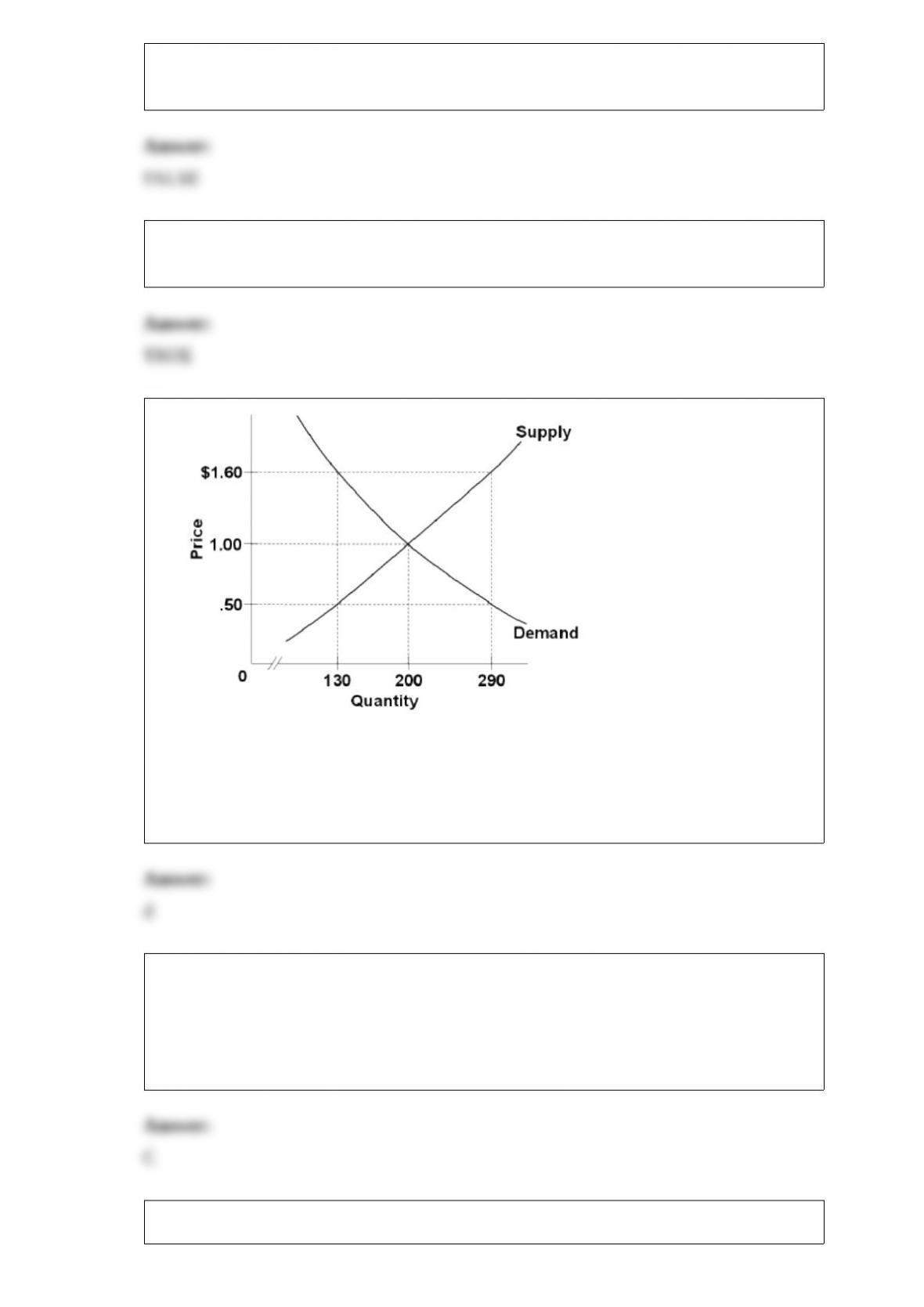
refer to the above diagram. a shortage of 160 units would be encountered if price was:
a.$1.10, that is, $1.60 minus $.50.
b.$1.60.
c.$1.00.
d.$.50.
11) The greater the legal reserve ratio, the:
A.higher is the spending multiplier.
B.lower is the spending multiplier.
C.lower is the monetary multiplier.
D.higher is the monetary multiplier.
12) Answer the next question(s) on the basis of the following table for a particular
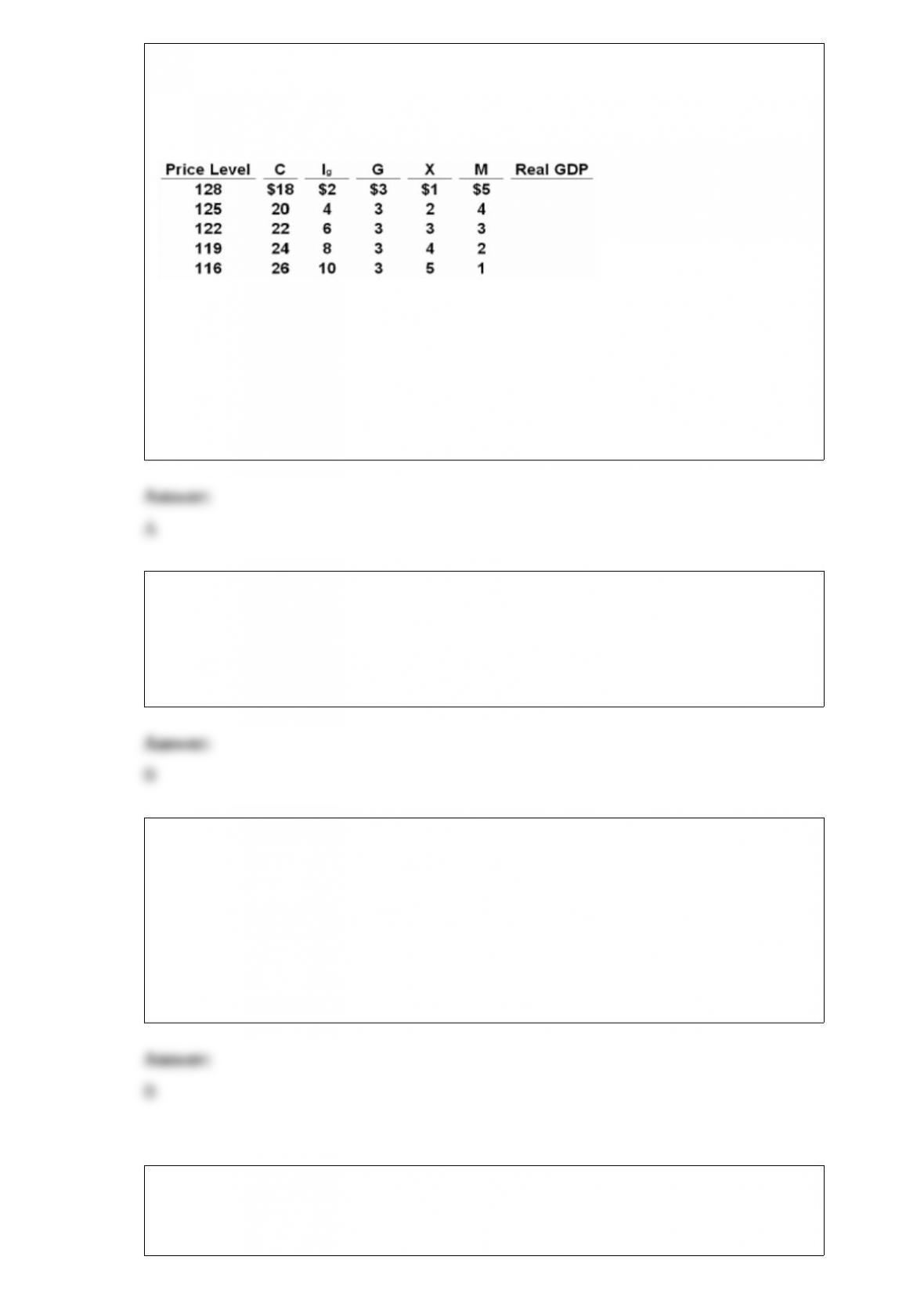
country in which C is consumption expenditures, Ig is gross investment expenditures, G
is government expenditures, X is exports, and M is imports. All figures are in billions of
dollars. Each question is independent of the other questions.
Refer to the above table. If the amounts of GDP supplied at the price levels shown (in
descending order) are $45, $43, $40, $37, and $31, the equilibrium level of real GDP
will be:
A.$37 billion.
B.$35 billion.
C.$26 billion.
D.$43 billion.
13) Other things equal, if the U.S. dollar were to depreciate, the:
A.aggregate demand curve would remain fixed in place.
B.aggregate supply curve would shift to the left.
C.aggregate supply curve would shift to the right.
D.aggregate demand curve would shift to the left.
14) Under the gold standard:
A.nations can protect their domestic price and employment levels from changes in the
volume and direction of world trade.
B.exchange rates are virtually fixed.
C.differences in exports and imports will be precisely balanced by capital account
flows, excluding gold.
D.exchange rates fluctuate freely in response to changes in the supply of, and demand
for, foreign currencies.
15) a market:
a.reflects upsloping demand and downsloping supply curves.
b.entails the exchange of goods, but not services.
c.is an institution that brings together buyers and sellers.
d.always requires face-to-face contact between buyer and seller.
16) An appropriate fiscal policy for a severe recession is:
A.a decrease in government spending.
B.a decrease in tax rates.
C.appreciation of the dollar.
D.an increase in interest rates.
17) (Last Word) The dispute over the pay of chief executive officers (CEOs) of U.S.
corporations hinges on whether or not such pay:
A.should be granted for past performance or for current performance.
B.is determined in a competitive labor market or in a monopsonistic labor market.
C.is justified on productivity grounds or mainly reflects an overestimation of CEO
importance by corporate boards of directors.
D.should contain performance incentives such as stock options, stock shares, or
bonuses.
18) Other things equal, the multiplier effect associated with a change in government
spending is:
A.the same as that associated with a change in taxes.
B.equal to that associated with a change in investment or consumption.
C.less than that associated with a change in investment.
D.greater than that associated with a change in investment.
19) if a legal ceiling price is set above the equilibrium price:
a.a shortage of the product will occur.
b.a surplus of the product will occur.
c.a black market will evolve.
d.neither the equilibrium price nor equilibrium quantity will be affected.
20) Reserves borrowed at the Federal funds rate are usually repaid:
A.in one year.
B.in five years.
C.at the end of the month.
D.the next day.
21) illegal immigration positively contributes to the u.s. standard of living by reducing:
a.the fiscal burdens of state and local governments.
b.the average wages of domestic-born workers.
c.crime rates.
d.prices of goods and services produced with illegal immigrant labor.
22) other things equal, which of the following would decrease the rate of economic
growth, as measured by changes in real gdp?
a.an increase in the educational attainment of the labor force
b.a permanent decrease in frictional unemployment
c.an increase in the amount of capital per worker
d.a decrease in the labor force participation rate
23) A reserve requirement of 20 percent means a bank must have $1,000 of reserves if
its checkable deposits are:
A.$100.
B.$1,000.
C.$5,000.
D.$12,000.
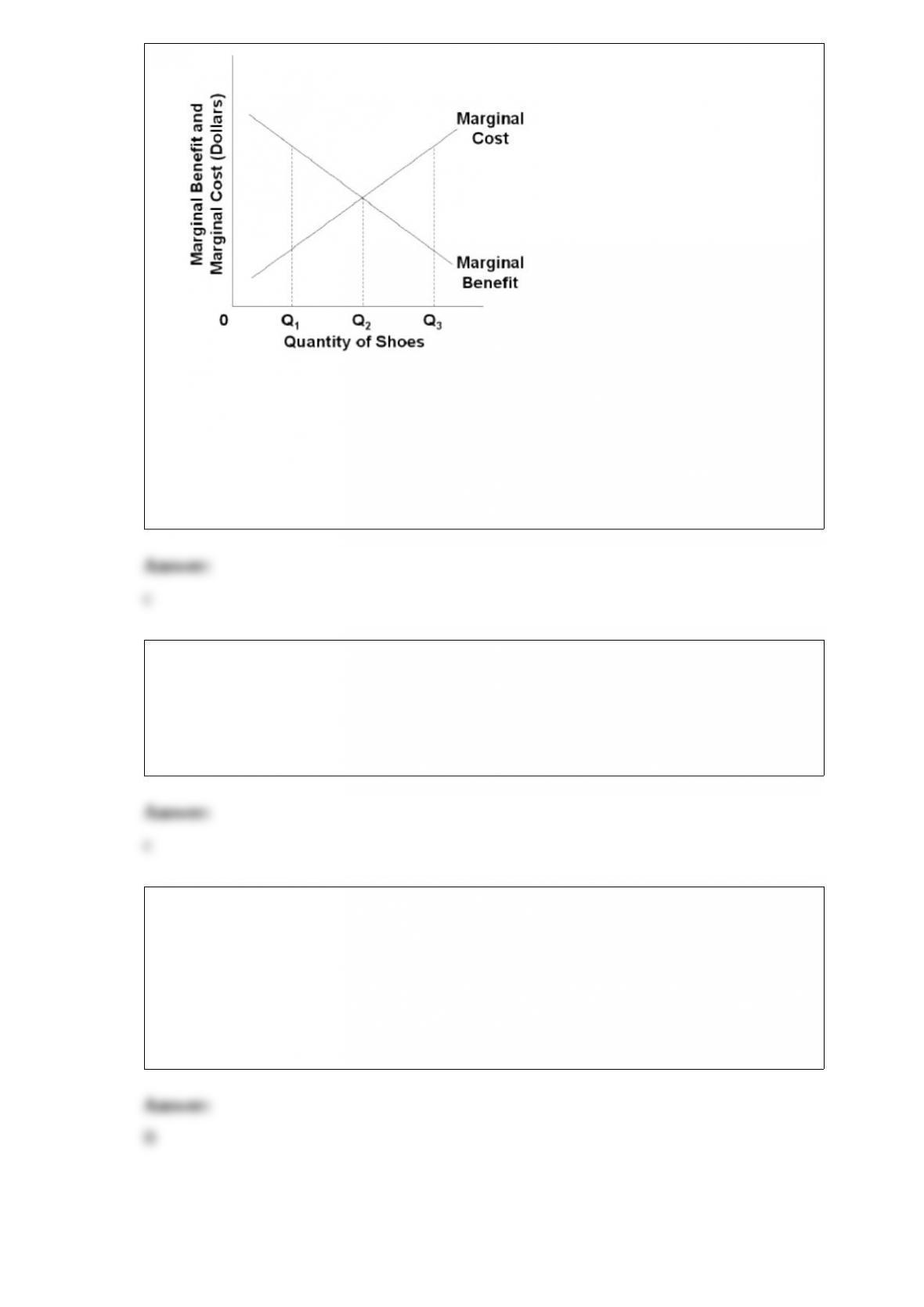
24)
refer to the above diagram for athletic shoes. if the current output of shoes is q3, then:
a.resources are being allocated efficiently to the production of shoes.
b.society would consider additional units of shoes to be more valuable than alternative
products.
c.society would consider additional units of shoes to be less valuable than alternative
products.
d.society would experience a net gain by producing more shoes.
25) the slope of a line parallel to the vertical axis is:
a.zero.
b.one.
c.infinite.
d.one-half.
26) Assume that a bank initially has no excess reserves. If it receives $5,000 in cash
from a depositor and the bank finds that it can safely lend out $4,500, the reserve
requirement must be:
A.zero.
B.10 percent.
C.20 percent.
D.25 percent.
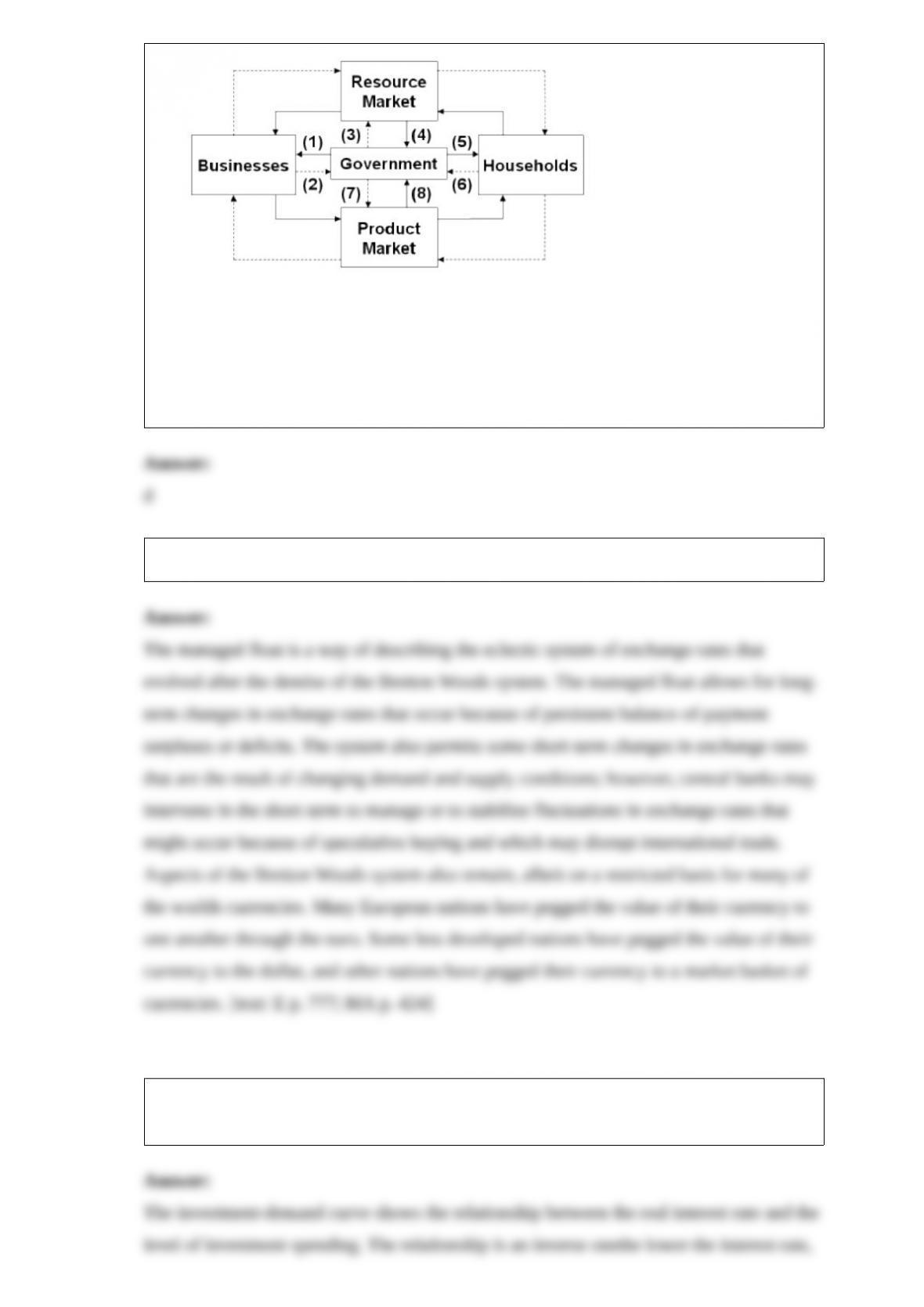
27)
refer to the above diagram, in which solid arrows reflect real flows; broken arrows are
monetary flows. flow (7) might represent:
a.a transfer payment to disabled persons.
b.wage payments to public school teachers.
c.subsidies to corporations to stimulate exports.
d.the u.s. bureau of engraving and printing’s expenditures for paper.
28) What is the managed float?
29) What is the difference between the investment-demand curve and the investment
schedule for the economy?
30) Does it hold that ethical investing increases returns?
31) Describe how changes in tastes affect the value of a nations currency.
32) Identify the two major ways economic growth is measured.
33) Explain what happens in the extended aggregate demand and aggregate supply
model when there is a recession.