1) assume a pure monopolist is currently operating at a price-quantity combination on
the inelastic segment of its demand curve. if the monopolist is seeking maximum
profits, it should:
a.retain its current price-quantity combination.
b.increase both price and quantity sold.
c.charge a lower price.
d.charge a higher price.
2) if a firm doubles its output in the long run and its unit costs of production decline, we
can conclude that:
a.technological progress has occurred.
b.economies of scale are being realized.
c.the firm is encountering diminishing returns.
d.diseconomies of scale are being encountered.
3) If a firm faces an upsloping labor supply curve (and there is no union or minimum
wage), its:
A.MRC curve is also upsloping.
B.MRC curve is perfectly elastic.
C.MRP curve is perfectly inelastic.
D.MRP curve is also uploping.
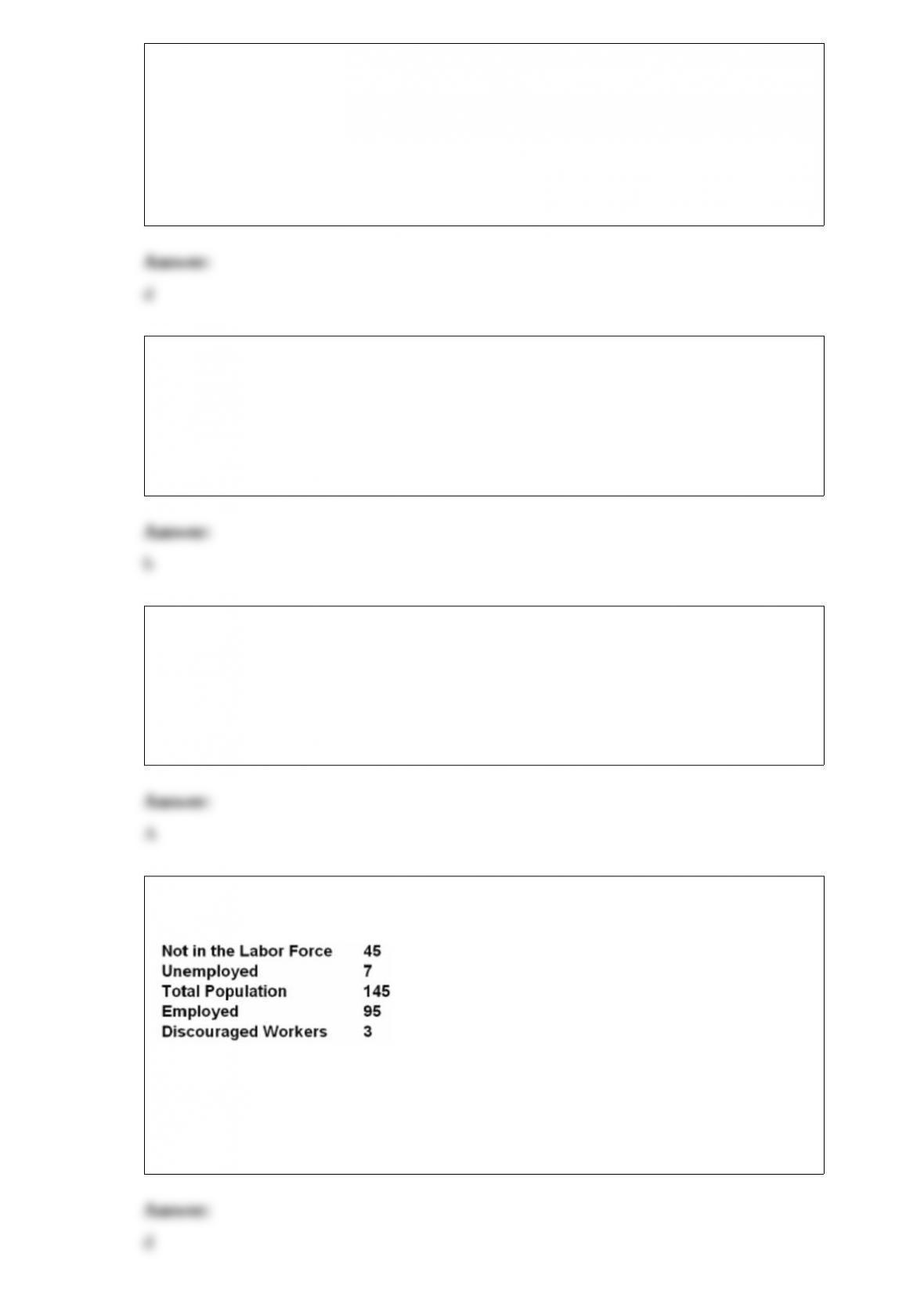
4) answer the next question(s) on the basis of the following information about the
hypothetical economy of scoob. all figures are in millions.
refer to the above information. the unemployment rate in scoob is:
a.2.5 percent.
b.3.2 percent.
c.5.0 percent.
d.6.9 percent.
5) we would expect the cross elasticity of demand between dress shirts and ties to be:
a.positive, indicating normal goods.
b.positive, indicating complementary goods.
c.negative, indicating substitute goods.
d.negative, indicating complementary goods.
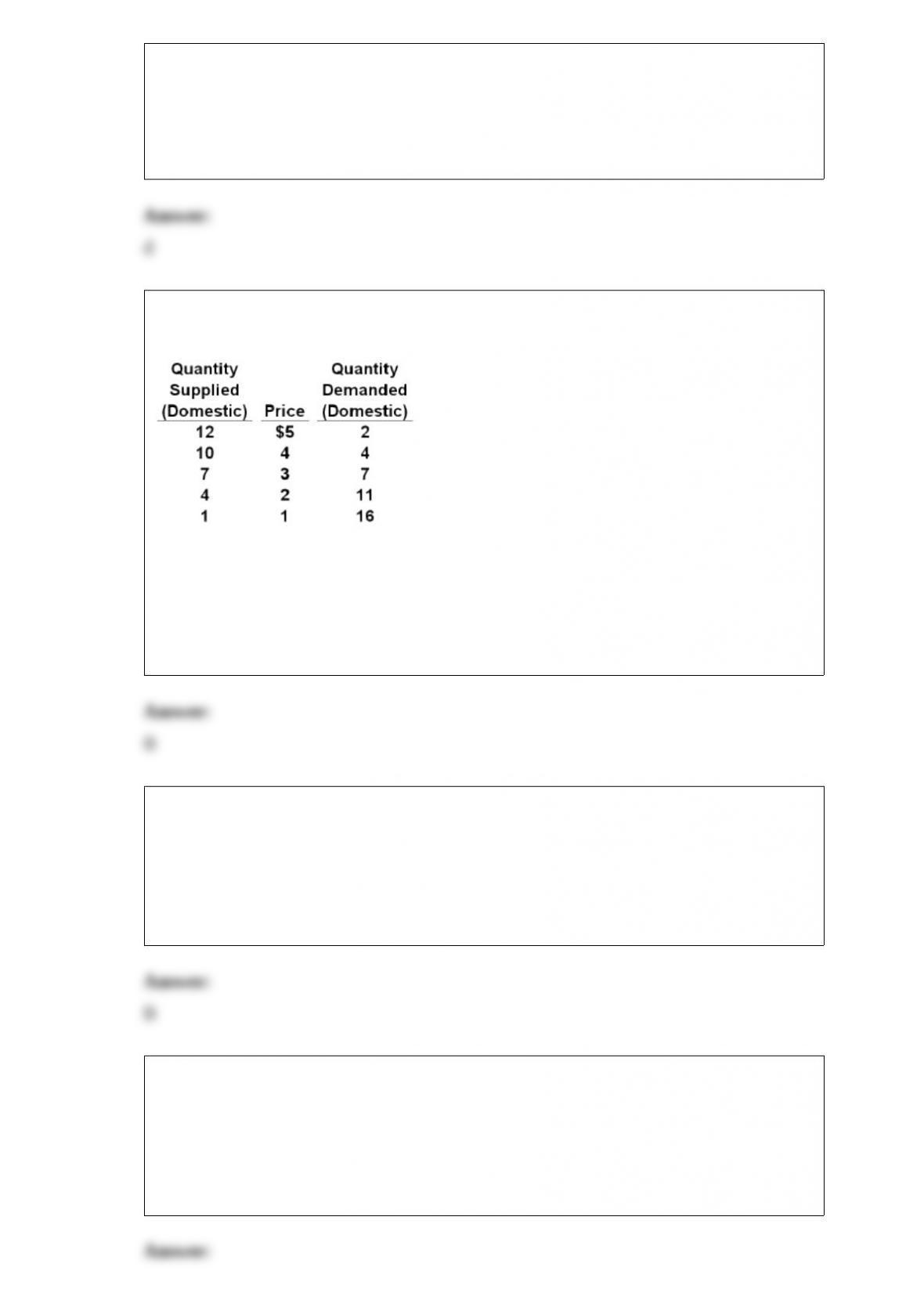
6) The following domestic supply and demand schedules for a product. Suppose that the
world price of the product is $1.
Refer to the above data. If the economy was opened to free trade and the world price of
$1 prevailed, the price and quantity sold of this product would be:
A.$1 and 1 unit.
B.$1 and 16 units.
C.$3 and 7 units.
D.$2 and 11 units.
7) Empirical studies suggest that, other things equal, the smaller the number of hospitals
in a city, the lower are nurses’ wages. This is evidence that:
A.the labor markets of nurses are purely competitive.
B.hospitals may possess some degree of monopsony power.
C.the minimum wage does not apply to nurses.
D.labor unions have been ineffective in increasing the wages of nurses.
8) income data that show the percentage of total income received by each fifth of all
households describe the:
a.functional distribution of income.
b.horizontal distribution of income.
c.personal distribution of income.
d.vertical distribution of income.
9) The public debt is held as:
A.U.S. securities, corporate bonds, and common stock.
B.Federal Reserve Notes.
C.U.S. gold certificates.
D.Treasury bills, Treasury notes, Treasury bonds, and U.S. savings bonds.
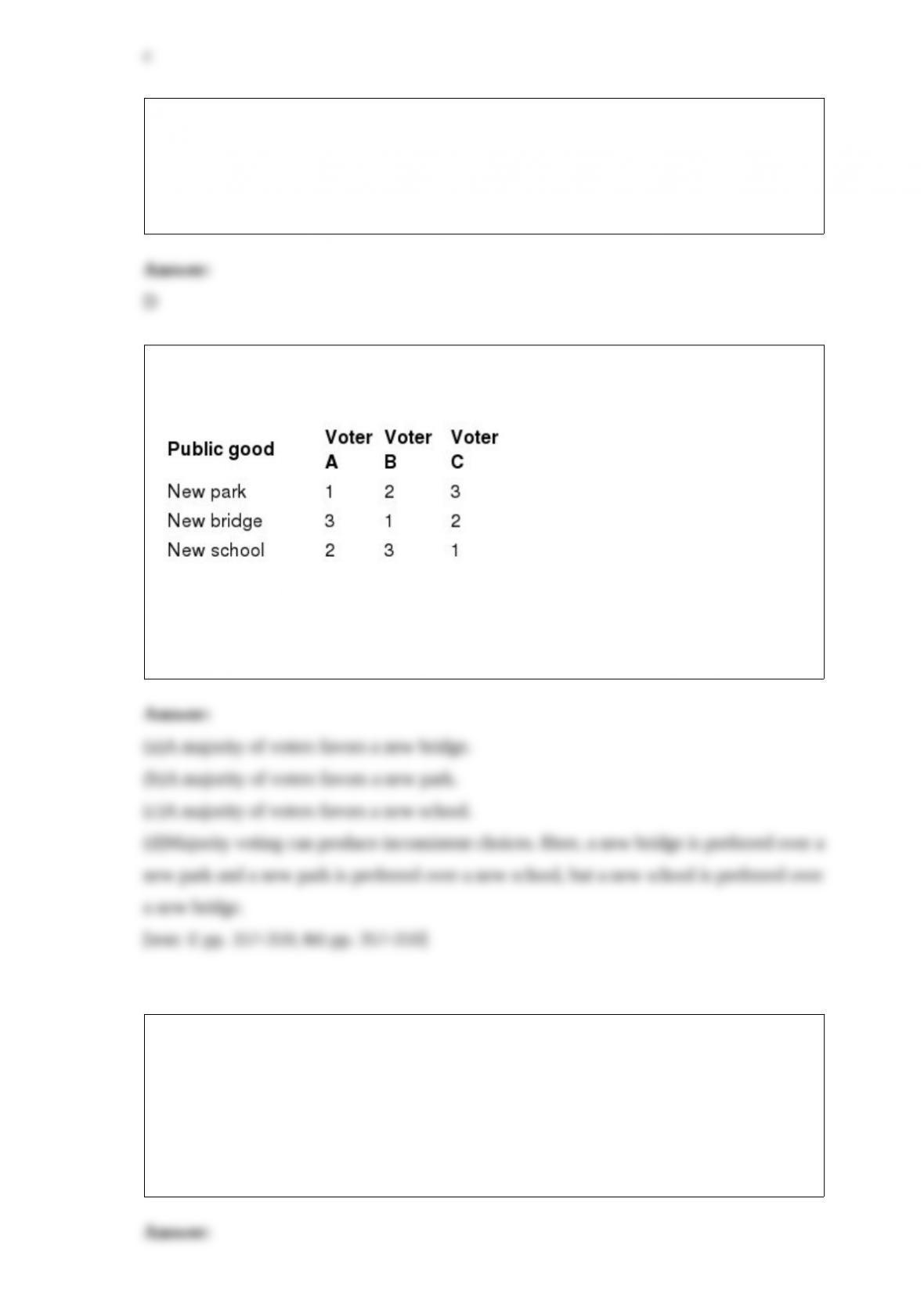
10) Answer the next four questions on the basis of the following table which shows the
rankings of the public goods by three voters: A, B, and C.
(a)What will be the choice between a new park and a new bridge?
(b)What will be the choice between a new school and a new park?
(c)What will be the choice between a new bridge and a new school?
(d)What do the rankings in the table indicate about choices made under majority rule?
11) (Advanced analysis) Assume the consumption schedule for a private closed
economy is C = 40 + 0.75Y, where C is consumption and Y is gross domestic product.
The multiplier for this economy is:
A.3.
B.4.
C.5.
D.10.
12) the equilibrium price and quantity in a market usually produces allocative efficiency
because:
a.all consumers who want the good are satisfied.
b.marginal benefit and marginal cost are equal at that point.
c.equilibrium insures an equitable distribution of output.
d.the excess of goods produced at equilibrium guarantees that all will have enough.
13) In a mixed closed economy:
A.government purchases and saving are injections, while investment and taxes are
leakages.
B.taxes and government purchases are leakages, while investment and saving are
injections.
C.taxes and savings are leakages, while investment and government purchases are
injections.
D.taxes and investment are injections, while saving and government purchases are
leakages.
14) As monetarists view the equation of exchange:
A.V changes erratically and unpredictably.
B.V is quite stable.
C.V usually changes in the same direction of any given change in M.
D.V usually changes in the opposite direction of any given change in M.
15) the government agency responsible for collecting and reporting unemployment data
is the:
a.bureau of labor statistics.
b.bureau of unemployment.
c.bureau of economic analysis.
d.bureau of economic research.
16) if the production and consumption of a good cause both positive and negative
externalities:
a.the equilibrium output will be the optimal allocation of resources to its production.
b.resources will necessarily be underallocated to its production.
c.resources will necessarily be overallocated to its production.
d.resources may be either underallocated or overallocated to its production.
17) The following information about the cost ratios for two products-fish (F) and
chicken (C)-in countries Singsong and Harmony. Assume that production occurs under
conditions of constant costs and these are the only two nations in the world.
Singsong: 1F = 2C
Harmony: 1F = 4C
Refer to the above information. Which one of the following would not be feasible terms
for trade between Singsong and Harmony?
A.1 fish for 2 chicken
B.1 fish for 3 chicken
C.1 chicken for 1/5 of a fish
D.1 chicken for 1/3 of a fish
18) If a good that generates positive externalities were produced and priced to take into
account these spillover benefits, then its:
A.price and output would increase.
B.output would increase but price would remain constant.
C.price would increase and output would decrease.
D.price would increase but output would remain constant.
19) How does simultaneous consumption affect economies of scale?
20) How are changes in one currency mirrored in changes in some other foreign
currency?
21) Describe how changes in the Feds major policy tool leads to expansionary and
restrictive monetary policies.
22) (Consider This) What is the ratchet effect? How does it apply to price level changes
in the economy as aggregate demand changes?
23) The benefits of unimpeded immigration exceed the costs. Do you agree?
24) Describe cost-push inflation and its major source.
25) What are the three different union strategies pursued to increase wages?