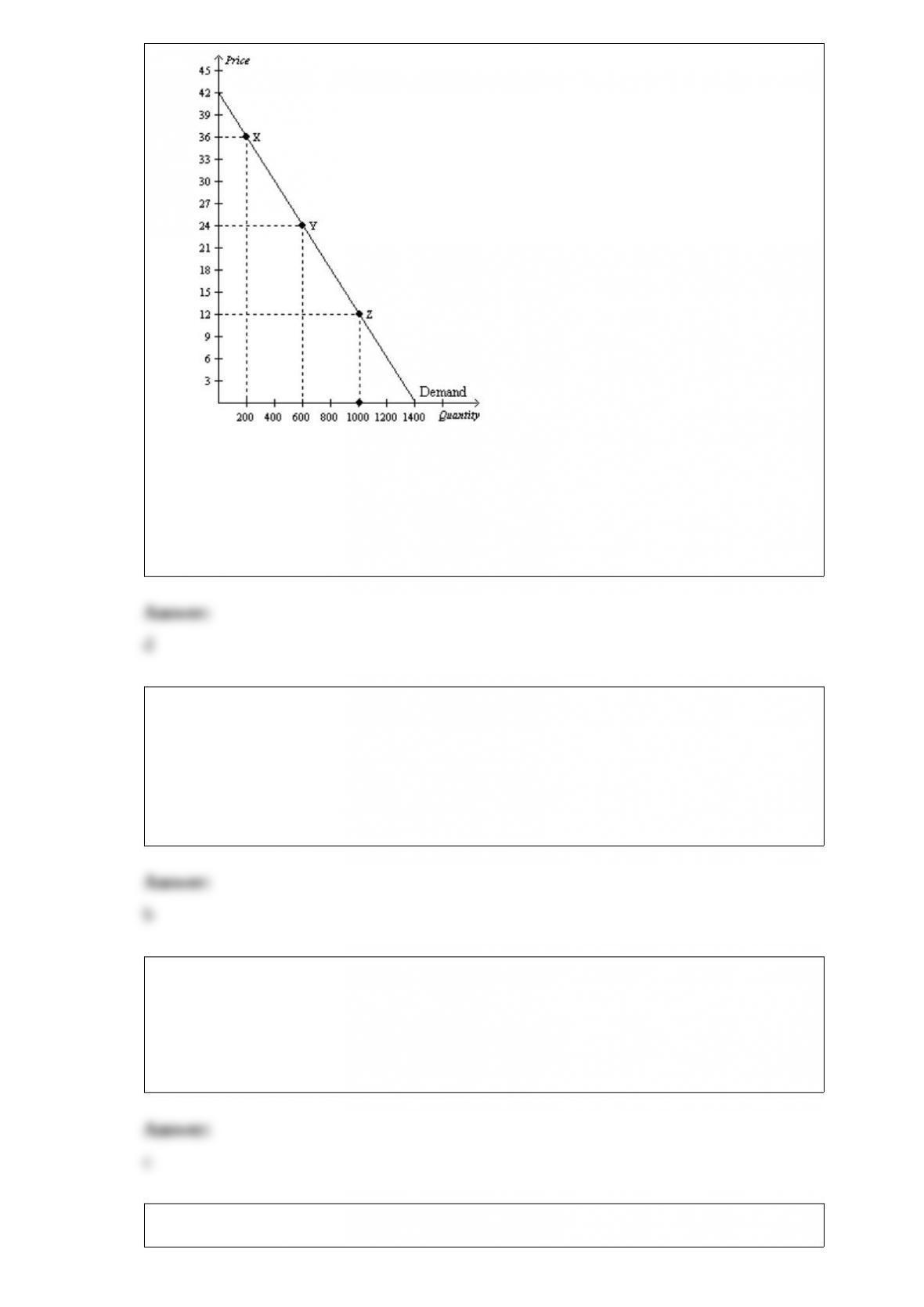
1)
Using the midpoint method, the between point X and point Y is
a. 0.4
b.1
c.2
d.2.5
2) Economists think that the best way to determine the value of a human life is to
a.evaluate the value of a person’s expected earnings in the labor market.
b.evaluate the risks people are willing to take and what they would have to be paid to
take them.
c.determine a person’s accumulated wealth at the time of death.
d.do nothing; human life is priceless.
3) Markets fail to allocate resources efficiently when
a.demanders and suppliers cannot agree on a price.
b.goods are rival in consumption and excludable.
c.property rights are not well established.
d.too many buyers and sellers exist in the same market.
4)
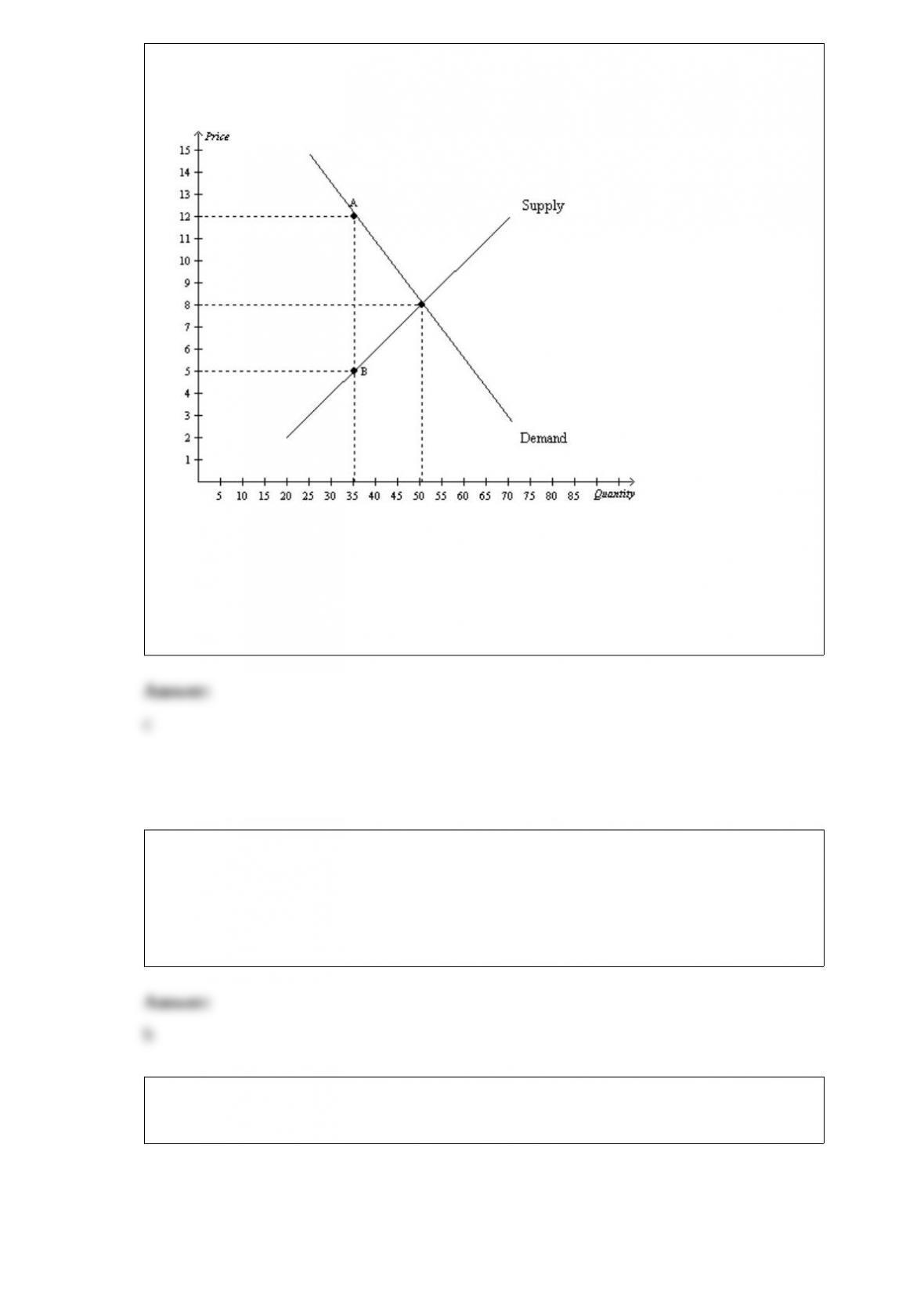
Figure 8-4
The vertical distance between points A and B represents a tax in the market.
The amount of
deadweight loss as a result of the tax is
a. $35.00.
b. $45.25.
c. $52.50.
d. $105.00.
5) Economists assume that monopolists behave as
a.cost minimizers.
b.profit maximizers.
c.price maximizers.
d.maximizers of social welfare.
6) Hosne’s Production Possibilities FrontierMerve’s Production Possibilities
Frontier
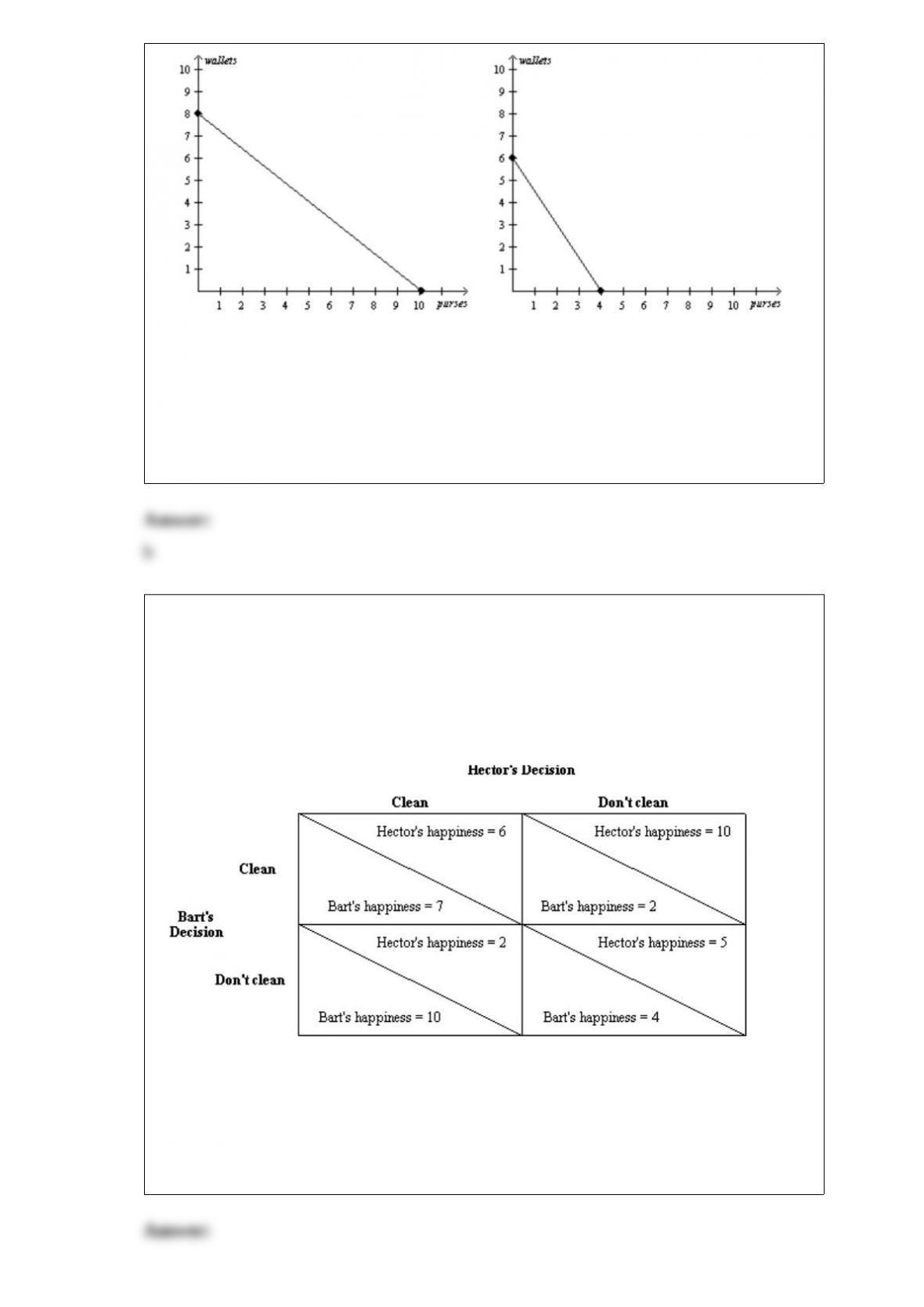
If Hosne and Merve each divides her time equally between making purses and making
wallets, then total production is
a.4 purses and 8 wallets.
b.7 purses and 7 wallets.
c.10 purses and 6 wallets.
d.14 purses and 14 wallets.
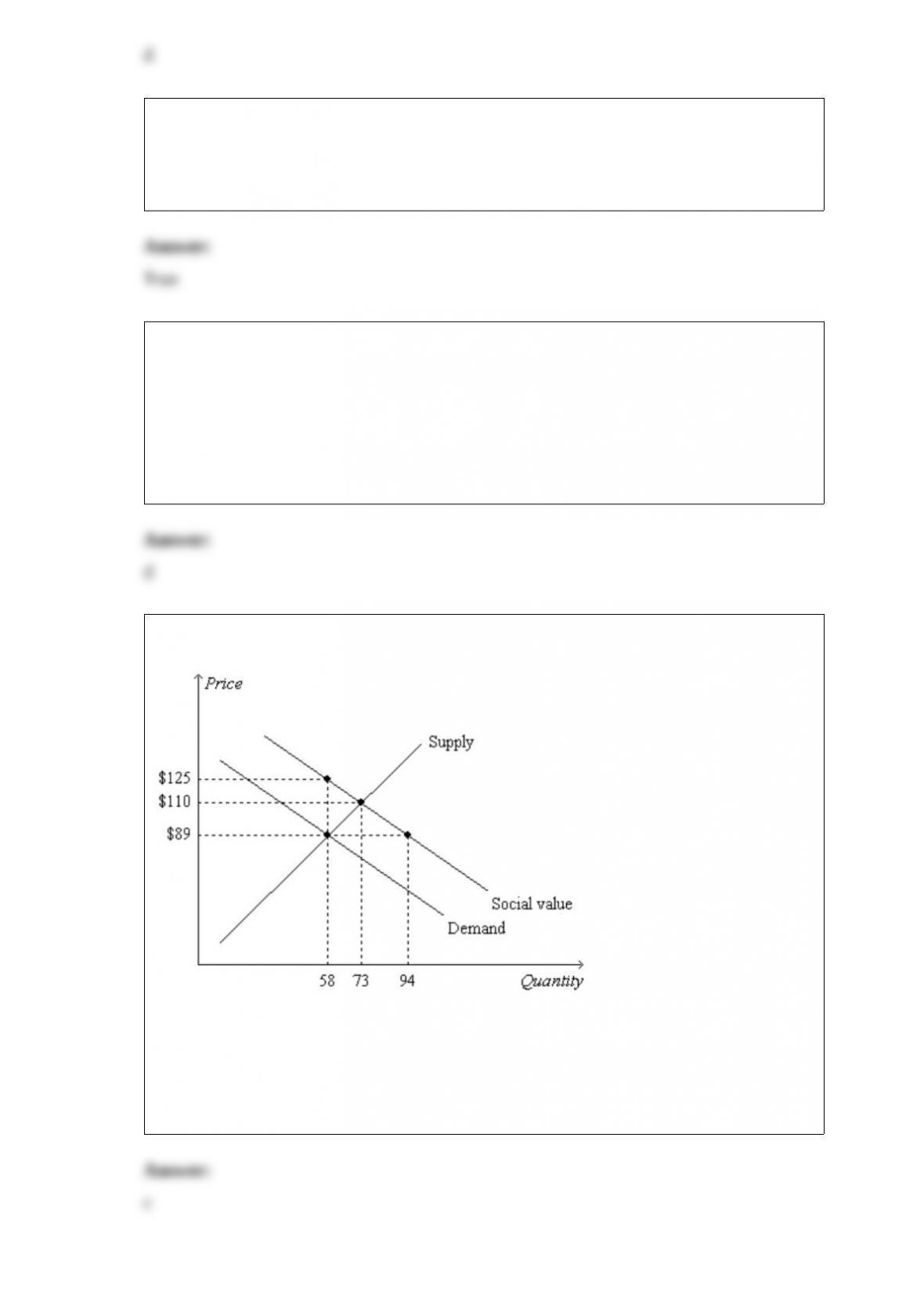
7) Figure 17-3. Hector and Bart are roommates. On a particular day, their apartment
needs to be cleaned. Each person has to decide whether to take part in cleaning. At the
end of the day, either the apartment will be completely clean (if one or both roommates
take part in cleaning), or it will remain dirty (if neither roommate cleans). With
happiness measured on a scale of 1 (very unhappy) to 10 (very happy), the possible
outcomes are as follows:
Refer to Figure 17-3. If this game is played only once, then the most likely outcome is
that
a.Hector and Bart both clean.
b.Hector cleans and Bart does not clean.
c.Bart cleans and Hector does not clean.
d.neither Hector nor Bart cleans.
8) The slope of the budget constraint reveals the relative price of good X compared to
good Y.
a.True
b.False
9) On average, electricians who work on dangerous high-voltage power lines earn more
per hour than similarly skilled electricians who don’t work on dangerous high-voltage
power lines. The difference in pay is attributed to
a.the marginal product of labor.
b.the marginal product of capital.
c.diminishing marginal returns.
d.a compensating differential.
10) Figure 10-19
Which of the following quantities decreases as the quantity of the good is increased?
a.the private cost of the good
b.the social cost of the good
c.the private value of the good
d.the external benefit of the good
11) Which parable describes the problem of wild animals that are hunted to the point of
extinction?
a.Coase theorem
b.The Tragedy of the Commons
c.The Wise Woman
d.The Tortoise and the Hare
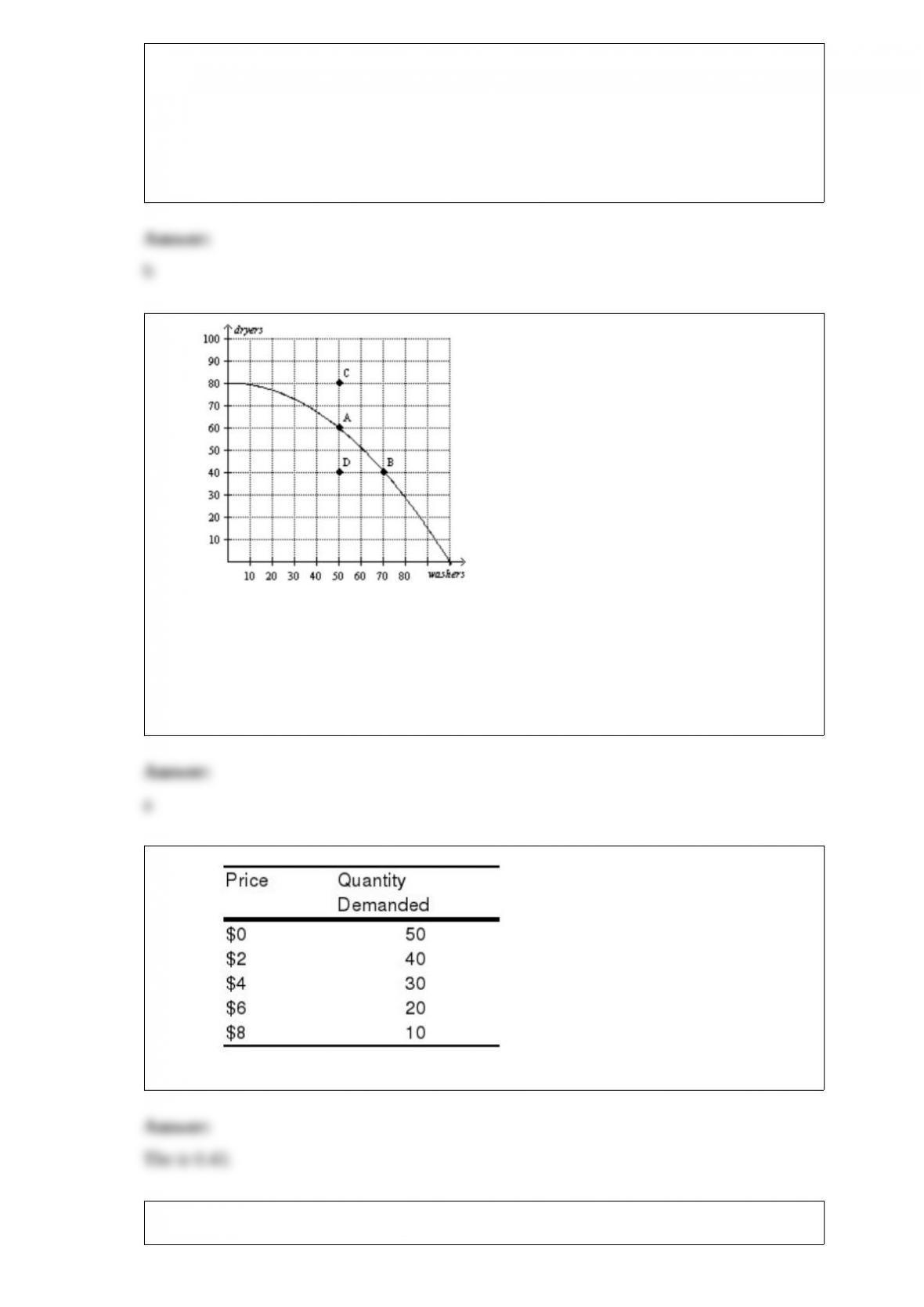
12)
The opportunity cost of this economy moving from point A to point B is
a.20 dryers.
b.20 washers.
c.20 dryers and 20 washers.
d.60 dryers.
13) Using the midpoint method, what is the between $2 and $4?
14) Scenario 13-21
Suppose that a small family farm sold its output for $100,000 in a given year. The
family spent $25,000 on fuel, $40,000 on seed, fertilizer, and pesticides, and $25,000 on
equipment, including maintenance. The family members could have earned $20,000
working at other occupations.
What is the economic profit for the family farm?
15) Which potentially anti-competitive business practice is often justified on the
grounds that it corrects for the free rider problem?
16) One solution to the problems of marginal-cost pricing of a regulated natural
monopolist is average cost pricing. In this model, the monopolist is allowed to price its
production at average total cost. How does average-cost pricing differ from
marginal-cost pricing? Does this solution maximize social well-being?
17) Suppose the government used the following formula to compute a family’s tax
liability:
Taxes owed = 28% of income – $8,000. How much would a family that earned $75,000
owe?