
The utilities commission in a city is currently examining pay telephone service in the
city. The commission has been asked to evaluate a proposal by a city council member to
place a $0.10 price ceiling on local pay phone service. The staff economist at the
utilities commission estimates the demand and supply curves for pay telephone service
as follows:
QD = 1600 – 2400P
QS = 200 + 3200P,
where P = price of a pay telephone call, and Q = number of pay telephone calls per
month.
a. Determine the equilibrium price and quantity that will prevail without the price
ceiling.
b. Analyze the quantity that will be available with the price ceiling (in the long-run).
c. The city council realizes that the telephone company could curtail pay phone service
in response to the ceiling. To prevent this, the council plans to impose a requirement
that the telephone company must maintain the current number of pay phones. In light of
this additional restriction, what will be the likely impact of the price ceiling?
Fine-dining restaurants commonly provide statements in their menus such as, “A 20%
gratuity will be added to all checks for parties of six or more patrons.” Given that this
statement tends to raise the level of tips or gratuities left by other groups of diners, the
statement is a good example of:
A) the endowment effect.
B) loss aversion.
C) anchoring.
D) none of the above
Suppose the federal government allows labor unions to act as the sole seller in labor
markets, but the government collects a $1 per hour fee to cover unemployment
insurance for each union worker. Assuming this fee is not so large that it forces the
unions to disband, what is the impact of this fee on the equilibrium wage and
employment level in the monopolized labor market?
A) After-tax wages and employment decline.
B) After-tax wages increase and employment declines.
C) Employment increases and after-tax wages decline.
D) No change in after-tax wages or employment levels.
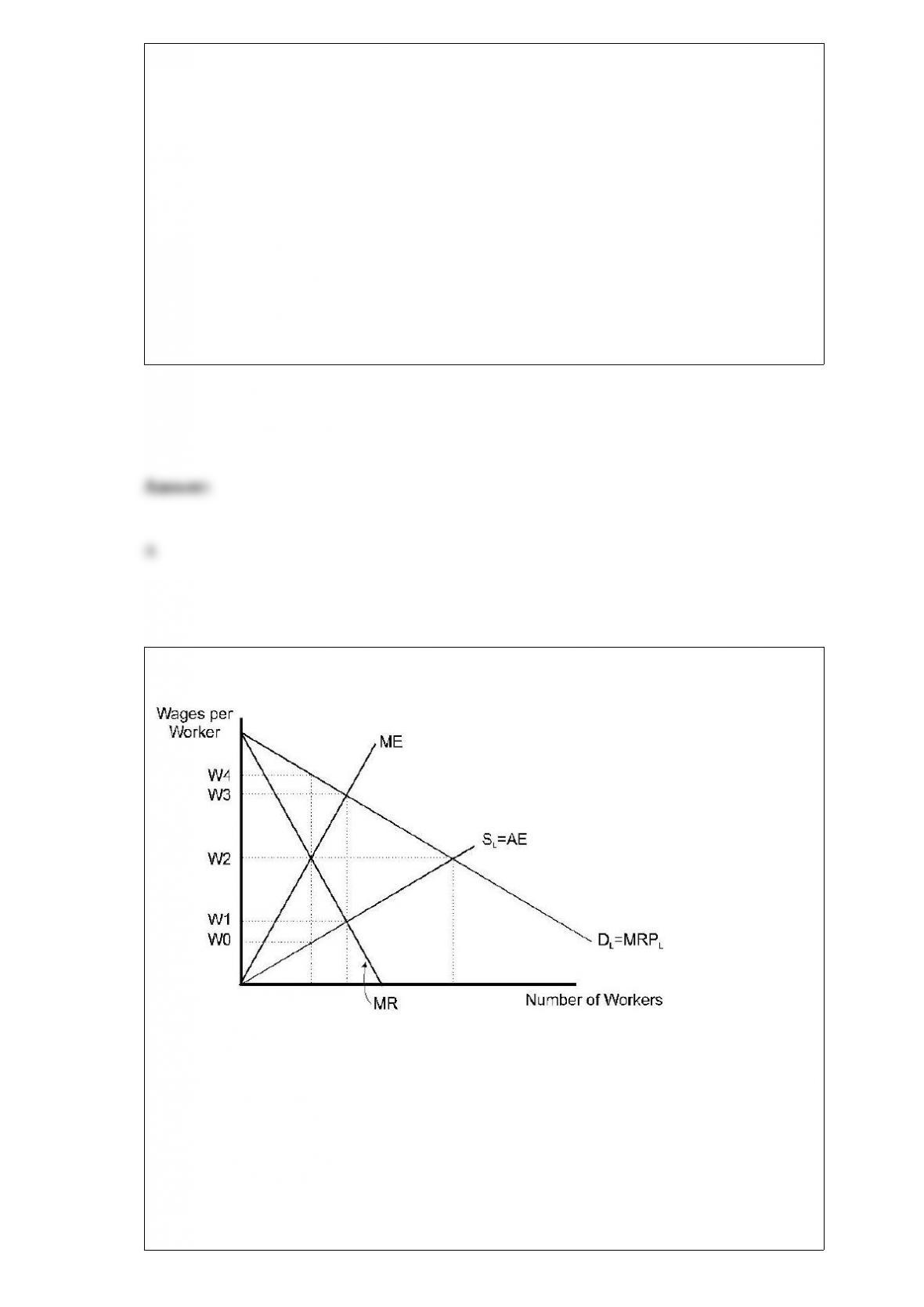
Figure 14.4
Given the information in Figure 14.4, the competitive wage rate is:
A) W1.
B) W2.
C) W3.

D) W4.
E) none of the above
You interview with an athletic footwear manufacturer that has annual advertising
expenditures of $32 million and total sales revenue of $100 million, and the firm selects
the profit maximizing level of advertising expenditures. If the advertising elasticity of
demand is 4, then you know that “Rule of Thumb for Advertising” implies that the
demand for the firm’s products is:
A) inelastic.
B) unit elastic.
C) elastic.
D) zero.
Why do workers tend to choose low effort levels when they are compensated with fixed
wage payments?
A) Workers ignore the cost of effort
B) The net compensation after deducting the cost of effort is always higher when the
worker provides low effort.
C) Workers care more about the stability of income than the level of income.
D) Workers tend to be risk averse and tend to choose low-intensity alternatives.
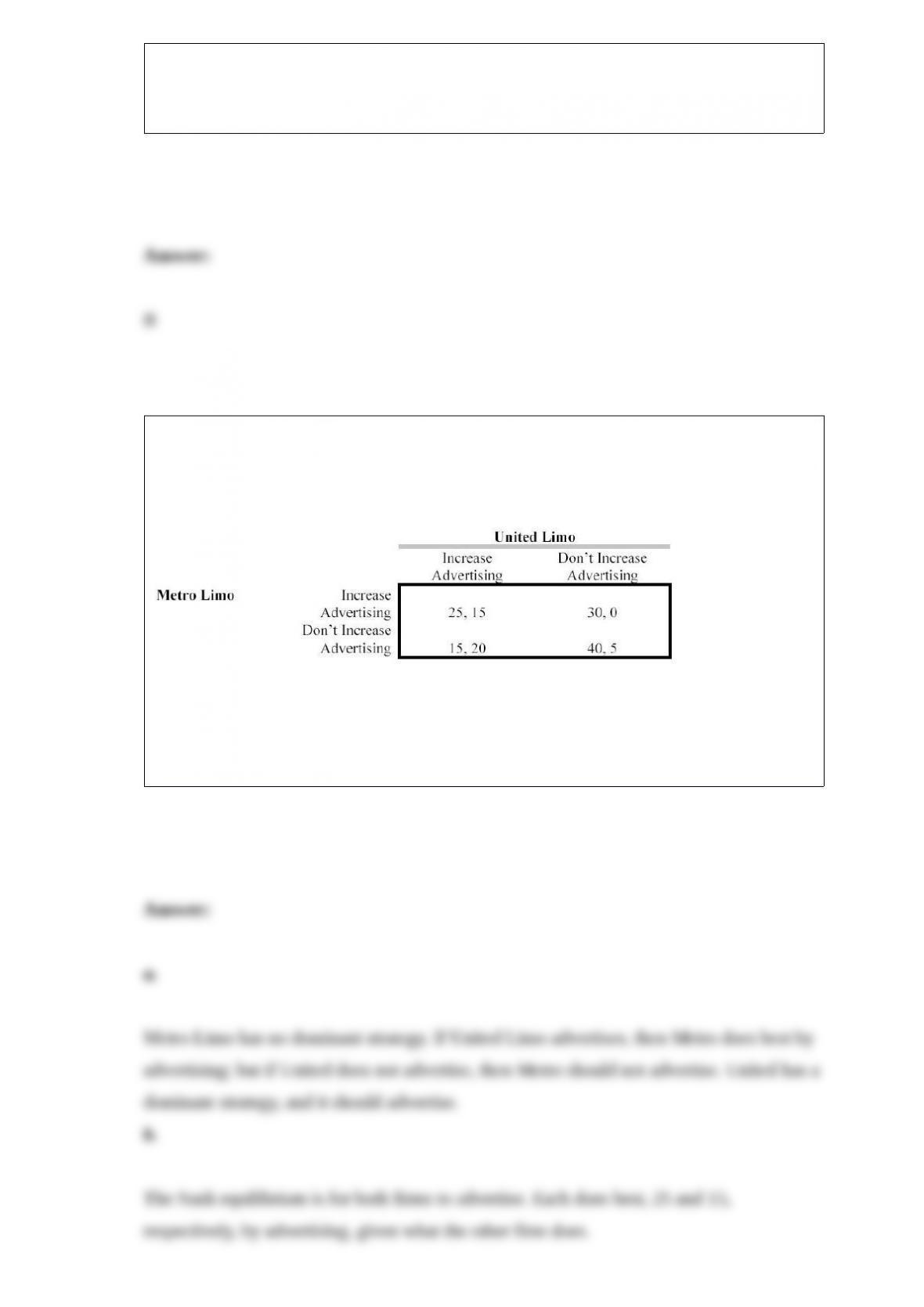
Two firms at the St. Louis airport have franchises to carry passengers to and from hotels
in downtown St. Louis. These two firms, Metro Limo and Urban Limo, operate nine
passenger vans. These duopolists cannot compete with price, but they can compete
through advertising. Their payoff matrix is below:
a. Does each firm have a dominant strategy? If so, explain and what that strategy is.
b. What is the Nash equilibrium? Explain where the Nash equilibrium occurs in the
payoff matrix.
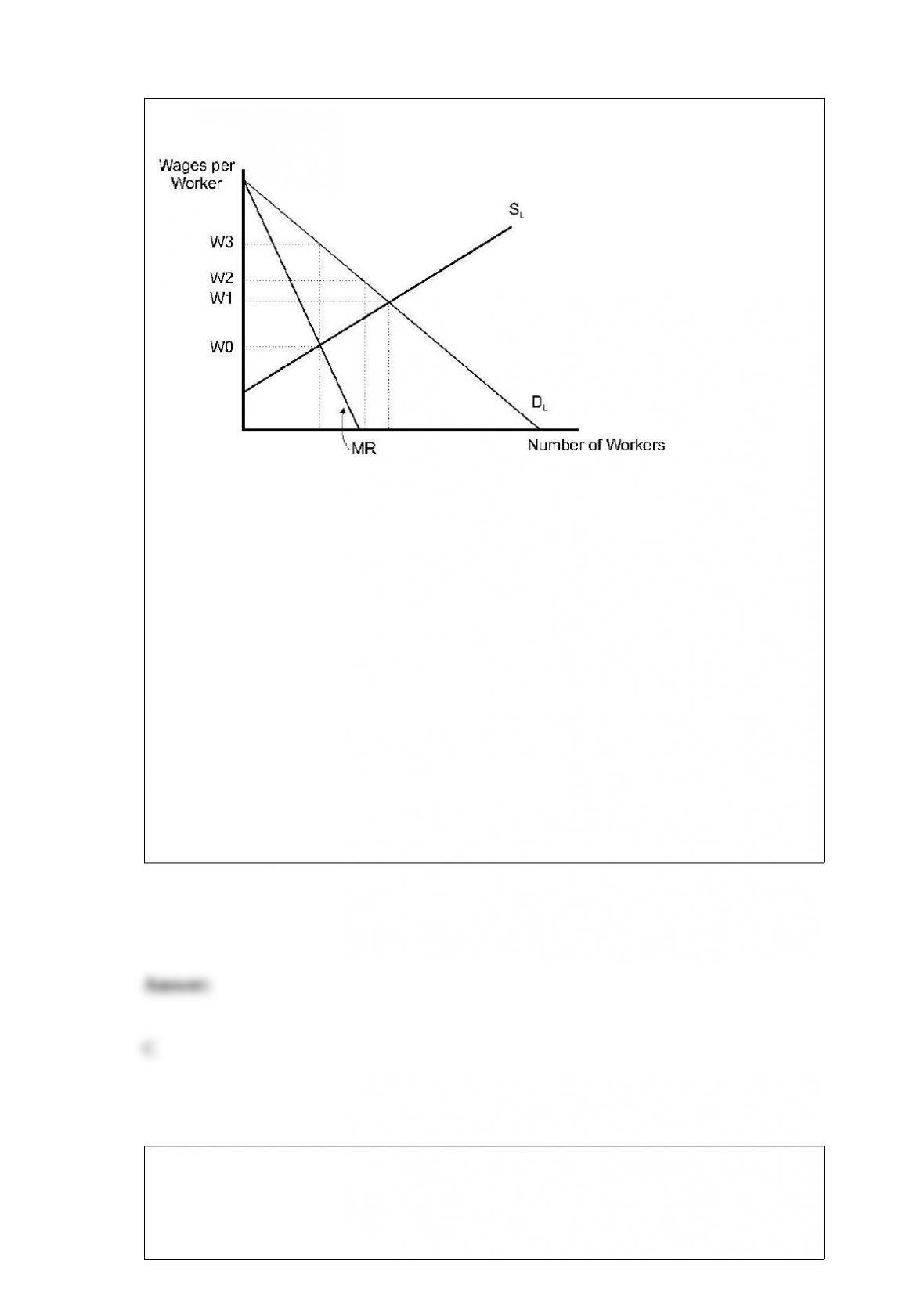
Figure 14.3
A labor union is exercising monopoly power in the labor market.
Refer to Figure 14.3. To maximize total wages paid to workers, the labor union will
agree to wage rate:
A) W0.
B) W1.
C) W2.
D) W3.
E) none of the above
Augustus bought his BMW convertible as a new car in 1998 and knows that it is in
excellent condition. He now wants to sell it and knows that there are many other similar
cars on the used car market that are lemons. As a result:

A) he should be able to sell my car at a premium price because of its excellent
condition.
B) he will have to accept a lower price for his car because buyers might think that it is a
lemon.
C) he will not be able to sell his car unless he offers some sort of guarantee.
D) he will get the best price for his car by selling it to a dealer.
One Guy’s Pizza advertising expenditures are $1,200 and sales are $30,000. When the
advertising expenditure increases to $1,400, pizza sales increase to $32,000. The arc
advertising elasticity of demand is approximately ________.
A) 0
B) 0.1
C) 0.4
D) 2.5
E) 12.5
Consider two goods X and Y available for consumption. Assume that the price of X
changes while the price of Y remains fixed. For these two goods, the price-consumption
curve illustrates the

A) relationship between the price of X and consumption of Y.
B) utility-maximizing combinations of X and Y for each price of X.
C) relationship between the price of Y and the consumption of X.
D) utility-maximizing combinations of X and Y for each quantity of X.
Which of the following is true about the demand for gasoline?
A) It is probably more price elastic in the long run because price will increase by a
higher percentage.
B) It is probably more price elastic in the long run because it is easier to find substitutes
for gasoline in the long run.
C) It is probably more price elastic in the short run because price will increase by a
higher percentage.
D) It is probably more price elastic in the short run because it is easier to find
substitutes for gasoline in the short run.
There are two techniques of egg production: free range (where hens roam around the
farm) or factory (where hens are fed and watered in wire cages). The free range
technique has a much more elastic supply curve than the factory technique. When the
demand for eggs falls:

A) egg production using the factory technique falls less than with the free range
technique.
B) egg production using the factory technique falls more than with the free range
technique.
C) the production using both techniques falls by the same amount.
D) the factory egg producers supply curve shifts inward.
E) the free range egg producers supply curve shifts inward.
If error in setting the policy is possible,
A) a standard generates smaller welfare losses than a fee when the MSC and MCA are
both relatively flat.
B) a standard generates smaller welfare losses than a fee when the MSC and MCA are
both relatively steep.
C) a standard generates smaller welfare losses than a fee when the MSC is relatively
steep and the MCA is relatively flat.
D) a standard generates smaller welfare losses than a fee when the MSC is relatively
flat and the MCA is relatively steep.
E) errors in standards and fees have equal welfare losses, so long as the errors are the
same in percentage terms.

Nervous Norman holds 70% of his assets in cash, earning 0%, and 30% of his assets in
an insured savings account, earning 2%. The expected return on his portfolio
A) is 0%.
B) is 0.6%
C) is 1%.
D) is 2%.
E) cannot be determined without knowing what the dollar value of his assets is.
In the economic literature on principal-agent problems, the ________ is the person who
takes some action, and the ________ is the person whom the action affects.
A) agent, principal
B) principal, agent
C) Both statements describe the agent.
D) Both statements describe the principal.
Which of the following statement is FALSE?

A) Perfectly competitive markets are composed of many buyers and sellers.
B) Some markets may have only a few sellers but exhibit the properties of perfect
competition.
C) A market may be composed of only one buyer and one seller.
D) All of the above statements are correct.
Suppose labor and capital are variable inputs. The wage rate is $20 per hour, the
marginal product of labor is 30 units, the rental rate of capital is $100 per machine hour,
and the marginal product of capital is 150 units. If the wage rate declines to $15 per
hour, the firm employs more labor and the marginal product of labor declines to 20
units. Assuming the rental rate of capital remains the same, what happens to the amount
of capital used by the firm?
A) Decreases
B) Increases
C) No change
D) We do not have enough information to answer this question.
To simplify our consumption models, suppose U.S. consumers only purchase food and
all other goods where food is plotted along the horizontal axis of the indifference map.

Also, suppose that all states initially impose state sales taxes on all goods (including
food), but then the states exempt food from the state sales tax. How does this tax policy
change alter the consumer’s budget line?
A) Makes the budget line steeper
B) Makes the budget line flatter
C) Parallel rightward shift
D) Parallel leftward shift
E) none of the above
Use the following statements to answer this question:
I. The effective yield is generally easier to compute for a perpetuity than for a 10-year
bond.
II. Two perpetuities that have the same annual payment must have the same price, even
if the issuers of the bonds are different companies.
A) I and II are true.
B) I is true and II is false.
C) II is true and I is false.
D) I and II is false.

Which statement most nearly describes a Nash equilibrium applied to price
competition?
A) Two firms cooperate and set the price that maximizes joint profits.
B) Each firm automatically moves to the purely competitive equilibrium because it
knows the other firm will eventually move to that price anyway.
C) Given the prices chosen by its competitors, no firm has an incentive to change their
prices from the equilibrium level.
D) One dominant firm sets the price, and the other firms take that price as if it were
given by the market.
Your local grocery store offers a coupon that reduces the price of milk during the
coming week. The regular retail price of milk in the store is $3.00 per gallon, and the
coupon price is $2.00 per gallon for the next week. If the store maximizes profits and
the price elasticity of demand for milk is -2 for coupon users, what is the price elasticity
of demand for non-users?
A) -0.67
B) -1.0
C) -1.5
D) We do not have enough information to answer the question.

Which of the following is NOT true for monopoly?
A) The profit maximizing output is the one at which marginal revenue and marginal
cost are equal.
B) Average revenue equals price.
C) The profit maximizing output is the one at which the difference between total
revenue and total cost is largest.
D) The monopolist’s demand curve is the same as the market demand curve.
E) At the profit maximizing output, price equals marginal cost.
A firm operating in a monopolistically competitive market faces demand and marginal
revenue curves as given below:
P = 10 – 0.1Q MR = 10 – 0.2Q
The firm’s total and marginal cost curves are:
TC = – 10Q + 0.0333Q3 + 130 MC = -10 + 0.0999Q2,
where P is in dollars per unit, output rate Q is in units per time period, and total cost C
is in dollars.
a. Determine the price and output rate that will allow the firm to maximize profit or
minimize losses.
b. Compute a Lerner index.
Suppose a technological innovation shifts the marginal cost curve downward. Which
one of the following cost curves does NOT shift?
A) Firm’s short-run supply curve

B) Average total cost curve
C) Average variable cost curve
D) Average fixed cost curve
Louey’s Greasy Spoon restaurant charges $15 for each dinner entree and $5 for each
dessert selection, and they offer a dinner special that provide an entree and dessert for
$18. If a diner at Louey’s assigns zero value to dessert and $19 to an entree, what is
their optimal decision?
A) Buy the dinner special
B) Buy only the entree
C) Buy only the dessert selection
D) We do not have enough information to determine the optimal decision
Use the following two statements to answer this question:
I. A firm can exert monopoly power if and only if it is the sole producer of a good.
II. The degree of monopoly power a firm possesses can be measured using the Lerner
Index:
L = (P – AC)/AC.

A) Both I and II are true.
B) I is true, and II is false.
C) I is false, and II is true.
D) Both I and II are false.
An ideal cost-of-living index measures:
A) The relative cost of maintaining a particular utility level.
B) The relative changes in consumer satisfaction that arise from price increases.
C) The relative price of those goods that are considered to be necessities in
consumption.
D) none of the above
Discrimination based upon the quantity consumed is referred to as ________ price
discrimination.
A) first-degree
B) second-degree

C) third-degree
D) group
The BCY Corporation provides accounting services to a wide variety of customers,
most of whom have had a business association with BCY for more than five years.
BCY’s demand and marginal revenue curves are:
P = 10,000 – 10Q
MR = 10,000 – 20Q.
BCY’s marginal cost of service is:
MC = 5Q.
a. If BCY charges a uniform price for a unit of accounting service, Q, what price must it
charge per unit, and how many units must it produce per time period in order to
maximize profit? Calculate the consumer surplus.
b. If BCY could enforce first-degree price discrimination, what would be the lowest
price that it would charge and how many units would it produce per time period?
c. With perfect price discrimination and ignoring any fixed cost, what is total profit?
How much additional consumer surplus is captured by switching from a uniform price
to first-degree price discrimination?

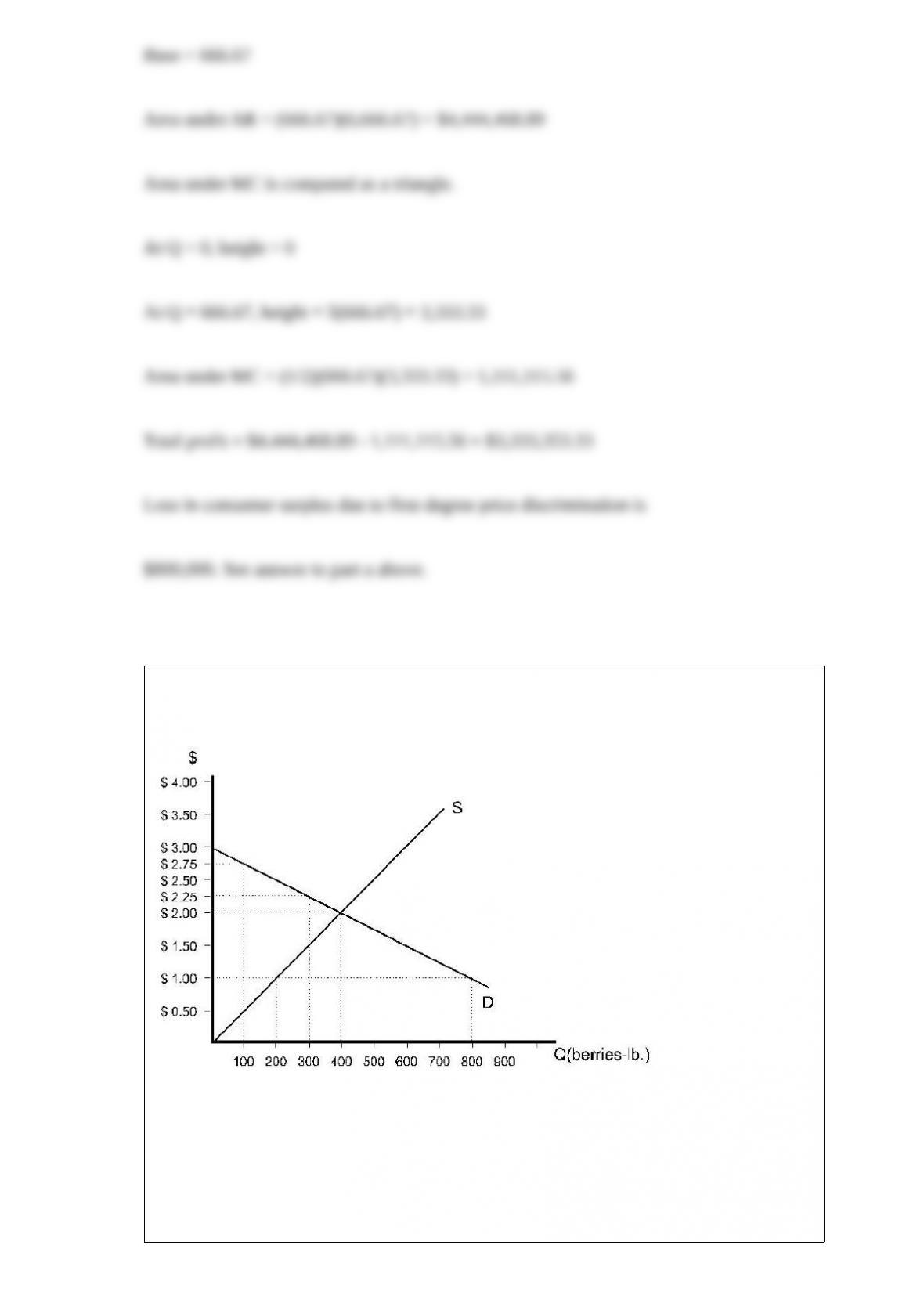
Figure 9.5
Refer to Figure 9.5. If the government establishes a price floor of $2.50 and farmers
grow only the amount of berries that will be sold, the resulting deadweight loss will be
A) $1.50.

B) 200 pounds of berries.
C) $150.
D) $250.
E) $300.