
1) negative externalities arise:
a.when firms pay more than the opportunity cost of resources.
b.when the demand curve for a product is located too far to the left.
c.when firms “use” resources without being compelled to pay for their full costs.
d.only in capitalistic societies.
2) A private closed economy includes:
A.households, businesses, and government, but not international trade.
B.households, businesses, and international trade, but not government.
C.households and businesses, but not government or international trade.
D.households only.
3) the marginal cost-marginal benefit approach to migration suggests that:
a.the optimal amount of immigration to the united states is probably zero.
b.everyone who wishes to come to the united states should be allowed to do so.
c.a particular level of immigration may be too low or too high.
d.efforts to reduce the inflow of illegal immigrants should be abandoned.
4) consumers spend their incomes to get the maximum benefit or satisfaction from the
goods and services they purchase. this is a reflection of:
a.resource scarcity and the necessity of choice.
b.purposeful behavior.
c.marginal costs that exceed marginal benefits.
d.the tradeoff problem that exists between competing goals.
5) Empirical studies suggest that, other things equal, the smaller the number of hospitals
in a city, the lower are nurses’ wages. This is evidence that:
A.the labor markets of nurses are purely competitive.
B.hospitals may possess some degree of monopsony power.
C.the minimum wage does not apply to nurses.
D.labor unions have been ineffective in increasing the wages of nurses.
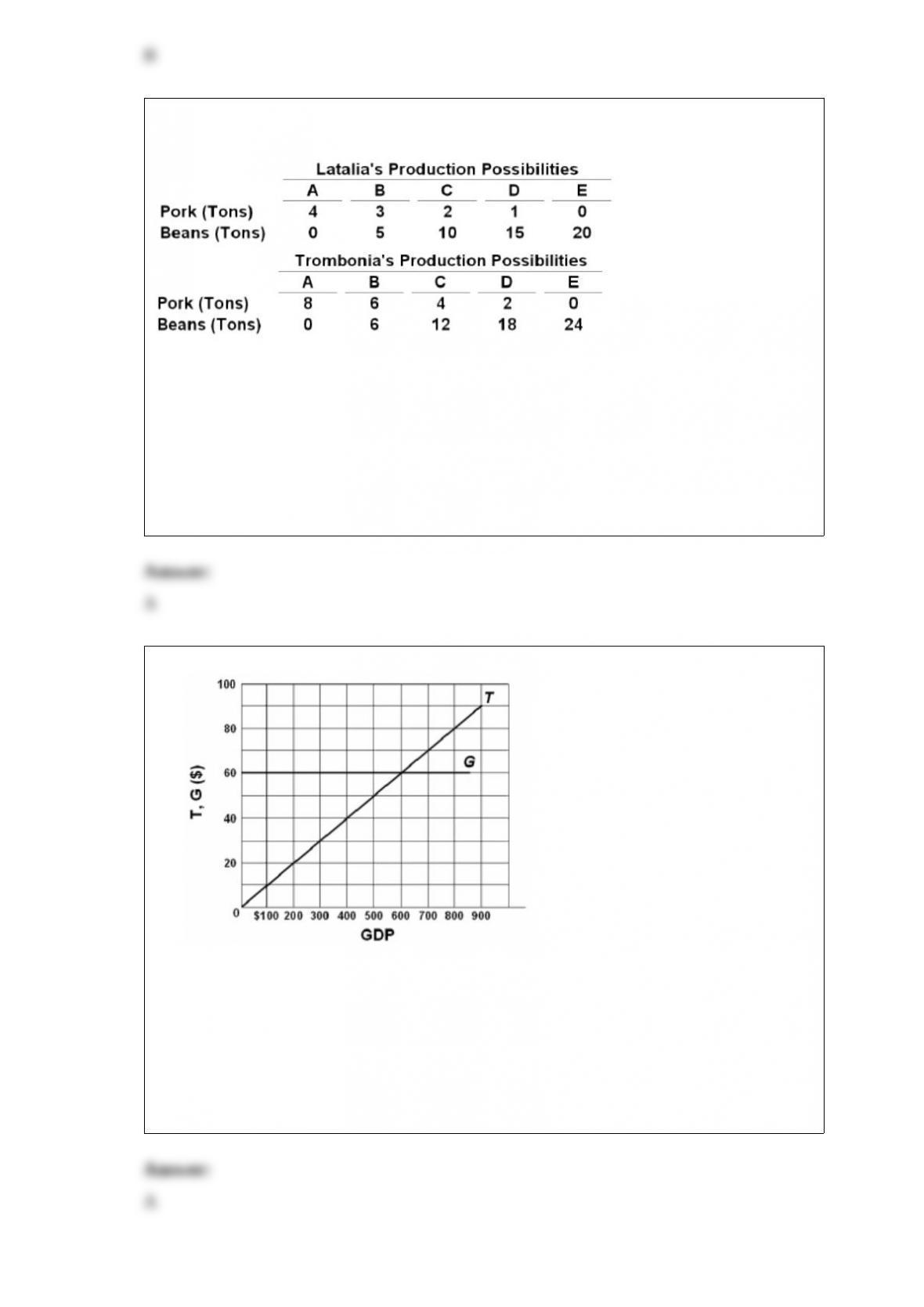
6) The following production possibilities tables for two countries, Latalia and
Trombonia:
Refer to the above tables. Assume that before specialization and trade, Latalia produced
combination C and Trombonia produced combination B. If these two nations now
specialize completely based on comparative advantage, the total gains from
specialization and trade will be:
A.4 tons of beans.
B.1 ton of pork and 2 tons of beans.
C.4 tons of pork.
D.2 tons of pork and 4 tons of beans.
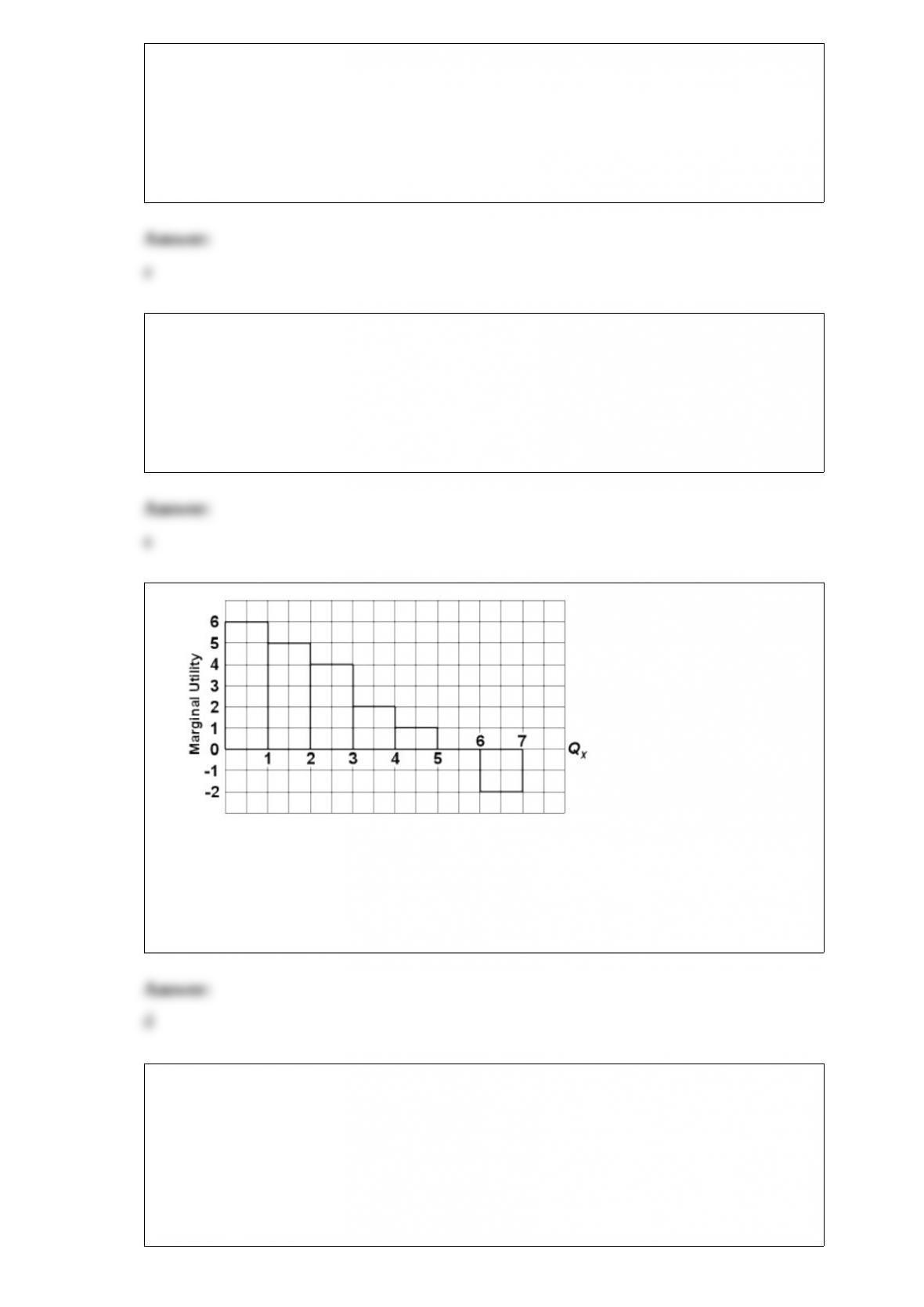
7)
Refer to the above diagram where T is tax revenues and G is government expenditures.
All figures are in billions of dollars. If the full-employment GDP is $400 billion while
the actual GDP is $200 billion, the:
A.actual budget deficit exceeds the standardized budget deficit.
B.actual budget deficit is less than the standardized budget deficit.
C.standardized deficit exceeds the cyclical deficit.
D.cyclical deficit exceeds the standardized deficit.
8) the relationship between quantity supplied and price is _____ and the relationship
between quantity demanded and price is _____.
a.direct, inverse
b.inverse, direct
c.inverse, inverse
d.direct, direct
9) if a firm wanted to know how much it would save by producing one less unit of
output, it would look to:
a.mc.
b.atc.
c.avc.
d.afc.
10)
refer to the above diagram. total utility is at a maximum at _____ units of x.
a.2
b.3
c.4
d.6
11) for a pure monopolist the relationship between total revenue and marginal revenue
is such that:
a.marginal revenue is positive when total revenue is at a maximum.
b.total revenue is positive when marginal revenue is increasing, but total revenue
becomes negative when marginal revenue is decreasing.
c.marginal revenue is positive when total revenue is increasing, but marginal revenue
becomes negative when total revenue is decreasing.
d.marginal revenue is positive so long as total revenue is positive.
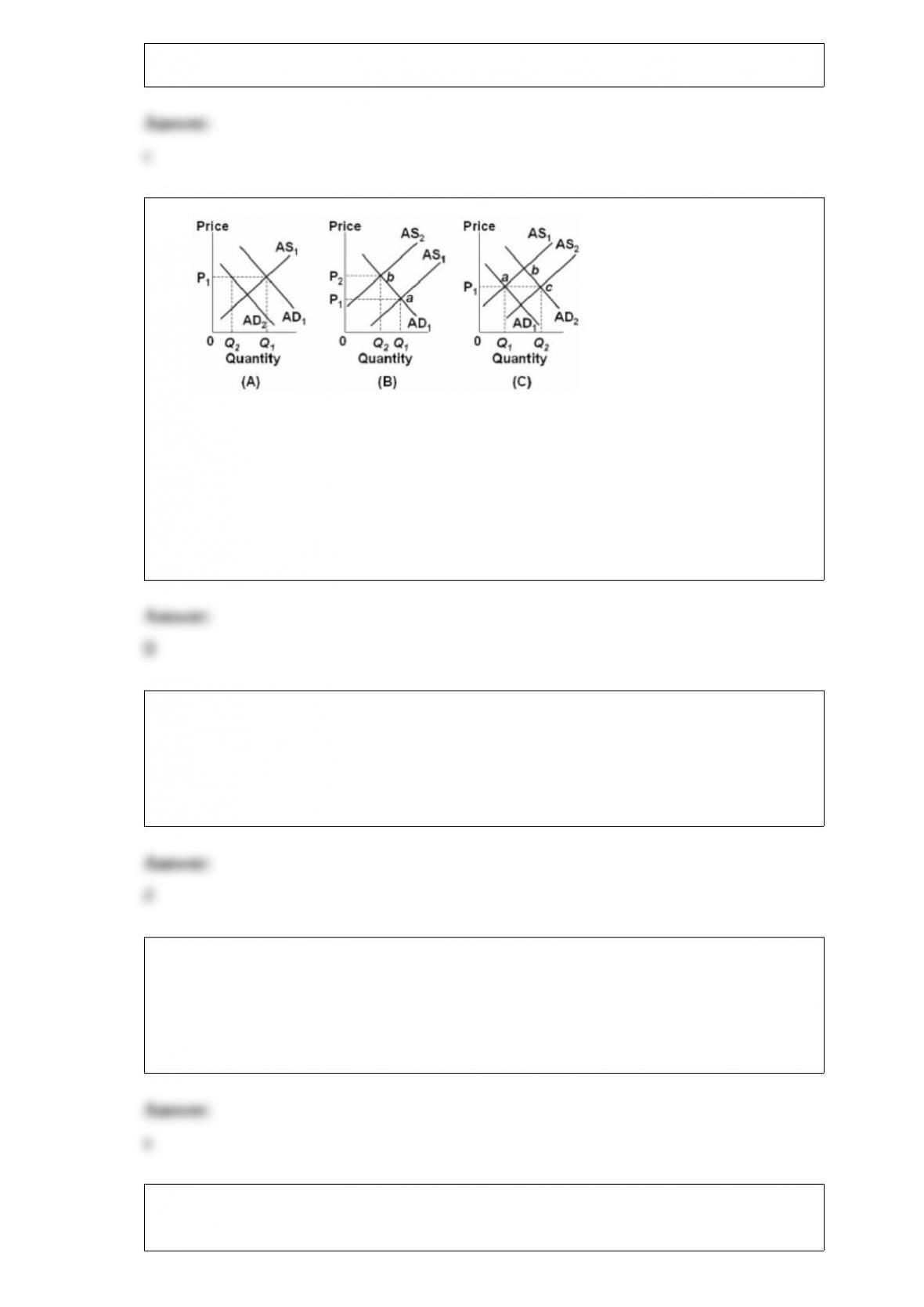
12)
Refer to the above diagrams, in which AD1 and AS1 are the “before” curves and AD2
and AS2 are the “after” curves. Other things equal, a decline in net exports caused by
the foreign purchases effect of a price-level increase is depicted by the:
A.shift of the AD curve in panel (A).
B.move from point a to point b in panel (B).
C.shift of the AS curve in panel (B).
D.move from point a to point c in panel (C).
13) which of the following is one of the five fundamental questions?
a.which products will be in scarce supply and which in excess supply?
b.who should appoint the head of the central bank?
c.how much should the society save?
d.what goods and services will be produced?
14) which of the following is not a main function of the entrepreneur?
a.make routine pricing decisions.
b.innovate.
c.assume the risk of economic losses.
d.makes strategic business decisions.
15) assume a household would consume $100 worth of goods and services per week if
its weekly income were zero and would spend an additional $80 per week for each $100

of additional income. letting c represent consumption and y represent income, the
equation that summarizes this relationship is:
a.c = 80 + 100y.
b.c = 100 + .8y.
c.c = 100 + 80y.
d.c = 80 + .1y.
16) suppose that a pure monopolist can sell 10 units of output at $5 per unit and 11 units
at $4.90 per unit. the marginal revenue of the eleventh unit is:
a.$3.90.
b.$.10.
c.$53.90.
d.$4.90.
17) the number of americans currently without health insurance is approximately:
a.20 million or about 7 percent of the population.
b.29 million or about 10 percent of the population.
c.45 million or about 15 percent of the population.
d.72 million or about 25 percent of the population.