
1) refer to the above diagram. at the profit-maximizing output, total variable cost is
equal to:
a.0ahe
b.0cfe
c.0bge
d.abgh
2) In which of the following U.S. occupations is the rate of unionization the lowest?
A.transportation workers
B.teachers
C.legal workers
D.sales workers
3) compared to other industrial nations, inflation rates in the united states are:
a.significantly higher.
b.significantly lower.
c.significantly higher than those in europe, and significantly lower than those in japan.
d.neither significantly higher nor significantly lower.
4) A major adverse aggregate supply shock:
A.automatically shifts the aggregate demand curve rightward.
B.causes the Phillips Curve to shift rightward and upward.
C.can be caused by rising productivity.
D.can be caused by falling wages.
5) Which of the following would most likely shift the aggregate demand curve to the
right?
A.An increase in stock prices that increases consumer wealth.
B.Increased fear that a recession will cause workers to lose their jobs.
C.An increase in personal income tax rates.
D.A reduction in household borrowing because of tighter lending practices.
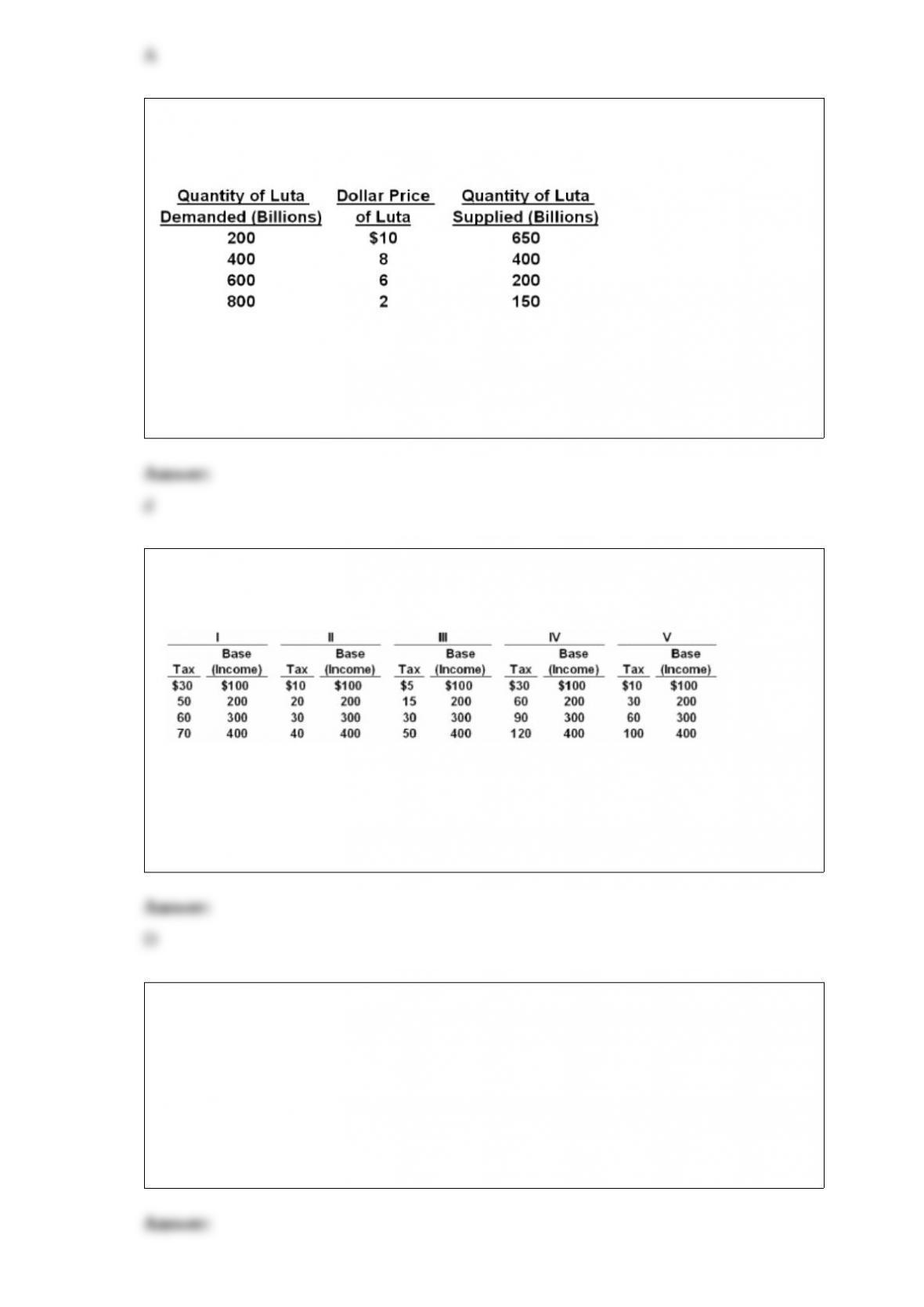
6) the following table which indicates the dollar price of luta, the currency used in the
hypothetical economy of luteland:
refer to the above table. the exchange rate in this market is:
a.8 luta for one dollar.
b.0.60 luta for one dollar.
c.6 luta for one dollar.
d.0.125 luta for one dollar.
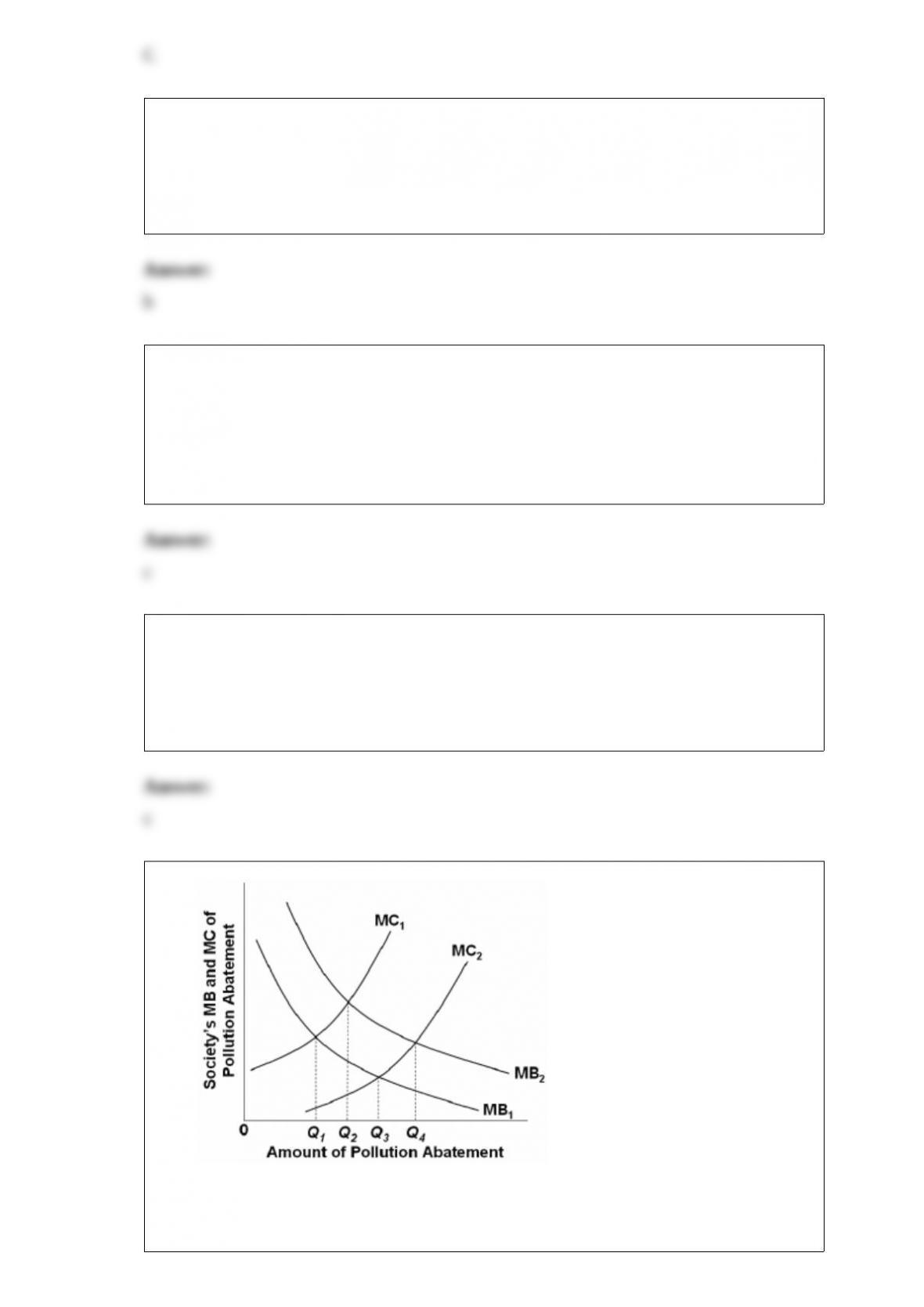
7) These five schedules represent income tax schedules for an economy. All figures are
in billions of dollars.
Which of the above schedules represent(s) a regressive tax?
A.V only
B.III and V
C.IV only
D.I only
8) Suppose that, for every 1-percentage point decline in the discount rate, commercial
banks collectively borrow an additional $2 billion from Federal Reserve banks. Also
assume that reserve ratio is 10 percent. If the Fed lowers the discount rate from 4.0
percent to 3.5 percent, bank reserves will:
A.increase by $1 billion and the money supply will increase by $5 billion.
B.decline by $1 billion and the money supply will decline by $10 billion.
C.increase by $1 billion and the money supply will increase by $10 billion.
D.increase by $10 billion and the money supply will increase by $100 billion.
9) if the rate of inflation is 12 percent per year, the price level will double in about:
a.4 years.
b.6 years.
c.10 years.
d.12 years.
10) if producers must obtain higher prices than previously to produce various levels of
output, the following has occurred:
a.a decrease in demand.
b.an increase in demand.
c.a decrease in supply.
d.an increase in supply.
11) total u.s. health care spending in 2006 was approximately:
a.$44.8 billion.
b.$862 billion.
c.$2.1 trillion.
d.$4.3 trillion.
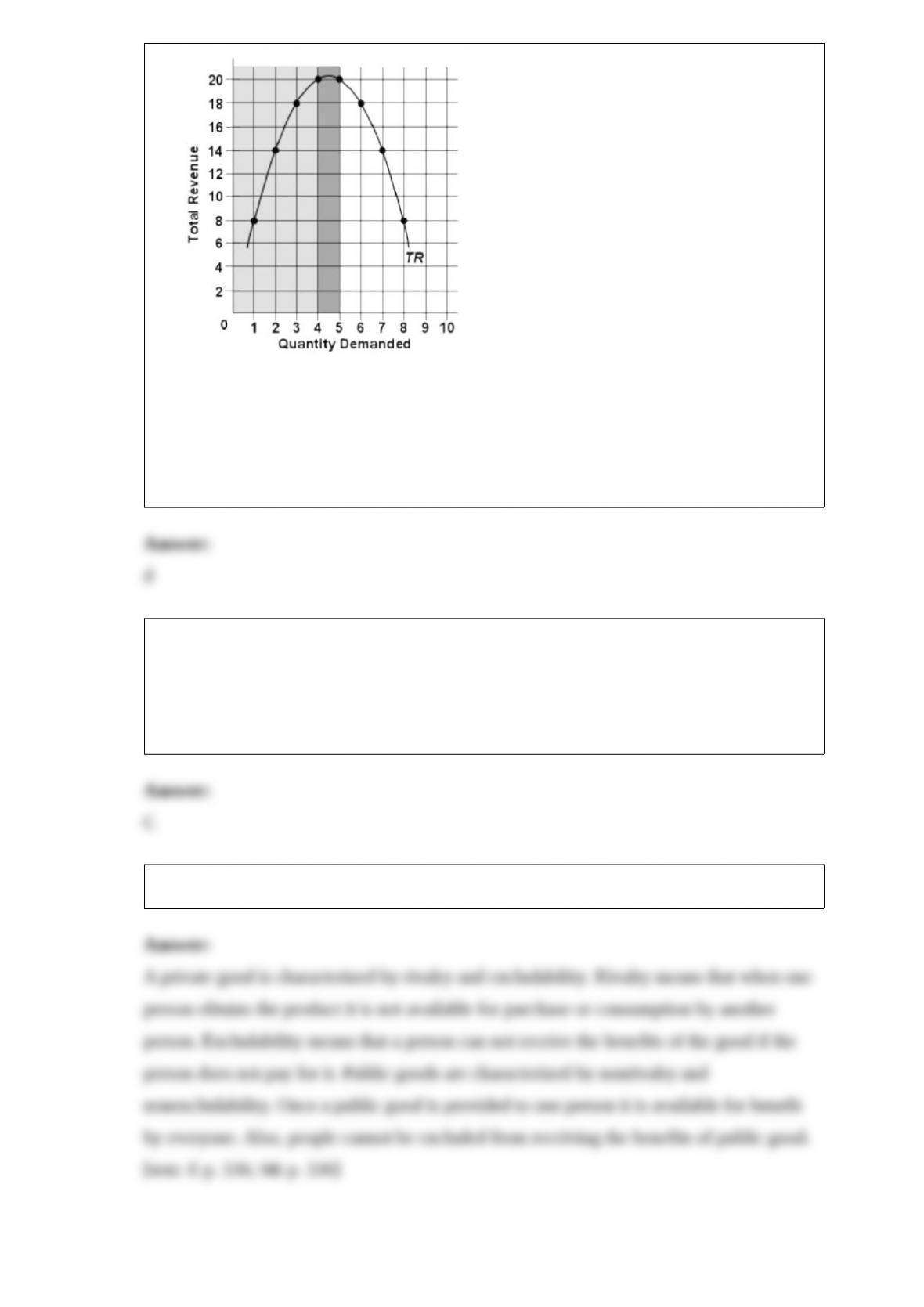
12)
The MB curves in the above diagram slope downward because of the law of:
A.conservation of matter and energy.
B.diminishing returns.

C.diminishing marginal utility.
D.increasing cost.
13) Suppose that the Anytown city government asks private citizens to donate money to
support the town’s annual holiday lighting display. Assuming that the citizens of
Anytown enjoy the lighting display, the request for donations suggests that:
A.the display creates negative externalities.
B.government should tax the producers of holiday lighting.
C.resources are currently overallocated to the provision of holiday lighting in Anytown.
D.resources are currently underallocated to the provision of holiday lighting in
Anytown.
14) Which of the following would contribute to a United States balance of payments
deficit?
A.Kawasaki builds a motorcycle manufacturing plant in Kansas City
B.United States tourists travel in large numbers to Europe
C.a wealthy Mexican citizen builds a mansion in Beverly Hills
D.Zaire pays interest on its debt to the United States
15) Assume the economy is at full employment and that investment spending declines
dramatically. If the goal is to restore full employment, government fiscal policy should
be directed toward:
A.an equality of tax receipts and government expenditures.
B.an excess of tax receipts over government expenditures.
C.an excess of government expenditures over tax receipts.
D.a reduction of subsidies and transfer payments and an increase in tax rates.
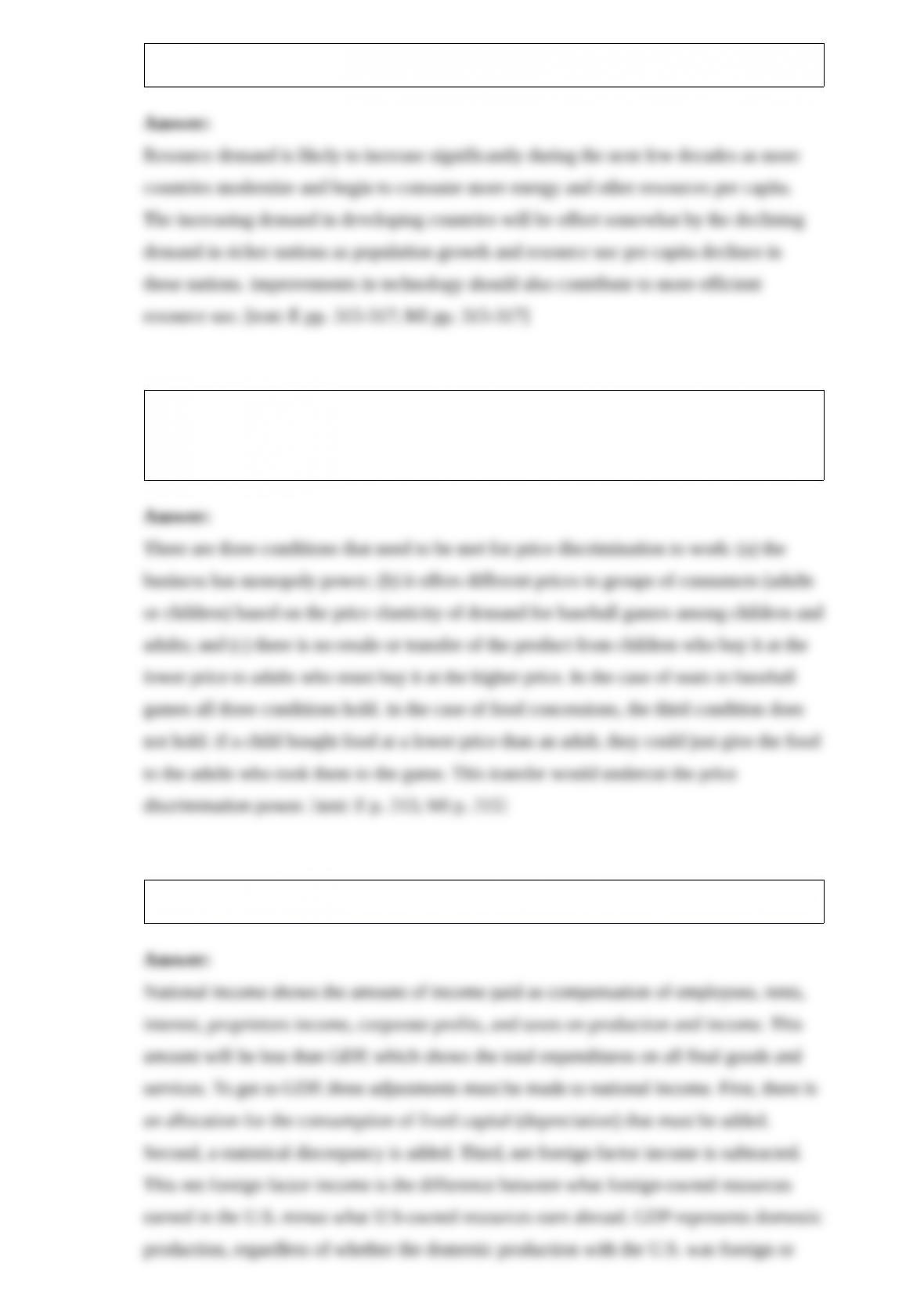
16)
suppose that the above total revenue curve is derived from a particular linear demand
curve. that demand curve must be:
a.inelastic for price declines that increase quantity demanded from 2 units to 3 units.
b.elastic for price declines that increase quantity demanded from 5 units to 6 units.
c.inelastic for price increases that reduce quantity demanded from 4 units to 3 units.
d.elastic for price increases that reduce quantity demanded from 4 units to 3 units.
17) The relationship between investment and GDP is shown by the:
A.consumption of fixed capital schedule.
B.saving schedule.
C.investment schedule.
D.consumption schedule.
18) What is the basic difference between a public good and a private good?
19) What is likely to happen to resource demand in the next few decades?
20) Why does price discrimination work in the sale of seats to children and adults at
baseball games, but not to the sale of food at concession stands to children and adults at
baseball games?
21) What adjustments need to be made to go from national income to GDP?
22) Explain: The land value tax is the economists ideal; it is neutral in its economic
effects.
23) Discuss the merits and demerits of GDP as a measure of the economys output
performance and as a measure of its standard of living.