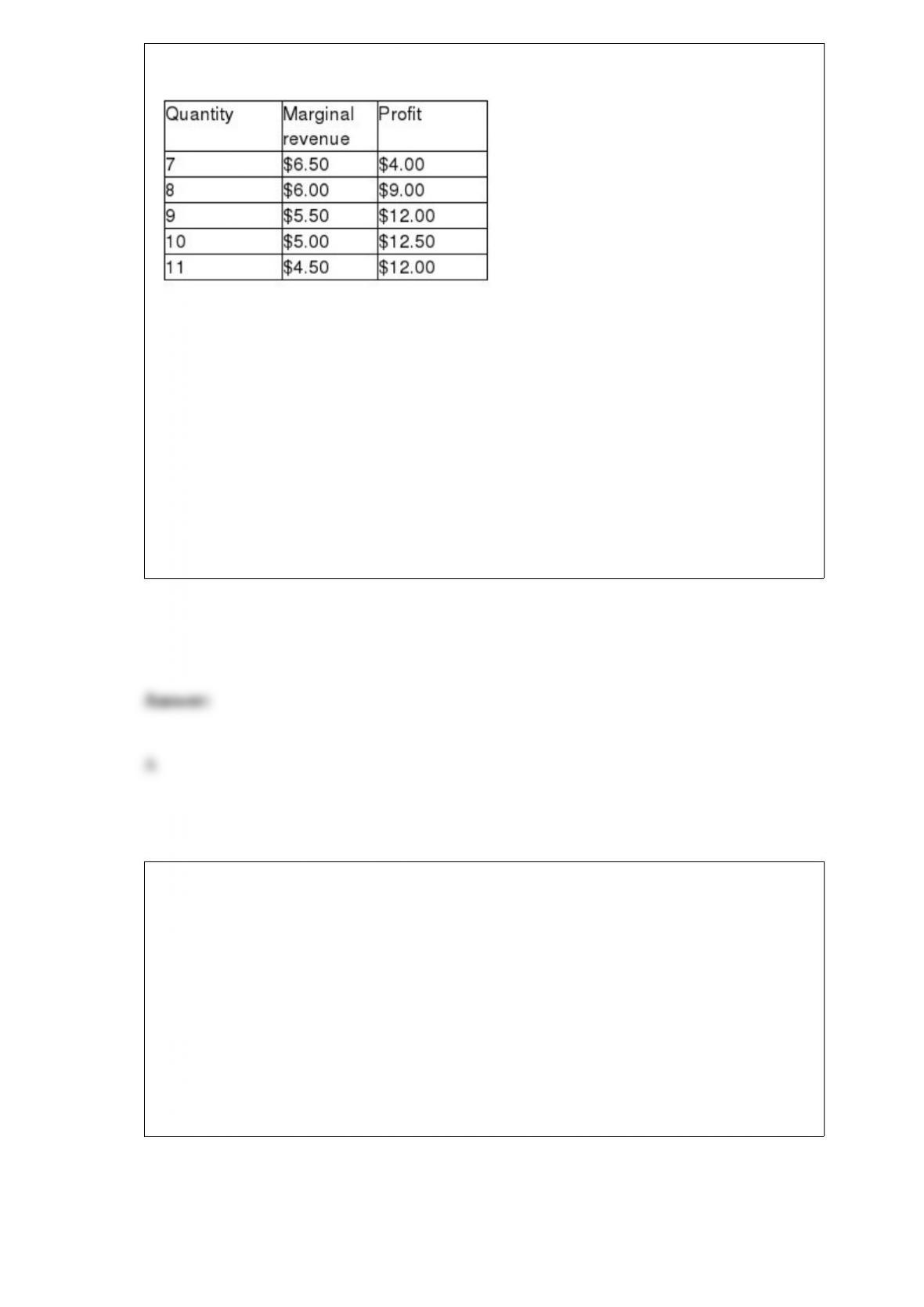
The following questions are based on the following data for a monopolist:
The profit-maximizing price is
a. above $5.
b. $5.
c. between $4.50 and $5.
d. below $4.50.
e. impossible to determine; more information is needed.
For a market to exhibit excess demand
a. supply must exceed demand.
b. the equilibrium price must be too high to clear the market.
c. the actual price must be below the equilibrium price.
d. the demand curve must slope upward.
e. the market must be growing.

A price ceiling often necessitates that
a. the government buy up and store surplus production.
b. a formal system of rationing be established.
c. the government encourage producers to buy more at existing prices.
d. consumers be encouraged to buy more at existing prices.
e. producers be required to increase equilibrium prices.
Under a system of fixed exchange rates, a balance-of-payments deficit means that a
country’s currency is
a. partially valued.
b. undervalued.
c. overvalued.
d. devalued.
e. revalued.
Inflation is said to be occurring when the
a. price of an individual commodity rises steadily because of increases in demand.
b. price of an individual commodity rises steadily because of decreases in supply.
c. value of the dollar increases.
d. consumer price index falls.
e. money income grows at a faster rate than real income.
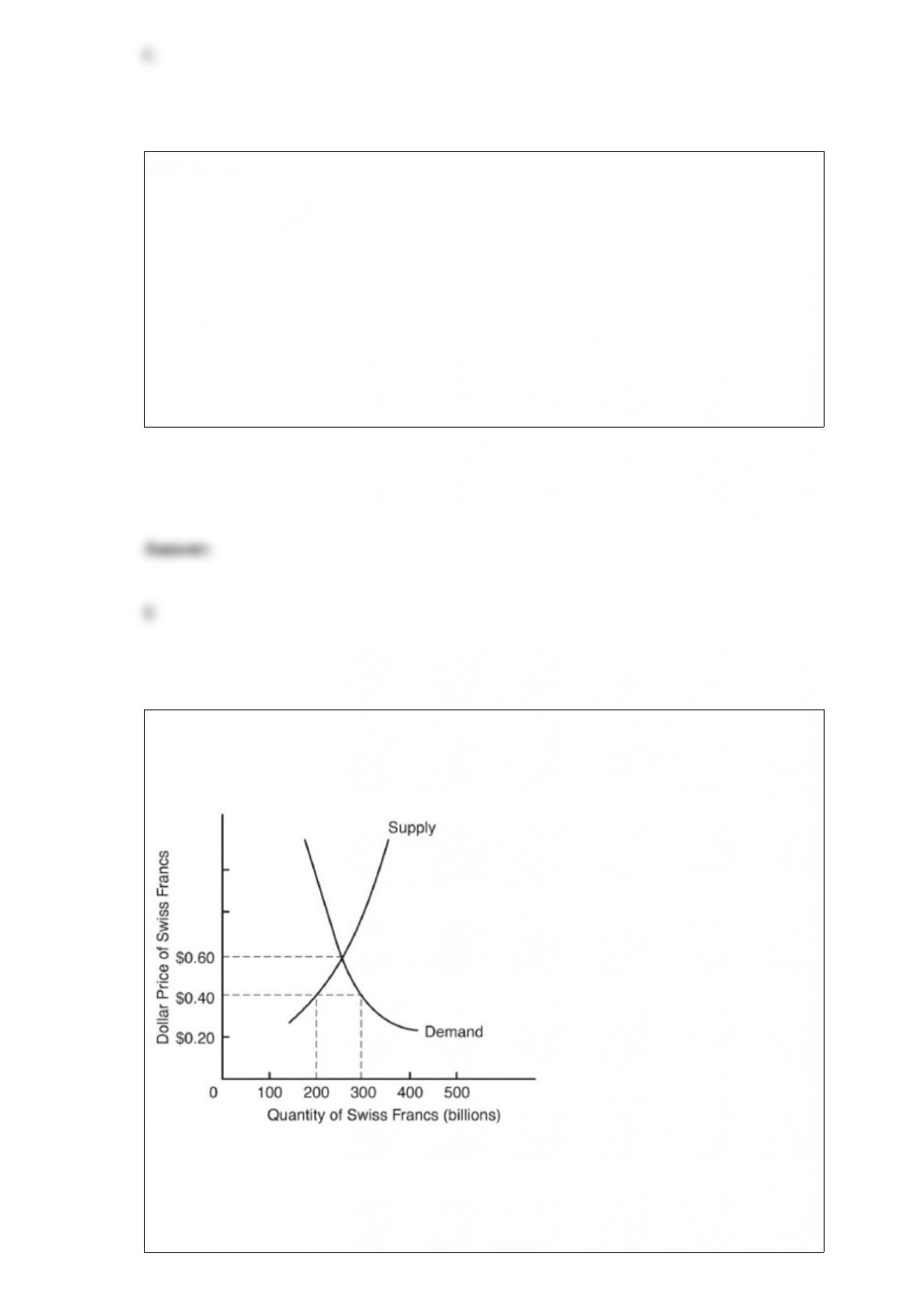
The following questions are based on the following diagram, showing the market for
Swiss francs. Assume Switzerland and the United States are engaged in a system of
fixed exchange rates. The official rate is $0.40 per franc.
If the Swiss government does nothing and the U.S. government attempts to remedy the
situation by buying and selling currencies, it must ________ billion worth of Swiss
francs.

a. buy $150
b. buy $120
c. buy $80
d. sell $80
e. sell $40
Which of the following describes oligopolistic interdependence?
a. Each oligopolist makes price and output policies with their effect on other firms in
mind.
b. There are important external diseconomies in an oligopolistic market.
c. No firm can change the price determined in the marketplace, except through
advertising.
d. There is no likelihood of collusion among producers.
e. Within each product group, each oligopolist’s product is identical.
The rule of reason concept
a. made conduct, rather than market structure, the test of illegality.

b. implied that merely having a large share of an industry’s market constituted an
offense.
c. gained importance after the ALCOA case.
d. was the Supreme Court interpretation of antitrust laws that prevailed before 1910.
e. was a procedural criterion adopted by the Antitrust Division of the Justice
Department under Thurman Arnold.
In 2012, the bottom fifth of U.S. households received incomes below
a. $5,000.
b. $12,000.
c. $18,000.
d. $23,000.
e. $27,000.
If there are no barriers to trade, the current domestic price of coffee in Brazil is 8 reals
per pound, the U.S. price is $4.50 per pound, and the exchange rate is 3.2 reals to the
dollar

a. Brazil is not exporting coffee to the United States.
b. the United States does not want to import as much coffee from Brazil as Brazil wants
to import from the United States.
c. there is a bilateral equilibrium in the U.S.-Brazilian coffee trade.
d. the U.S. price of coffee falls below $4.50 per pound and the Brazilian price rises
above 8 reals per pound.
e. the United States is exporting coffee to Brazil.
A major reason why Henry Ford was able to sell the Model T for as little as $360 per
car was
a. advertising.
b. an increase in the capital-labor ratio at Ford.
c. an expanded number of versions of the car (for example, convertible, hardtop, sedan,
and so on).
d. cheap immigrant labor.
e. longer workdays.
Of those listed below, the main factor contributing to the downfall of the New York

Herald Tribune was
a. poor management.
b. the fear of new technology among union representatives.
c. an unwillingness by the newspaper to install new technology.
d. an unwillingness of Tribune representatives to compromise.
e. competition from the Times, News, and Post.
In the theory of games, the optimal behavior for a decision-making unit, regardless of
what the other players do, is called a
a. payoff matrix.
b. rule.
c. contingency plan.
d. dominant strategy.
e. primary path.
Suppose, under a system of flexible exchange rates, a small TV costs $150 in the
United States and 15,000 yen in Japan. Other things being equal, the exchange rate is

a. 1 yen equals $0.15.
b. $1 equals 15 yen.
c. 1 yen equals $0.01.
d. $1 equals 150 yen.
e. $1 equals 1,500 yen.
If the long-run Phillips curve is vertical, expansionary monetary and fiscal policies that
attempt to reduce the unemployment rate below its natural rate
a. lower inflationary expectations.
b. eliminate the wage-price spiral.
c. lead to accelerating rates of inflation.
d. shift the short-run Phillips curve downward to the left.
e. reduce the consumer price index.
In the debate between the monetarists and the Keynesians over how best to achieve
economic stability, the monetarists have tended to emphasize the role of

a. aggregate supply shifts.
b. economic dualism.
c. random events.
d. the federal budget.
e. the money supply.
The Social Security Act, which provides compulsory old-age insurance for both
workers and self-employed people, was passed in
a. 1887.
b. 1914.
c. 1929.
d. 1933.
e. 1935.
Two important indicators of monetary tightness or ease are the
a. discount rate and the prime rate of interest.

b. level of short-term interest rates and the rate of growth of the money supply.
c. size of the government deficit and the tax rate.
d. size of the money supply and its rate of growth.
e. levels of real output and interest rates.
The budget policy that requires revenues to equal expenditures each and every year is
called
a. an annually balanced budget.
b. functional finance.
c. a full-employment budget.
d. a conflict resolution budget.
e. a budget balanced over the course of the business cycle.
In the short run
a. all of the firm’s inputs are fixed.
b. at least one of the firm’s inputs is fixed.

c. none of the firm’s inputs is fixed.
d. the output of the firm is fixed.
e. only things that are broken can be fixed.
If the money supply is fixed, decreases in the price level
a. reduce the total real output households and businesses want to purchase.
b. reduce the average money cost of each transaction.
c. shift the aggregate demand curve upward and to the right.
d. shift the aggregate supply curve upward and to the left.
e. raise interest rates and reduce total business borrowing.
If an economy is operating at a point on the C + I line that lies above the 45-degree line
a. the economy is in equilibrium.
b. the C + I line shifts down.
c. GDP will rise.
d. unwanted inventories will accumulate.
e. intended saving equals intended investment.

If inputs are combined so that their marginal product”price ratios are equal, ________
minimized.
a. costs are
b. profits are
c. production is
d. efficiency is
e. returns are
Economists’ views and analyses of the economy are most clearly influenced by their
political beliefs when
a. gathering data.
b. formulating theory.
c. testing hypotheses.
d. making policy recommendations.
e. engaging in positive economics.

If firms’ production functions are such as to achieve the lowest unit costs when each
produces a substantial share of total market output, the industry is likely to exhibit the
characteristics of
a. perfect competition.
b. monopolistic competition.
c. monopsony.
d. oligopoly.
e. monopoly.
The view that unemployment becomes increasingly severe as machinery is substituted
for labor is most closely associated with
a. Ernst Say.
b. Maynard Keynes.
c. Eric Mill.
d. Karl Marx.
e. Adam Smith.

Werner H., an engineer very experienced in bridge design, is looking for a position with
a firm that specializes in bridge building. In presenting his qualifications, he takes care
to point out his experience in handling difficult terrain. Werner is currently doing
business in a ________ market.
a. consumers’
b. business
c. product
d. resource
e. closed
The easiest and most inexpensive form of business organization to establish is a
a. firm.
b. corporation.
c. partnership.
d. foundation.
e. proprietorship.

Which of the following is the best example of an innovation?
a. Boeing introduces computer-assisted design and manufacturing to the aircraft
industry.
b. GM brings out its version of a minivan to compete with Chrysler’s.
c. Exxon introduces a higher-octane grade of unleaded gas.
d. McDonald’s increases the size of its hamburger.
e. Microsoft updates its Windows operating system.
In the absence of fractional-reserve banking practices, commercial banks would
a. be less safe as places to keep money.
b. have more money available to be put to work on behalf of business firms.
c. charge depositors higher fees for keeping deposits.
d. be considered as nonprofit organizations.
e. need to borrow money if a run occurred.