Suppose that the salary range for recent college graduates with a bachelor’s degree in
economics is $30,000 to $50,000, with 25 percent of jobs offering $30,000 per year, 50
percent offering $40,000 per year and 25 percent offering $50,000 per year and that in
all other respects, the jobs are equally satisfying. Assume that in this market, a job offer
remains open for only a short time so that continuing to search requires an applicant to
reject any current job offer. The expected starting salary for a college graduate with a
bachelor’s degree in economics is ______.
A. $30,000
B. $40,000
C. $45,000
D. $50,000
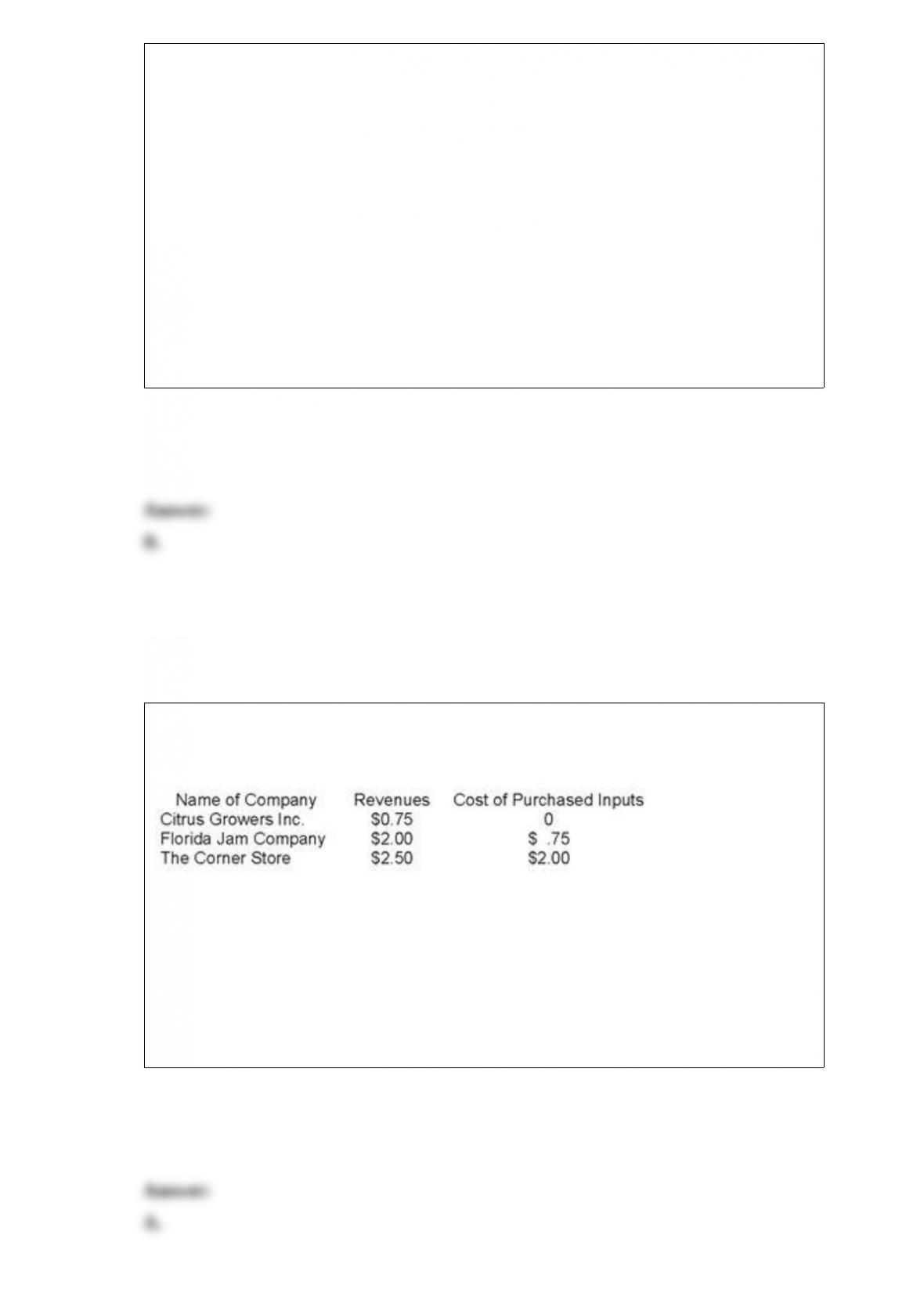
Suppose a jar of orange marmalade that is ultimately sold to a customer at The Corner
Store is produced by the following production process:
What is the value added of The Corner Store?
A. $0.50
B. $1.75
C. $2.00
D. $2.50
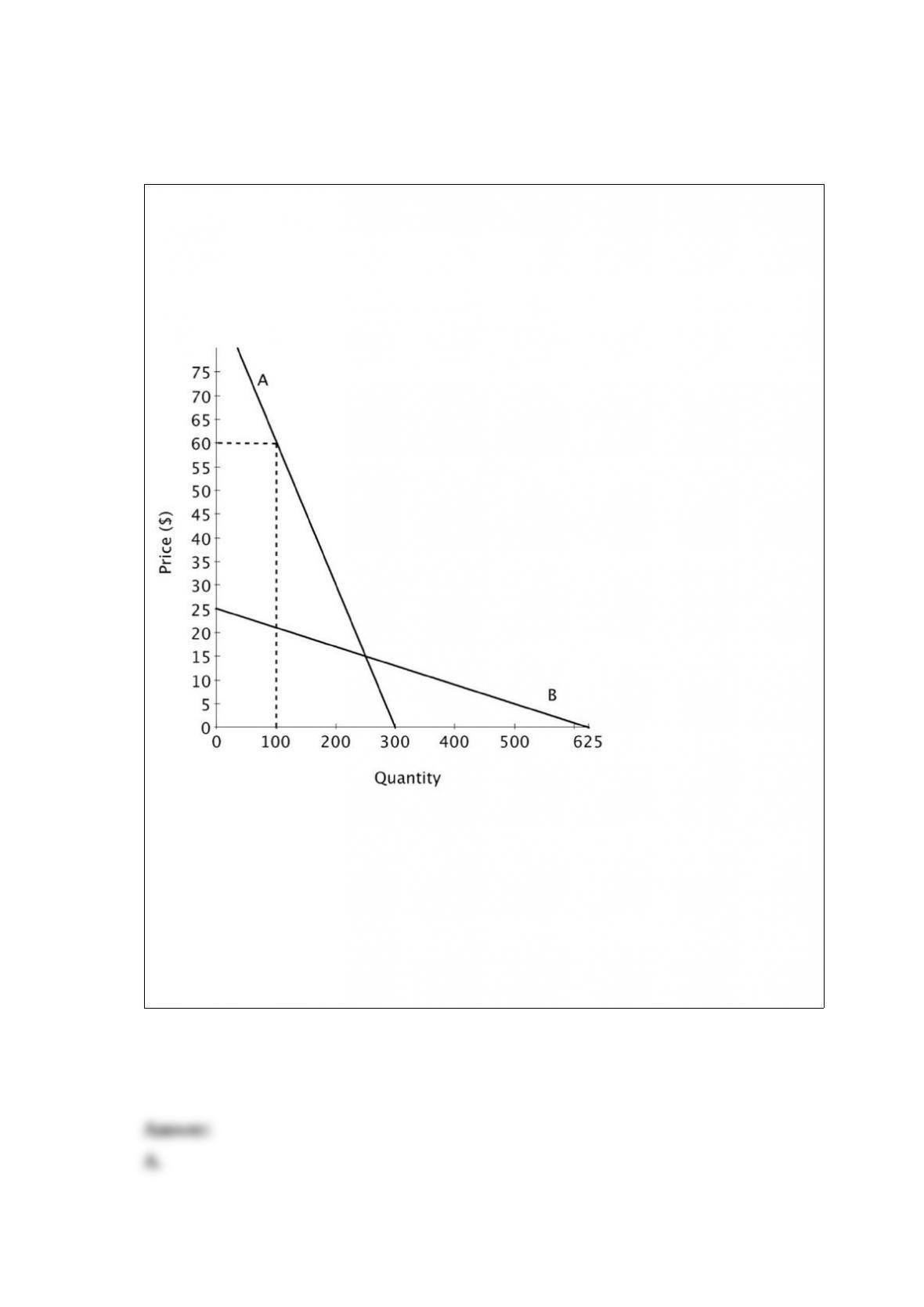
Suppose that a new drug has been approved to treat a life-threatening disease. The
demand for that drug is shown on the graph below. Prior to approval of this drug, the
only treatment for this condition was any one of several non-prescription, or
over-the-counter, pain relievers. The demand for one brand of the several
non-prescription pain relievers is also shown on the graph.
The manufacturer of the new drug would ______ total revenue by increasing the price
from $15 to $16.
A. increase
B. decrease
C. experience no change in
D. experience an uncertain change in
A monopolistically competitive firm is one:
A. that behaves like a monopolist.
B. of many firms that sell products that are close but not perfect substitutes.
C. of many firms that all sell the exact same product.
D. of a small number of firms that sell products that are close but not perfect
substitutes.
If firms sell less output than expected, planned investment:
A. is greater than actual investment.
B. is less than actual investment.
C. equals actual investment.
D. equals zero.

The problems of externalities and poorly formed property rights are:
A. minor in modern economies.
B. among several rationales for the existence of government.
C. better solved by private rather than government action.
D. the only two legitimate reasons for creating government.
In most markets, scarce goods or services are rationed among competing users using:
A. non-monetary prices
B. monetary prices
C. government organizations
D. private organizations
Citizens of Tinytown are considering building a new park. If each voter in Tinytown has
a reservation price that is less than the total cost of the park, then:
A. the benefit of the park is less than the cost of the park, so the park should not be

built.
B. some sort of collective action by voters will be necessary to fund the park.
C. a private firm will have an incentive to build the park.
D. the park will never be built.
One thousand adults live in Milltown. Every day, they all leave work at 4:30 p.m.,
arrive home at exactly 5:00 p.m., and go to bed at 9:00 p.m. Three fundraisers, Alpha,
Beta, and Charlie, have targeted Milltown’s population. To get a donation, they must
call Milltown’s residents after they get home from work but before they go to bed.
Because the charities raising the funds are identical, the first to call a willing donor will
get the donation. To an economic naturalist, this scenario would explain why:
A. fundraising calls typically occur shortly before people go to bed.
B. fundraising calls typically occur shortly after people arrive home from work.
C. fundraising calls are outsourced to Asian countries.
D. telephone fundraisers have become less popular.

The fact that most people make some decisions based on intuition rather than
calculation is:
A. irrational, because intuition is usually wrong.
B. consistent with the cost-benefit model because calculating costs and benefits is
irrational.
C. consistent with the cost-benefit model because most people intuitively weigh costs
and benefits.
D. inconsistent with the cost-benefit model, but still rational.
The central bank of the United States is:
A. Bank of America.
B. Bank of the United States.
C. Bank One.
D. the Federal Reserve System.

Holding other factors constant, an increase in the tax rate on revenue generated by
capital will:
A. increase national saving.
B. decrease national saving.
C. increase investment.
D. decrease investment.
Steve uses $300 from his paycheck to pay off his credit card balance. Based on this
information:
A. Steve’s saving has increased by $300.
B. Steve’s saving has decreased by $300.
C. Steve’s wealth is unchanged.
D. Steve has a capital loss of $300.
Suppose there are ten people playing cards in a room. One of them wants to smoke a
cigar; nine of them dislike the smell of cigar smoke. The smoker values the privilege of
smoking at $5, and each of the other nine people of the room would be willing to pay
fifty cents for clean air in the room. The rules governing use of the room state that
smoking is not allowed unless everyone agrees to allow smoking. Is it socially optimal

for the cigar smoker to smoke?
A. No, because the majority of people in the room dislike the smell of cigar smoke.
B. No, because the value to the cigar smoker of smoking is less than the total value to
the other people in the room of clean air.
C. Yes, because the value to the cigar smoker of smoking is greater than the total value
to the other people in the room of clean air.
D. Yes, because the value to the cigar smoker of smoking is greater than 50 cents.
When the actual reserve/deposit ratio exceeds the desired reserve/deposit ratio banks:
A. do nothing because this is a profitable situation.
B. stop making loans.
C. send the extra reserves to the central bank.
D. make more loans.
The U.S. Congress instituted a system of deposit insurance for banks in:
A. 1789.
B. 1865.

C. 1913.
D. 1934.
If both supply and demand decrease simultaneously, the new equilibrium price is
___________ and the new equilibrium quantity is _________________.
A. lower; lower
B. lower; indeterminate
C. indeterminate; higher
D. indeterminate; lower
Two firms, Industrio and Capitalista, have access to five production processes, each of
which has a different cost and gives off a different amount of pollution. The daily costs
of the processes and the corresponding number of tons of smoke emitted are shown in
the table below. Both firms currently use process A, and each emits 4 tons of smoke per
day. The government is considering two plans to reduce pollution: requiring both firms
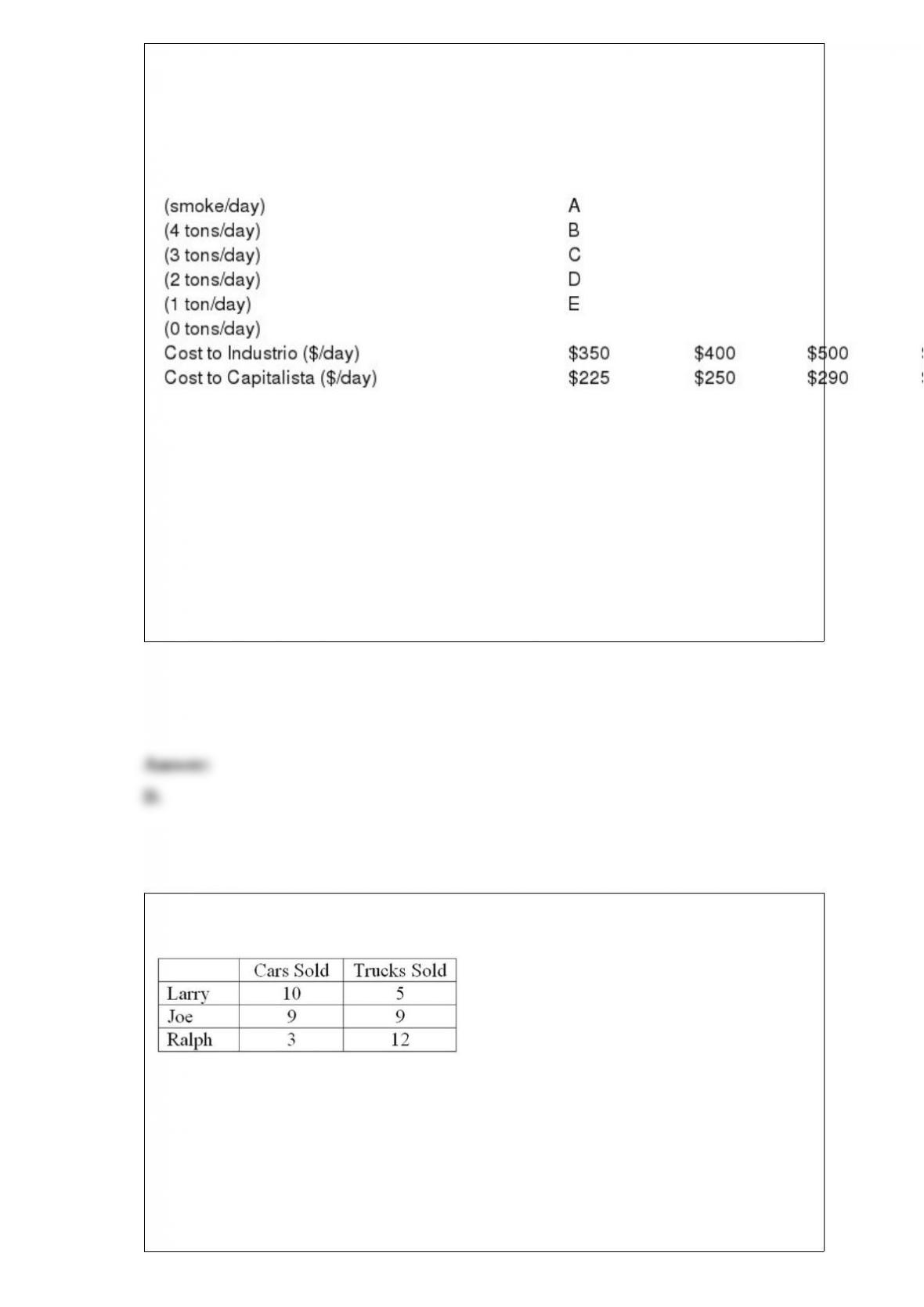
to reduce pollution by 25 percent or auctioning pollution permits. Each permit would
entitle the owner to emit one ton of smoke per day. Without a permit, no smoke can be
emitted.
process
If neither firm had any permits, Industrio would be willing to pay up to ______ for the
right to emit 1 ton of smoke, and Capitalista would be willing to pay up to ______ for
the right to emit 1 ton of smoke.
A. $50; $25
B. $1000, $600
C. $50, $50
D. $300, $200
Dent ‘n’ Scratch Used Cars and Trucks employs 3 salesmen. Data for their sales last
month are shown in this table:
Based on last month’s data, ______ has an absolute advantage in selling cars and
______ has an absolute advantage in selling trucks.
A. Joe; Joe
B. Larry; Ralph
C. Ralph; Larry

D. Larry; Joe
You want to buy a TV that regularly costs $250. You can either buy the TV from a
nearby store or from a store that’s downtown. Relative to going to the nearby store,
driving downtown involves additional time and gas. The downtown store, however, has
a 10% off sale this week. Last week you drove downtown to save $20 on some concert
tickets, a 15% savings. Should you drive downtown to buy the TV?
A. Yes, because you will save 10%, which is better than nothing.
B. No, because you will save more than $20.
C. Yes, because you will save more than $20.
D. No, because you will only save 10%, which is less than 15%.
Adam Smiths theory of the invisible hand posits the actions of independent,
self-interested buyers and sellers will ______ lead to the most efficient allocation of
resources.
A. always
B. often
C. rarely
D. never
The increasing availability of temporary job placement agencies and online job services
has ______ the efficiency of matching workers and jobs, and has therefore ______ the
natural rate of unemployment in the United States.
A. increased; increased
B. increased; decreased
C. decreased; decreased
D. decreased; increased
Suppose there are two small island countries: Avarice, which is populated by people
who are completely self-interested, and Altruism, which is populated by people who
have adopted social norms of generosity and cooperation. If two residents of Avarice
play a prisoner’s dilemma game, they are likely to:
A. never reach the Nash equilibrium.
B. reach the Nash equilibrium more often than would residents of Altruism.
C. reach the Nash equilibrium less often than would residents of Altruism.
D. play their dominated strategies more often than would residents of Altruism.
A nominal value is measured:
A. in physical terms.
B. in terms of current dollar value.
C. using the consumer price index.
D. by indexing.

Which of the following is an example of the life-cycle motive for saving?
A. Pat puts $400 per month in his 401(k) retirement account.
B. Jordan sets aside $200 per month in case she has to pay for a new roof for her house.
C. Gerry and Terry put $2,000,000 in a trust fund that will go to their children when
they die.
D. Chris keeps $15,000 in a money market account to pay expenses in case he loses his
job.
Last year Christine worked as a consultant. She hired an administrative assistant for
$15,000 per year and rented office space (utilities included) for $3,000 per month. Her
total revenue for the year was $100,000. If Christine hadn’t worked as a consultant, she
would have worked at a real estate firm earning $40,000 a year.
Last year, Christine’s explicit costs were ______, and her implicit costs were ______.
A. $15,000; $43,000
B. $18,000; $40,000
C. $36,000; $140,000
D. $51,000; $40,000

Real GDP per person in Westland is $30,000, while real GDP in Eastland is $10,000,
Westland’s real GDP per person is growing at 3percent per year and Eastland’s real GDP
per person is growing at 3 percent per year. If these growth rates persist indefinitely,
then:
A. Eastland’s real GDP per person will rise until it equals Westland’s real GDP per
person.
B. Westland’s real GDP per person will always be at least $20,000 greater than
Eastland’s.
C. Eastland’s real GDP per person will always be exactly $20,000 less than Westland’s.
D. Eastland’s real GDP per person will eventually be greater than Westland’s.
The growth of real GDP per person in the United States between 1960 and 2013was the
result of:
A. growth in average labor productivity only.
B. growth in the share of population employed only.
C. growth in both average labor productivity and the share of population employed.
D. neither the growth in average labor productivity nor the share of population
employed.
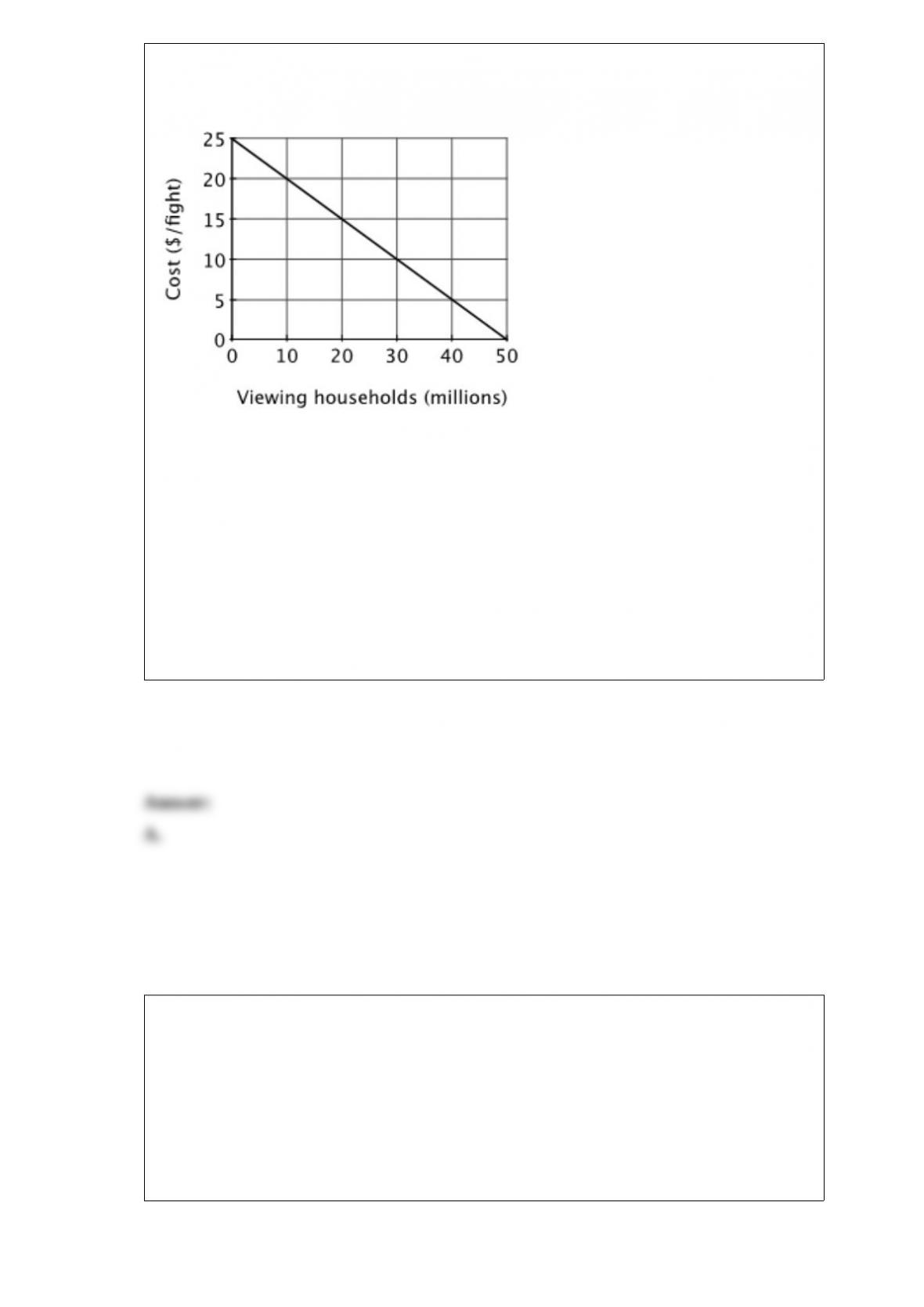
If a boxing fight is shown on pay-per-view television every Saturday at 4pm, the
demand curve for each fight is given below.
If the regulated pay-per-view charge to watch a fight were $5 per household, then what
would be the loss in total economic surplus relative to when the there is no charge to
watch the fight?
A. $25 million
B. $50 million
C. $225 million
D. $625 million
Which of the following is an example of a positional arms control agreement?
A. Campaign spending limits
B. Highly selective admissions standards at colleges
C. Prohibiting speech that causes more harm than good
D. Public education

A measure of GDP in which quantities produced are valued at current-year prices is
called:
A. real GDP.
B. nominal GDP.
C. base GDP.
D. physical GDP.
Savings deposits are ______ the M1 measure of money and ______ the M2 measure of
money.
A. included in; excluded from
B. included in; included in
C. excluded from; excluded from
D. excluded from; included in

The growth rate of average annual earnings in the United States from 1973 to 1995was:
A. higher than it was from 1960 to 1973.
B. lower than it was from 1960 to 1973.
C. the same as it was from 1960 to 1973.
D. roughly equal to zero.