
Which of the following most resembles a perfectly competitive market?
a. the stock market
b. the publishing industry
c. the steel industry
d. the new car market
The largest share of the typical American family budget goes to:
a. goods
b. health care
c. housing
d. transportation
A free rider is one who enjoys the benefits of a public good without paying for it.
a. True
b. False

A monopolistically competitive firm
a. tries to differentiate its product from competitors’ products.
b. faces a perfectly elastic demand curve for its product.
c. has more monopoly power in the long run than does a perfectly competitive firm.
d. is always a retail establishment.
The slope of the aggregate demand curve illustrates that real GDP demanded will
increase when
a. the price level rises.
b. the price level falls.
c. real income rises.
d. real income falls.

When the price of one product falls,
a. consumers’ real income will increase.
b. consumers will buy less of that product.
c. consumers will not change their buying patterns.
d. consumers’ real income will decrease.
Speculation serves the market in which of the following ways?
a. It helps smooth out price fluctuations.
b. It raises the price of certain goods.
c. It manufactures a demand for goods that would not ordinarily be found.
d. It allows risk takers the ability to make large amounts of economic rent.
Tax loopholes are equally available to all taxpayers.
a. True
b. False

The opportunity cost of a given investment is the potential earnings forfeited by tying
up money in the investment.
a. True
b. False
The factor that most often leads to under pricing and overuse of an economic resource
is human greed.
a. True
b. False
Wages in most other countries have increased as a percentage of U.S. wages in the past
33 years.
a. True

b. False
If a voluntary trade takes place,
a. both parties will benefit from the transaction.
b. only one party will benefit from the transaction.
c. neither party will benefit from the transaction.
d. both parties will benefit only if the government regulates the transaction.
With a monopoly, the consumer’s surplus is lower than it would be with a perfectly
competitive industry.
a. True
b. False

In 2009, the U.S. economy was experiencing an inflationary gap.
a. True
b. False
The theory of factor pricing uses supply-demand analysis.
a. True
b. False
If a budget deficit increases interest rates, it is possible that investment will
a. fall, leading to a larger capital stock.
b. fall, so that there is a smaller capital stock.
c. rise, because investment is directly related to interest rates.
d. rise, because investment is more attractive when interest rates are higher.

If a firm sells its output at a price greater than AVC, it will earn economic profit.
a. True
b. False
Since countries differ in the amount of economic activity that is transacted in organized
markets,
a. some countries are more productive than others.
b. persons live better in some countries than others.
c. international comparisons of per capita GDP are often misleading.
d. comparisons between countries are totally impossible.
The primary conclusion of using inflation accounting is that inflation

a. distorts the tax system, and results in slower economic growth.
b. reduces the national debt to its nominal value instead of its real value.
c. causes recessions, and increases the structural deficit.
d. distorts government budget accounting by exaggerating interest expense.
The producer’s surplus is equal to the difference between how much the seller can
charge for a product and how much the consumer is willing to purchase it for.
a. True
b. False
A corporation may be reluctant to raise capital by issuing stock because
a. issuing stock to obtain money for investment is riskier than selling bonds.
b. holders of already-existing stock will gain more voting power in the corporation.
c. obtaining government permission to issue stock can be time-consuming and
expensive.
d. All of the above are correct.

The total burden of a tax equals tax receipts plus excess burden.
a. True
b. False
An increase in capital stock will shift the production function
a. downward.
b. rightward.
c. upward.
d. outward.
Recently, Chrysler bonds with a face value of 100 closed at 103. The coupon rate was
12.75. The current yield on these bonds was
a. 103 percent.
b. 3 percent.
c. 12.75 percent.
d. less than 12.75 percent.
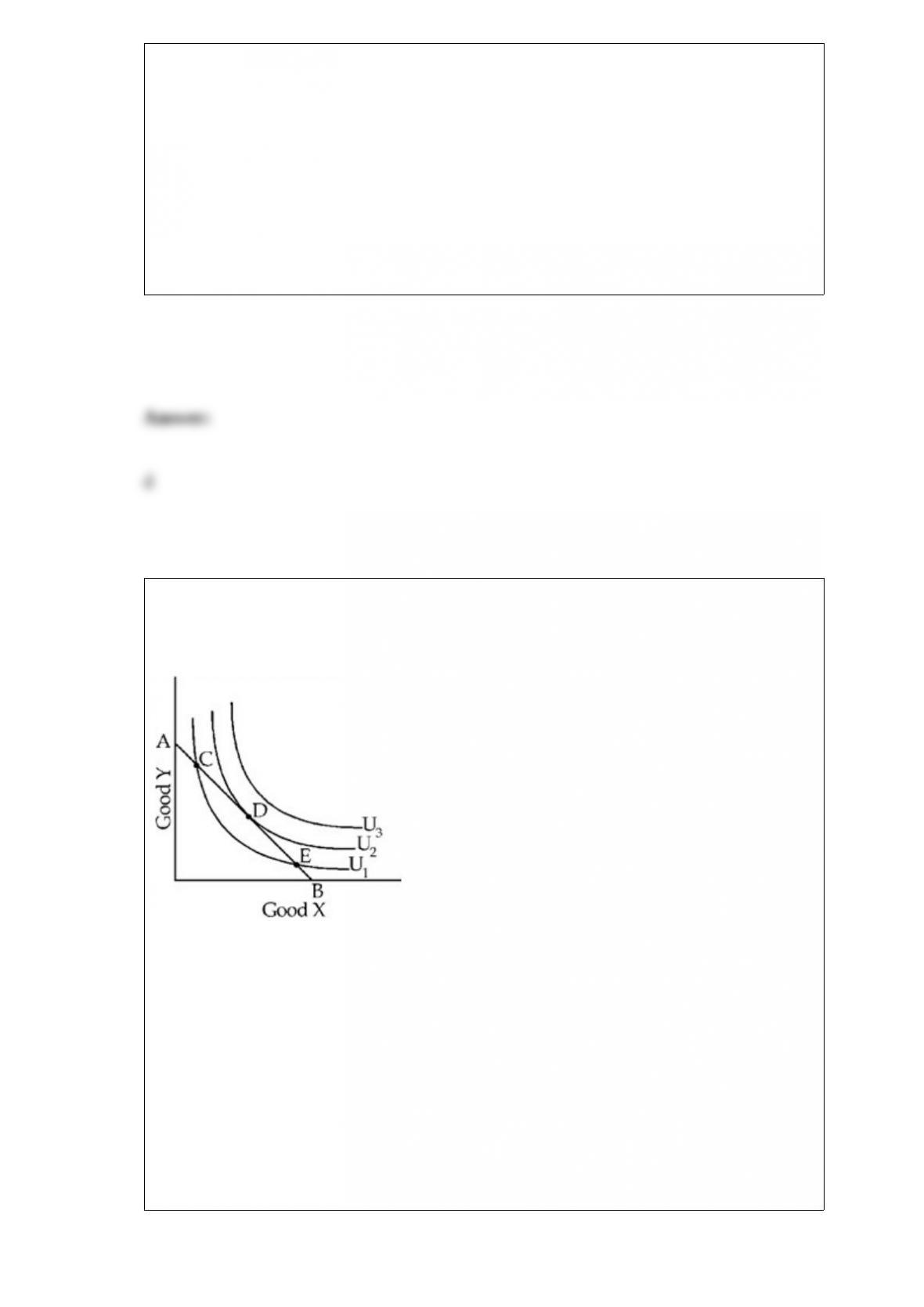
Figure 5-13
According to Figure 5-13, if the price of good X falls, a consumer making her optimal
decision will move from a point on
a. U1 to a point on U3.
b. U2 to a point on U3.
c. U1 to a point on U3.
d. U2 to a point on U1.
If in some production range average cost is rising, the firm is experiencing
a. increasing returns to scale.
b. decreasing returns to scale.
c. constant returns to scale.
d. increasing costs per unit of output.
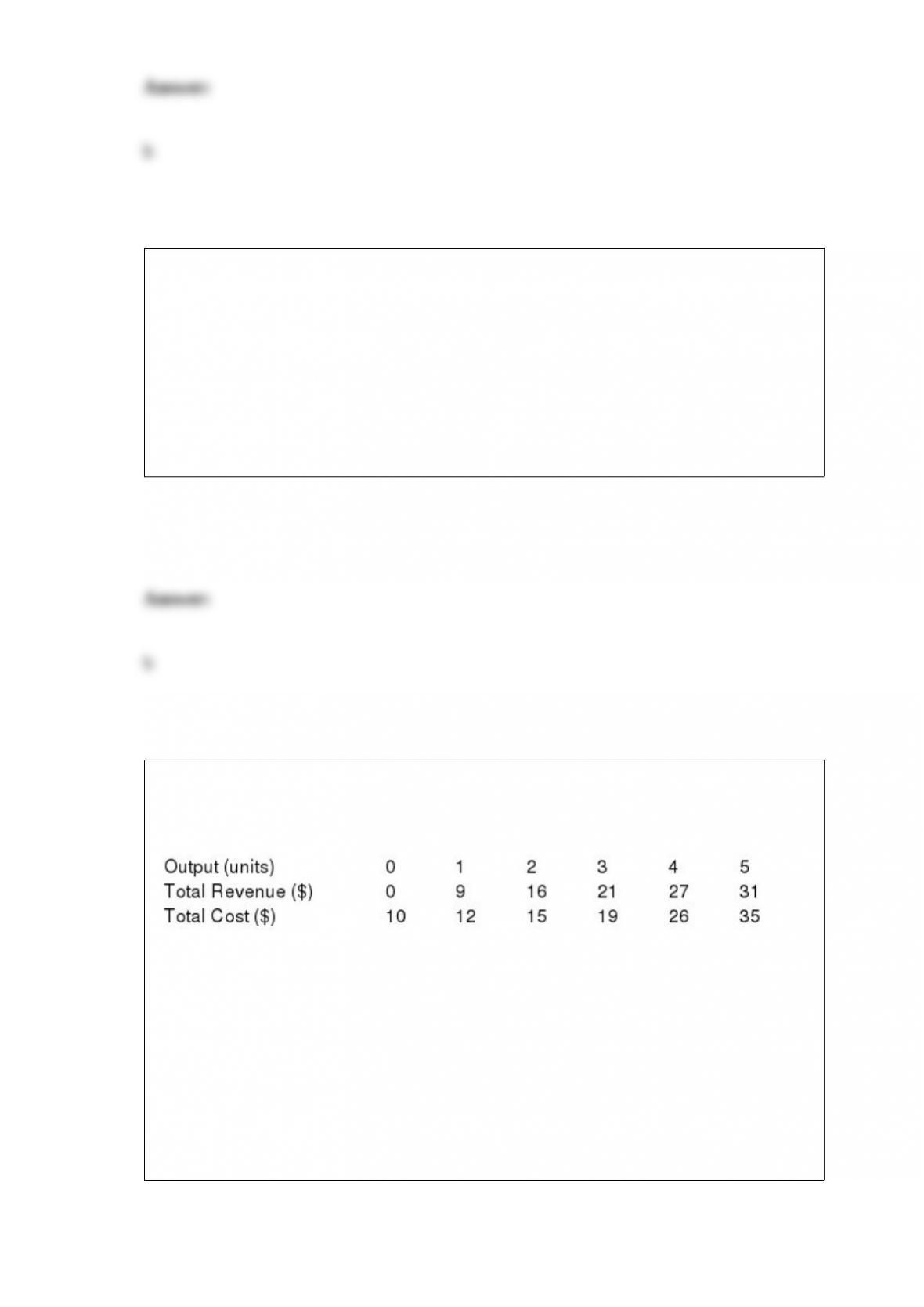
Table 8-1
The firm described in Table 8-1 has a fixed cost of ____ at its optimal level of output.
a. 2
b. 6
c. 10
d. 26

An outward shift in the demand curve for land will
a. make previously zero-rent land profitable.
b. induce people to begin to use land more extensively.
c. force reductions in rents.
d. be accompanied by a shift in the supply of land.
Because there is a trade-off between inflation and unemployment in the short run,
a. lower unemployment will typically cause inflation to fall.
b. policies designed to reduce unemployment will typically set off a recession.
c. policies designed to reduce inflation will cause unemployment to fall as well.
d. higher inflation will generally be associated with higher unemployment.
e. lower inflation will generally be associated with higher unemployment.

The cure for inflation can come only from changes on the demand side.
a. True
b. False
Under monopolistic competition, profits cannot persist because new firms will be
attracted to the market.
a. True
b. False
If fixed cost rises,
a. the profit maximizing level of output would decrease.
b. the profit maximizing level of output would not change.
c. marginal cost rises.
d. variable cost falls.

“Dumping” means destroying goods to prevent driving down the price.
a. True
b. False
Devoting more of a country’s resources for producing consumer goods means
a. economy is using it resources for future production.
b. fewer resources to producing investment goods.
c. country will grow more rapidly in the future.
d. productivity of the invested capital is extremely high.