
The monopolistic competitor is a
a. price taker.
b. price searcher.
c. single seller of a good with no close substitutes.
d. firm that faces a horizontal demand curve.
e. b and c
Which of the following situations probably would not yield a negative externality?
a. a rock concert in the quad next to the library
b. one person who is smoking cigarettes in a closed room where several other people
are present
c. a tutor quietly instructs a student in economics as a bystander willingly listens in
without the tutor knowing it
d. mowing your lawn early on a Saturday morning when you live in a densely
populated neighborhood
e. All of the above situations would yield negative externalities.
Which of the following is true of average fixed costs in the long run?
a. Average fixed costs start increasing.
b. Average fixed costs are above average variable costs.
c. There are no fixed costs in the long run, so there are also no average fixed costs in the
long run.
d. Average fixed costs intersect the marginal cost curve at its minimum point.
e. a and b.
The supply curve for land is __________ when the total supply is in question and
__________ when subparcels are in question.
a. upward sloping; vertical
b. upward sloping; upward sloping
c. vertical; vertical
d. vertical; upward sloping
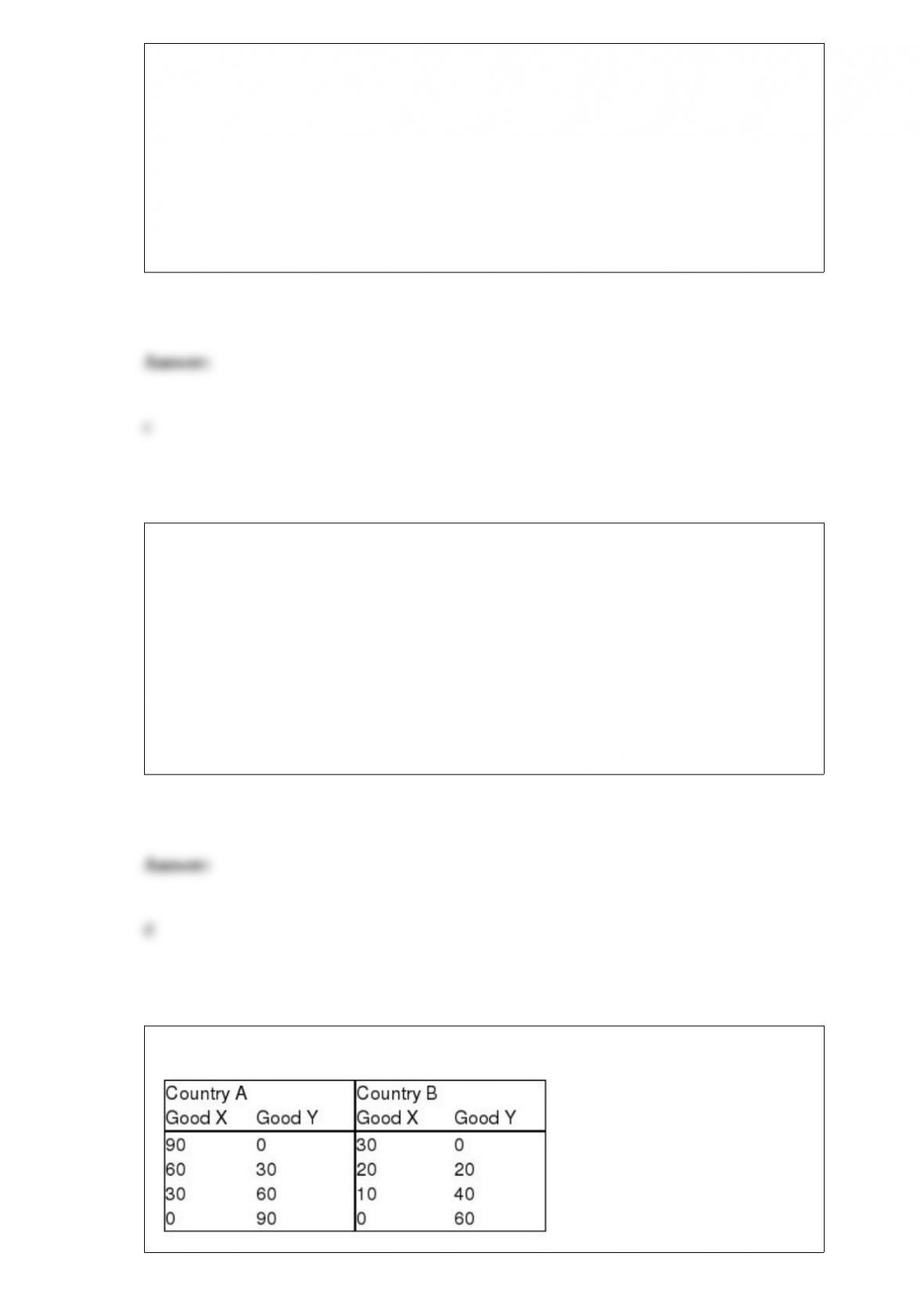
Exhibit 34-1
Country B is the lower opportunity cost producer of
a. good Y.
b. both goods.
c. neither good.
d. good X.
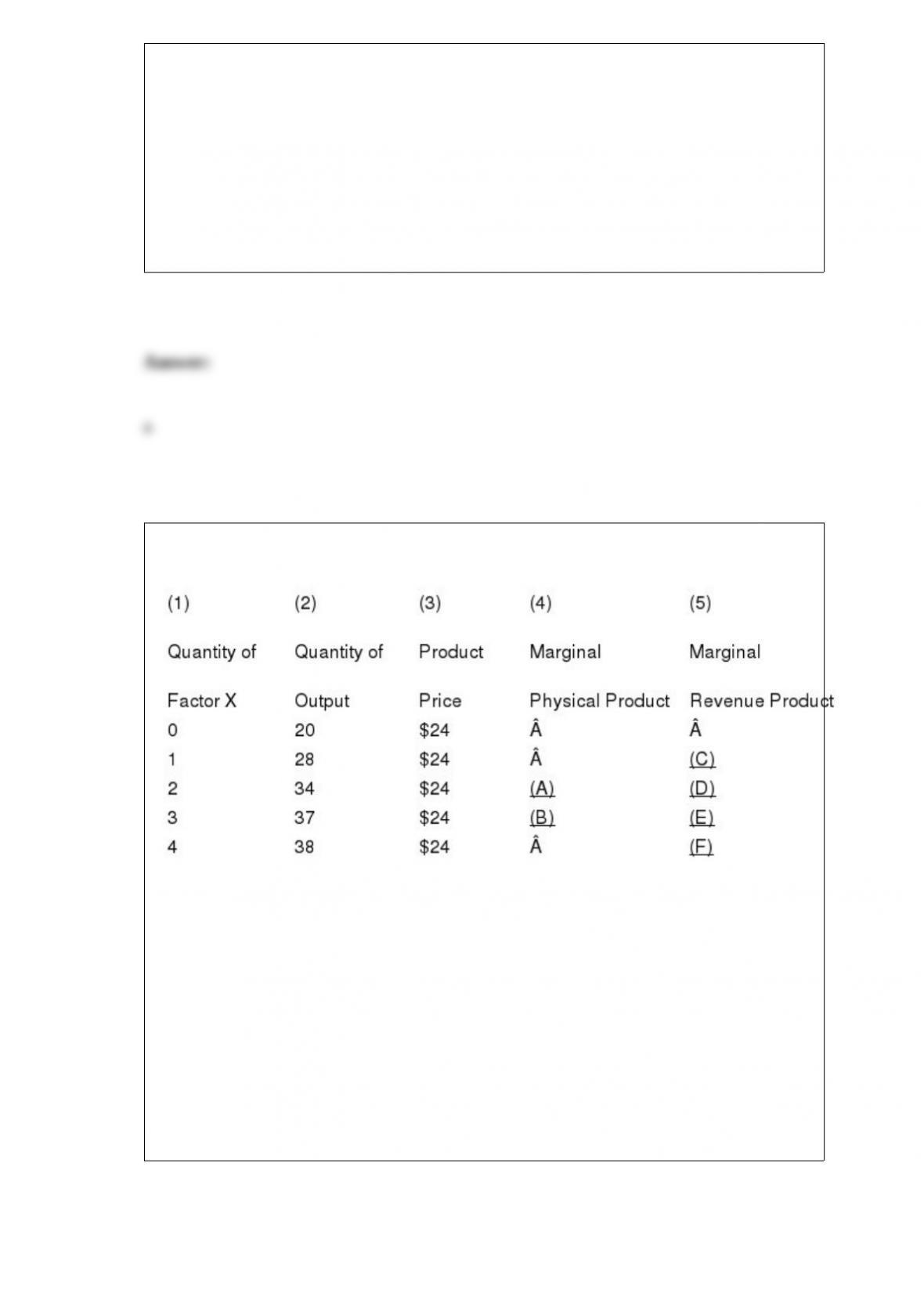
Exhibit 27-8
The marginal physical product of the second and third units of factor X, respectively
[blanks (A) and (B)], are,
a. 19 and 20.
b. 4.58 and 4.07.
c. 10 and 11.
d. 6 and 3.
e. none of the above

“The theory’s predictions are consistent with what I believe, so now I have good reason
to believe what the theory says.”This statement is likely to have been made by a person
who believes that
a. theories should be tested by gathering and analyzing data.
b. theories are descriptive of reality.
c. theories should be falsifiable or refutable.
d. b and c
e. none of the above
If the marginal utility of X is negative, then the last unit of X is
a. a bad
b. a normal good
c. an inferior good
d. not subject to the law of diminishing marginal utility

The Robinson-Patman Act of 1936 prohibited
a. large retailers from selling at prices below those prices charged by small retailers.
b. large retailers from engaging in false and deceptive acts and practices.
c. suppliers from offering price discounts to large retailers unless they also offered
discounts to all other retailers.
d. customers from seeking out the lowest-priced good from different retailers.
e. all of the above
The profit-maximizing monopolistic competitive firm produces the level of output at
which
a. price equals marginal cost.
b. marginal revenue equals marginal cost.
c. there is resource allocative efficiency.
d. average total cost is at a minimum.
Suppose that prices in France increase by 8 percent while prices in the United States
remain relatively stable. We would expect that (on the foreign exchange market) the
demand for U.S. dollars will __________ and the supply of U.S. dollars will
__________.
a. increase; decrease
b. increase; increase
c. decrease; decrease
d. decrease; increase

The poverty income threshold (or poverty line) is updated each year to reflect changes
in the consumer price index.
a. True
b. False
Mario earns profits by developing a product that is unusual, unique, and greatly in
demand. Which of the following theories of profit best describes the reason behind his
success?
a. Uncertainty is the source of profits.
b. Profit is the reward for alertness to arbitrage opportunities.
c. Profit is the return to the entrepreneur as innovator.
d. Profit is the return for being smart.
e. Profit is the return for being in the right place at the right time.
Resource X is necessary to the production of good Y. If the price of resource X rises,
a. the supply curve of Y shifts leftward.
b. the supply curve of Y shifts rightward.
c. the supply curve of Y is unaffected.
d. there is a movement down the supply curve of Y.
e. there is a movement up the supply curve of Y.

Carol works for Firm X. She takes long breaks and often daydreams when she is being
paid to work. Carol is
a. satisfying.
b. shirking.
c. monitoring.
d. separating ownership from control.
If the MU/P ratio for good X is less than the MU/P ratio for good Y, this means that
a. an individual is receiving more utility per dollar from good Y than good X.
b. the price of good X is lower than the price of good Y.
c. the price of good Y is lower than the price of good X.
d. the MU of good X is lower than the MU of good Y.
e. none of the above