1)
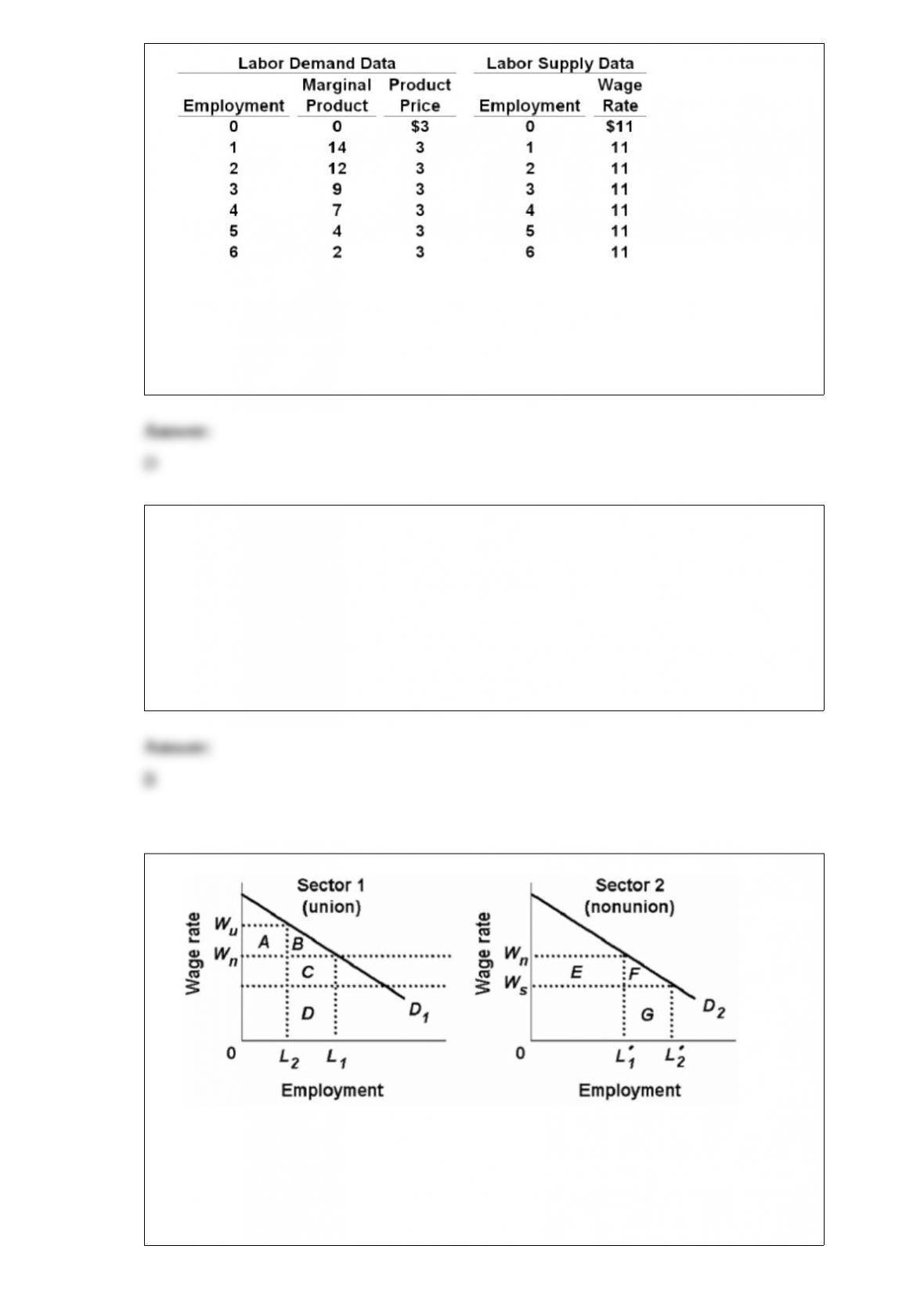
Refer to the above data. The labor supply curve facing firms is:
A.such that it does not intersect the labor demand curve.
B.upsloping.
C.perfectly inelastic.
D.perfectly elastic.
2) Under the gold standard:
A.nations can protect their domestic price and employment levels from changes in the
volume and direction of world trade.
B.exchange rates are virtually fixed.
C.differences in exports and imports will be precisely balanced by capital account
flows, excluding gold.
D.exchange rates fluctuate freely in response to changes in the supply of, and demand
for, foreign currencies.
3)
Assumptions: These two graphs show two sectors of the labor market for a particular
kind of labor. Relevant product markets are competitive. The two labor demand curves
are identical and initially the quantities of labor employed in the two sectors are L1and
L’1and the wage rate in each sector is Wn.

Refer to the above diagram and assumptions. If a union is formed in sector 1 and the
union increases the wage rate from Wn to Wu, then employment will:
A.decrease, but we cannot determine by how much.
B.decrease by 0L2 in sector 1
C.decrease by L1L2 in sector 1
D.increase by L1L2 in sector 1
4) if a technological advance increases a firm’s labor productivity, we would expect its:
a.average total cost curve to rise.
b.average total cost curve to fall.
c.total cost curve to rise.
d.average total cost curve to be unaffected.
5) Discretionary fiscal policy refers to:
A.any change in government spending or taxes that destabilizes the economy.
B.the authority that the President has to change personal income tax rates.
C.changes in taxes and government expenditures made by Congress to stabilize the
economy.
D.the changes in taxes and transfers that occur as GDP changes.
6) illegal immigration tends to:
a.increase average wages and employment where illegal workers are complements to
domestic-born workers.
b.increase average wages and employment where illegal workers are substitutes for
domestic-born workers.
c.increase average wages and employment whether illegal workers are complements to
or substitutes for domestic-born workers.
d.reduce average wages and employment whether illegal workers are complements to
or substitutes for domestic-born workers.
7) The following consolidated balance sheet of the commercial banking system.
Assume that the reserve requirement is 10 percent. All figures are in billions and each
question should be answered independently of changes specified in any preceding ones.
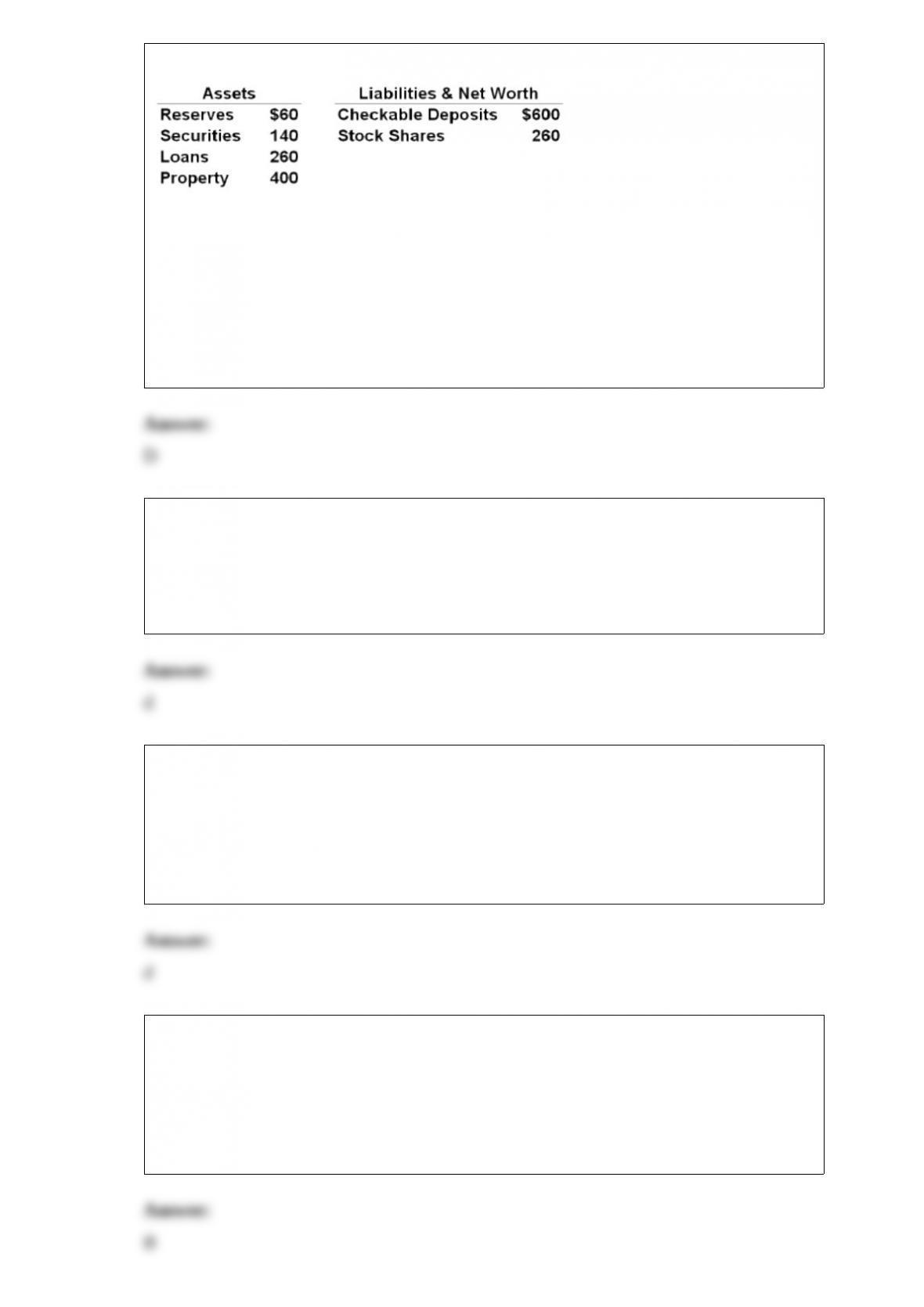
Refer to the above data. Suppose the Fed wants to increase the money supply by $400
billion to drive down interest rates and stimulate the economy. Assuming that the
money multiplier is operating to full effect, to accomplish the desired increase the Fed
could:
A.sell $20 billion of U.S. securities to the banks.
B.buy $20 billion of U.S. securities from the banks.
C.sell $40 billion of U.S. securities to the banks.
D.buy $40 billion of U.S. securities from the banks.
8) if the equation y = 15 – 4x was plotted, the:
a.vertical intercept would be -4
b.vertical intercept would be +4
c.vertical intercept would be +9
d.slope would be -4
9) the primary economic advantage of the european union (eu) to its members is that:
a.the tax structures of each participating nation have been made nearly identical.
b.each nation is free to formulate its own antitrust and agricultural policies.
c.participating nations must all use a common currency.
d.the reduction of trade barriers permits producers to achieve mass-production
economies.
10) The “time-value of money” refers to the fact that:
A.a given amount of money becomes more valuable over time.
B.a given amount of money is more valuable the sooner it is obtained.
C.people expect monetary compensation for their labor time.
D.a given amount of money today is equivalent to a smaller amount of money in the
future.
11)
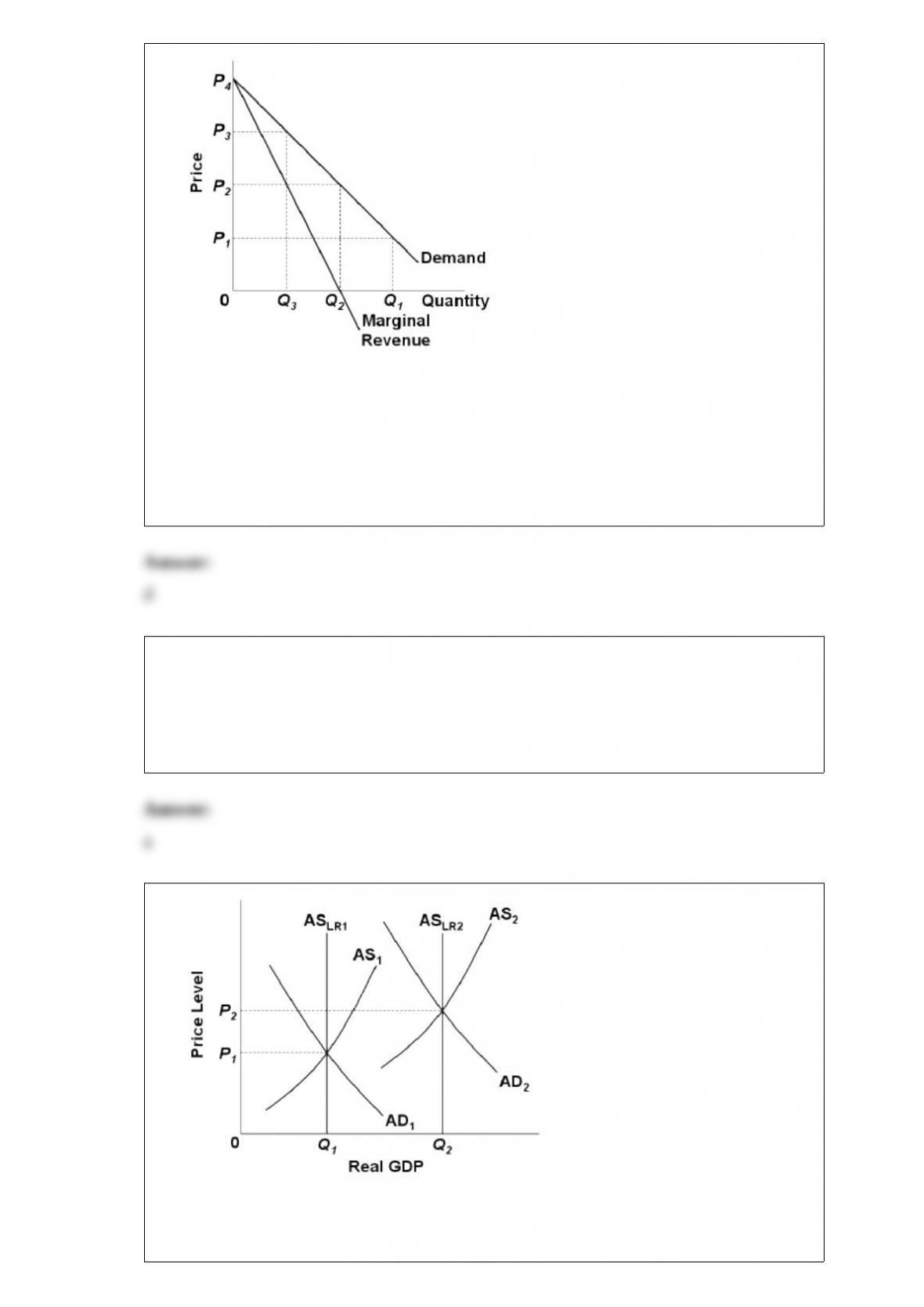
refer to the above diagram. if this somehow was a costless product (that is, the total cost
of any level of output was zero), the firm would maximize profits by:
a.selling the product at the highest possible price at which a positive quantity will be
demanded.
b.producing q1 units and charging a price of p1.
c.producing q3 units and charging a price of p3.
d.producing q2 units and charging a price of p2.
12) if total utility is increasing, marginal utility:
a.is positive, but may be either increasing or decreasing.
b.must also be increasing.
c.may be either positive or negative.
d.will be increasing at an increasing rate.
13)
Refer to the above graphs, where the subscripts on the labels denote years 1 and 2.
From the graphs we can clearly conclude that from year 1 to year 2:
A.the economy recovered from a recession.
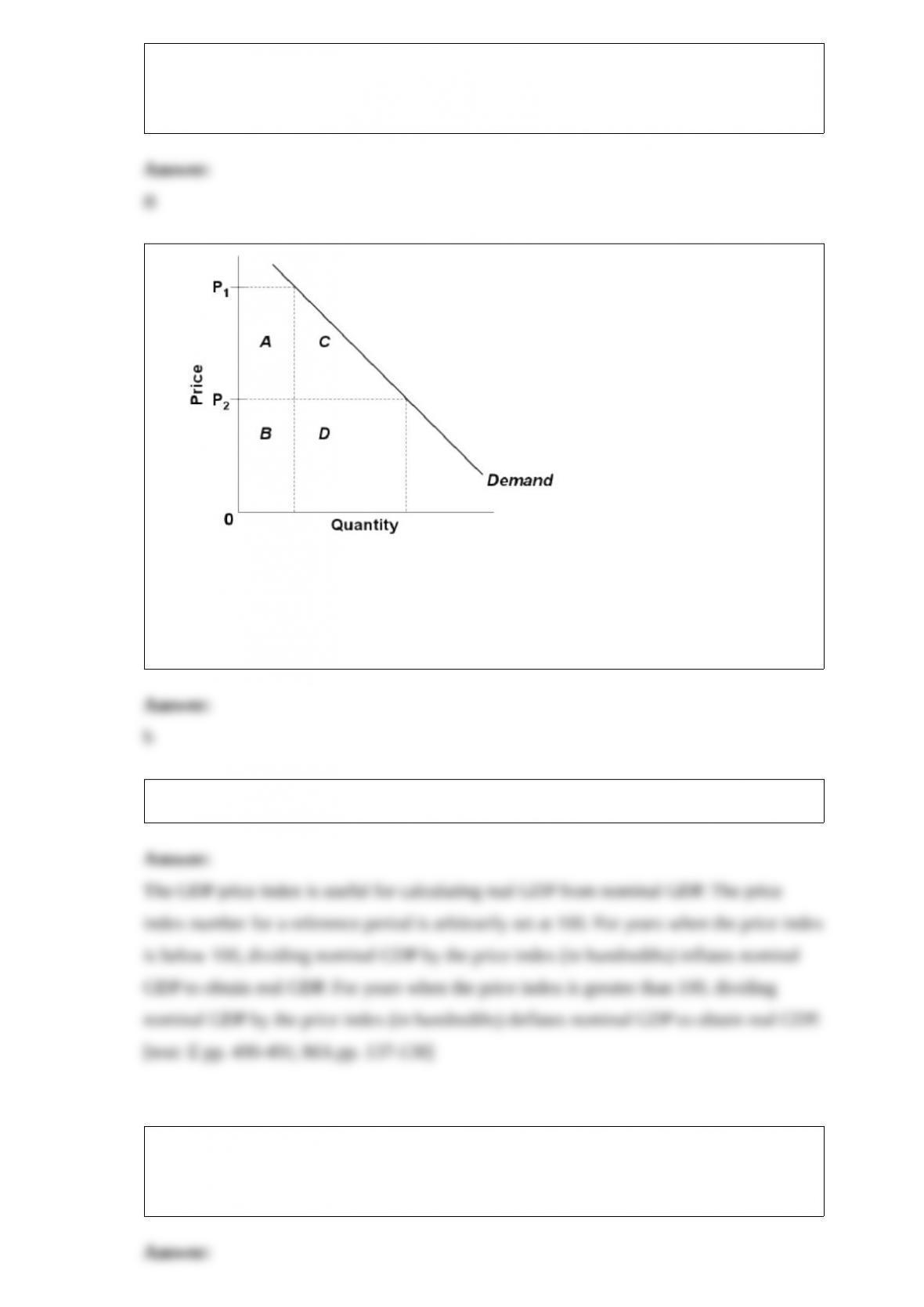
B.the economy experienced economic growth and mild inflation.
C.output grew and the unemployment rate fell.
D.the government engaged in expansionary fiscal and monetary policies.
14)
refer to the above diagram. total revenue at price p1is indicated by area(s):
a.c + d
b.a + b
c.a + c
d.a
15) What is the relationship between real GDP, nominal GDP, and the price index?
16) If monopolistically competitive firms have some control over their prices, why dont
they set price above average total cost so they will realize an economic profit in the
long run?
17) (Last Word) Do tax increases reduce real GDP?
18) How do direct controls and specific taxes affect externalities? Briefly explain in
terms of supply and demand.

19) What was the purpose of the Celler-Kefauver Act of 1950?
20) Why is a monopolist a price maker?
21) Explain how consumption and saving are related to disposable income in the
aggregate expenditures model.
22) What are the similarities and differences in the economic effects of tariffs and
quotas?

23) Cite five recent developments that have affected money and banking in the United
States.
24) What does the standardized budget measure and of what significance is this
concept?