1) The interest rate on seasonal credit equals
A) the federal funds rate
B) the primary credit rate
C) the secondary credit rate
D) an average of the federal funds rate and rates on certificates of deposits
2)
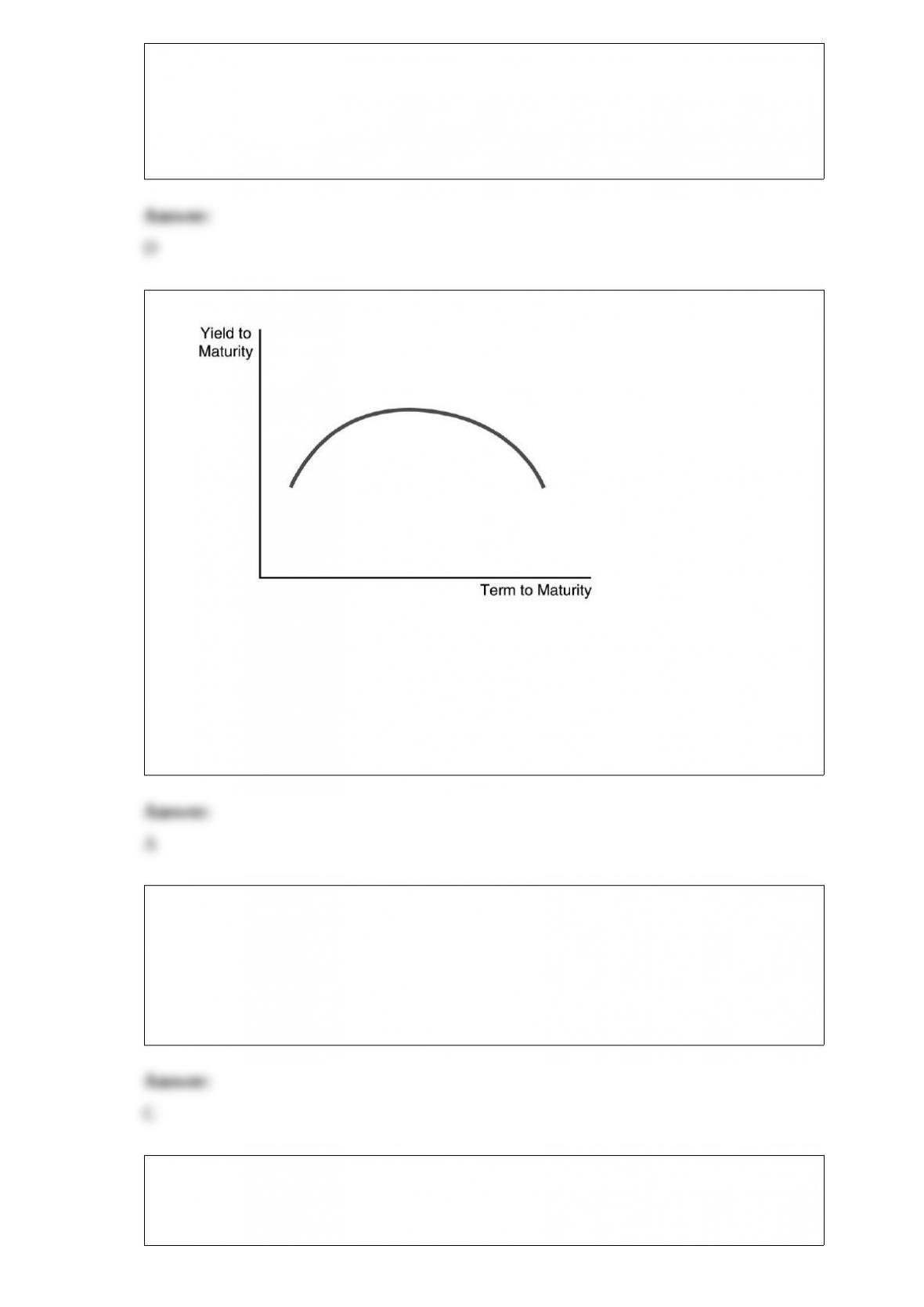
The mound-shaped yield curve in the figure above indicates that short-term interest
rates are expected to
A) rise in the near-term and fall later on
B) fall moderately in the near-term and rise later on
C) fall sharply in the near-term and rise later on
D) remain unchanged in the near-term and fall later on
3) Keynes hypothesized that the transactions component of money demand was
primarily determined by the level of
A) interest rates
B) velocity
C) income
D) stock market prices
4) Which of the following is not a disadvantage of exchange-rate targeting?
A) It relies on a stable money-inflation relationship
B) The targeting country gives up an independent monetary policy

C) The targeting country is left open for a speculative attack
D) It can weaken the accountability of policymakers
5) Much of the credit for prevention of a financial market meltdown after “Black
Monday” ( October 19, 1987 ) must be given to the Federal Reserve System and its
chairman
A) Paul Volker
B) Alan Blinder
C) Arthur Burns
D) Alan Greenspan
6) If a corporation begins to suffer large losses, then the default risk on the corporate
bond will
A) increase and the bond’s return will become more uncertain, meaning the expected
return on the corporate bond will fall
B) increase and the bond’s return will become less uncertain, meaning the expected
return on the corporate bond will fall
C) decrease and the bond’s return will become less uncertain, meaning the expected
return on the corporate bond will fall
D) decrease and the bond’s return will become less uncertain, meaning the expected
return on the corporate bond will rise
7) The ratio that relates the change in the money supply to a given change in the
monetary base is called the
A) money multiplier
B) required reserve ratio
C) deposit ratio
D) discount rate
8) In general, banks make profits by selling ________ liabilities and buying ________
assets.

A) long-term; shorter-term
B) short-term; longer-term
C) illiquid; liquid
D) risky; risk-free
9) Everything else held constant, when the inflation rate is expected to rise, interest
rates will ________; this result has been termed the ________.
A) fall; Keynes effect
B) fall; Fisher effect
C) rise; Keynes effect
D) rise; Fisher effect
10) The combination of a successful wage push by workers and the government’s
commitment to high employment leads to
A) demand-pull inflation
B) supply-side inflation
C) supply-shock inflation
D) cost-push inflation
11) Financial institutions that accept deposits and make loans are called
A) exchanges
B) banks
C) over-the-counter markets
D) finance companies
12) The theory of purchasing power parity states that exchange rates between any two
currencies will adjust to reflect changes in
A) the trade balances of the two countries
B) the current account balances of the two countries
C) fiscal policies of the two countries
D) the price levels of the two countries

13) If the nominal rate of interest is 2 percent, and the expected inflation rate is -10
percent, the real rate of interest is
A) 2 percent
B) 8 percent
C) 10 percent
D) 12 percent
14) When Americans or foreigners expect the return on ________ assets to be high
relative to the return on ________ assets, there is a higher demand for dollar assets and
a correspondingly lower demand for foreign assets.
A) dollar; dollar
B) dollar; foreign
C) foreign; dollar
D) foreign; foreign
15) If a bank’s liabilities are more sensitive to interest rate movements than are its
assets, then
A) an increase in interest rates will reduce bank profits
B) a decrease in interest rates will reduce bank profits
C) interest rates changes will not impact bank profits
D) an increase in interest rates will increase bank profits
16) The primary liabilities of a commercial bank are
A) bonds
B) mortgages
C) deposits
D) commercial paper
17) A negative supply shock causes ________ to ________.
A) aggregate demand; increase

B) aggregate demand; decrease
C) short-run aggregate supply; decrease
D) short-run aggregate supply; increase
18) Differences in ________ explain why interest rates on Treasury securities are not all
the same.
A) risk
B) liquidity
C) time to maturity
D) tax characteristics
19) An important function of secondary markets is to
A) make it easier to sell financial instruments to raise funds
B) raise funds for corporations through the sale of securities
C) make it easier for governments to raise taxes
D) create a market for newly constructed houses
20) Under the current managed float exchange rate regime, countries with balance of
payments ________ frequently do not want to see their currencies ________ because it
makes foreign goods more expensive for domestic consumers and can stimulate
inflation.
A) surpluses; depreciate
B) deficits; depreciate
C) surpluses; appreciate
D) deficits; appreciate
21) An increase in which of the following leads to a decline in the monetary base?
A) Float
B) Discount loans
C) Foreign deposits at the Fed
D) SDRs

22) Hedging by buying an option
A) limits gains
B) limits losses
C) limits gains and losses
D) has no limit on option premiums
23) According to the efficient markets hypothesis, purchasing the reports of financial
analysts
A) is likely to increase one’s returns by an average of 10%
B) is likely to increase one’s returns by about 3 to 5%
C) is not likely to be an effective strategy for increasing financial returns
D) is likely to increase one’s returns by an average of about 2 to 3%
24) Of the three agencies that have been created to promote residential housing, the
only one that is an entity of the U.S. government is
A) Fannie Mae
B) Ginnie Mae
C) Freddie Mac
D) Sallie Mae
25) If a bank has excess reserves of $4,000 and demand deposit liabilities of $100,000,
and if the reserve requirement is 10 percent, then the bank has actual reserves of
A) $14,000
B) $19,000
C) $24,000
D) $29,000
26) During the 1950s, Fed monetary policy targeted
A) the monetary base
B) the exchange rate

C) discount loans
D) interest rates