A decrease in the unemployment rate may be represented as a movement from a point
on the production possibilities frontier to a point outside the frontier.
If consumers believe the price of iPads will decrease in the future, this will cause the
demand for iPads to decrease now.
In a centrally planned economy, the households and firms decide how economic
resources will be allocated.
Real business cycle models argue that fluctuations in real GDP are caused by
unanticipated changes in the money supply.
Globalization is the process of countries imposing trade restrictions on other countries.
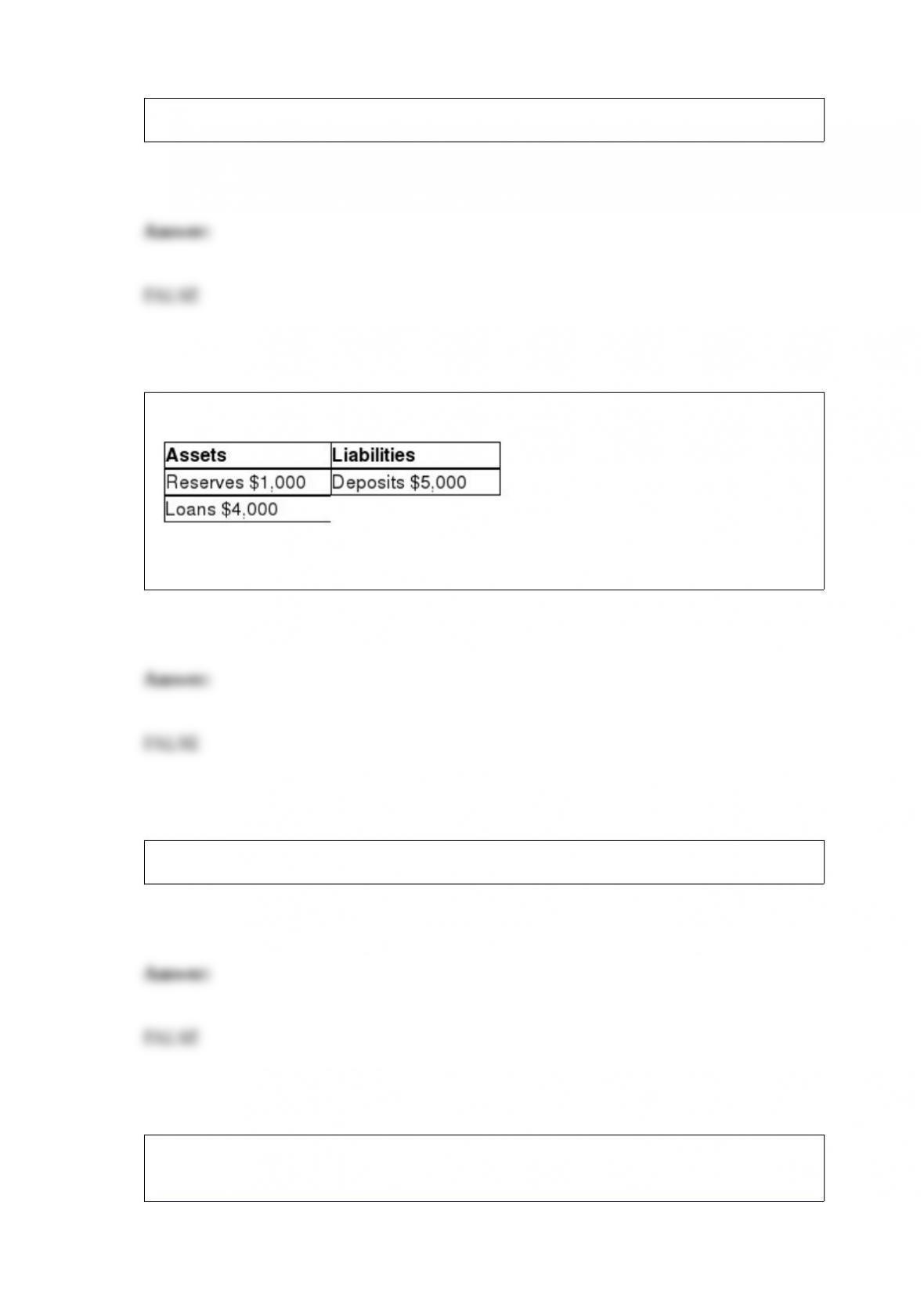
Consider the following T-account for a bank:
If the required reserve ratio is 10 percent, the bank at this point can make no more
loans.
A successful strategy of price discrimination requires that a firm be a price-taker.
The Social Security and Medicare programs have been a failure in terms of reducing
poverty among elderly U.S. citizens.
If it costs Hobie $900 to produce 5 lamps and $1,200 to produce 6 lamps, then the
difference of $300 is the marginal cost of producing the 5th lamp.
Despite saving Lehman Brothers from failing, the Fed and the Treasury decided to
allow Bear Stearns to go bankrupt, which it did in September, 2008.
An economy without money would have no exchanges of goods and services.
The marginal rate of substitution is determined by the slope of an indifference curve.

Accumulating a greater number of inputs will ensure that an economy will experience
economic growth.
A financial asset is considered ________ if it can be sold in a secondary market.
A) a commodity
B) a security
C) a liability
D) durable
Which of the following accurately describes growth rates in the United States from
1900 to the present?
A) Growth rates rose until the 1970s and then fell until the present.
B) Growth rates have risen continuously from 1900 to the present.
C) Growth rates rose until the 1970s, slowed until the 1990s, and then rose up to the
present.
D) Growth rates have fallen continuously from 1900 to the present.
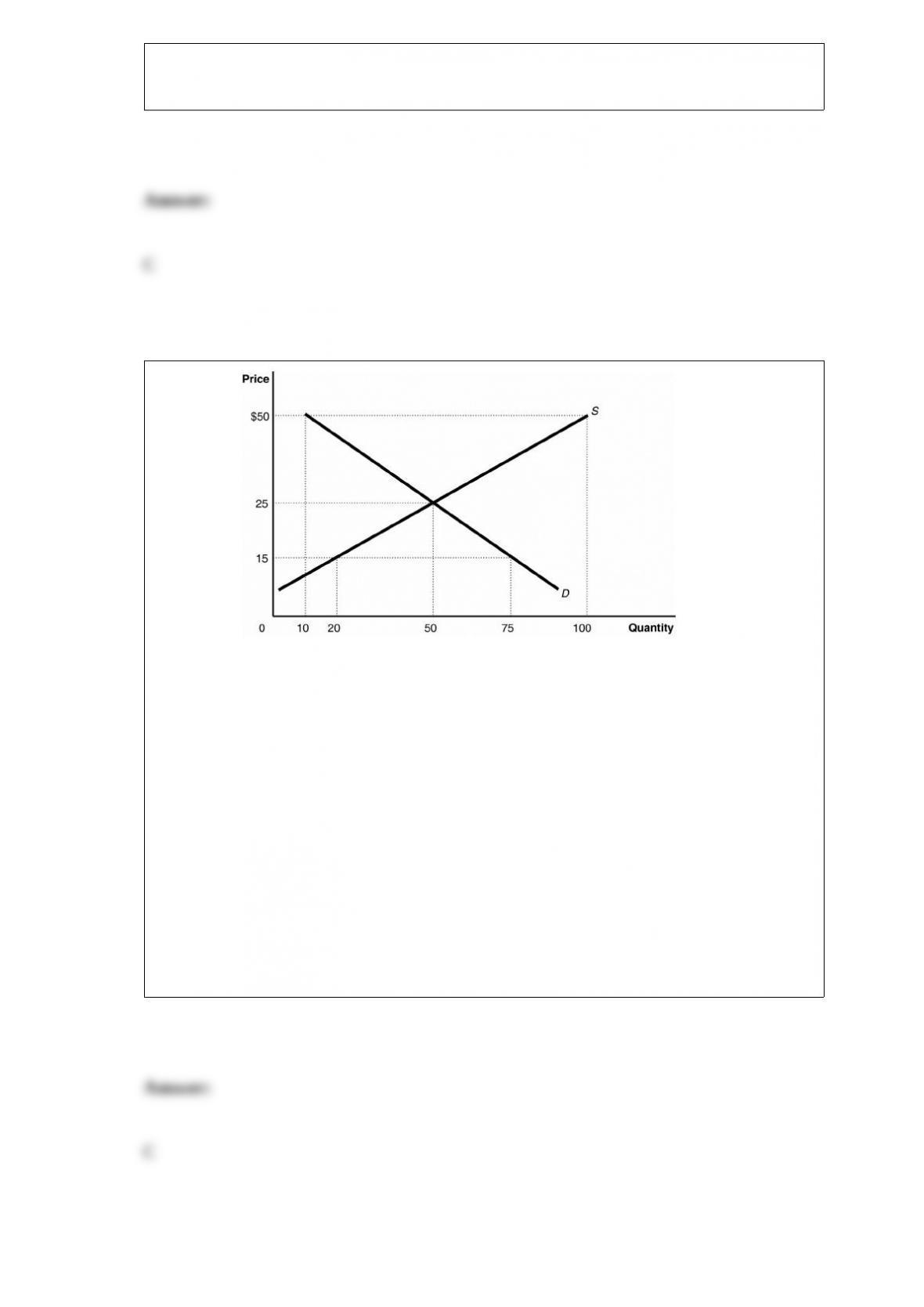
Figure 3-6
The figure above represents the market for coffee grinders. Assume that the price of
coffee grinders is $50. At this price:
A) the quantity supplied exceeds the quantity supplied by 100. The price will eventually
fall to $25 where quantity demanded will equal quantity supplied.
B) the supply exceeds the demand by 90. Some producers will have an incentive to
offer to sell coffee grinders at a lower price.
C) there is a surplus equal to 90 coffee grinders that will be eliminated when the price
falls to $25.
D) there is a surplus equal to 90 coffee grinders and the price of coffee grinders will fall
until demand is equal to supply.

Without an increase in the supplies of factors of production, how can a nation achieve
economic growth?
A) by producing more high-value goods and less of low-value goods
B) through technological advancement which enables more output with the same
quantity of resources
C) by lowering the prices of factors of production
D) by increasing the prices of factors of production
Health insurance markets have a problem with insuring people who are “poor health
risks” while many people who are “good health risks” do not buy insurance. This
problem is an example of
A) moral hazard.
B) adverse selection.
C) market signaling.
D) asymmetric information.
If marginal cost is zero, with an optimal two-part tariff,
A) total revenue is maximized.
B) consumers maximize their surplus

C) the firm does not have to charge a fixed-fee portion.
D) firms may not maximize profit.
An increase in interest rates
A) decreases investment spending on machinery, equipment and factories, but increases
consumption spending on durable goods and net exports.
B) decreases investment spending on machinery, equipment and factories, and
consumption spending on durable goods, but increases net exports.
C) decreases investment spending on machinery, equipment and factories, consumption
spending on durable goods, and net exports.
D) increases investment spending on machinery, equipment and factories, consumption
spending on durable goods, and net exports.
The average tax rate is calculated as
A) total income divided by the total tax paid.
B) the change in total tax paid divided by the change in income.
C) total tax paid divided by total income.
D) the change in income divided by the change in total tax paid.
A horizontal merger
A) is a merger between firms in the same industry.
B) results in a trust (for example, the Standard Oil Company).
C) is a merger between firms at different stages of production of a good.
D) was illegal in the United States until the Federal Trade Commission Act was passed
by Congress in 1914.
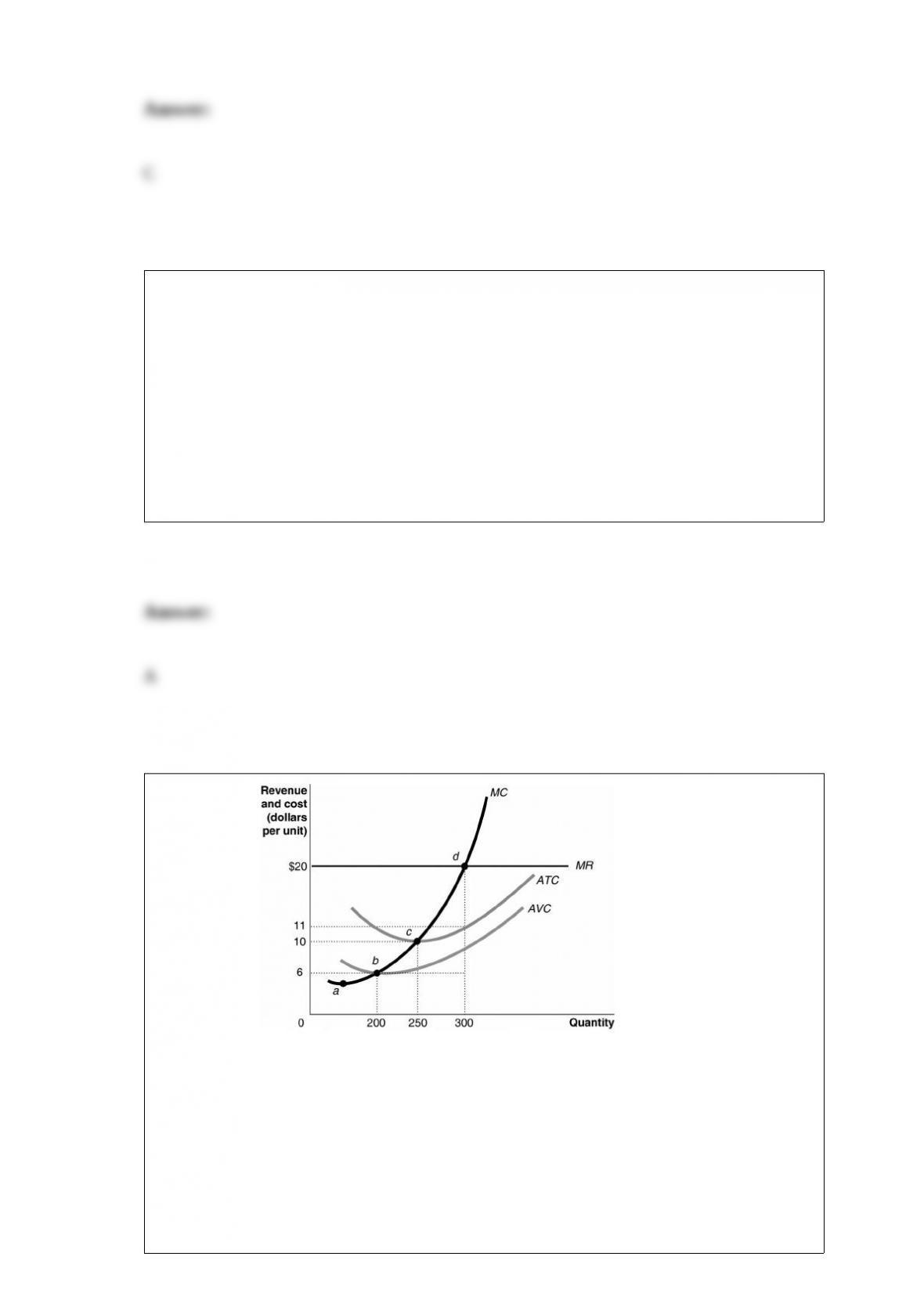
Figure 12-10
Total revenue at the profit-maximizing level of output is
A) $1,200.
B) $2,500.
C) $4,800.

D) $6,000.
Which of the following is the most liquid asset?
A) a Renoir painting
B) bonds
C) a car
D) money
Ocean Spray is considered to be an oligopoly firm because, until the 1990s, it faced
little competition in the market for fresh and frozen cranberries. Why?
A) Ocean Spray had a patent on the production of cranberries that gave the company
the exclusive right to market its product for 20 years. The 20-year period ended in the
1990s.
B) Until the 1990s, Ocean Spray controlled almost the entire supply of cranberries.
C) Ocean Spray was able to achieve significant economies of scale in the production of
cranberries. Beginning in the 1990s, other firms finally achieved economies of scale as
well, but Ocean Spray still controls about 80 percent of the cranberry market.
D) The federal government imposed a high tariff on cranberry imports. During the
1990s the tariff was eliminated, but Ocean Spray still controls about 80 percent of the
cranberry market.
Describe each of the principles governments consider when deciding which taxes to
use.
What area on a supply and demand graph represents producer surplus?
Why would a company continue to operate for many years while never once turning a
profit rather than shut down immediately? Using revenue and cost analysis, explain
when the company would shut down.
Firms engage in odd pricing when they charge prices that appear to be less than they
really are; for example, charging a price of $4.95 instead of $5.00 and $.99 instead of
$1.00. How have researchers tried to determine whether odd pricing is successful in
convincing consumers that odd prices are less than they really are?
What factors would make you more sensitive or less sensitive to price when purchasing
gasoline?
What is corporate governance?
What is the difference between total cost and variable cost in the long run?
Describe what has happened to state obesity rates in the United States since 1994.
What has happened to health care’s share of gross domestic product in the United States
since 1965? How does this compare to what has happened to out-of-pocket spending on
health care as a percentage of all spending on health care?