You have a bond that pays $60 per year in coupon payments. Which of the following
would result in a decrease in the price of your bond?
A) Coupon payments on newly-issued bonds fall to $40 per year.
B) The likelihood that the firm issuing your bond will default on debt decreases.
C) The price of a share of stock in the company rises.
D) Coupon payments on newly-issued bonds rise to $75 per year.
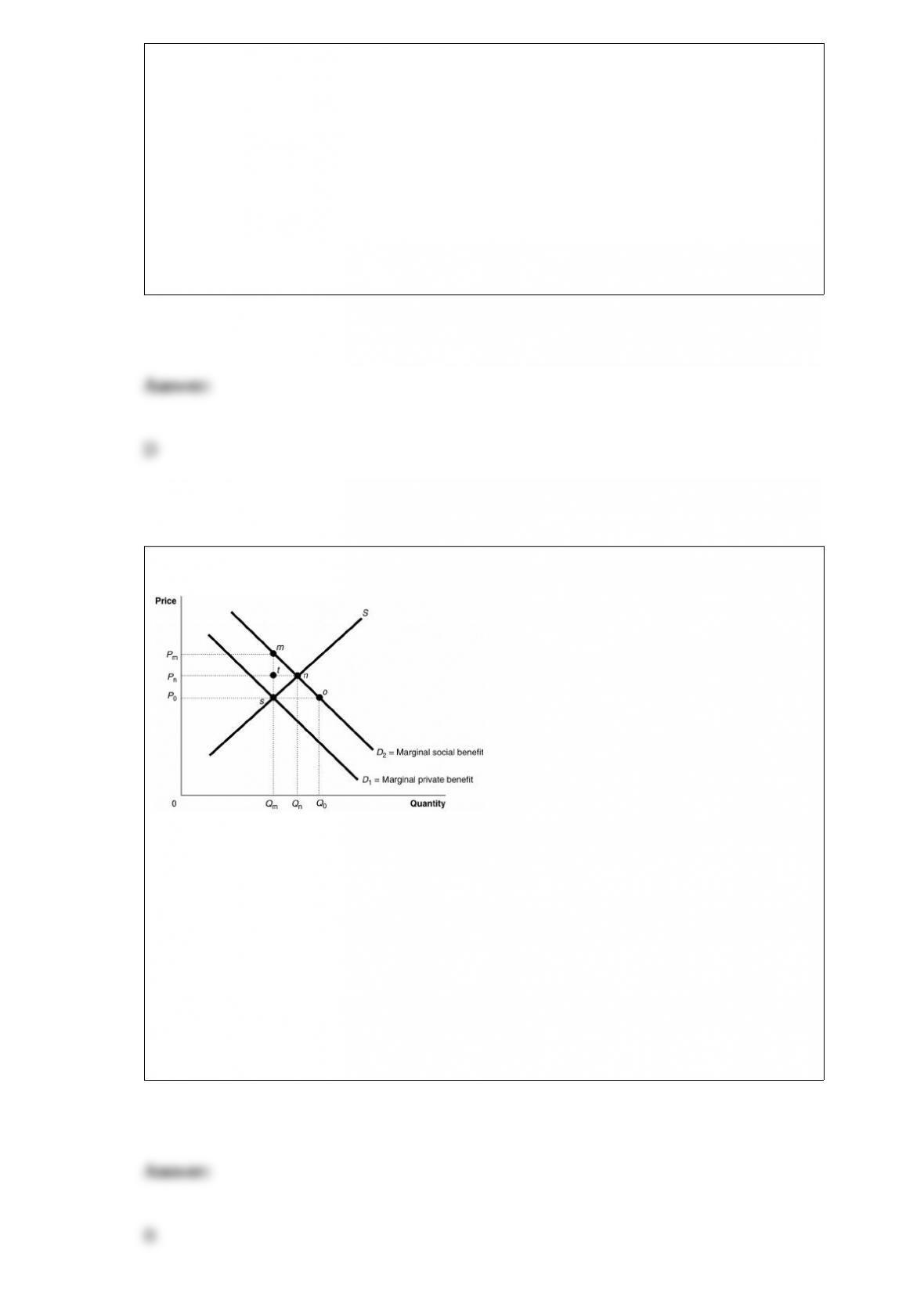
Figure 5-3
At the competitive market equilibrium, for the last unit produced
A) the size of the external cost is Pm– Po.
B) the size of the external benefit is Pm– Po.
C) the size of the external cost is P– Po.
D) the size of the external benefit is P– Po.

Prices of smartphones (assume that this is a normal good) have fallen in recent years.
Over this same period, the price of the components used to produce smartphones has
also fallen and consumer incomes have risen. Which of the following best explains the
falling prices of smartphones?
A) The supply curve for smartphones has shifted to the right while the demand curve
for smartphones has shifted to the left.
B) The demand curve for smartphones has shifted to the right more than the supply
curve has shifted to the right.
C) The demand curve and the supply curve for smartphones have both shifted to the
left.
D) The supply curve for smartphones has shifted to the right more than the demand
curve has shifted to the right.
If the marginal propensity to consume is 0.75, the marginal propensity to save is
A) 0.25.
B) 0.5.
C) 1.
D) 3.

The Taylor rule accurately predicted the changes in the federal funds target during the
period
A) when Alan Greenspan was the chairman of the Federal Reserve Board.
B) when Paul Volcker was the chairman of the Federal Reserve Board.
C) when Arthur Burns was the chairman of the Federal Reserve Board.
D) when William McChesney Martin was the chairman of the Federal Reserve Board.
One reason why, in the last four decades, the number of new auto makers in the world
has been very small compared to the past is that
A) the automobile cannot be improved upon in any way by new producers.
B) new auto makers cannot obtain necessary inputs to produce new cars.
C) governments restrict who can produce automobiles.
D) new producers cannot match the economies of scale of existing auto makers.
Real GDP will increase
A) only if the price level rises.
B) only if the price level falls.
C) only if the quantity of final goods and services produced rises.
D) if either the price level rises or the quantity of final goods and services produced
rises.
a. Draw a production possibilities frontier for a country that produces two goods, wine
and cheese. Assume that resources are not equally suited to both tasks.
b. Define opportunity costs.
c. Use your production possibilities frontier graph to demonstrate the principle of
opportunity costs.

Which of the following is one of the most important benefits of money in an economy?
A) Money allows for the exchange of goods and services.
B) Money allows for the accumulation of wealth.
C) Money makes exchange easier, leading to more specialization and higher
productivity.
D) Money encourages people to produce all of their own goods (self-sufficiency) and
therefore increases economic stability.
Compared to perfect competition, the consumer surplus in a monopoly
A) is unchanged because price and output are the same.
B) is lower because price is higher and output is lower.
C) is higher because price is higher and output is the same.
D) is eliminated.