1) rosenbaum is purchasing products c and d in utility-maximizing amounts. if the price
of c is $4 and the price of d is $2, then:
a.the marginal utility of d is twice that of c
b.the marginal utility of d is the same as that of c
c.the marginal utility of c is twice that of d
d.the marginal utility of c is four times that of d
2) The World Trade Organization:
A.is also known as the International Monetary Fund (IMF).
B.is also known as NAFTA.
C.was established to resolve disputes arising under world trade rules.
D.enhances world trade by providing interest rate subsidies to foreign borrowers who
buy exports on credit.
3)
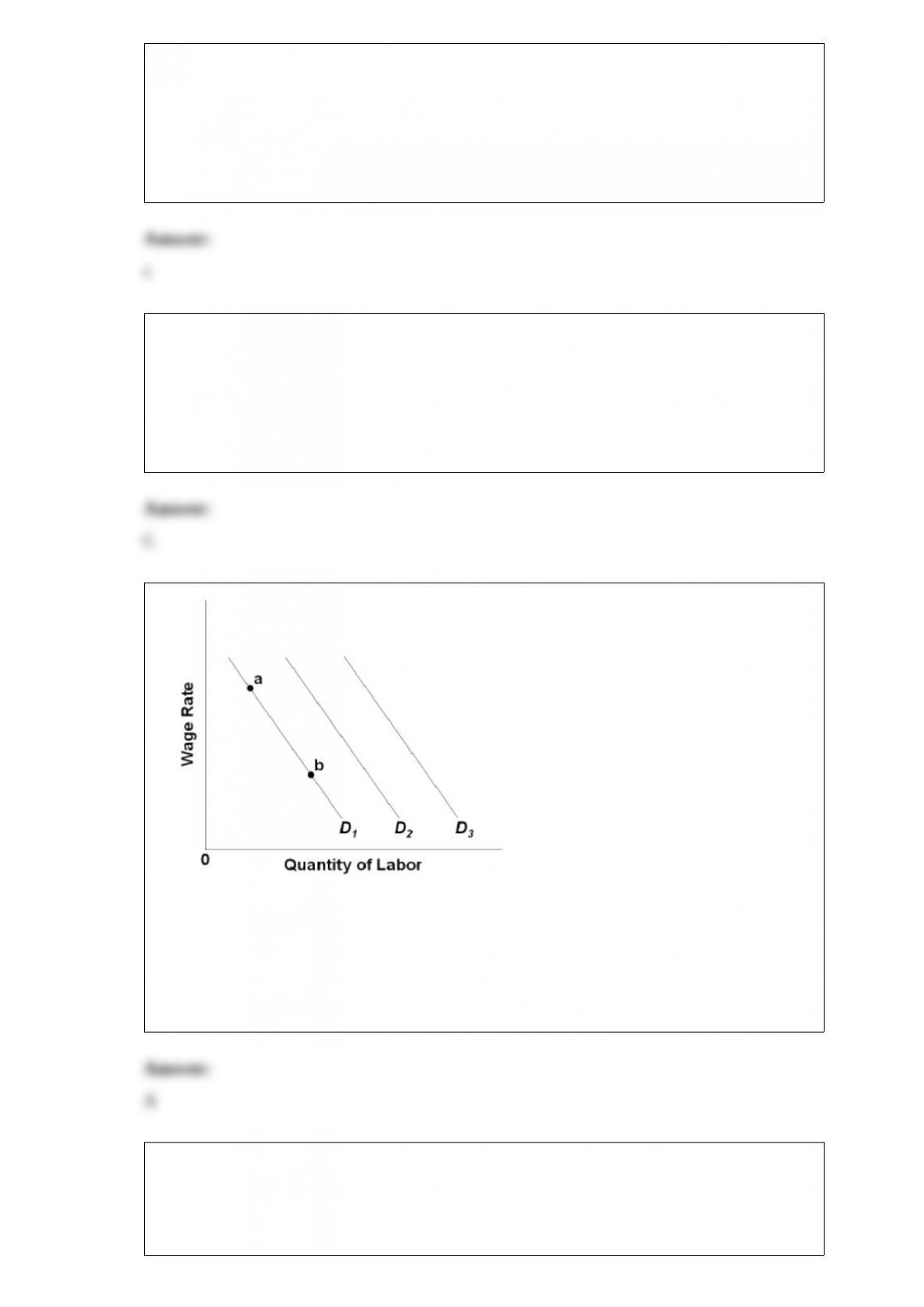
Refer to the above graph. Other things equal, an increase in the price of substitute
resource would cause a(n):
A.shift from D2 to D3 assuming the substitution effect exceeds the output effect.
B.move from a to b on D1.
C.move from b to a on D1.
D.shift from D3 to D2 assuming the substitution effect exceeds the output effect.
4) (Consider This) The main idea highlighted in the story about artist Pablo Picasso is:
A.derived demand.
B.human capital.
C.opportunity cost.
D.occupational licensure.
5) a fundamental difference between the command system and the market system is
that, in command systems:
a.the division of output is decided by central planning rather than by individuals
operating freely through markets.
b.all economic decisions are made by the government, whereas there is no government
in a market system.
c.scarcity does not exist, as it does in a market system.
d.money is not used, whereas it is in a market system.
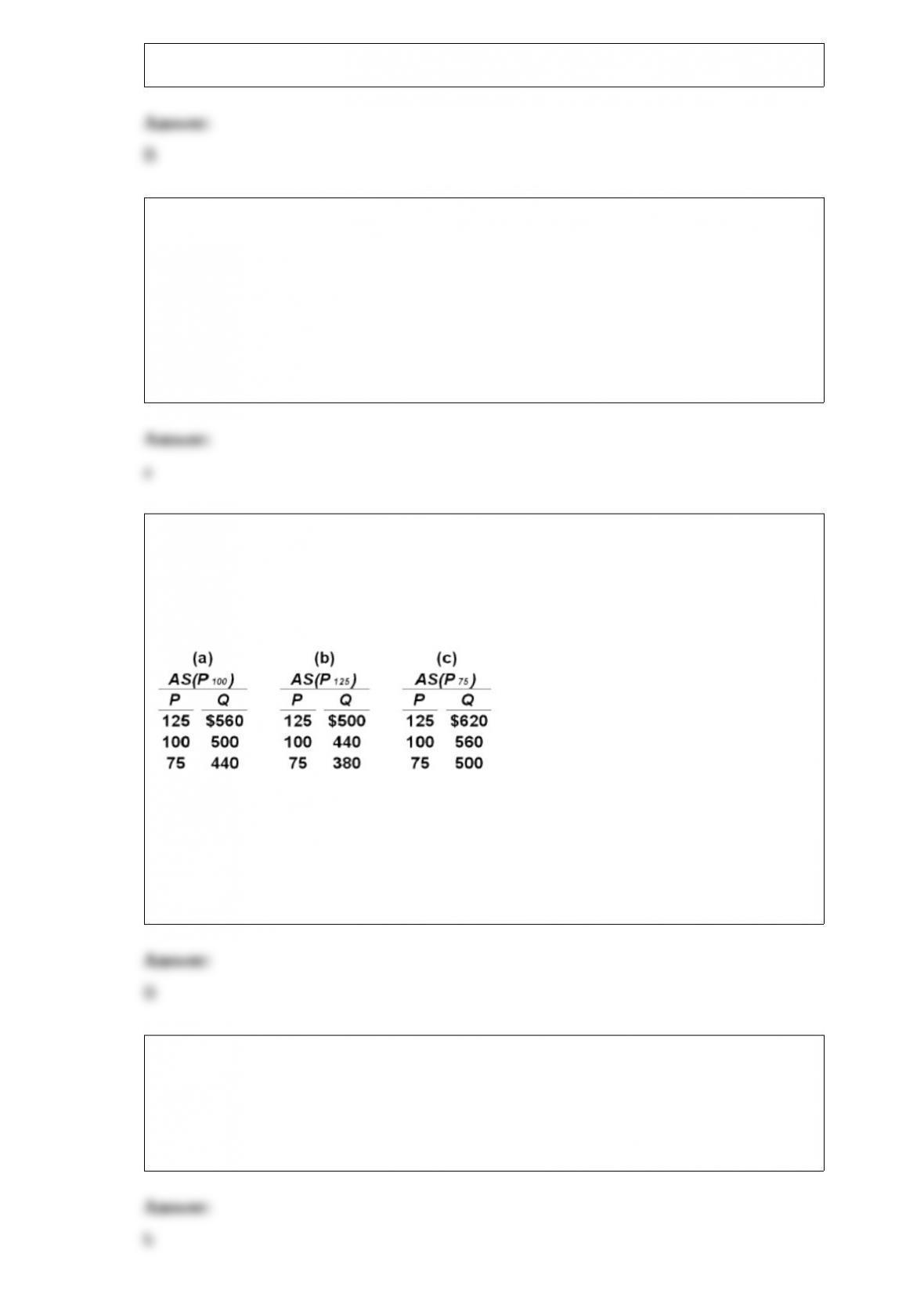
6) Suppose the full employment level of real output (Q) for a hypothetical economy is
$500, the price level (P) initially is 100, and that prices and wages are flexible both
upward and downward. Use the following short-run aggregate supply schedules to
answer the next question(s).
Refer to the information above. If the price level unexpectedly declines from 100 to 75,
the level of real output in the short run will:
A.rise from $500 to $560.
B.fall from $500 to $440.
C.fall from $560 to $500.
D.rise from $440 to $500.
7) consumption of fixed capital (depreciation) can be determined by:
a.adding taxes on production and imports to ndp.
b.subtracting ndp from gdp.
c.subtracting net investment from gdp.
d.adding net investment to gross investment.

8) Which of the following is an example of market failure?
A.information asymmetries
B.externalities
C.public goods
D.all of these
9) The creation of a market for pollution rights would:
A.reduce air and water pollution to zero.
B.stimulate the search for pollution-reducing technologies.
C.induce an increase in the supply of pollution rights.
D.be in conflict with the concept of user charges.
10) “remittances” occur when:
a.two countries send immigrants to each other in approximately equal numbers.
b.physical capital flows into a country that has lost labor due to migration.
c.immigrants send financial payments back to family in their country of origin.
d.migrants return to their home country.
11) In international financial transactions, what are the only two things that individuals
and firms can exchange?
A.currency and real assets.
B.services and manufactured goods.
C.preexisting assets and currently produced goods and services.
D.currency and currently produced goods and services.
12) Answer the next question(s) on the basis of the following information for a bond
having no expiration date: bond price = $1000; bond fixed annual interest payment =
$100; bond annual interest rate = 10 percent.
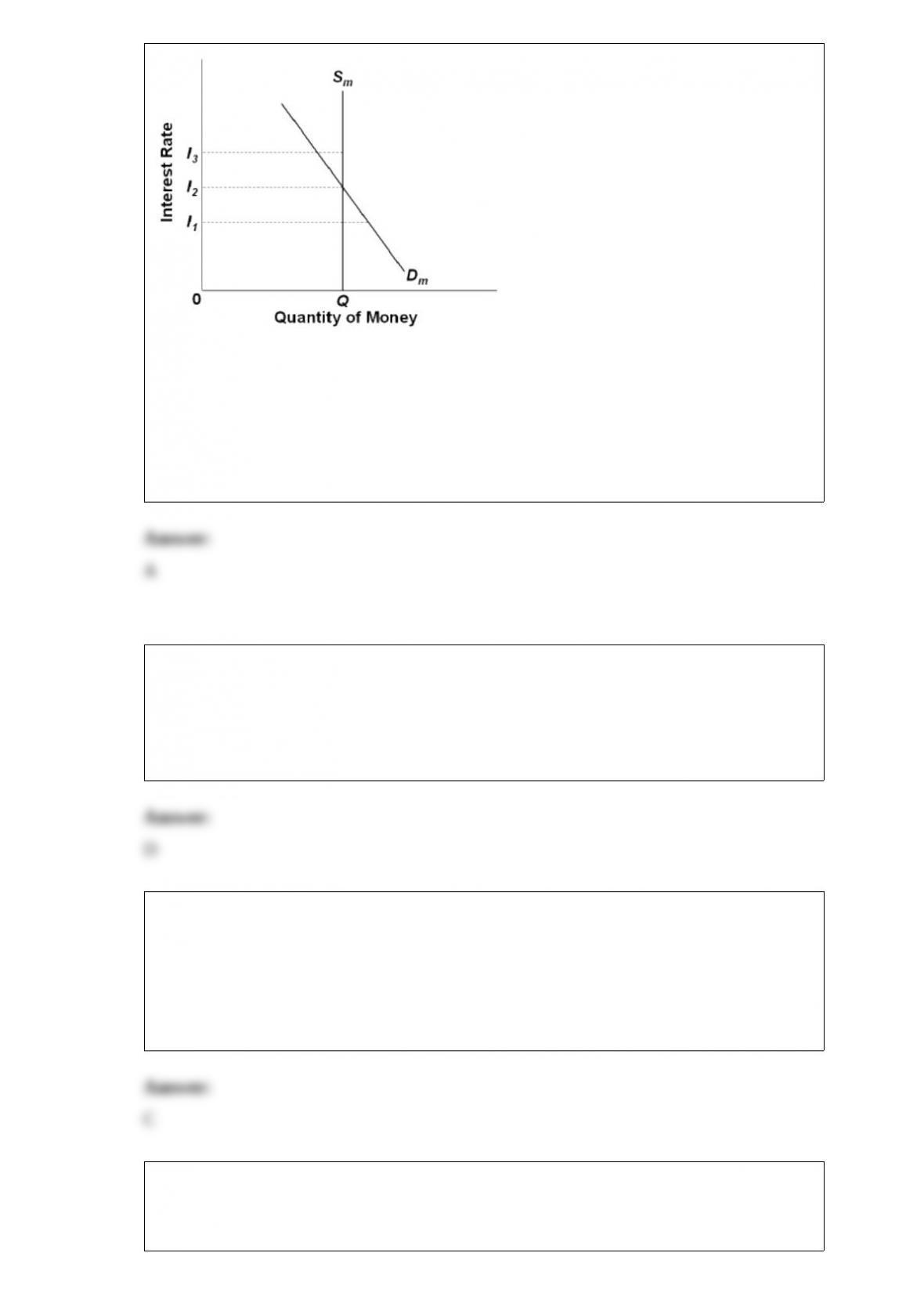
Refer to the above information. If the price of this bond falls by $200, the interest rate
will:
A.rise by 2.5 percentage points.
B.rise by 5 percentage points.
C.fall by 2.5 percentage points.
D.fall by 5 percentage points.
13) Social, as distinct from industrial, regulation is the major focus of the:
A.Federal Trade Commission.
B.Federal Energy Regulatory Commission.
C.Federal Communications Commission.
D.Consumer Products Safety Commission.
14) Which of the following correctly orders, highest to lowest, the relative magnitudes
of U.S spending by businesses on components of R&D?
A.invention, basic research, innovation.
B.invention, innovation, basic research.
C.innovation, invention, basic research.
D.basic research, invention, innovation.
15) In the real business cycle theory:
A.declines in real output cause declines in the money supply and thus aggregate
demand.
B.decreases in long-run aggregate supply are fully anticipated and therefore do not
reduce real output.
C.technology is constant.
D.economic instability results from inappropriate monetary policy.
16)
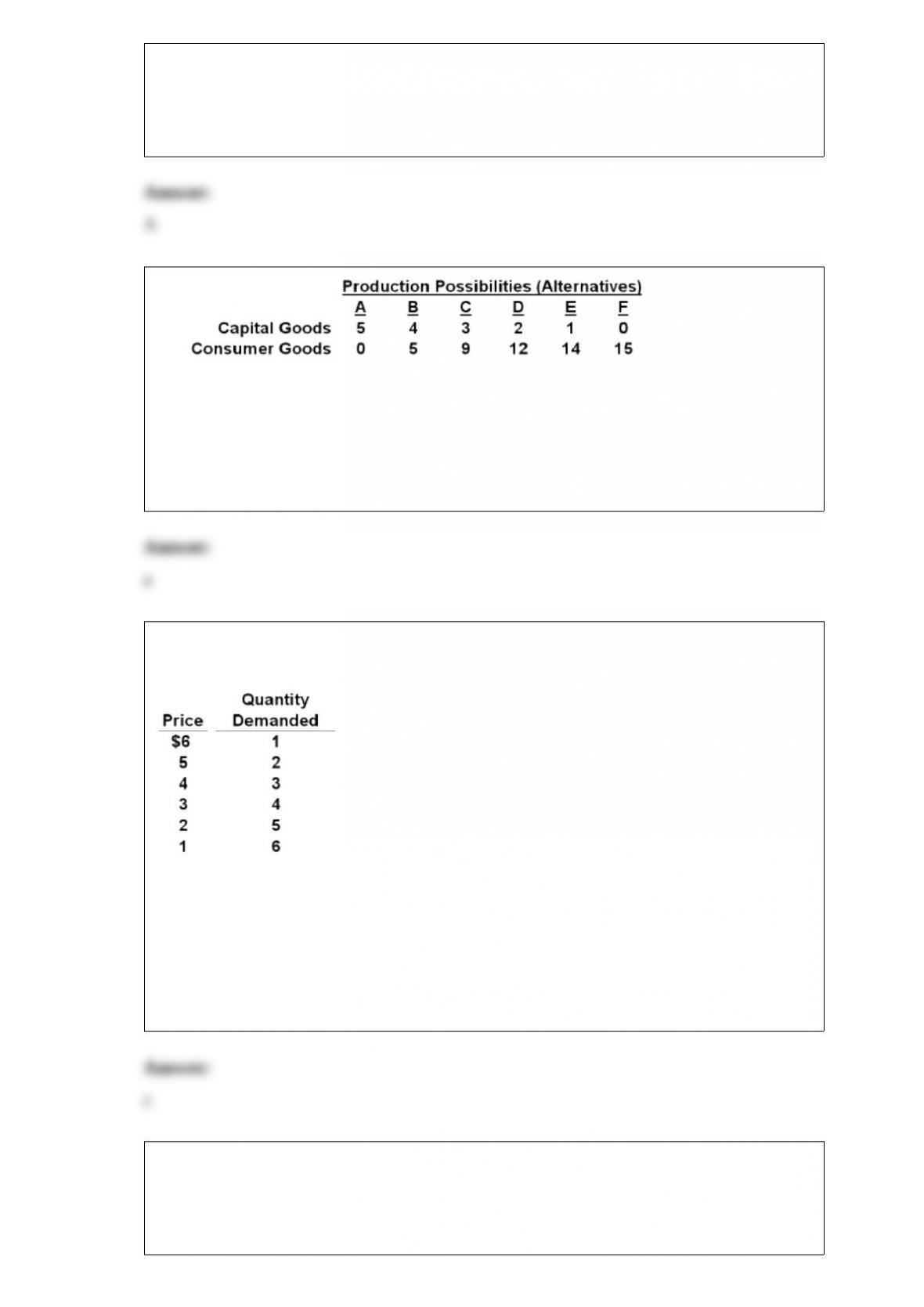
refer to the above table. for this economy to produce a total output of 3 units of capital
goods and 13 units of consumer goods it must:
a.achieve economic growth.
b.use its resources more efficiently than the data in the table now indicate.
c.allocate its available resources most efficiently among alternative uses.
d.achieve the full employment of available resources.
17) the following demand schedule:
if the price elasticity of demand for gasoline is 0.20:
a.the demand for gasoline is linear.
b.a rise in the price of gasoline will reduce total revenue.
c.a 10 percent rise in the price of gasoline will decrease the amount purchased by 2
percent.
d.a 10 percent fall in the price of gasoline will increase the amount purchased by 20
percent.
18) (consider this) the consider this box on patents and innovation demonstrates that:
a.patent protection for u.s. companies may not be as effective when other countries do
not respect or enforce u.s. patent laws.
b.patent laws are relatively uniform across nations.
c.countries like india have no incentive to enact or enforce patent laws.
d.follower countries tend to have stronger patent laws than leader countries.
19) (Advanced analysis) Answer the next question(s) on the basis of the following
consumption and investment data for a private closed economy. Figures are in billions
of dollars.
C = 60 + .6Y
I = I0 = 30
Refer to the above data. In equilibrium the level of consumption spending will be:
A.170.
B.270.
C.160.
D.195.
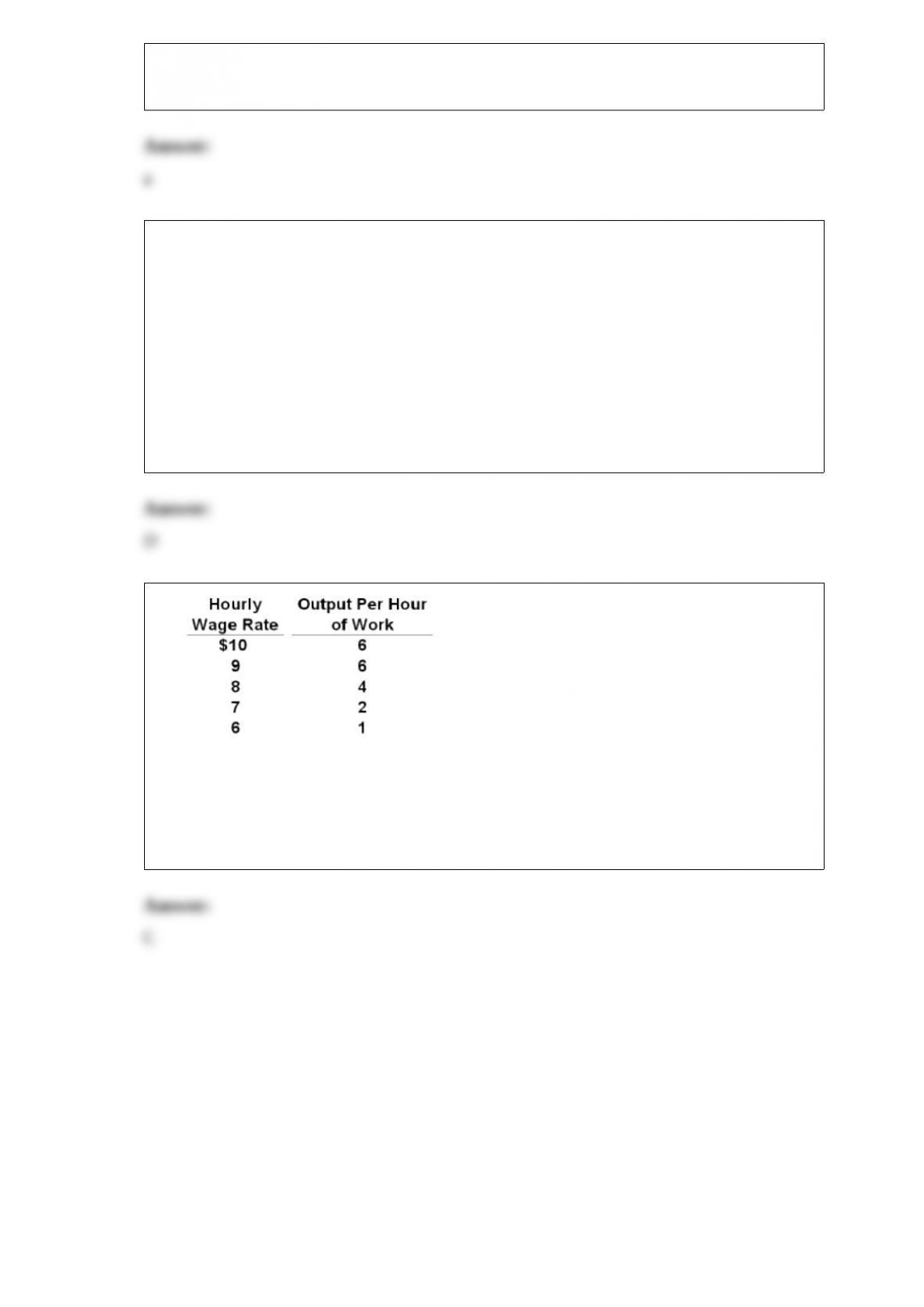
20)
Refer to the above table. At the $8 wage, labor cost per-unit of output is:
A.$1.25.
B.$1.50.
C.$2.00.
D.$1.67.