1) the invisible-hand concept suggests that:
a.market failures imply the need for a national economic plan.
b.big businesses are inherently more efficient than small businesses.
c.the competitiveness of a capitalistic market economy invariably diminishes over time.
d.assuming competition, private and public interests will coincide.
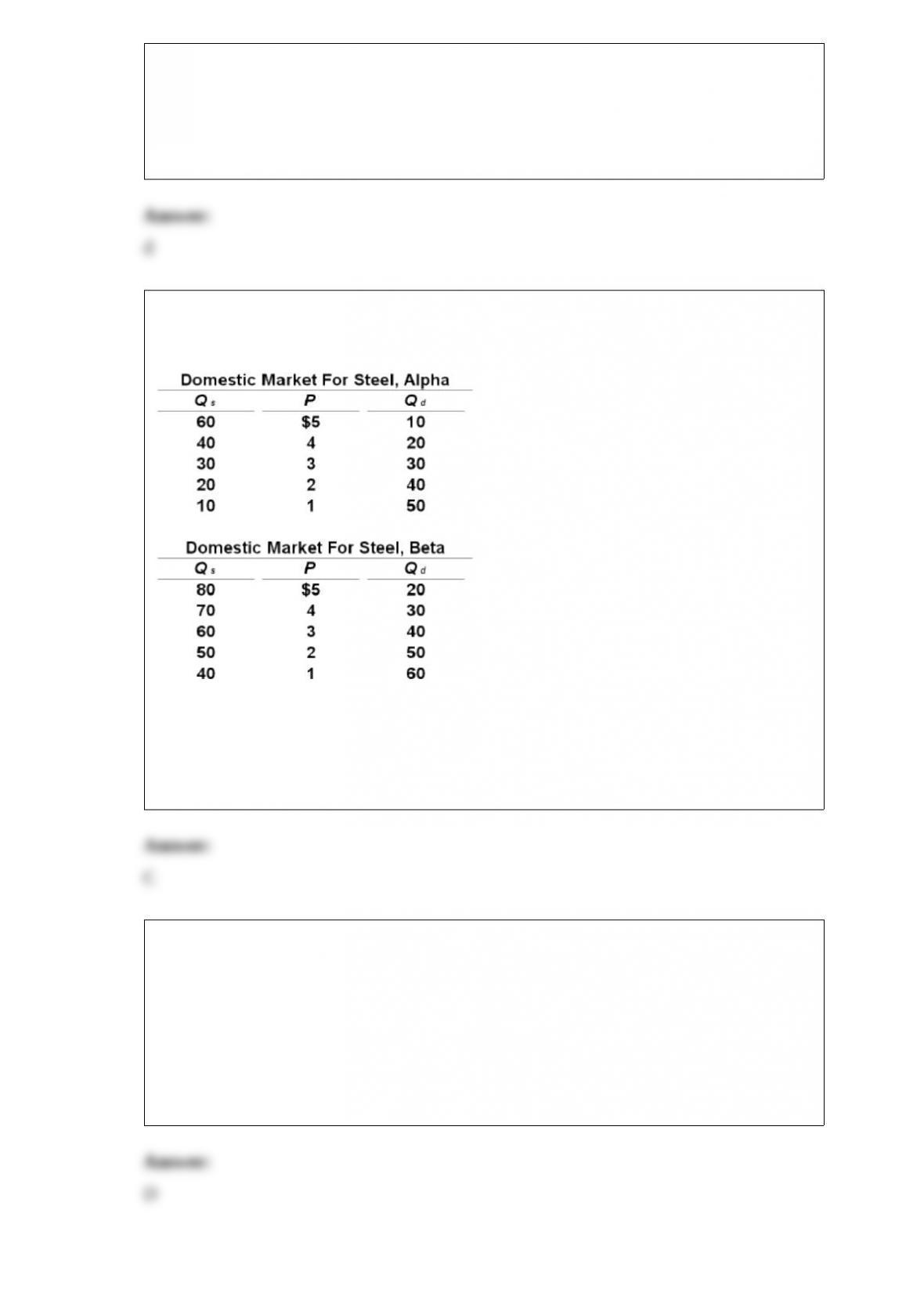
2) The following data for the hypothetical nations of Alpha and Beta. Qs is domestic
quantity supplied and Qd is domestic quantity demanded.
Refer to the above data. The equilibrium prices of steel in Alpha and Beta are:
A.$5 and $4, respectively.
B.$2 and $4, respectively.
C.$3 and $2, respectively.
D.$1 and $2, respectively.
3) If the demand for money and the supply of money both decrease, the equilibrium:
A.interest rate will decline, but we cannot predict the change in the equilibrium quantity
of money.
B.quantity of money and the equilibrium interest rate will both increase.
C.quantity of money will increase, but we cannot predict the change in the equilibrium
interest rate.
D.quantity of money will decline, but we cannot predict the change in the equilibrium
interest rate.
4) refer to the above diagram. this firm is selling its product in a(n):
a.purely competitive market.
b.imperfectly competitive market.
c.monopsonistic market.
d.monopolistic market.
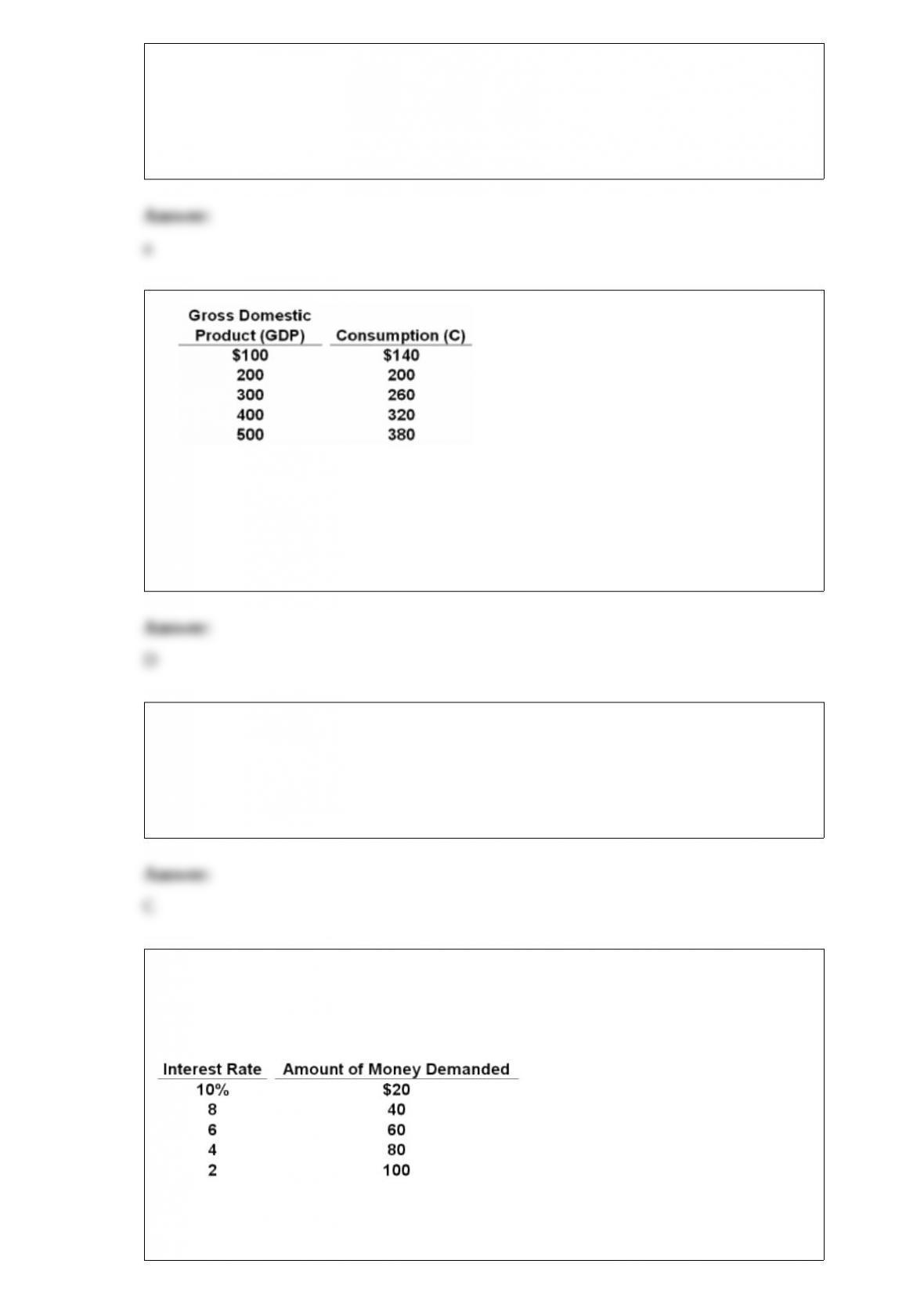
5)
Refer to the above data. A 10 percent proportional tax on income would:
A.affect neither the size of the multiplier nor the stability of the economy.
B.increase the size of the multiplier and make the economy more stable.
C.increase the size of the multiplier and make the economy less stable.
D.reduce the size of the multiplier and make the economy more stable.
6) A nation’s infrastructure refers to:
A.its ability to realize economies of scale.
B.its stock of technological knowledge.
C.public capital goods such as highways and utilities.
D.the productivity of its labor force.
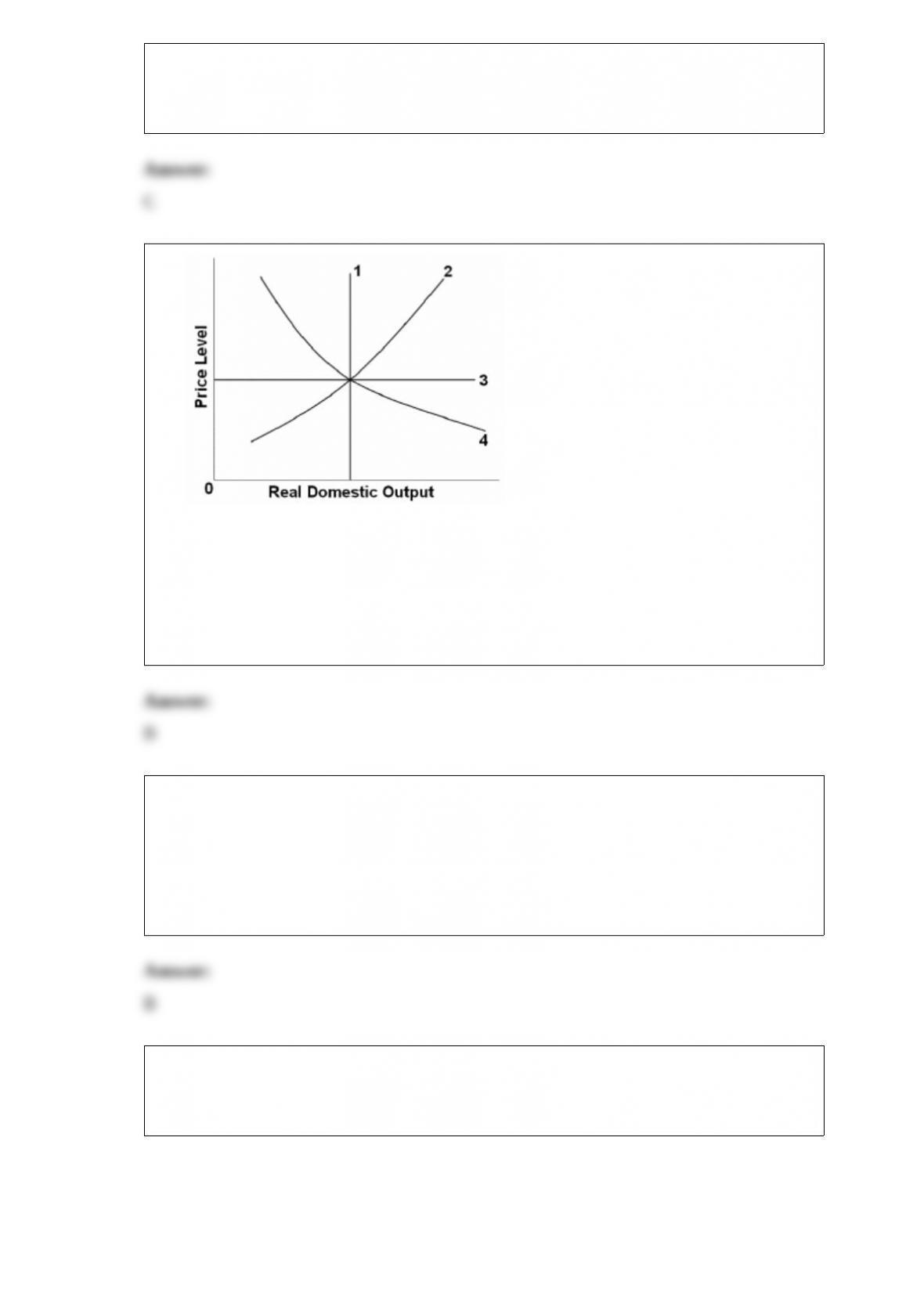
7) The following information. For transactions, households and businesses want to hold
an amount of money equal to one half of nominal GDP. The table shows the amounts of
money they want to hold as an asset at various interest rates.
Refer to the above information. If nominal GDP is $200 and the interest rate is 6
percent, the total amount of money that households and businesses will want to hold is:
A.$120.
B.$140.
C.$160.
D.$180.
8)
In the above diagram, the economy’s relevant aggregate demand and long-run aggregate
supply curves, respectively, are lines:
A.4 and 2.
B.4 and 1.
C.2 and 4.
D.2 and 3.
9) A minority person is prohibited from entering certain high paying occupations. This
illustrates:
A.human-capital discrimination.
B.the crowding model.
C.the taste-for-discrimination model.
D.statistical discrimination.
10) The following balance sheet for the ABC National Bank in answering the next
question(s). Assume the required reserve ratio is 20 percent.
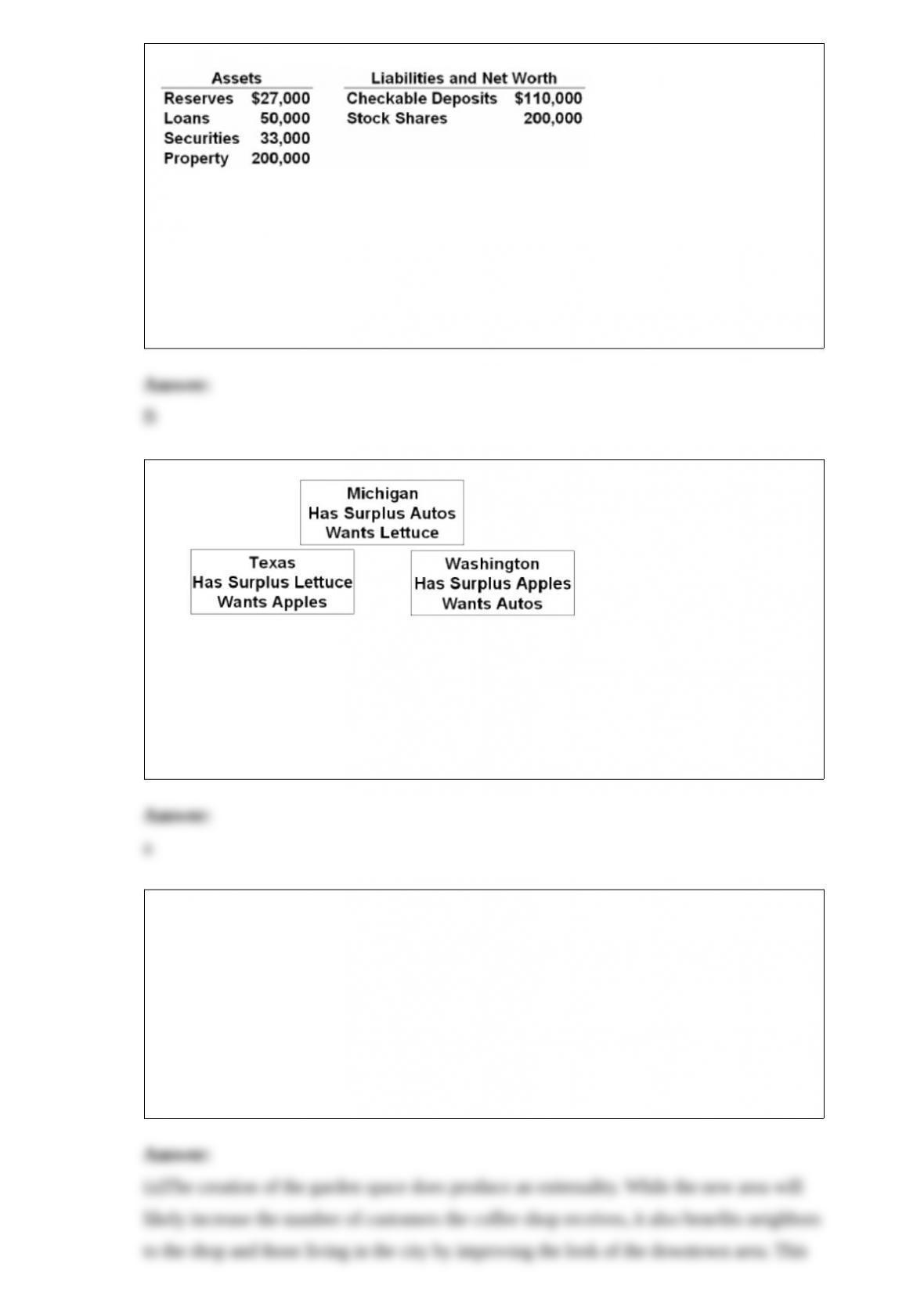
Refer to the above data. Assuming the bank loans out all of its remaining excess
reserves as a checkable deposit, and has a check cleared against it for that amount, its
reserves and checkable deposits will now be:
A.$25,000 and $122,000 respectively.
B.$22,000 and $110,000 respectively.
C.$32,000 and $115,000 respectively.
D.$22,000 and $105,000 respectively.
11)
on the basis of the above information and assuming trade occurs between the three
states we can expect:
a.washington to exchange apples with texas and receive money in return.
b.washington to exchange apples with michigan and receive money in return.
c.texas to exchange lettuce with michigan and receive autos in return.
d.texas to trade lettuce directly for washington apples.
12) Suppose a local coffee shop in the downtown area decides to purchase a
neighboring abandoned lot and convert it into a garden area with outdoor seating.
(a)Does this decision create an externality? If so, what kind?
(b)Despite the citys positive response to the coffee shops renovation, other businesses
in the area have not followed suit in renovating the many decrepit buildings and
abandoned lots. How might the presence of an externality be in part the cause of this?
(c)In response to the lack of effort on the part of businesses to renovate the downtown
area, city council members to take action. What are some ways that the city government
could promote this kind of revival?
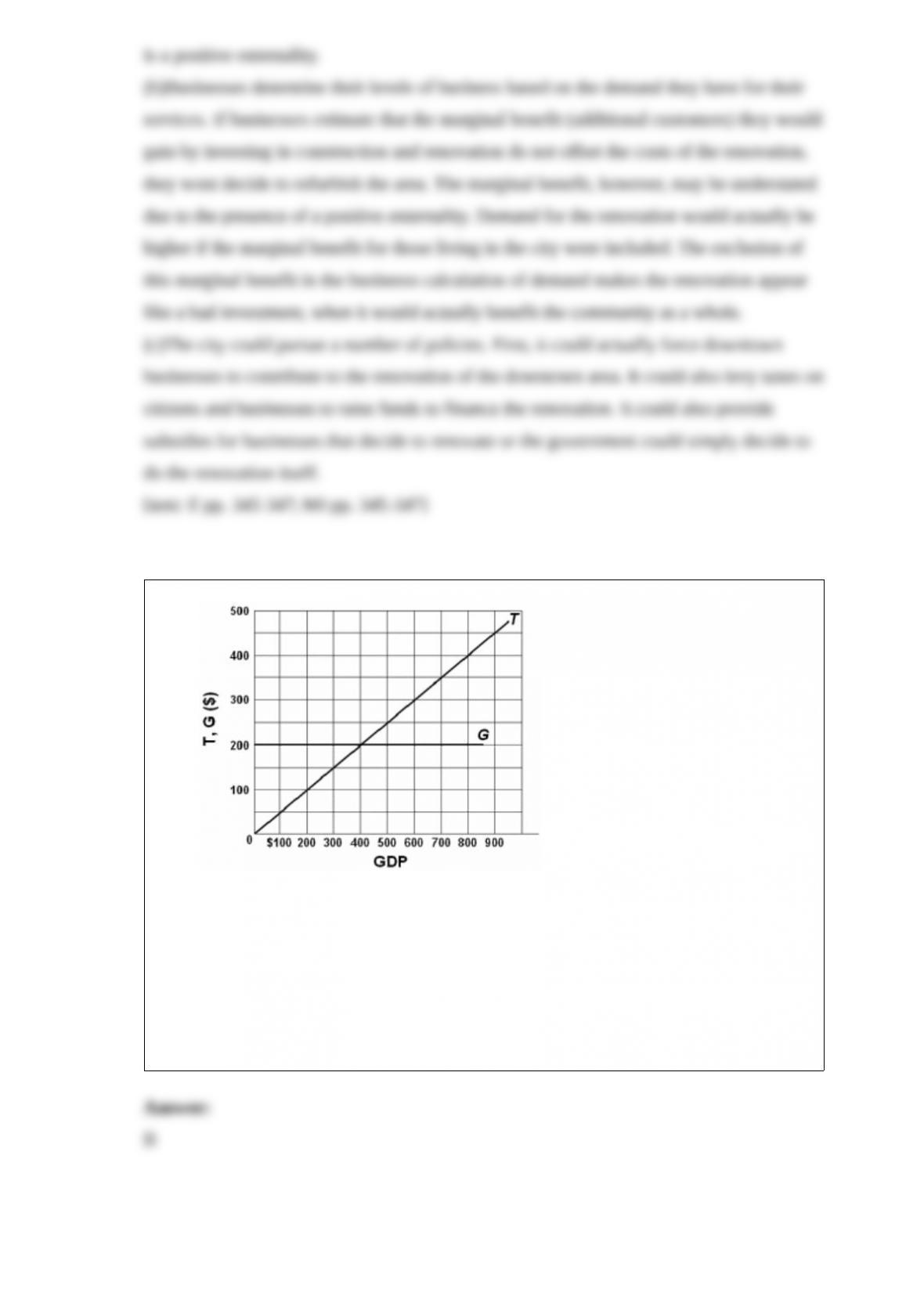
13)
Refer to the above diagram in which T is tax revenues and G is government
expenditures. All figures are in billions. In this economy:
A.tax revenues and government spending both vary directly with GDP.
B.tax revenues vary directly with GDP, but government spending is independent of
GDP.
C.tax revenues and government spending both vary inversely with GDP.
D.government spending varies directly with GDP, but tax revenues are independent of
GDP.
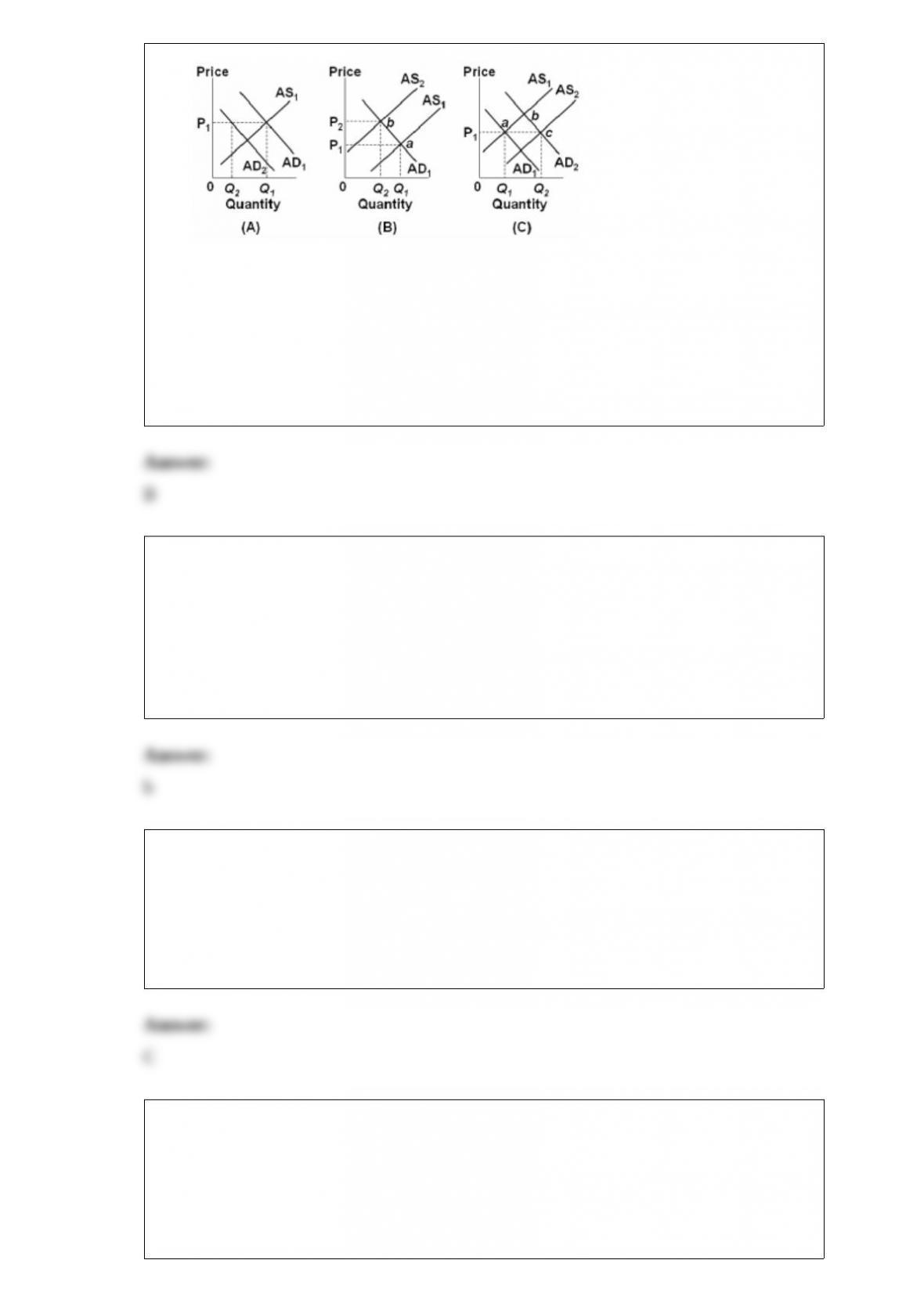
14)
Refer to the above diagrams, in which AD1 and AS1 are the “before” curves and AD2
and AS2 are the “after” curves. Other things equal, a decline in net exports caused by
the foreign purchases effect of a price-level increase is depicted by the:
A.shift of the AD curve in panel (A).
B.move from point a to point b in panel (B).
C.shift of the AS curve in panel (B).
D.move from point a to point c in panel (C).
15) a firm is producing an output such that the benefit from one more unit is more than
the cost of producing that additional unit. this means the firm is:
a.producing more output than allocative efficiency requires.
b.producing less output than allocative efficiency requires.
c.achieving productive efficiency.
d.producing an inefficient output, but we cannot say whether output should be increased
or decreased.
16) In the past, Canada has agreed to set an upper limit on the total amount of softwood
lumber sold to the United States. This is an example of a(n):
A.import quota.
B.export subsidy.
C.voluntary export restriction.
D.protective tariff.
17) when product prices change, consumers are inclined to purchase larger amounts of
the now cheaper products and less of the now more expensive products. this describes:
a.the cost effect.
b.the price effect.
c.the income effect.
d.the substitution effect.