1) if a rational consumer is in equilibrium, which of the following conditions will hold
true?
a.mua = mub = muc = … = mun.
b.the marginal utility of each good purchased will be zero.
c.the marginal utility of the last dollar spent on each good purchased will be the same.
d.the total utility obtained from each good purchased will be the same.
2) Market failure is said to occur whenever:
A.private markets do not allocate resources in the way that best satisfies society’s wants.
B.prices rise.
C.some consumers who want a good do not obtain it because the price is higher than
they are willing to pay.
D.government intervenes in the functioning of private markets.
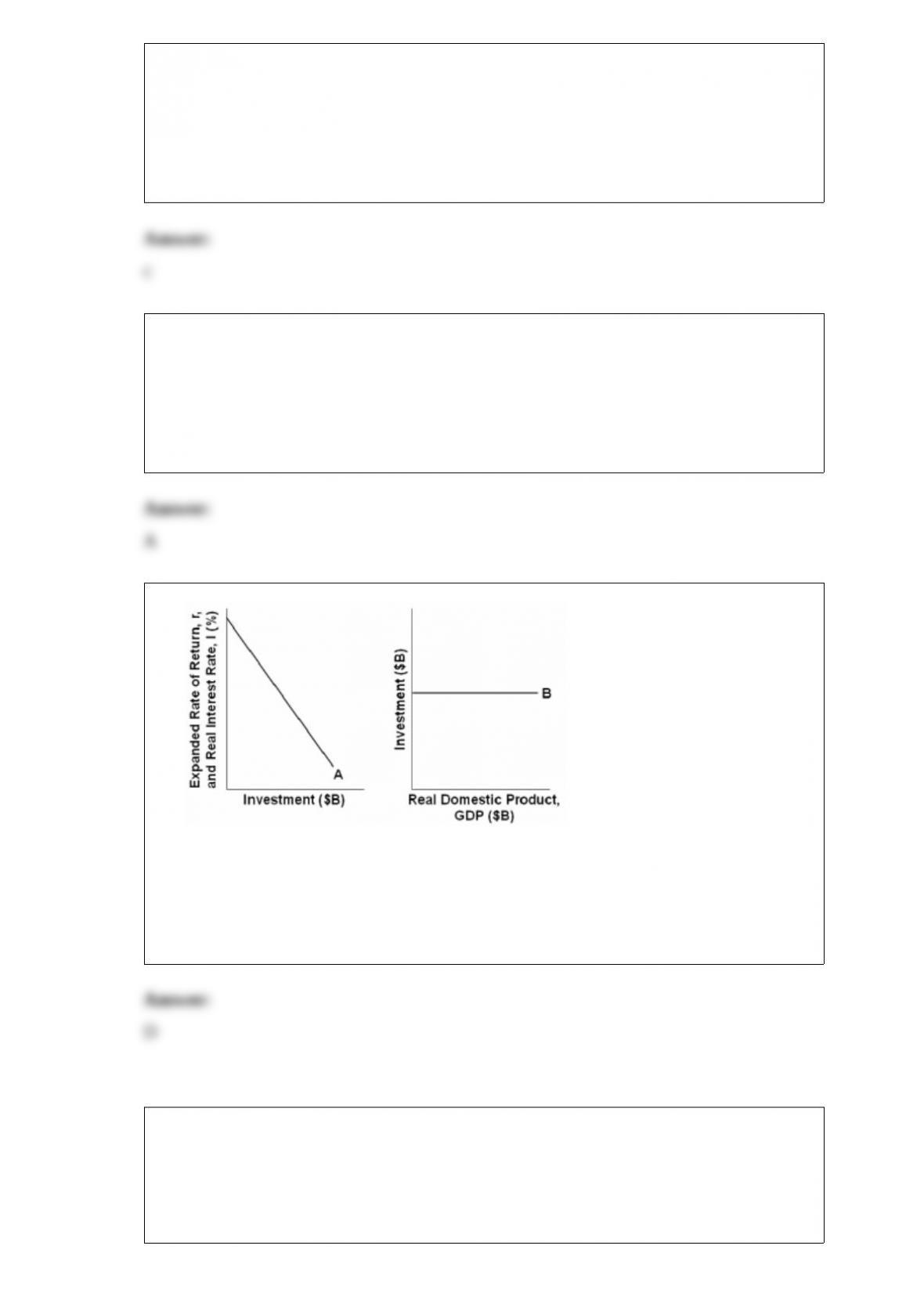
3)
Refer to the above diagrams. Other things equal, an interest rate decrease will:
A.shift curve A to the right and shift curve B upward.
B.shift curve A to the left and shift curve B downward.
C.leave curve A in place but shift curve B downward.
D. leave curve A in place but shift curve B upward.
4) which of the following is true concerning purely competitive industries?
a.there will be economic losses in the long run because of cut-throat competition.
b.economic profits will persist in the long run if consumer demand is strong and stable.
c.in the short run, firms may incur economic losses or earn economic profits, but in the
long run they earn normal profits.

d.there are economic profits in the long run, but not in the short run.
5) the abc corporation decreases all of its inputs by 12 percent and finds that its output
falls by only 8 percent. this means that initially it was producing:
a.in the range of diseconomies of scale.
b.in the range of economies of scale.
c.where ap is less than mp.
d.at the point of minimum efficient scale.
6) Economists who contend that oligopolists have a strong incentive to engage in R&D
say that:
A.the undistributed profits of oligopolists give them a source of readily available,
relatively low cost funds for financing R&D.
B.entry barriers enable oligopolists to sustain the profit it gains from innovation.
C.the large size of oligopolists’ R&D departments allow them to use very specialized,
expensive R&D equipment and employ teams of specialized researchers.
D.all of these are true.
7) the full-employment unemployment rate means an unemployment rate of about:
a.15 percent.
b.10 percent.
c.4-5 percent.
d.2 percent.

8)
Assumptions: (1) the labor force is comprised of 9 million men and 9 million women
workers; (2) the economy has 3 occupations, X, Y, and Z, each having identical demand
curves for labor; (3) men and women workers are homogeneous with respect to their
labor-market capabilities; (4) women are discriminated against by being excluded from
occupations X and Y and are confined to Z; and (5) aside from discrimination, the
economy is competitive.
Refer to the above diagram and list of assumptions. If discrimination is ended, women:
A.and men will both receive a wage rate of $4.
B.and men will both receive a wage rate of $5.
C.and men will both receive a wage rate of $6.
D.will receive a wage rate of $4 and men will receive a wage rate of $5.
9) Which of the following statements is correct? Other things equal:
A.a decline in real output will shift both the transactions demand curve for money and
the total money demand curve to the right.
B.a decline in the interest rate will shift the asset demand curve for money to the right,
but leave the total money demand curve unchanged.
C.deflation will shift both the transactions demand curve for money and the total money
demand curve to the left.
D.inflation will shift the transactions demand curve for money to the right, but leave the
total money demand curve unchanged.
10) suppose that inventories were $80 billion in 2007 and $70 billion in 2008. in 2008,
accountants would:
a.add $10 billion to other elements of investment in calculating total investment.
b.subtract $10 billion from other elements of investments in calculating total
investment.
c.add $75 billion (= $150/2) to other elements of investment in calculating total

investment.
d.subtract $75 billion (= $150/2) from other elements of investment in calculating total
investment.