1) The financial account balance is a nation’s:
A.net investment income minus its net transfers.
B.exports of goods and services minus its imports of goods and services.
C.sale of real and financial assets to people living abroad minus its purchases of real
and financial assets from foreigners.
D.domestic investment spending minus domestic saving.
2) Which of the following is not included in the current account of a nation’s balance of
payments?
A.its goods exports
B.its goods imports
C.its net investment income
D.its purchases of real assets abroad
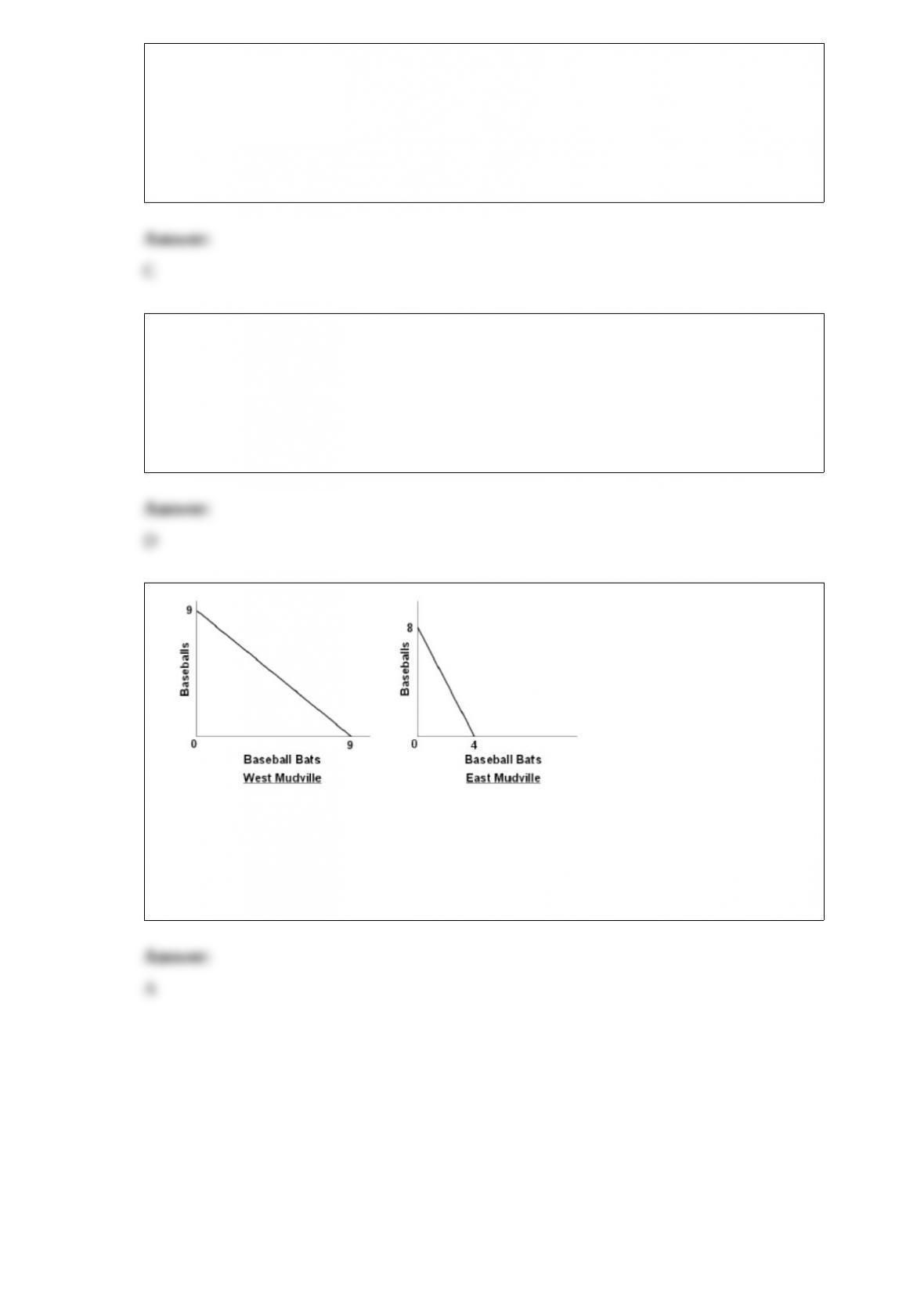
3)
The production possibilities curves above suggest that:
A.West Mudville should specialize in, and export, baseball bats.
B.West Mudville should specialize in, and export, both baseballs and baseball bats.
C.East Mudville should specialize in, and export, baseball bats.
D.workers will try to immigrate from West Mudville to East Mudville.
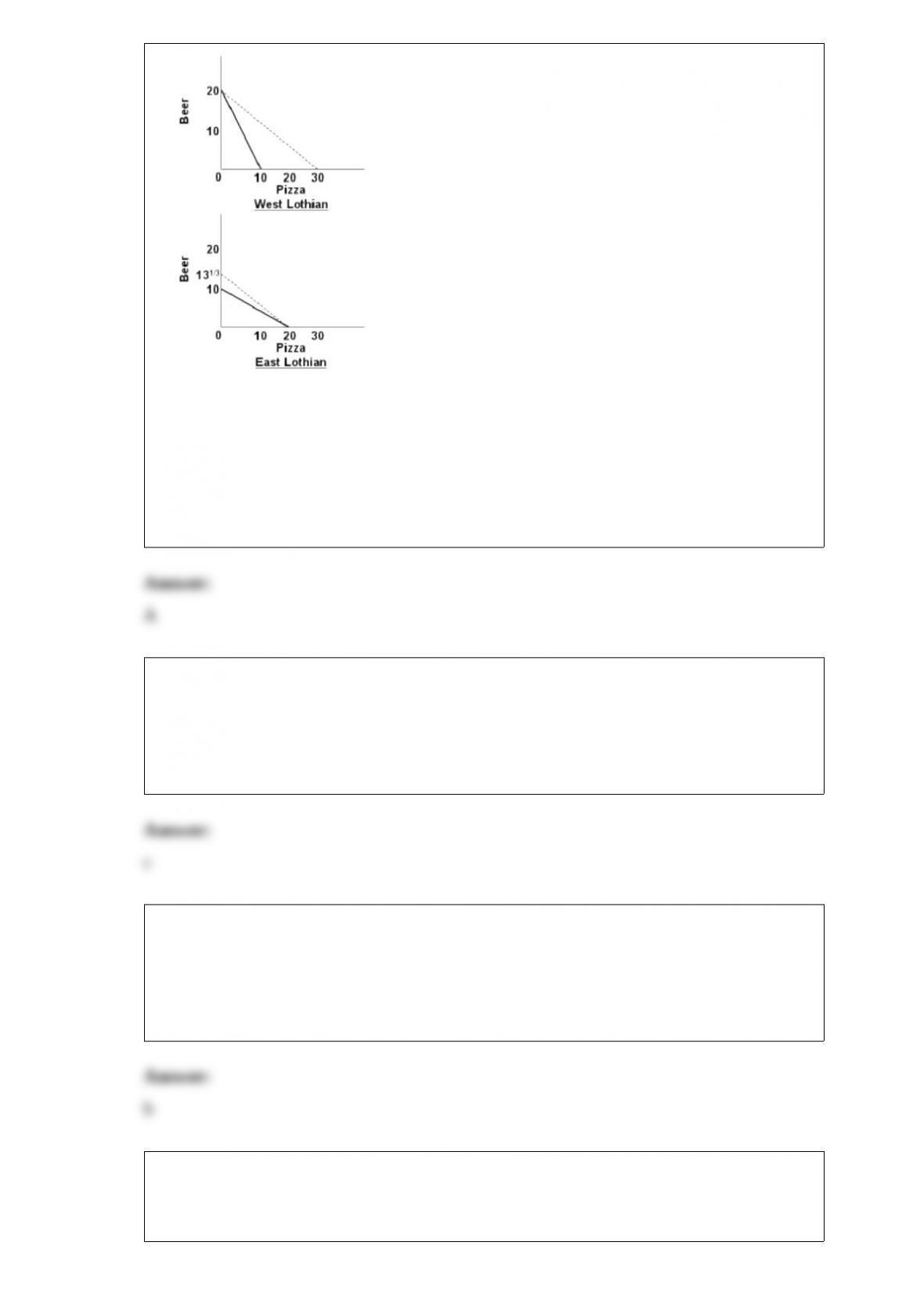
4)
Refer to the above diagrams. The solid lines are production possibilities curves; the
dashed lines are trading possibilities curves. The data suggest that:
A.West Lothian should specialize in, and export, beer.
B.both countries will be better off if they do not engage in specialization and trade
involving these two products.
C.West Lothian should specialize in, and export, pizza.
D.East Lothian should specialize in, and export, beer.
5) which of the following characteristics is least unique to a market system?
a.private ownership of property resources
b.competition among buyers and sellers pursuing monetary returns
c.the widespread use of money
d.freedom of enterprise and choice
6) economic scarcity:
a.is peculiar to the united states economy.
b.applies to all economies.
c.is peculiar to command systems.
d.is peculiar to market systems.
7) In monopsony:
A.each firm employs a small portion of the total supply of labor.
B.the work force is highly mobile.
C.the wage rate paid by the employer varies directly with the number of workers
employed.
8) A profit-maximizing company should not extract any of a particular non-renewable
resource in the present if:
A.the total cost exceeds the market price of the resource.
B.the extraction cost exceeds the market price of the resource.
C.the user cost exceeds the current market price of the resource.
D.any of these conditions occur.
9) a firm can sell more or less output at a constant price. demand is thus:
a.perfectly inelastic.
b.perfectly elastic.
c.relatively inelastic.
d.relatively elastic.
10) The pure rate of interest is approximated by the:
A.rate which savings and loan associations charge on mortgage loans.
B.rate charged consumers by credit card companies.
C.rate paid on long-term government bonds.
D.announced rate at which commercial banks make business loans.
11) In the aggregate expenditures model, the level of GDP moves toward an equilibrium
because:
A.the investment schedule is steeper than the saving schedule.
B.the 45-degree line is steeper than the aggregate expenditures schedule.
C.the saving schedule is steeper than the consumption schedule.
D.wages and prices are flexible downward.