
A fixed-weight price index like the CPI ______ the change in the cost of living because
it ______ take into account that people can substitute less expensive goods for ones that
have become more expensive.
A) underestimates; does not
B) overestimates; does
C) accurately estimates; does
D) overestimates; does not
If the interest rate is above the equilibrium value, the:
A) demand for real balances exceeds the supply.
B) supply of real balances exceeds the demand.
C) market for real balances clears.
D) demand for real balances increases.
When bread is baked but put away for later sale, this is called:
A) waste.
B) saving.

C) fixed investment.
D) investment in inventory.
The link between the flow of new housing and the stock of existing housing is the:
A) relative price of housing.
B) demand for housing.
C) demand for residential investment.
D) real interest rate.
The dynamic aggregate demand curve is downward sloping because as inflation falls,
the central bank reduces the nominal interest rate by more than the fall in the inflation
rate, which _____the real interest rate and _____ the quantity of goods and services
demanded.
A) decreases; decreases
B) decreases; increases
C) increases; increases
D) increases; decreases

The formula for the steady-state ratio of capital to labor (k*), with no population growth
or technological change, is s:
A) divided by the depreciation rate.
B) multiplied by the depreciation rate.
C) divided by the product of f(k*) and the depreciation rate.
D) multiplied by f(k*) divided by the depreciation rate.
If an increase of an equal percentage in all factors of production results in an increase in
output of the same percentage, then a production function has the property called:
A) constant marginal product of labor.
B) increasing marginal product of labor.
C) constant returns to scale.
D) increasing returns to scale.

Assume that the consumption function is given by C = 150 + 0.85(Y ” T), the tax
function is given by T = t0 + t1Y, and Y is 5,000. If t1 decreases from 0.3 to 0.2, then
consumption increases by:
A) 85.
B) 425.
C) 500.
D) 525.
All of the following could be considered automatic stabilizers except:
A) transfer payments that increase during recessions.
B) discretionary changes in taxes.
C) a system of unemployment insurance.
D) the federal income tax.

In Irving Fisher’s two-period model, if the consumer is initially a saver and the interest
rate increases, and first-period consumption decreases, then we can conclude that the
income effect:
A) was greater than the substitution effect.
B) was less than the substitution effect.
C) exactly offset the substitution effect.
D) and the substitution both decreased consumption.
Explain why the value of GDP in 2012 would or would not change as a result of each
transaction described below:
a. In 2012, the Smith family purchases a new house that was built in 2012.
b. In 2012, the Jones family purchases a house that was built in 2001.
c. In 2012, a construction company purchases windows to put in the Smith family home
that was built in 2012.
d. In 2012, Mr. Jones paints all of the rooms of the Jones family house purchased in
2009, using paint and supplies purchased in 2012.
e. In 2012, Mr. Smith uses an online brokerage service to purchases shares of stock in a
construction company.

In a system with 100-percent-reserve banking:
A) all banks must hold reserves equal to 100 percent of their loans.
B) no banks can make loans.
C) the banking system completely controls the size of the money supply.
D) no banks can accept deposits.
According to the imperfect-information model, when the price level rises by the amount
the producer expected it to rise, the producer:
A) increases production.

B) does not change production.
C) decreases production.
D) hires more workers.
The vertical long-run aggregate supply curve satisfies the classical dichotomy because
the natural rate of output does not depend on:
A) the labor supply.
B) the supply of capital.
C) the money supply.
D) technology.
What are two types of tools that economists use to forecast future economic
developments?
A) leading indicators and computer models
B) direct imputations and indirect attributions
C) visual assessment and global positioning
D) monetary instruments and fiscal instruments

In the IS“LM model, a decrease in the interest rate would be the result of a(n):
A) increase in the money supply.
B) increase in government purchases.
C) decrease in taxes.
D) increase in money demand.
The long-run aggregate supply curve is vertical at the level of output:
A) determined by aggregate demand.
B) at which unemployment is at its natural rate.
C) at which the inflation rate is zero.
D) at a predetermined price level.

English-style legal systems give ______ protections to shareholders and creditors than
French Napoleonic Codes, typically resulting in ______ capital markets and faster rates
of economic growth.
A) greater; more developed
B) greater; more corrupt
C) less; more developed
D) less; less corrupt
Inflation-indexed government bonds have all of the following benefits except:
A) eliminating inflation.
B) reducing the government’s incentive to produce surprise inflation.
C) encouraging financial innovation.
D) eliminating inflation risk.
If GDP (measured in billions of current dollars) is $5,465 and the sum of consumption,
investment, and government purchases is $5,496, while exports equal $673, imports
are:

A) $673.
B) “$673.
C) $704.
D) “$704.
Real GDP is a better measure of economic well-being than nominal GDP, because real
GDP:
A) excludes the value of goods and services exported aboard.
B) includes the value of government transfer payments.
C) measures changes in the quantity of goods and services produced by holding prices
constant.
D) adjusts the value of goods and services produced for changes in the foreign
exchange rate.
The interest rate charged on loans by the Federal Reserve to banks is called the:
A) federal funds rate.
B) prime rate.

C) discount rate.
D) Treasury bill rate.
When banks borrow through the Term Auction Facility, the price of borrowing is
determined by:
A) the Federal Reserve.
B) a competitive bidding process.
C) the difference between the discount rate and the interest rate on three-month
Treasury securities.
D) open-market operations.
An explanation for the slope of the LM curve is that as:
A) the interest rate increases, income becomes higher.
B) the interest rate increases, income becomes lower.
C) income rises, money demand rises, and a higher interest rate is required.
D) income rises, money demand rises, and a lower interest rate is required.

Using the IS“LM analysis, if the LM curve is not horizontal, the multiplier for an
increase in government spending is ______ for an increase in government purchases
using the Keynesian-cross analysis.
A) larger than the multiplier
B) the same as the multiplier
C) smaller than the multiplier
D) sometimes larger and sometimes smaller than the multiplier
According to the neoclassical theory of distribution, in an economy described by a
Cobb”Douglas production function, when average labor productivity is growing
rapidly:
A) labor’s share of total income will be increasing.
B) labor’s share of income will be decreasing.
C) workers will experience high rates of real wage growth.
D) economic profits will be positive.

Which of the following is NOT an effect of expected inflation?
A) causes lower real wages.
B) leads to shoeleather costs.
C) increases menu costs.
D) leads to taxing of nominal capital gains that are not real.
In the national income accounts, goods bought for future use are classified as which
type of expenditure?
A) services
B) investment
C) government purchases
D) net exports

In practice, inflation targeting is better considered as operating with constrained
discretion rather than according to a policy rule because central banks with inflation
targets typically:
A) are not allowed to adjust the target in the event of shocks.
B) set the inflation target as a range rather than as a particular number.
C) are not held accountable for achieving their target.
D) must achieve their target regardless of economic conditions.
Inventory investment, at least in theory, should:
A) rise when the real interest rate rises, other things being equal.
B) not depend on the real interest rate, other things being equal.
C) fall when the real interest rate rises, other things being equal.
D) depend only on the change in real GDP.
The real interest rate should be inversely related to investment in:
A) plant and equipment, home building, and inventories.
B) plant and equipment and home building, but not inventories.
C) plant and equipment and inventories, but not home building.
D) inventories and home building, but not plant and equipment.
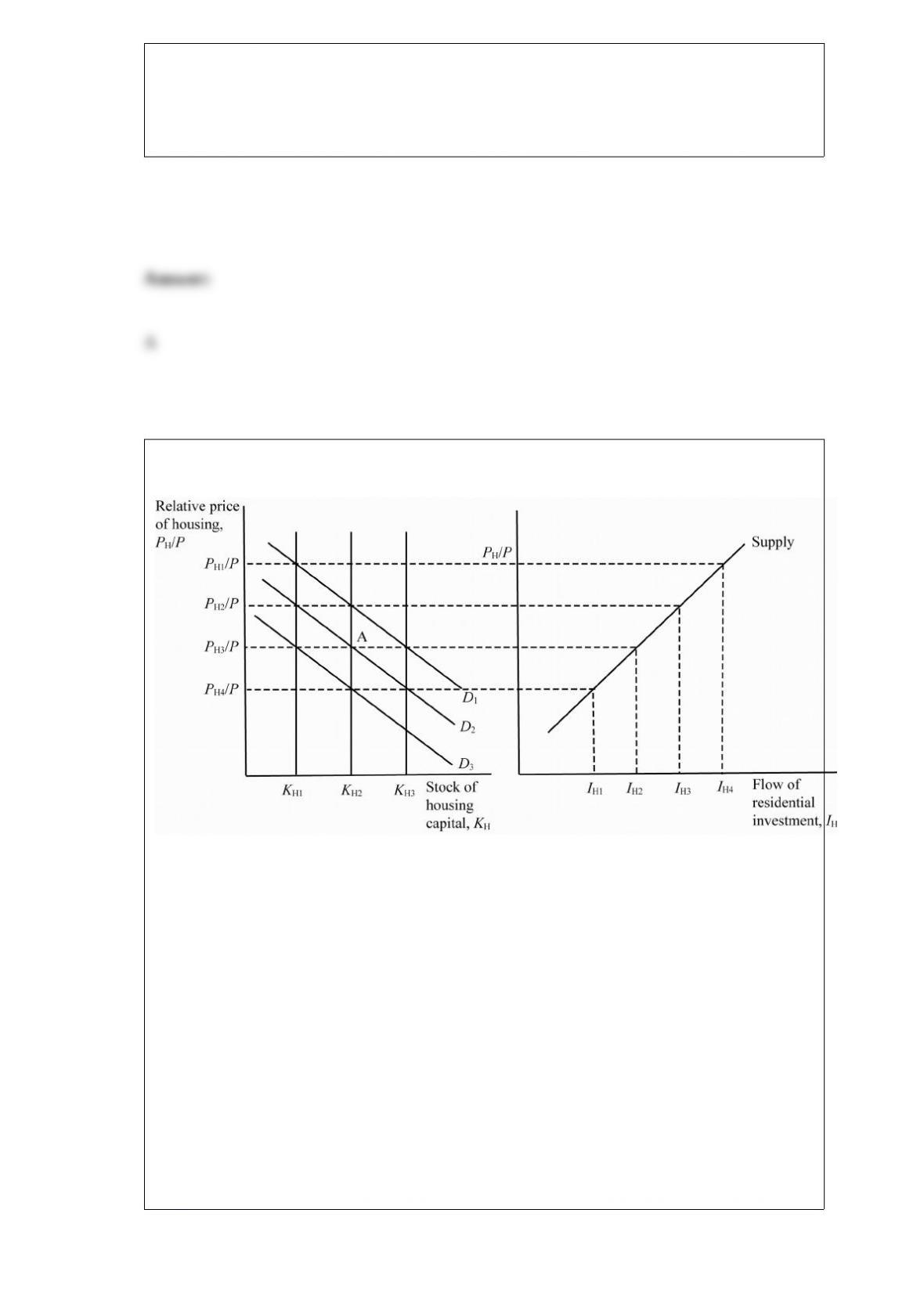
Exhibit: Residential Investment
(Exhibit: Residential Investment) Based on the graph, if the capital market is initially in
equilibrium at A with the relative price of housing equal to PH3/P and the stock of
housing capital equal to KH2, then holding other factors constant, if a massive
earthquake destroys a significant portion of the stock of housing capital, house prices
will move to ______ and the flow of residential housing will move to______.
A) PH1/P; IH4
B) PH2/P; IH3
C) PH3/P; IH2
D) PH4/P; IH1

The government making loans that are secured by collateral of dubious value to prop up
the financial system is an example of:
A) a giveaway of public funds.
B) risky lending.
C) a capital injection.
D) conventional monetary policy.
Variables that a model takes as given are called:
A) endogenous.
B) exogenous.
C) market clearing.
D) macroeconomic.

If an example of a Keynesian consumption function is C = 2,000 + 0.8Y, and Y is
30,000, then the average propensity to consume is about:
A) 0.8.
B) 0.82.
C) 0.85.
D) 0.87.