
Mexico and Japan
The following questions refer to the following table which shows the abilities of
Mexico and Japan to produce food and cloth. Food and cloth are the only two
commodities in the world and their production requires only labor. The amounts of
labor required to produce one unit of each of these commodities in the two countries are
shown in the table below.
Can trade in food and cloth benefit Mexico and Japan?
a. It cannot benefit Japan, because Japan cannot successfully compete with Mexico.
b. It cannot benefit Mexico, because Japan is too small to be an effective trading
partner.
c. It can benefit both only if the people in Mexico and Japan have different tastes.
d. It can benefit both if Mexico specializes in food and Japan specializes in cloth.
When a bond is sold at a discount, the term discount refers to
a. the rate of interest.
b. the face value of the bond minus its current price.
c. its current price.
d. its face value multiplied by 1 + r.

An example of a horizontal integration would be a merger between
a. a newspaper and a television station.
b. two grocery store chains.
c. Intel and Dell.
d. Delta Airlines and American Airlines.
The fact that employees often take longer lunch breaks than they are supposed to is an
example of
a. the principal-agent problem.
b. moral hazard.
c. adverse selection.
d. a golden parachute.

In the Battle of the Sexes game, there
a. are two Nash equilibria, neither of which is Pareto optimal.
b. is one Nash equilibrium and it is not Pareto optimal.
c. is one Nash equilibrium and it is Pareto optimal.
d. are two Nash equilibria, both of which are Pareto optimal.
Which of the following is a problem of economic dynamics?
a. Determining how an equilibrium changes when an exogenous variable changes.
b. Finding the Nash equilibrium in the Prisoners’ Dilemma.
c. Solving a simple monopoly’s profit-maximization problem.
d. Modeling the process by which an equilibrium is achieved.
Cournot Problem. Consider Cournot Duopolists that produce homogeneous goods.
These firms each have constant marginal costs of $10. The market for these firms’
product has demand Q = 100 – P.
In the Nash Equilibrium, the deadweight loss will be

a. $300
b. $450
c. $600
d. $900
Demand for a product is given by Q = 100 – P and supply is given by Q = P – If the
quantity demanded rises by 10 units at every possible price, then the equilibrium price
will
a. increase by $5
b. increase by $10
c. decrease by $5
d. increase by $7.50
Consider a portfolio that consists of all of the risky assets in the economy, held in
proportion to their existing quantities. This portfolio is
a. a risk-free asset.
b. the only asset that a risk-averse investor chooses to hold.

c. a market portfolio.
d. in the center of the set of all risky assets.
Suppose a firm doubles its employment of all inputs in the long run. If this action more
than doubles the amount of output produced, then this firm is experiencing
a. increasing returns to scale.
b. diminishing marginal returns.
c. technological progress.
d. positive marginal revenue.
Which of the following would cause a rightward shift in the labor demand curve?
a. Manna from heaven.
b. A rise in the wage rate.
c. A rise in workers’ marginal productivity.
d. A decline in workers’ nonlabor incomes.

Recent evidence supports the belief that new information is incorporated into the value
of most stocks within
a. one trading day.
b. one week.
c. one month.
d. about 30 seconds.
Which oligopoly model results in firms successively undercutting their rivals’ prices
until the competitive outcome is reached?
a. The contestable market model.
b. The Cournot model of oligopoly.
c. The Bertrand model of oligopoly.
d. The monopolistic competition model.

Consider the usual case where a higher wage rate increases firms’ marginal costs. In this
case, the industry’s demand curve for labor
a. is more inelastic than the individual firms’ demand curves would indicate.
b. coincides with the horizontal sum of individual firms’ demand curves.
c. contains only substitution effects but no scale effects.
d. is horizontal at the going market wage.
Consider a demand curve for reckless driving, for which the “price of reckless driving”
is interpreted as the probability of having a fatal accident. When could safer cars lead to
an increase in total number of driver fatalities?
a. Always.
b. Never.
c. When the demand curve is relatively flat.
d. When the demand curve is relatively steep.
Competition to dominate an industry by being slightly better than one’s rivals is referred
to as

a. monopolistic competition.
b. a contestable market.
c. a Cournot oligopoly.
d. a tournament.
Discrimination is difficult to measure empirically because
a. it is hard to measure and control for differences in marginal productivity.
b. data on racial and gender differences is rarely available.
c. discrimination is practiced by very few employers.
d. economists find no significant wages differentials due to gender or race.
Assume that the supply curve is horizontal because marginal cost is constant at $10.
John, Robert, and Jimmy each value one compact disc at $20 but only Jimmy and John
value a second compact disc (Jimmy at $5 and John at $15). If a social planner dictates
that two compact discs be produced and distributed to John, Robert, and Jimmy, then
even if the compact discs are allocated based on demand, this market will lose out on
$___ of value.
a. $5.

b. $10.
c. $15.
d. There will be no lost value as five compact discs is the efficient level..
A decrease in the wage rate causes the budget line to
a. become flatter.
b. become steeper.
c. shift upward.
d. shift downward.
Suppose the exact statements of the assumptions of a model do not enter in a crucial
way, so that slightly different assumptions still lead to the same conclusion. When this
occurs, the model is
a. tractable.
b. robust.
c. rational.

d. efficient.
Goods X and Y
For the following questions, assume that good X is on the horizontal axis and good Y is
on the vertical axis in the consumer-choice diagram. PX denotes the price of good X, PY
is the price of good Y, and I is the consumer’s income. Unless otherwise stated, the
consumer’s preferences are assumed to satisfy the standard assumptions.
The relative price of good X in terms of good Y is always equal to
a. the magnitude of the slope of the budget line.
b. the marginal value of X in terms of Y.
c. the horizontal intercept of the budget line.
d. the vertical intercept of the budget line.
Sales Tax
The following questions refer to the accompanying diagram which shows the effects of
a sales tax imposed on consumers. The initial price and quantity are P0 and Q0,
respectively. After the tax is imposed, the equilibrium quantity is Q1, firms receive the
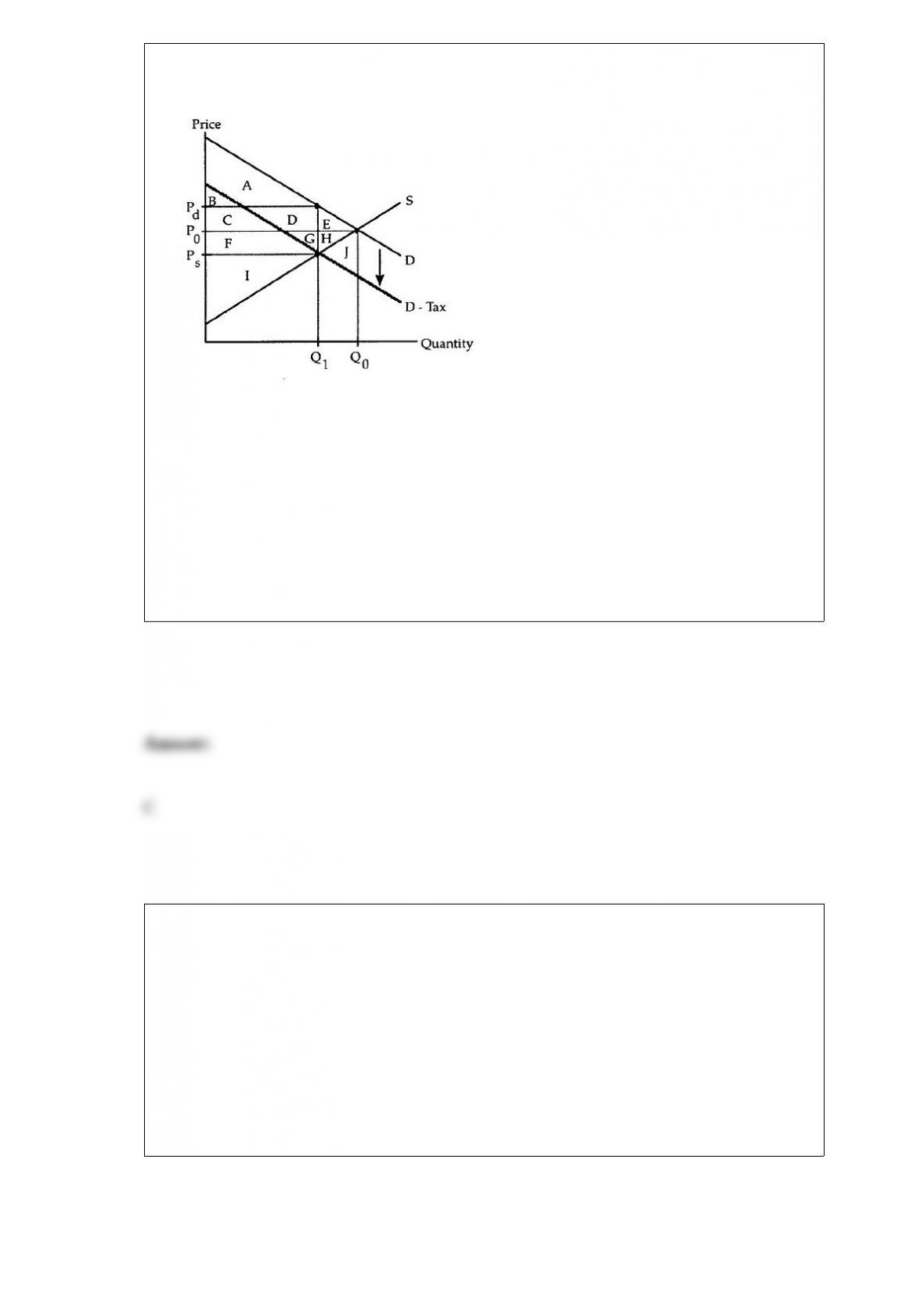
price Ps, and consumers pay the price Pd.
After the tax is imposed, the deadweight loss is equal to
a. area A + D + G.
b. area F + G + H.
c. area E + H.
d. area E + H + J.
According to the Weak Coase Theorem, in the absence of transactions costs, the
assignment of property rights has no effect on
a. damages paid by liable parties.
b. the distribution of income.
c. the allocation of resources.
d. economic efficiency.

If providing more labor and consuming less leisure would make a worker better off,
then the wage rate must be greater than the worker’s
a. marginal revenue product.
b. marginal value of leisure.
c. nonlabor income.
d. human capital.
When will speculators’ actions raise social welfare?
a. Always.
b. When they drive down market prices.
c. When their expectations prove to be correct.
d. When they are not risk averse.
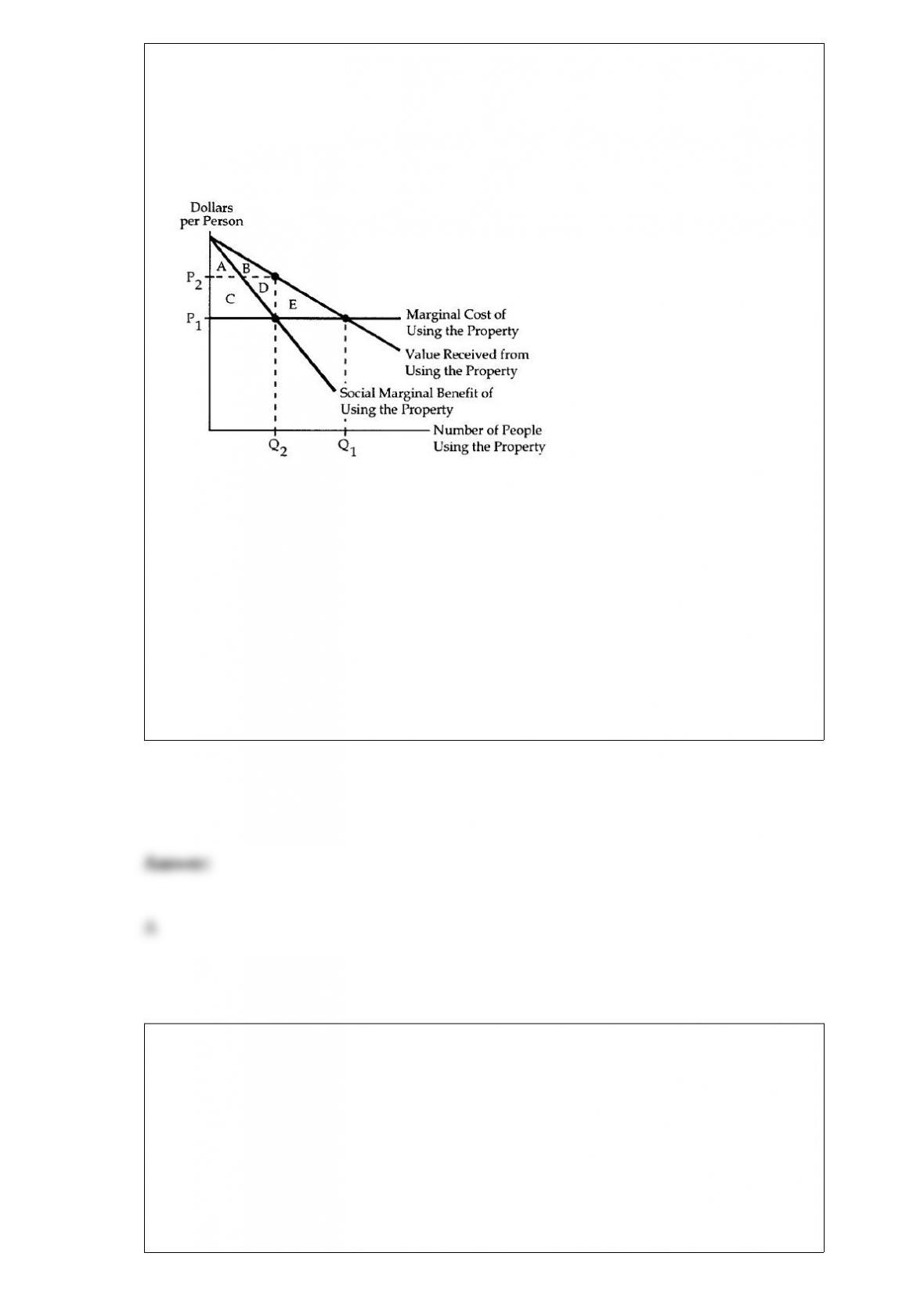
Common Property I
The following questions refer to the accompanying diagram, which shows the benefits
and costs associated with the use of a common property.
If access to the common property cannot be prohibited, then the resulting social gain
equals
a. zero.
b. area E.
c. area A + B.
d. area C + D.
In the Prisoners’ Dilemma game,
a. the Nash equilibrium is the only outcome that is not Pareto optimal.
b. neither player has a dominant strategy.
c. the Stackelberg equilibrium will be Pareto optimal if the game is played sequentially.
d. all possible outcomes are Nash equilibria.

A man can rewire a house in 12 hours and can panel a room in 15 hours, and his
teenage son can rewire a house in 18 hours and can panel a room in 16 hours. Who is
more efficient in rewiring a house, and who is more efficient in paneling a room?
a. The father is more efficient at both activities.
b. The father is more efficient at rewiring a house, and the son is more efficient at
paneling a room.
c. The father is more efficient at paneling a room, and the son is more efficient at
rewiring a house.
d. The two are equally efficient at both activities.
The absolute price of beef in Japan is $10.00 per pound and the absolute price of tuna is
$5.00 per pound then the relative price of tuna in terms of beef is
a. one-half.
b. two.
c. fifteen.
d. fifty.
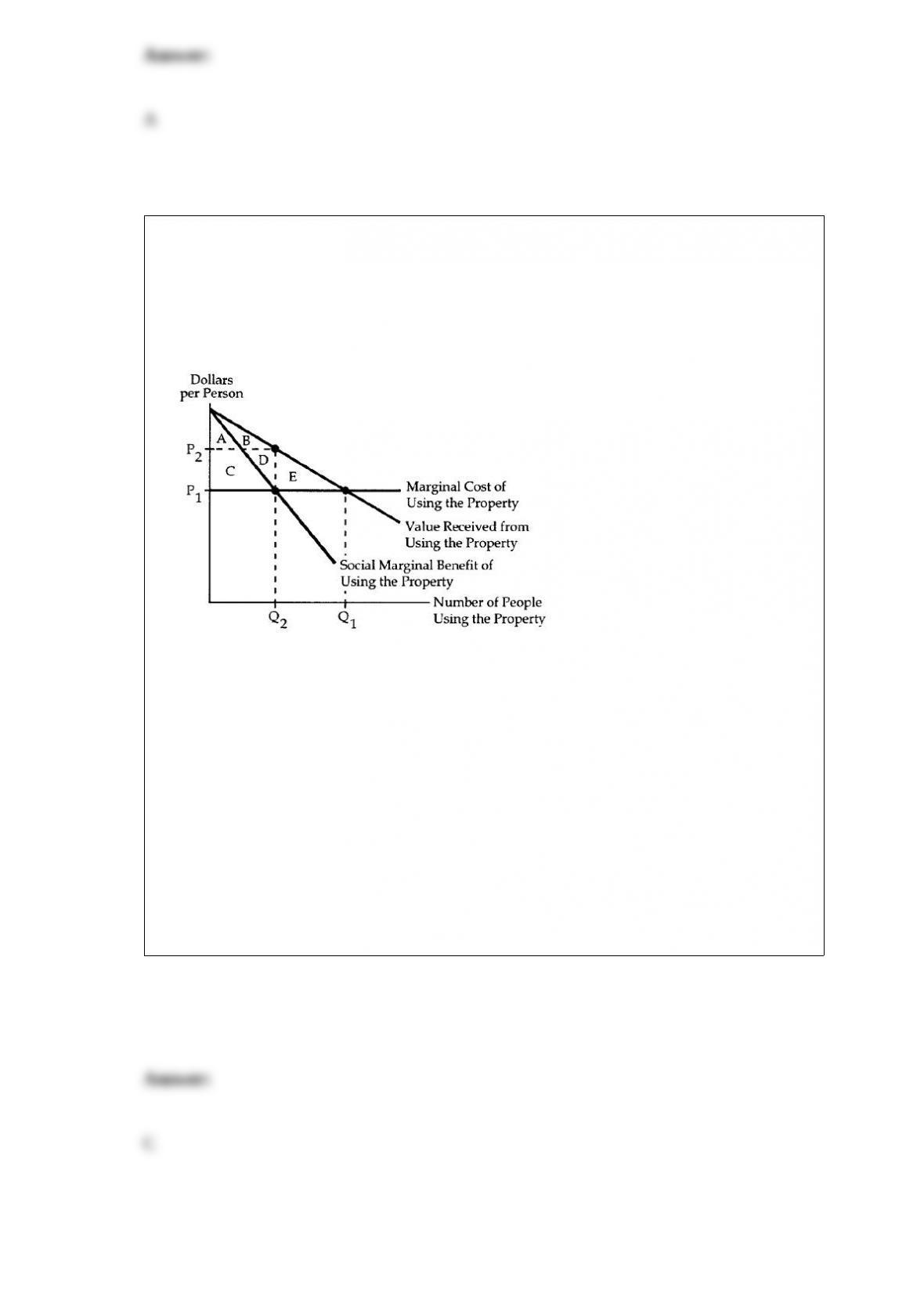
Common Property I
The following questions refer to the accompanying diagram, which shows the benefits
and costs associated with the use of a common property.
Suppose the common property becomes privately owned. The owner behaves
competitively and charges people an entrance fee for the right to use the property. The
fee will be
a. P1.
b. P2.
c. P2 – P1.
d. zero.

Assume that the supply curve is horizontal because marginal cost is constant at $10. If
John, Robert, and Jimmy each value one compact disc at $20 but only Jimmy values a
second compact disc, then the total value in this market is $35 if
a. Jimmy’s value for a second compact disc is $0.
b. Jimmy’s value for a second compact disc is $5.
c. Jimmy’s value for a second compact disc is $10.
d. Jimmy’s value for a second compact disc is $35.
Suppose a price index is formed to measure changes in the price level between 1995 to
2000. To form a Laspeyres price index, one would
a. compare the cost of the typical basket of goods purchased in 1995 with the cost of the
typical basket of goods purchased in 2000.
b. calculate the increase in the cost of the typical market basket purchased in 1995.
c. calculate the increase in the cost of the typical market basket purchased in 2000.
d. take the typical basket of goods purchased in 1997, and compare the costs of that
basket in 1995 and 2000.
Reducing Long-Run Labor Usage
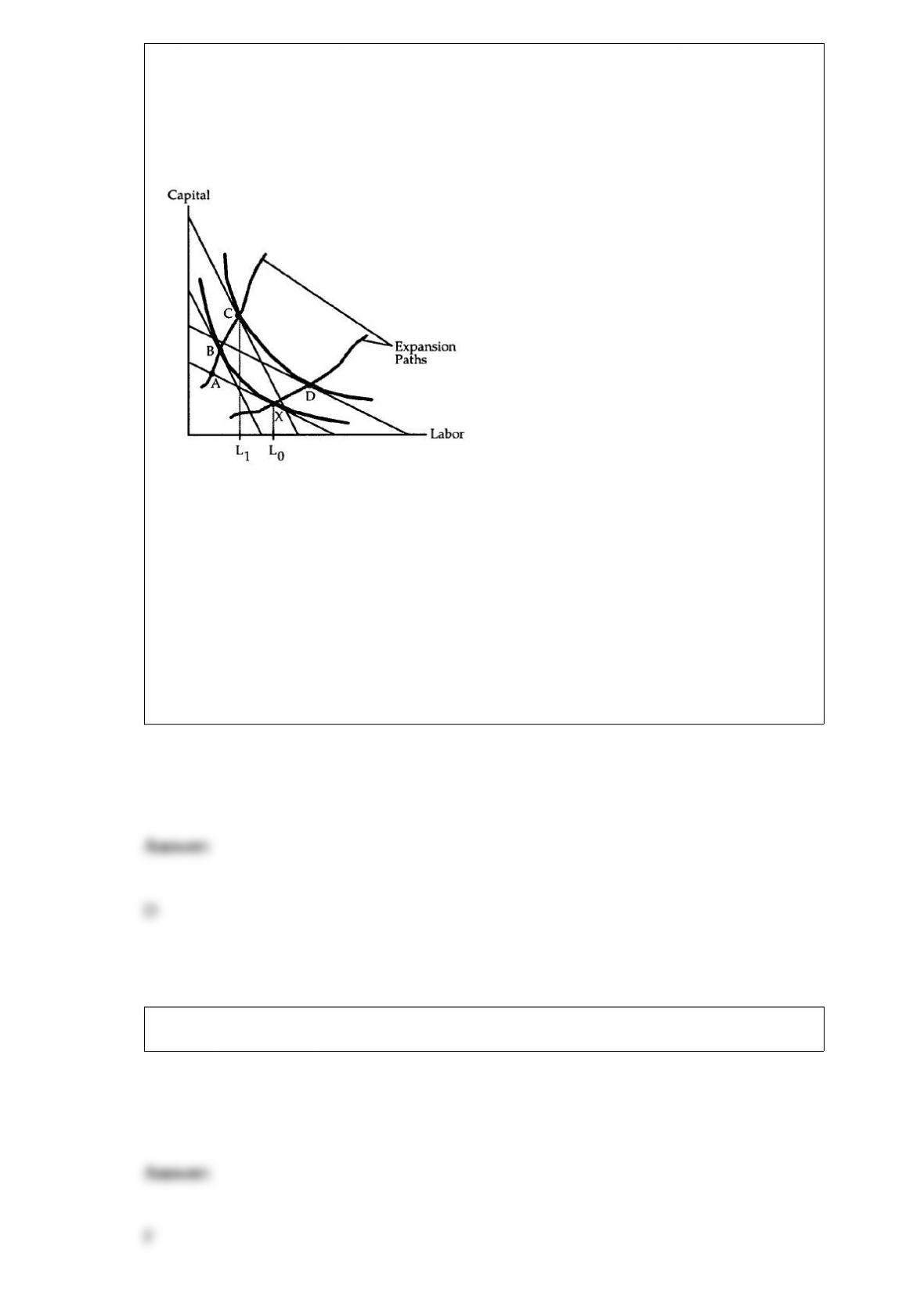
The following questions refer to the accompanying diagram, which shows a firm
reducing its long-run labor usage from L0 to L1 in response to an increase in the wage
rate.
The diagram illustrates the situation where
a. the long-run demand for labor is upward sloping.
b. the scale effect reinforces the substitution effect.
c. the higher wage raises the firm’s long-run marginal costs.
d. labor is a regressive factor.
In any game situation, at least one player always has a dominant strategy.

From this chapter we know that a profit maximizing competitive firm will set its price
equal to the market price. Briefly describe why a profit maximizing competitive firm
will not set its price above the market price. Also, describe why a profit maximizing
competitive firm will not set its price below the market price.
In the law of torts, what is meant by a negligence standard? How does a negligence
standard promote economic efficiency? How can it lead to less-than-efficient
outcomes?

A dividend is the amount of money a shareholder is paid (per share) at years end.
What is a mixed strategy? Describe a mixed strategy that would be a Nash equilibrium
for the Copycat Game, and indicate why neither player would want to deviate from that
mixed strategy.
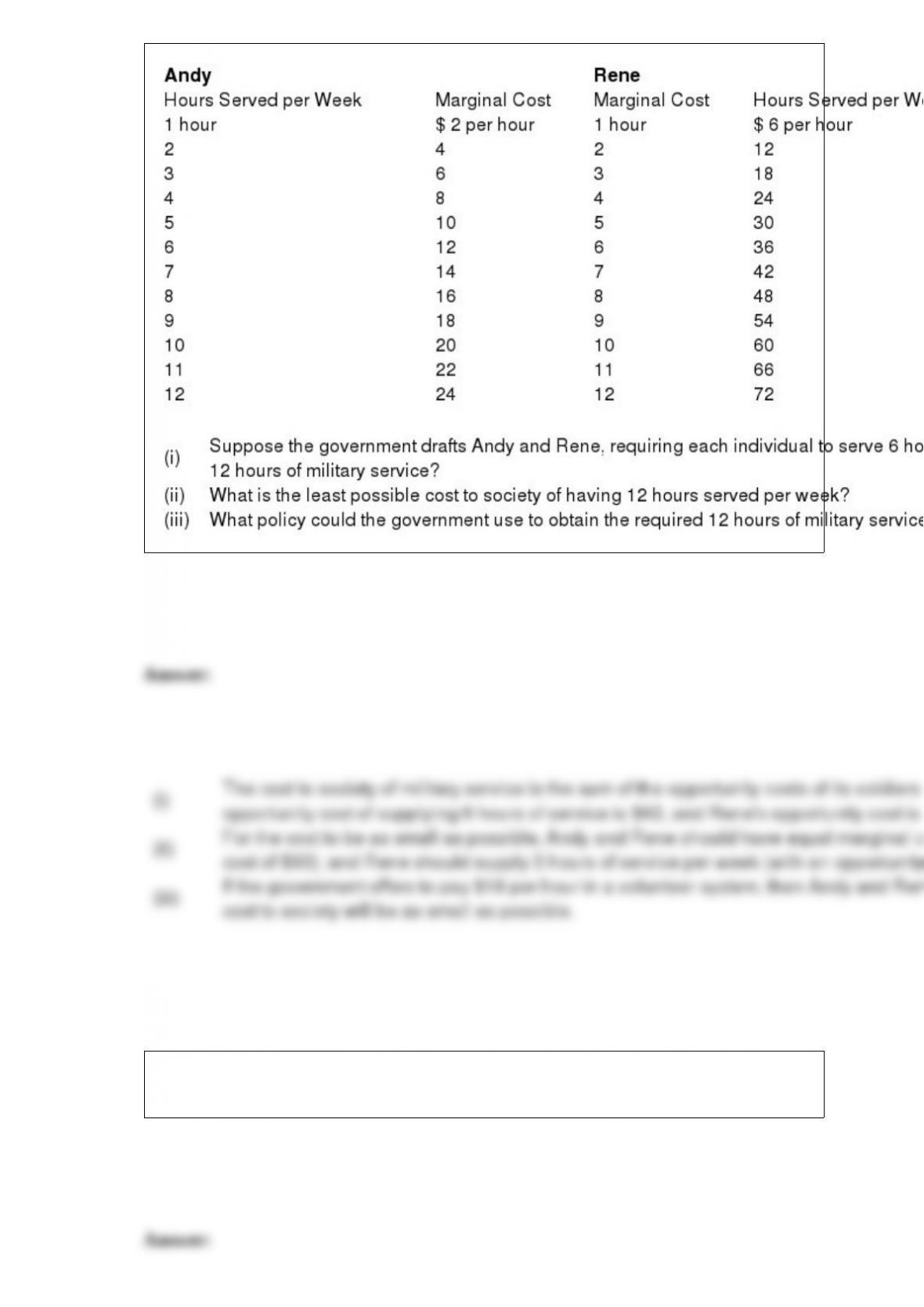
Consider two individuals, Andy and Rene, and their decision to serve in the military.
The accompanying tables show their opportunity costs of supplying military service.
The government has determined that it needs 12 total hours of military service per week
from these two individuals.
When an economist talks about equilibrium he is specifically discussing a situation
where the quantity supplied equals the quantity demanded.

The Prisoners’ Dilemma game is another situation where the Invisible Hand Theorem is
true.
A golden parachute is a mechanism that stockholders employ to encourage executives
to be more risky than they would be without the parachute.
Given two supply curves passing through the same point, the flatter one has the higher
elasticity.

The Marginal Rate of Technical Substitution can be expressed as the ratio of the
Marginal Productivities of Labor and Capital.
A government subsidy would allow all firms in a competitive constant-cost industry to
earn a positive profit in the long run.
When regulating a natural monopoly one should set the regulatory price such that the
monopoly will produce the efficient level of output.
When a gamble is repeated many times, the average outcome is the expected value.

Public goods can frequently be provided by private action when the resulting benefits
are widespread.
A worker’s labor supply may either rise or fall when nonlabor income increases,
depending on whether the substitution effect or the income effect dominates.
When access to a common property is unrestricted, why does the resulting social gain
fail to be as large as possible? How can an entrance fee increase social gain in this
situation?