
1) According to new classical economists, the:
A.short-run demand for labor curve is vertical.
B.short-run aggregate demand curve is vertical.
C.long-run aggregate supply curve is horizontal.
D.long-run aggregate supply curve is vertical.
2) which of the following is an example of monetary policy?
a.raising taxes to reduce inflation.
b.increasing government spending to reduce unemployment and stimulate production.
c.lowering interest rates to encourage spending and promote full employment.
d.cutting food stamps and other transfer payment programs during periods of rapid
growth and high inflation.
3) Legal protections against competitors producing and selling a product identical to the
one you invented are called _________; legal protections against competitors using
your product’s name are called __________.
A.patents; trademarks
B.trademarks; copyrights
C.copyrights; patents
D.trademarks; patents
4) The demand for agricultural products rises less rapidly than income. This means that
the demand for agricultural products is:
A.income inelastic.
B.income elastic.
C.price inelastic.
D.price elastic.
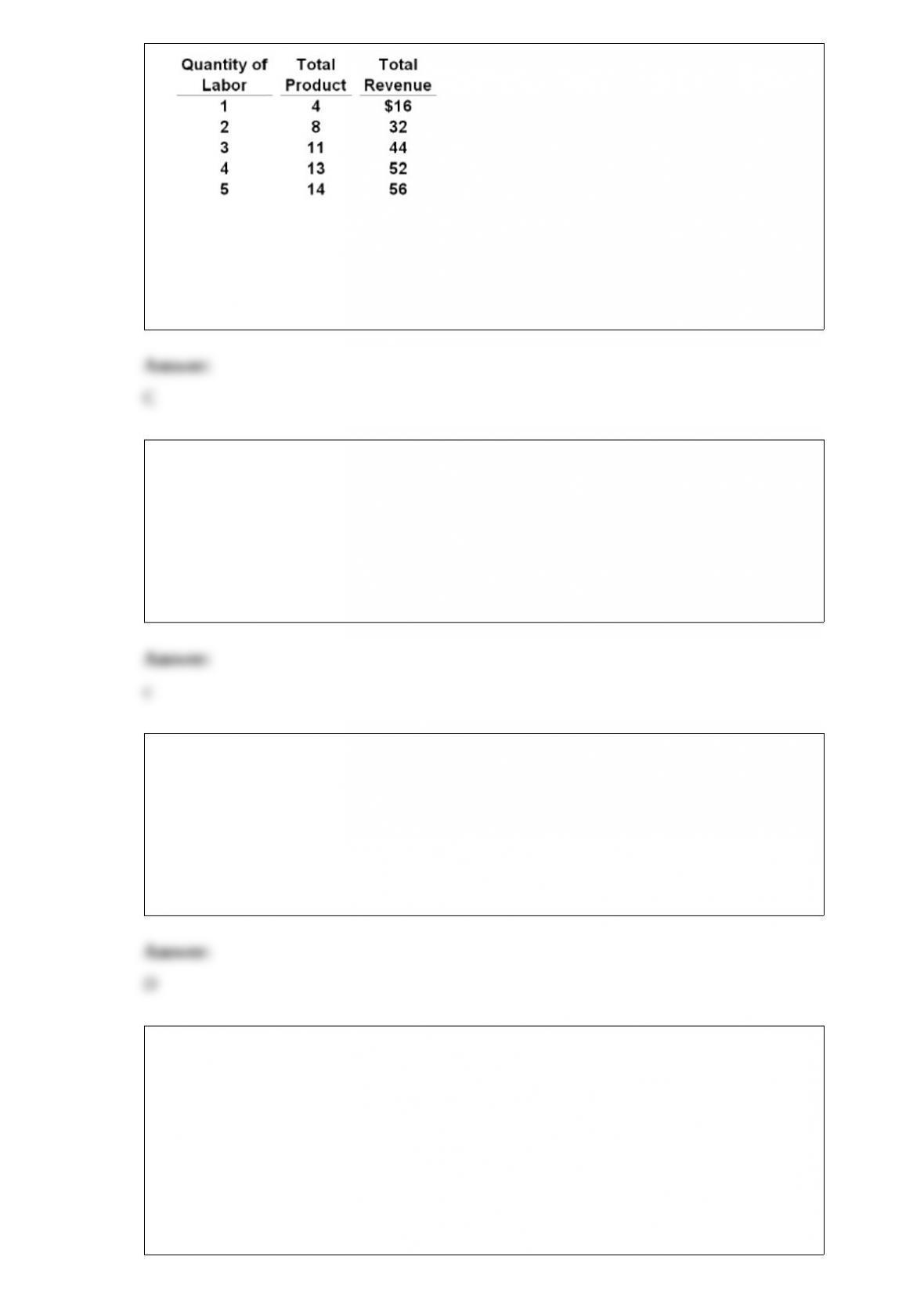
5)
Refer to the above data. This firm’s product price is:
A.$2.
B.$3.
C.$4.
D.$16.
6) in the short run, which of the following statements is correct?
a.the marginal cost curve intersects the average variable and average fixed cost curves
at their minimum points.
b.average variable cost declines continuously as total output is expanded.
c.total cost will exceed variable cost.
d.if the inputs of all resources are increased by equal amounts, total output will expand
by diminishing amounts.
7) In 2005, the 20 percent of families with the lowest incomes paid an average Federal
tax rate (on all Federal taxes) of about ____ percent, whereas the 20 percent of families
with the highest incomes paid an average tax rate of about ____ percent.
A.5.5; 50.1
B.10.3; 30.9
C.8.4; 27.2
D.4.3; 25.5
8) joe sold gold coins for $1000 that he bought a year ago for $1000. he says, “at least i
didn’t lose any money on my financial investment.” his economist friend points out that
in effect he did lose money, because he could have received a 3 percent return on the
$1000 if he had bought a bank certificate of deposit instead of the coins. the economist’s
analysis in this case incorporates the idea of:
a.opportunity costs.
b.marginal benefits that exceed marginal costs.
c.imperfect information.
d.normative economics.
9) The international agency that lends money to DVCs for economic development
projects is the:
A.World Bank.
B.International Monetary Fund (IMF).
C.World Trade Organization (WTO).
D.World Credit Union.
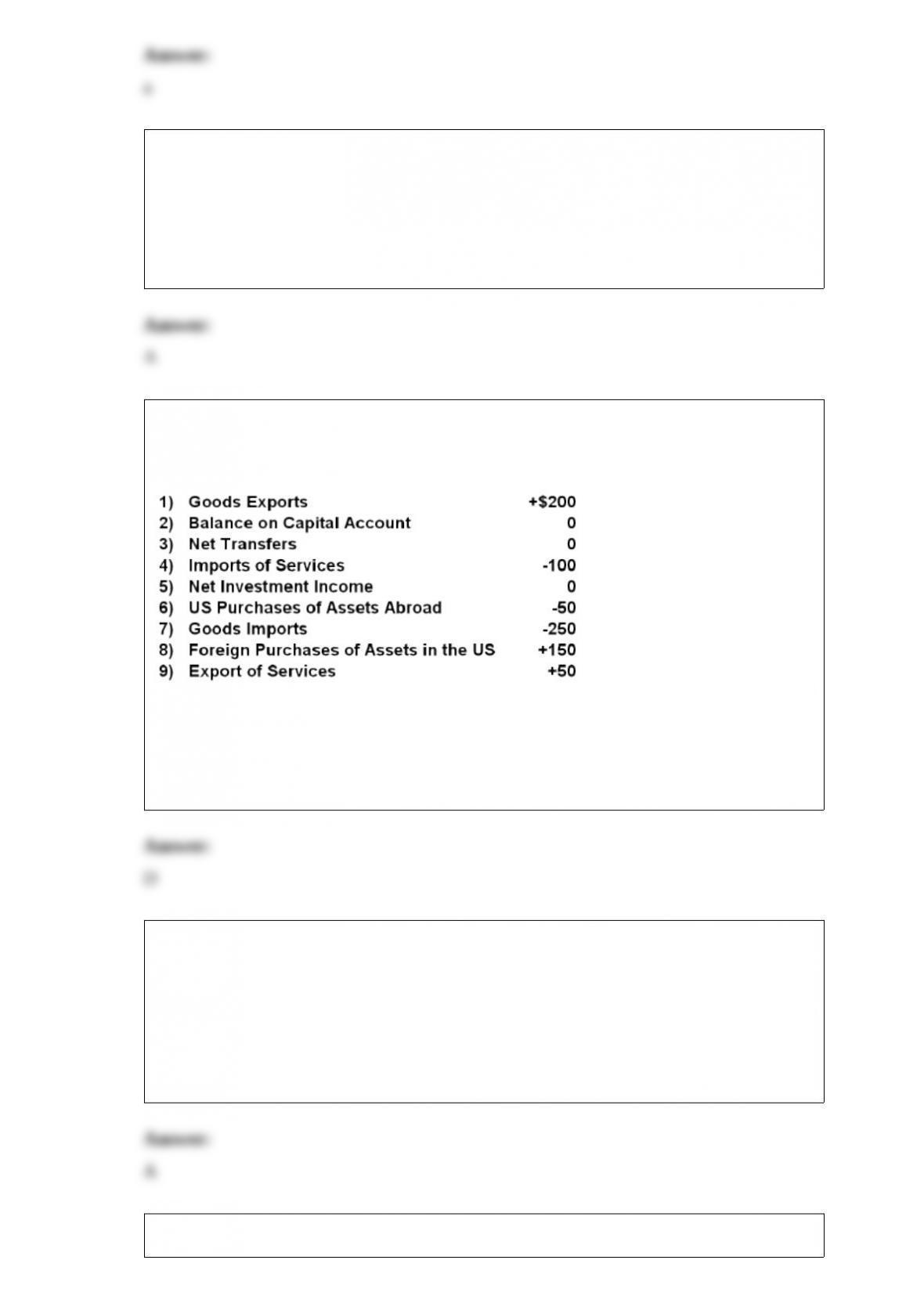
10) The plus items below are “export-type” entries and the minus items are
“import-type” entries in the balance of payments for the hypothetical country of Zippo.
Refer to the above information. Zippo has:
A.a current account surplus.
B.a financial account deficit.
C.a trade surplus on goods and services.
D.neither a balance of payments deficit nor a surplus.
11) Suppose that Marlen Fisher has legal protection against anyone producing and
selling a fishing lure specifically named “MarFish.” This legal protection is most likely
to be a:
A.trademark.
B.restraining order.
C.patent.
D.copyright.
12) Suppose that a large tree on Betty’s property is blocking Chuck’s view of the lake
below. Betty accepts Chuck’s offer to pay Betty $100 for the right to cut down the tree.
This situation describes:
A.the Coase theorem.
B.the adverse selection problem.
C.tragedy of the commons.
D.a market for externality rights.
13) The ABC Commercial Bank has $5,000 in excess reserves and the reserve ratio is
30 percent. The bank must have:
A.$90,000 in outstanding loans and $35,000 in reserves.
B.$90,000 in checkable deposit liabilities and $32,000 in reserves.
C.$20,000 in checkable deposit liabilities and $10,000 in reserves.
D.$90,000 in checkable deposit liabilities and $35,000 in reserves.
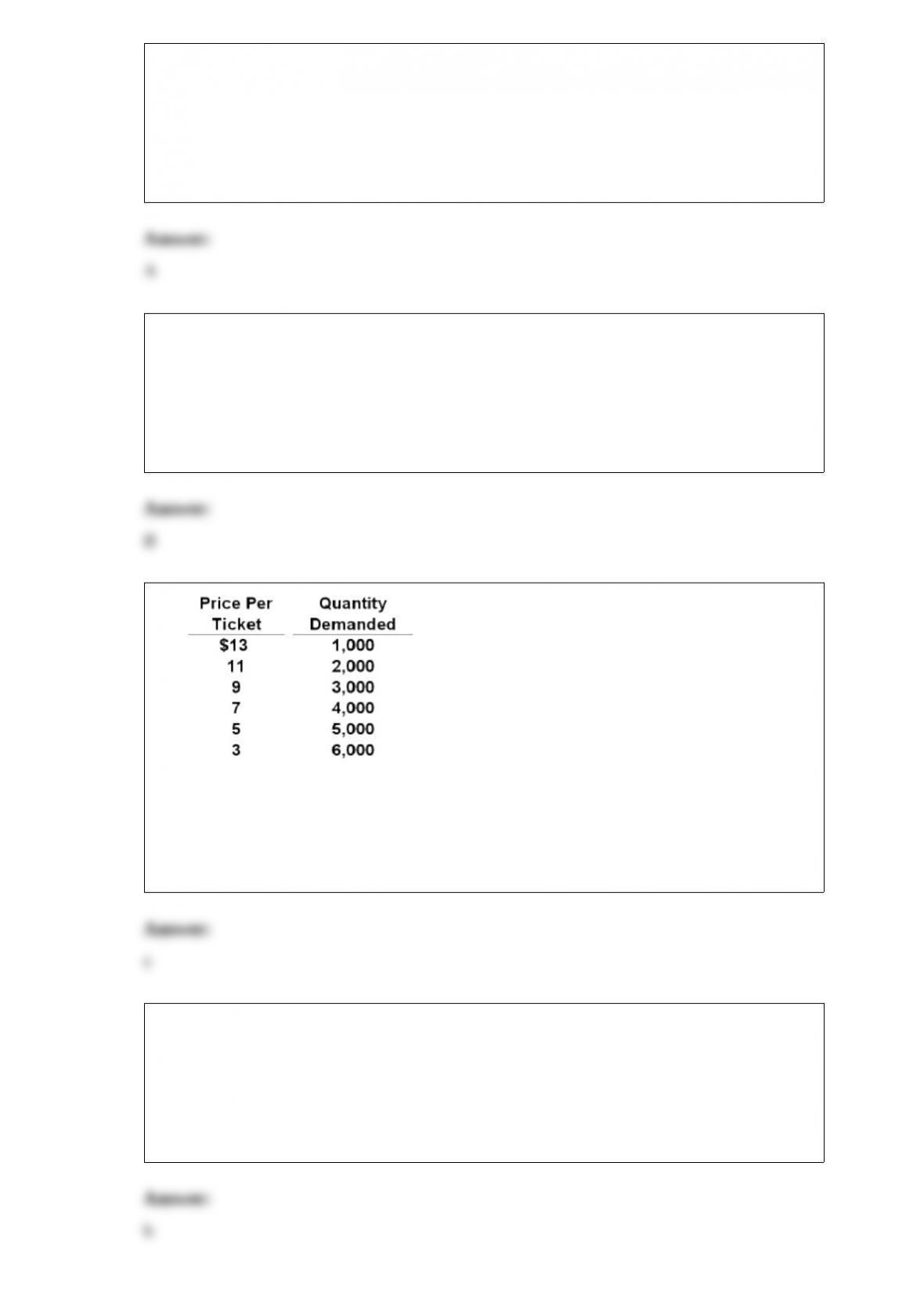
14)
refer to the above information. over the $11-$9 price range, demand is:
a.perfectly elastic.
b.perfectly inelastic.
c.elastic.
d.inelastic.
15) other things equal, an increase in a consumer’s money income:
a.increases the amount of utility a consumer receives from a given quantity of a good.
b.shifts her budget line rightward because she can now purchase more of both products.
c.eliminates the individual’s economizing problem.
d.causes the consumer to choose a different combination of goods along a given budget
line.
16) Suppose there is a decline in the demand for the product labor is producing.
Furthermore, the price of capital, which is complementary to labor, increases. Thus the
demand for labor:
A.will increase.
B.will decrease.
C.may either increase or decrease.
D.will not change.
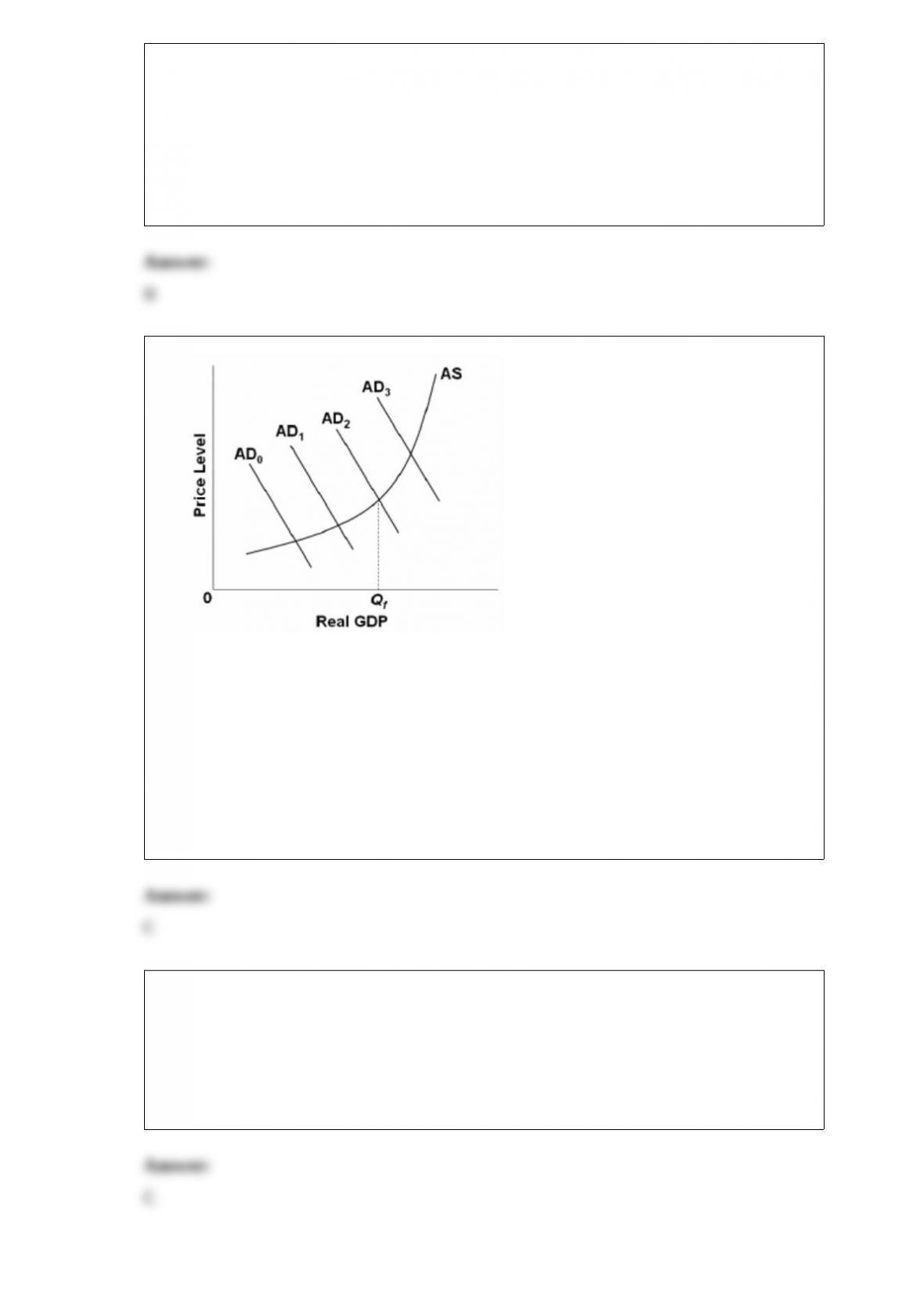
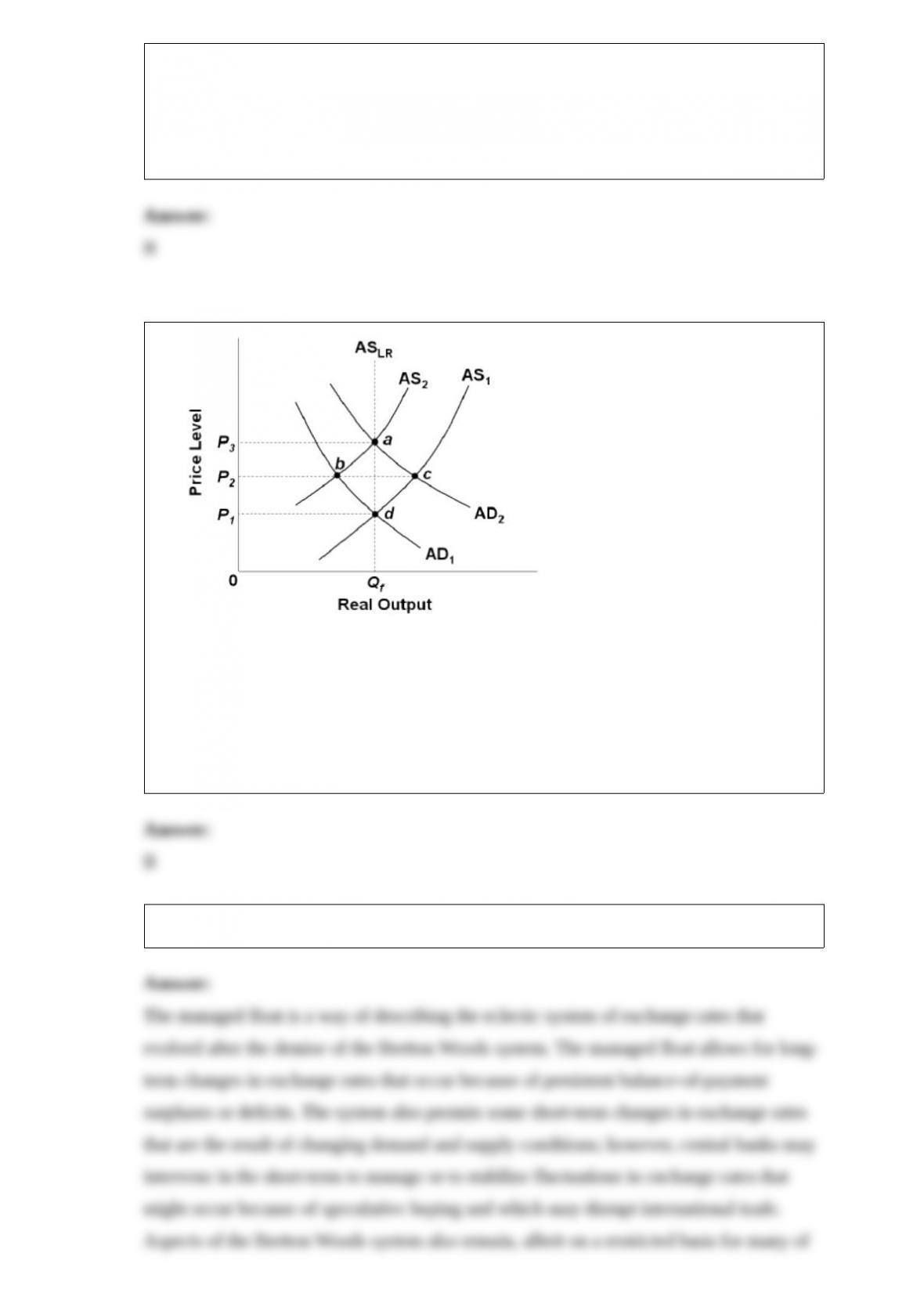
17)
Refer to the above diagram, in which Qf is the full-employment output. If the
economy’s present aggregate demand curve is AD2:
A.the most appropriate fiscal policy is an increase of government expenditures or a
reduction of taxes.
B.the most appropriate fiscal policy is a reduction of government expenditures or an
increase of taxes.
C.government should undertake neither an expansionary nor a contractionary fiscal
policy.
D.the economy is achieving its maximum possible output.
18) Which of the following correctly orders, highest to lowest, the relative magnitudes
of U.S spending by businesses on components of R&D?
A.invention, basic research, innovation.
B.invention, innovation, basic research.
C.innovation, invention, basic research.
D.basic research, invention, innovation.
19) If discrimination based on gender and race was eliminated, we would expect the:
A.personal distribution of income to become less equal.
B.personal distribution of income to become more equal.
C.personal distribution of income to be unaffected.
D.functional distribution of income to change in favor of profits and interest.
20)
Refer to the above diagram. The initial aggregate demand curve is AD1 and the initial
aggregate supply curve is AS1. Assuming no change in aggregate demand, the long-run
response to a recession caused by cost-push inflation is best depicted as a:
A.move from a to d along the long-run aggregate supply curve.
B.rightward shift of the aggregate supply curve from AS2 to AS1.
C.move from a to c to d
D.leftward shift of the aggregate supply curve from AS1 to AS2.
21) What is the managed float?
22) What were the key features of the Bretton Woods system?
23) What is meant by economies of scale and what is the importance of this concept to
economic growth?
24) Why is it difficult for most investors to take advantage of arbitrage opportunities?
25) What are the three primary measures used in macroeconomics to assess the
performance of an economy?