
The substitution effect of a wage increase is observed when
A) the higher wage income causes workers to take more leisure and work less.
B) leisure’s higher opportunity cost causes workers to take less leisure and work more.
C) the higher wage income causes workers to take more leisure and work more.
D) leisure’s higher opportunity cost causes workers to take more leisure and work less.
Expansionary fiscal policy
A) can be effective in the short run.
B) causes complete crowding out in the short run.
C) is never effective because of crowding out.
D) can be effective in the long run.
At the end of World War II in 1945, many economists and business managers expected
that the U.S. economy would enter a severe recession. At that time, Sears and
Montgomery Ward were the two largest department store chains in the country. Sears
CEO Robert Wood expected continuing prosperity and opened new stores. Montgomery
Ward CEO Sewell Avery expected falling incomes and rising unemployment and closed
a number of existing stores. The results of their actions were seen during the late 1940s,
when
A) Sears declared bankruptcy and was purchased by Montgomery Ward.

B) Montgomery Ward weathered the economic downturn in better financial shape than
Sears.
C) Sears rapidly gained market share at Montgomery Ward’s expense.
D) Sears had to close many of the new stores it had opened following the end of the
war.
Table 14-2 Table 14-2
shows the payoff matrix for Wal-Mart and Target from every combination of pricing
strategies for the popular PlayStation 3. At the start of the game each firm charges a low
price and each earns a profit of $7,000.
For each firm, is there a better outcome than the current situation in which each firm
charges the low price and earns a profit of $7,000?
A) Yes, the firms can implicitly collude and agree to charge a higher price.
B) No, there is no incentive for each firm to consider any other strategy.
C) No, any other strategy hurts consumers.
D) Yes, each firm can implicitly agree to increase output and not to deviate from a low
price.

The law of diminishing marginal utility states that
A) eventually total utility falls as more of a good is consumed, other things constant.
B) the extra satisfaction from consuming a good decreases as more of a good is
consumed, other things constant.
C) the extra satisfaction from consuming a good increases slowly as more of a good is
consumed, other things constant.
D) when the extra satisfaction from consuming a good becomes negative, total utility
starts falling, other things constant.
Government intervention in agricultural markets in the U.S. began
A) during World War II to ensure that enough food was available for domestic
consumption.
B) after World War I in order to assist farmers to adjust from a war-time economy to a
peace-time economy.
C) during the Great Depression.
D) during the Korean War.
A change in tax rates
A) has a less complicated effect on GDP than does a tax cut of a fixed amount.
B) has a larger multiplier effect the smaller the tax rate.
C) will not affect disposable income.
D) will not affect the size of the multiplier.
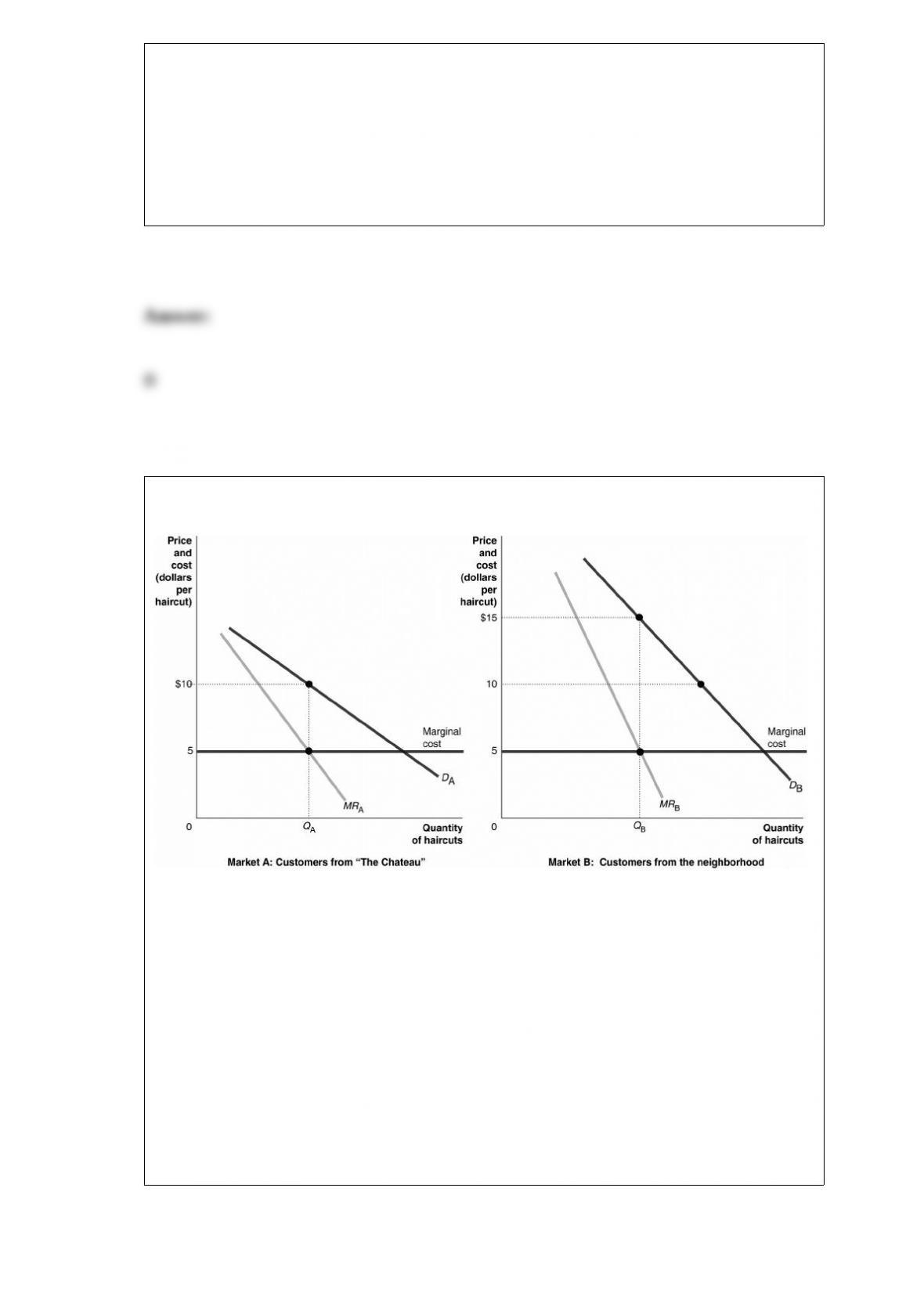
Figure 16-3
Chantal owns a hairdressing salon which caters to two main groups of customers:
residents of “The Chateau,” a retirement community, and other residents in the
neighborhood. Figure 16-3 shows the demand curves for the residents of the retirement
community, labeled Market A, and other residents in the neighborhood, labeled Market
B. The demand curves are not identical. What prices are charged in the two markets?
A) price in market A = price in market B = $15
B) price in market A = $10; price in market B = $15
C) price in market A = price in market B = $5
D) price in market A = price in market B = $10

The industrialized group of countries has growth rates that are consistent with the
findings of the economic growth model. That is, Taiwan, Korea, and Singapore had
________ incomes in 1960 than the United States and Switzerland, and Taiwan, Korea,
and Singapore grew ________ than the United States and Switzerland between 1960
and 2010.
A) lower; more rapidly
B) greater; less rapidly
C) lower; less rapidly
D) greater; more rapidly
The ratio of the increase in ________ to the increase in ________ is called the
multiplier.
A) equilibrium nominal GDP; autonomous expenditure
B) equilibrium real GDP; autonomous expenditure
C) autonomous expenditure; equilibrium real GDP
D) induced expenditure; equilibrium real GDP

Which of the following statements is false?
A) Not all individuals in both countries are made better off as a result of international
trade.
B) Within each country, some individuals are made better off as a result of international
trade, but one of the countries will be worse off overall.
C) Although some individuals may not be made better off as a result of international
trade, both countries may be made better off overall.
D) Each country as a whole is made better off as a result of international trade, but
individuals within each country may be made worse off.
Which of the following would occur if the United States switched from income taxes to
consumption taxes?
A) Consumption would increase.
B) The supply of loanable funds would decrease.
C) Saving would increase.
D) Tax revenues would rise.

Daniel Hammermesh and Stephen Donald studied the determinants of the earnings of
college graduates years after they graduated. Which of the following is one result of
their study?
A) The earnings of identical twins were about 9 percent higher than the earnings of all
other students.
B) Students who had taken 15 credits of upper-division science and mathematics
courses and earned high grades in these courses earned about 10 percent more than
students who took no upper-division classes in these subjects.
C) Students who took more Advanced Placement (AP) courses while still in high school
earned significantly more income for each AP course they passed with a grade of 4 or 5.
D) Students who took at least three economics courses earned about 9 percent more
income than students who took no college economics courses.
The Federal Trade Commission (FTC) Act
A) gave the FTC full power to regulate mergers.
B) closed the loopholes in the Sherman and Clayton Acts.
C) divided authority to police mergers between the FTC and the Department of Justice.
D) prohibited charging buyers different prices if the result would reduce competition.

Figure 13-10 Figure 13-10 shows cost
and demand curves for a monopolistically competitive producer of iced-tea.
Answer the following questions.
a. What is the profit-maximizing output level?
b. What is the profit-maximizing price?
c. At the profit-maximizing output level, how much profit will be realized?
d. Does this graph most likely represent the long run or the short run? Why?
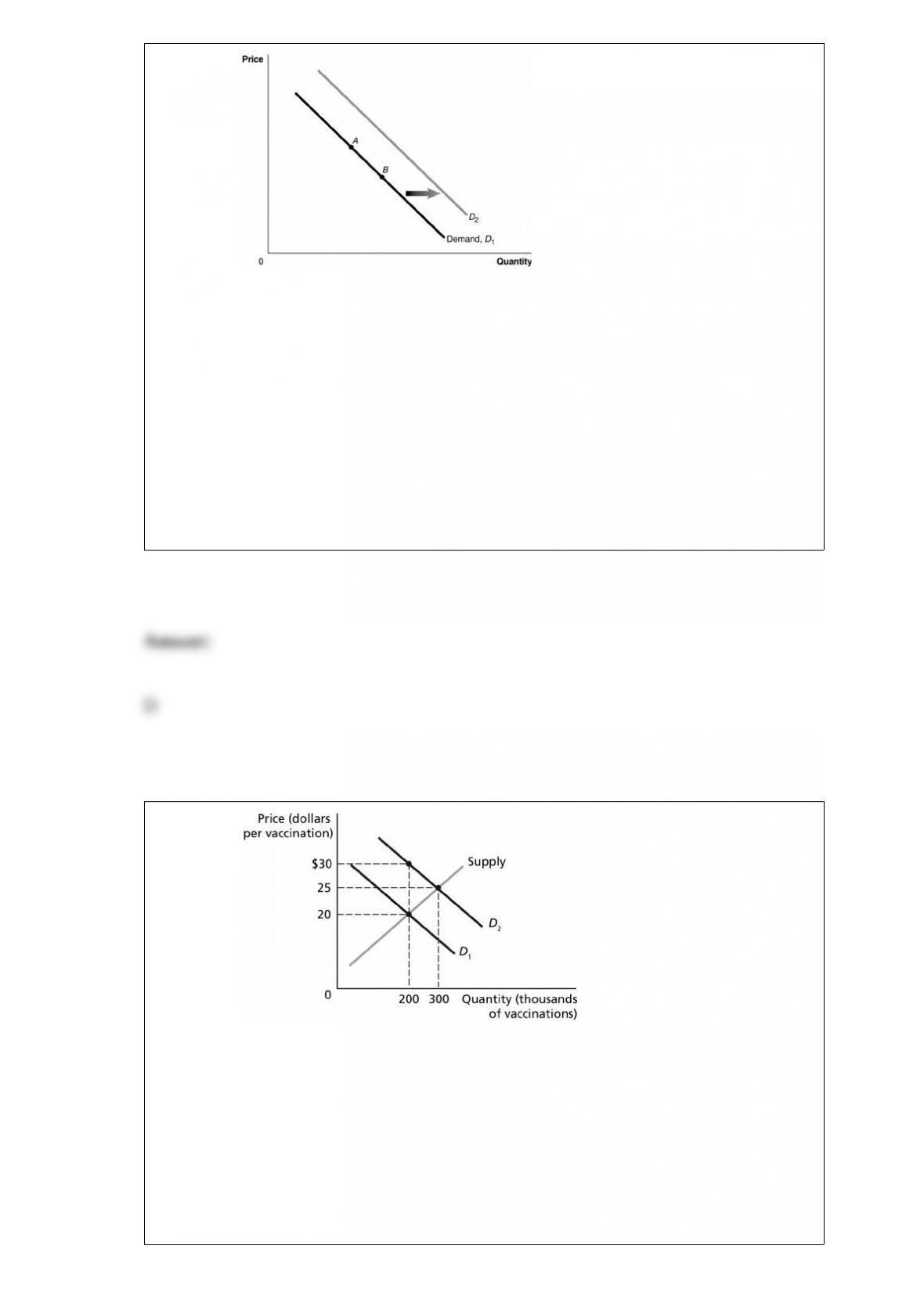
Figure 3-1
If the product represented is an inferior good, an increase in income would be
represented by a movement from
A) A to B.
B) B to A.
C) D1 to D2.
D) D2 to D1.
Figure 7-1 Figure 7-1 represents the
market for vaccinations. Vaccinations are considered a benefit to society, and the figure
shows both the marginal private benefit and the marginal social benefit from
vaccinations.
The market equilibrium price is
A) $30.
B) $25.

C) $20.
D) <$20.
Consider the following items:
a. the album “21” by Adele
b. a Dutch horticulturalist’s new method for cultivating hybrid tulips
c. Rolls Royce’s “Spirit of Ecstasy” hood ornament design
d. the sale of Tumi luggage at a Macy’s department store. Which of the items listed is an
example of intellectual property?
A) a and b only
B) a, b, and c
C) a and d only
D) all of the items listed
If a firm produces 20 units of output and incurs a total cost of $1,000 and a variable cost
is $700, calculate the firm’s average fixed cost of production if it expands output to 25
units.
A) $300
B) $15
C) $12
D) It is impossible to determine without additional information.
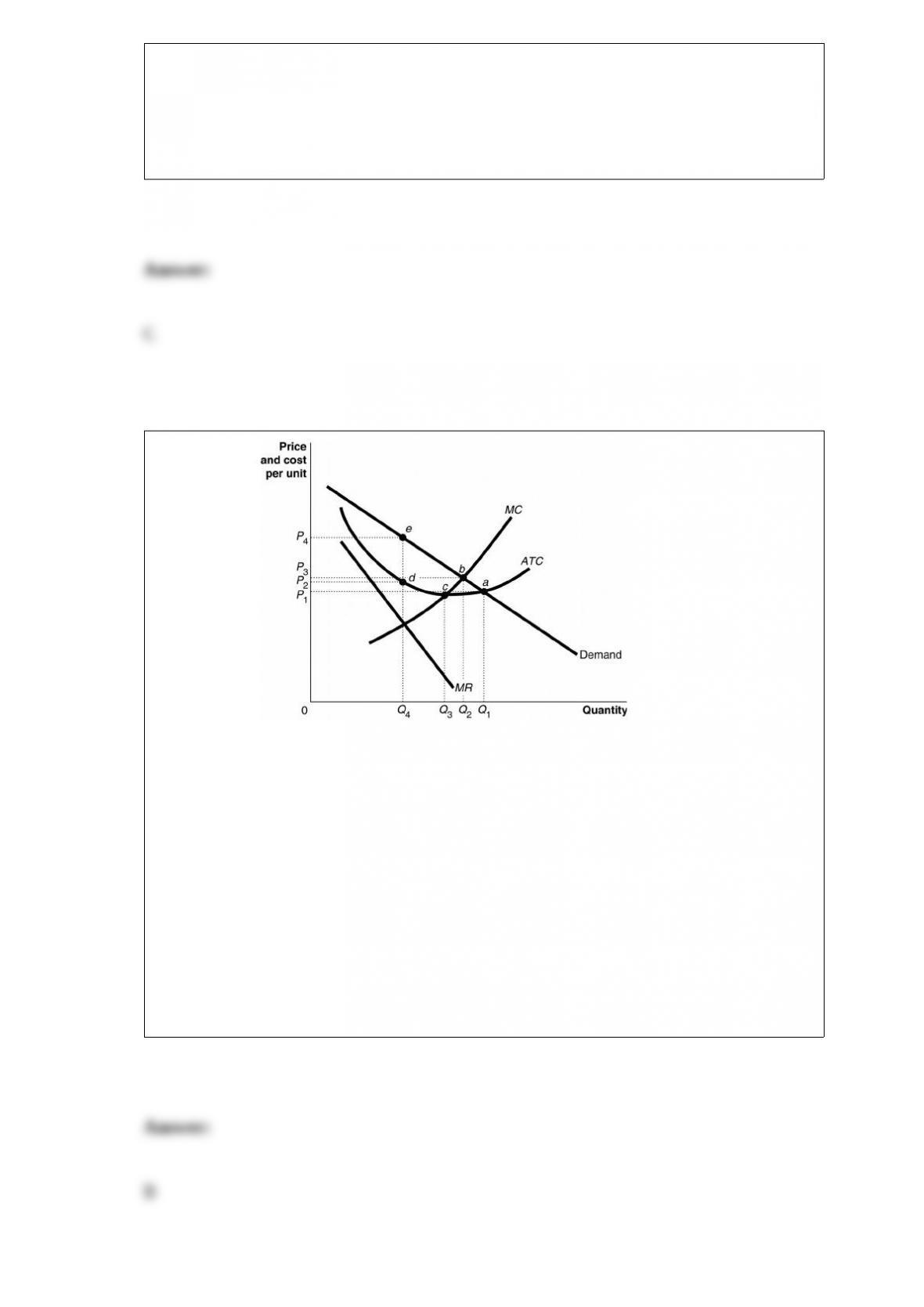
Figure 13-13
If the diagram represents a typical firm in the market, what is likely to happen in the
long run?
A) Some firms will exit the market causing the demand to increase for firms remaining
in the market.
B) New firms will enter the market causing the demand to decrease for existing firms.
C) Inefficient firms will exit the market, and new cost-efficient firms will enter the
market.
D) Competition will be intensified as firms strive to make long-run profits.