
An individual has a utility function for tennis rackets (x) and tennis balls (y) of the form
U(x, y) = min (3x, y). His or her expenditure function is given by
a. .
b. .
c. .
d. .
A Nash equilibrium is a set of strategies that are mutual
a. best responses.
b. dominant strategies.
c. Pareto optima.
d. All of these answers are correct.
The following definitions for an individual who consumes only two goods:
x = share of income spent on x.
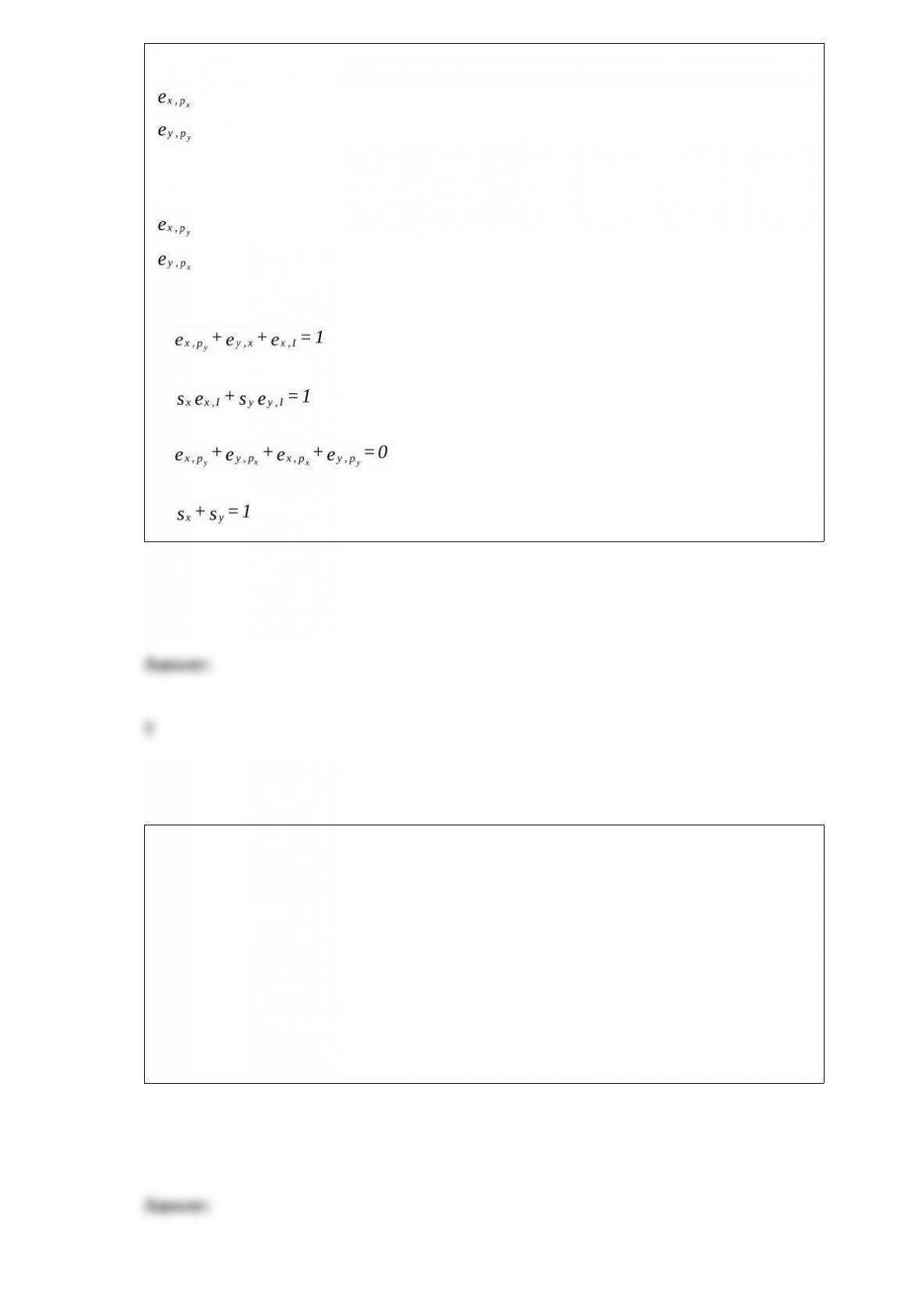
y = 1 -sx .
= price elasticity of demand for x.
= price elasticity of demand for y.
ex, I = income elasticity of demand for x.
ey, I = income elasticity of demand for y.
= cross price elasticity of demand for x.
= cross price elasticity of demand for y.
A generalization of Engel’s Law is given by
a. .
b. .
c. .
d. .
Suppose utility is given by U(x, y) = ln x + ln y and x = 1, I = 10. If y must be purchased
in whole units, what is the maximum price this person would pay for that good?
a. 1.
b. 5.
c. 10.
d. 20.

Long-run producer surplus in a perfectly competitive industry accrues mainly to
a. suppliers of inputs with inelastic supply curves.
b. suppliers of inputs with elastic supply curves.
c. firms’ owners.
d. marginal consumers.
If an individual’s utility function is quasi-concave, his or herMRS will
a. diminish as xis substituted for y.
b. increase as xis substituted for y.
c. be undefined except in special cases.
d. always depend only on the ratio of xto y.
If the demand for a product is elastic, then a rise in price will
a. cause total spending on the good to increase.
b. cause total spending on the good to decrease.

c. keep total spending the same, but reduce the quantity demanded.
d. keep total spending the same, but increase the quantity demanded
The opportunity cost of leisure is approximated by
a. the price of leisure activities (such as theater tickets).
b. an individual’s hourly real wage rate.
c. commuting expense.
d. an individual’s total income.
A monopoly’s economic profits are represented by
a. (price minus marginal cost) times number of units sold.
b. (price minus average cost) times number of units sold.
c. (marginal revenue minus price) times number of units sold.
d. (marginal cost minus price) times number of units sold.

If a consumer purchases only two goods (x and y) and the demand for x is elastic, then a
rise in the price of x
a. will cause total spending on good y to rise.
b. will cause total spending on good y to fall.
c. will cause total spending on good y to remain unchanged.
d. will have an indeterminate effect on total spending on good y.
For a monopsonistic hirer of labor the gap between labor’s marginal revenue product
and its wage rate will be greater
a. the more elastic the supply curve for labor.
b. the more inelastic the supply curve for labor.
c. the more elastic the firm’s demand for labor.
d. the more inelastic the firm’s demand for labor.
Price controls

a. are always popular with consumers because they lower prices.
b. create shortages.
c. increase producer surplus because firms can now sell a greater quantity of a good at a
lower price.
d. are necessary to preserve equity.
Graphically, the average productivity of labor is illustrated by
a. the slope of the total product curve at the relevant point.
b. the slope of the marginal productivity curve at the relevant point.
c. the negative of the slope of the marginal productivity curve at the relevant point.
d. the slope of the chord connecting the origin with the relevant point on the total output
curve.
Which of the following will not cause a demand curve to shift position?
a. A doubling of the good’s price.
b. A doubling of the price of a closely substitutable good.
c. A doubling of income.

d. A shift in preferences.
e. A doubling of both the price of X and the price of Y.
If the government requires a natural monopoly to price at marginal cost,
a. monopoly firms will earn zero economic profits because the price of the good equals
the cost of producing that good.
b. monopoly firms will operate at a loss because P < AC.
c. more firms will be able to enter the market.
d. producer surplus will increase because quantity supplied is greater.
A game of incomplete information is distinct from one of complete information in that
players
a. do not observe each others’ actions.
b. do not know each others’ payoff functions.
c. do not know the timing of moves.
d. use mixed strategies.

The “freerider problem” of public goods refers to
a. individuals’ refusal to pay taxes.
b. individuals’ attempts to hide their preferences for collective goods and to avoid
paying for them.
c. individuals’ overuse of collective goods.
d. the inelasticity of individuals’ demands for public goods.
If goods x and y are complements, then the cross price elasticity of demand between
them will be
a. positive.
b. negative.
c. zero.
d. infinity.

“Compensating wage differentials” arise because
a. workers possess different skills.
b. workers prefer some jobs to others.
c. firms pay higher wages for workers with higher marginal productivities.
d. firms discriminate in hiring.
The attributes model of consumer choice explains the possibility that an individual does
not purchase a particular good, z by assuming
a. the person’s preferences do not favor z.
b. linear combinations of other goods dominate z.
c. that MUz / z is less than the marginal utility of income.
d. z is inferior.
If a 1 percent increase in price leads to a 0.7 percent increase in quantity supplied, the
shortrun supply curve is
a. elastic.

b. inelastic.
c. unit elastic.
d. perfectly inelastic.
Which statement is true of the Battle of the Sexes game?
a. It is a coordination game.
b. The mixed-strategy Nash equilibrium provides players with lower expected payoffs
than other equilibria.
c. The first mover has an advantage in the sequential version.
d. All of these answers are correct.
If more and more labor is employed while keeping all other inputs constant, the
marginal physical productivity of labor will eventually
a. increase.
b. decrease.
c. remain constant.

d. We cannot tell from the information provided.
A firm whose production function displays increasing returns to scale will have a total
cost curve that is
a. a straight line through the origin.
b. a curve with a positive and continually decreasing slope.
c. a curve with a positive and continually increasing slope.
d. a curve with a negative and continually decreasing slope.
Which of the following best explains why the elasticity of supply of labor for an
individual with a Cobb-Douglas utility function (for consumption and leisure) is zero?
a. Income and substitution effects are precisely offsetting.
b. The elasticity of substitution of leisure for consumption is zero.
c. Leisure is an inferior good.
d. Consumption is subject to diminishing marginal utility.

Consider a firm composed of 5 workers, each with a utility function of the form
where l is hours worked and w is the wage. Suppose the firm can monitor
the number of hours worked by each worker and pays them per hour. How
many hours will each worker choose to work?
a. 2 hours.
b. 4 hours.
c. 8 hours.
d. 10 hours.
The primary additional insight provided by expanding the theory of choice from two to
three goods is that a pair of goods may now be
a. gross substitutes.
b. gross complements.
c. net substitutes.
d. net complements.

In the Slutsky equation for , the income effect is given by
a. .
b. .
c. .
d. .
The substitution effect of a change in wage rate on a firm’s demand for labor input will
be more significant
a. the greater the change in output.
b. the more sharply curved are the firm’s isoquants.
c. the flatter are the firm’s isoquants.
d. the larger the quantity of labor employed.
Short-run producer surplus can be caluculated by integration as (where q* is the firm’s
profit maximizing output level and MC(q) is its marginal cost function)
a. .

b. .
c. .
d. .
In the 1980s, it became increasingly common for consumers to sign two-year leases
rather than buying the cars outright. As these leases expired, the supply of used cars
expanded considerably. How would the addition of this large volume of off-lease cars
influence the possibility of a lemons problem on the used-car market?
a. The lemons problem would be alleviated because off-lease cars tend to be
put up for sale automatically, rather than being offered only when the seller obtains
private information about the car’s poor quality.
b. The lemons problem would be worsened because used-car prices would fall
in response to the glut of off-lease cars.
c. The lemons problem would be worsened because, with more used cars, searching for
the appropriate car would become much more difficult for buyers.
d. Very little; the existence of off-lease cars has little to do with the lemons problem.

A profit maximizing monopoly will produce that output for which
a. marginal revenue equals price.
b. average cost is minimized.
c. marginal cost is minimized.
d. marginal cost equals marginal revenue.
In the long run, the greater burden of a specific tax will usually be absorbed by
a. consumers.
b. the party — consumers or producers — with the more elastic demand/supply curve.
c. the party with the least elastic demand/supply curve.
d. shareholders and employees of the firm in the form of reduced dividends and wages.
Which of the following is not a straightforward example of a (principal agent)
relationship?
a. Homeowner real estate agent.
b. Shareholder manager.

c. Manager line employee.
d. Doctor patient.
The principal difference between economic profits for a monopolist and for a
competitive firm is that
a. monopoly profits create major problems of equity whereas competitive profits do not.
b. competitive profits exist only in the short run whereas monopoly profits may exist in
the long run as well.
c. monopoly profits represent a transfer out of consumer surplus whereas competitive
profits do not.
d. monopoly profits are usually larger than competitive profits.