
1) Right-to-work laws prohibit the formation of labor unions.
2) Total Allowable Catch policies promote economic efficiency better than Individual
Transferable Quotas.
3) as it relates to public goods, nonexcludability means that nonpayers cannot be barred
from obtaining the benefits.
4) it is generally agreed that the most promising reform of the health care system is for
government to fix doctors’ fees below current levels.
5) The concept of parity has provided a rationale for government price supports for
farm products.
6) marginal analysis means that decision-makers compare the extra benefits with the
extra costs of a specific choice.
7) Farmers typically sell their products in highly competitive markets and buy in
imperfectly competitive markets.

8) improvements in education and training explain about 80 percent of the historical
growth of u.s. labor productivity.
9) a rational consumer will cease purchasing a product at that quantity where marginal
utility begins to diminish.
10) economists treat economic immigration as a human capital investment decision.
11) Saving is low in many DVCs primarily because income is very equally distributed.
12) a competitive market system promotes growth by providing producers with market
signals on which to base investment and production decisions.
13) A firm might choose to pay its employees a wage higher than that which would
clear the market because:
A.the higher wage raises the opportunity cost of shirking.
B.the higher wage may shift the labor demand curve to the left.
C.the firm will have higher turnover, allowing “new blood” to invigorate older workers
who have a greater tendency to shirk.
D.this policy reduces the proportion of experienced to inexperienced workers, resulting
in a lower overall wage bill.
14) when the price of a product increases, a consumer is able to buy less of it with a

given money income. this describes:
a.the cost effect.
b.the inflationary effect.
c.the income effect.
d.the substitution effect.
15) which of the following is a public good?
a.chewing gum
b.bread
c.a professional baseball game
d.street lights in a city
16) if we are considering the relationship between two variables and release one of the
other-things-equal assumptions, we would expect:
a.the relationship to change from direct to inverse.
b.the line representing that relationship on a graph to shift.
c.the data points to have a tighter fit to the line representing the relationship.
d.the relationship to change from inverse to direct.
17) u.s. tariffs on imported goods:
a.have steadily increased since the 1970s.
b.have declined since the 1940s and are currently around 5 percent.
c.are currently around 20 percent.
d.are illegal.
18) Technological change:
A.always entails increased investment.
B.never entails increased investment.
C.may or may not entail increased investment.
D.is of little relevance to economic growth in the DVCs.
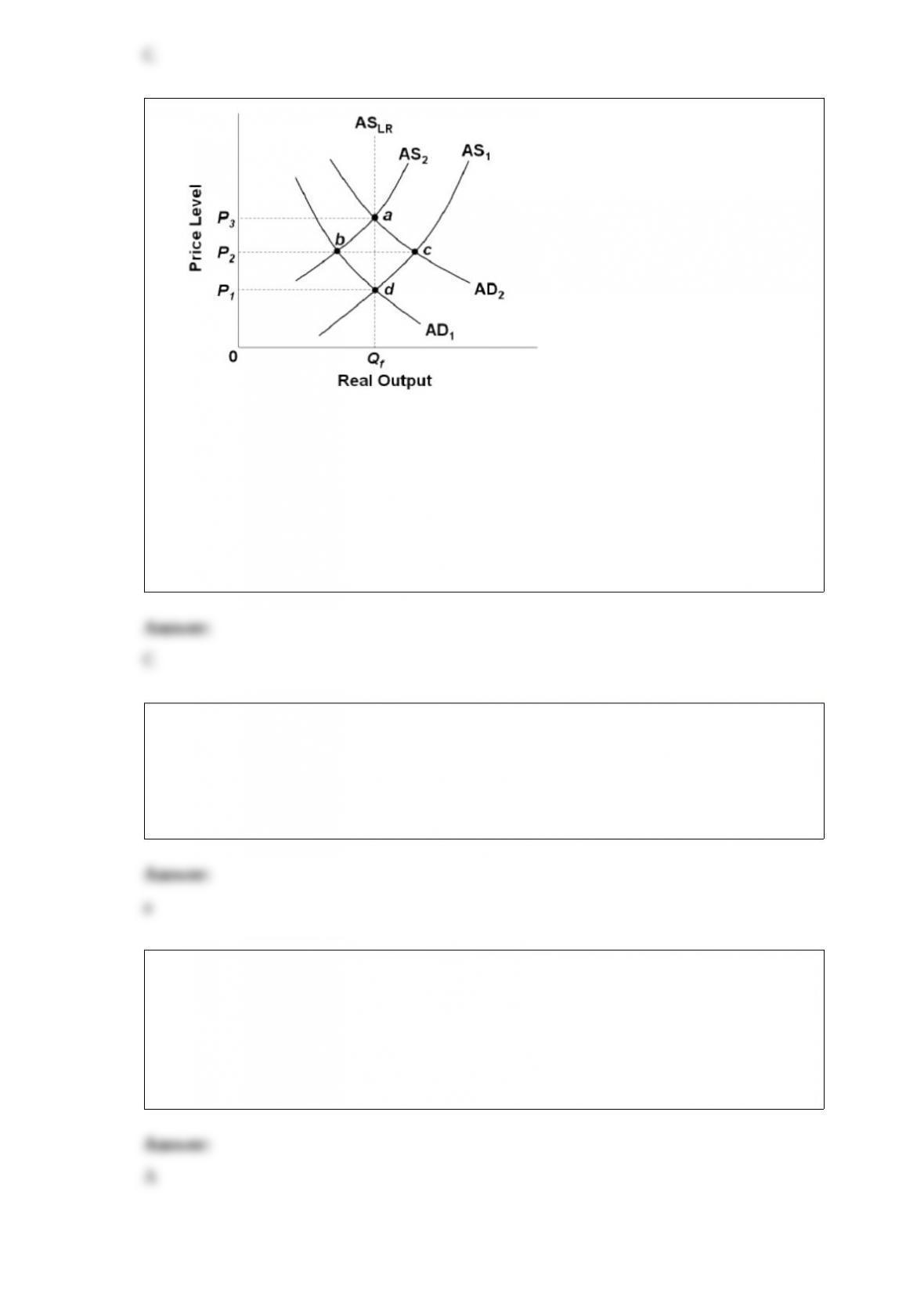
19)
Refer to the above diagram. The initial aggregate demand curve is AD1 and the initial
aggregate supply curve is AS1. In the long run, the aggregate supply curve is vertical in
the diagram because:
A.nominal wages and other input prices are assumed to be fixed.
B.real output level Qf is the potential level of output.
C.price level increases produce perfectly offsetting changes in nominal wages and other
input prices.
D.higher than expected rates of actual inflation reduce real output only temporarily.
20) the law of increasing opportunity costs exists because:
a.resources are not equally efficient in producing various goods.
b.the value of the dollar has diminished historically because of persistent inflation.
c.wage rates invariably rise as the economy approaches full employment.
d.consumers tend to value any good more highly when they have little of it.
21) The number of countries belonging to the World Trade Organization (WTO), as of
2008, is about:
A.153.
B.135.
C.80.
D.202.
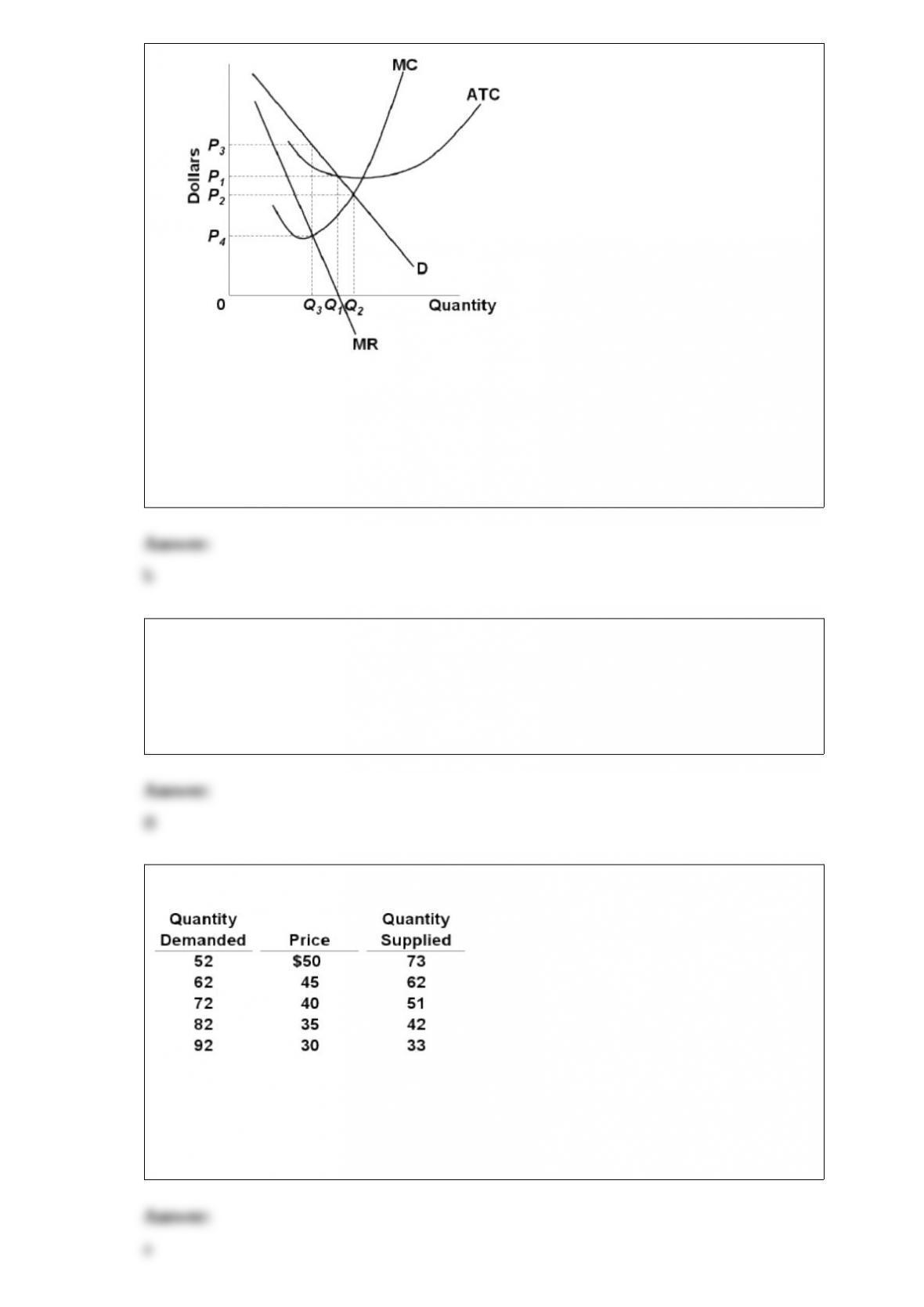
22)
refer to the above diagram for a pure monopolist. if the monopolist is unregulated, it
will maximize profits by charging:
a.a price above p3 and selling a quantity less than q3.
b.price p3 and producing output q3.
c.price p2 and producing output q2.
d.price p1 and producing output q1.
23) A union might increase the demand for the labor services of its members by:
A.decreasing the demand for the product it is producing.
B.decreasing the prices of complementary inputs.
C.decreasing the prices of substitute inputs.
D.increasing the prices of complementary inputs.
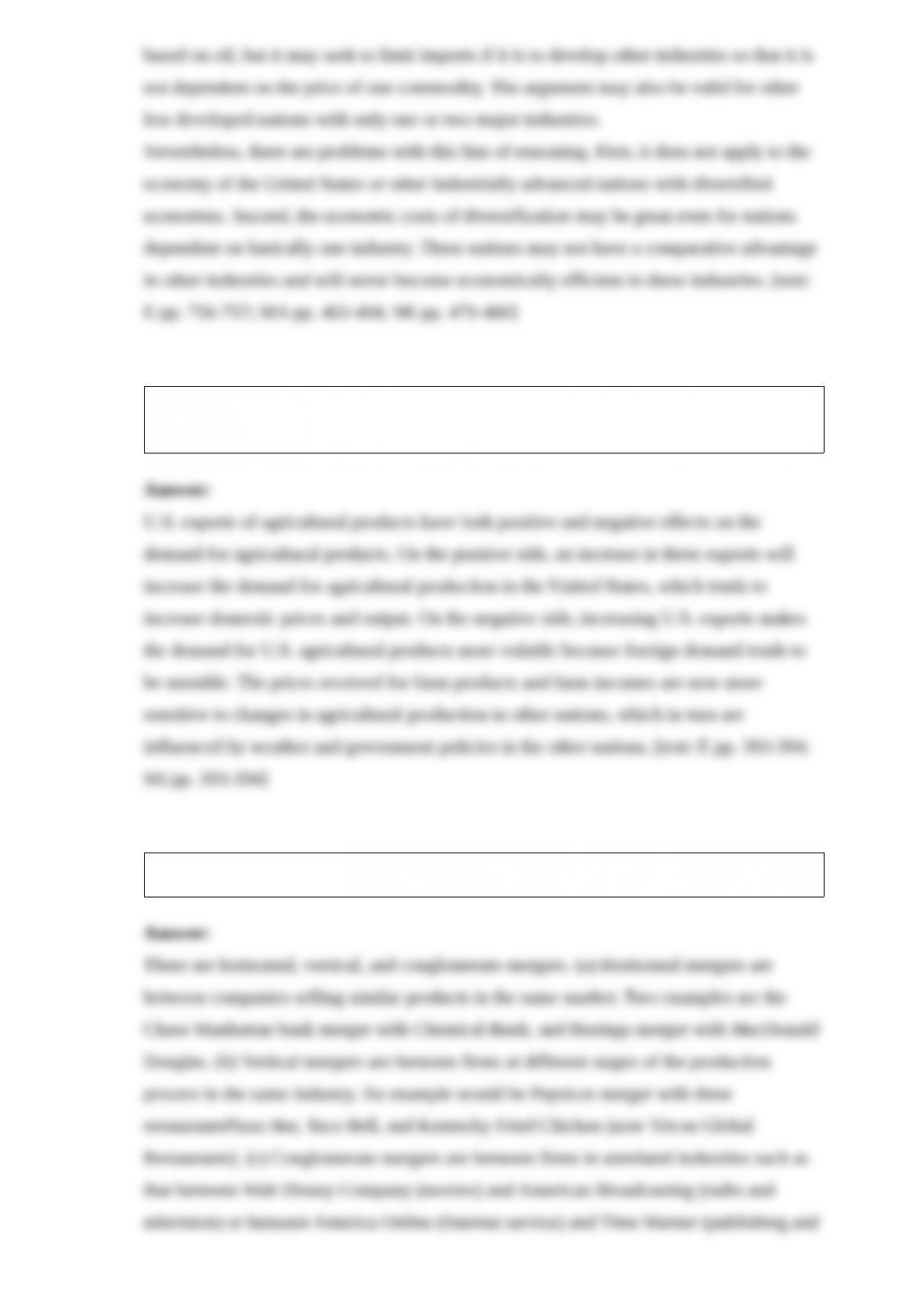
24) government-set prices
in the above market, economists would call a government-set maximum price of $40 a:
a.price ceiling.
b.price floor.
c.equilibrium price.
d.fair price.

25)
Refer to the above data. This firm is selling its product in:
A.an imperfectly competitive market at prices that decline as sales increase.
B.a purely competitive market at $3 per unit.
C.a purely competitive market at $2 per unit.
D.an imperfectly competitive market at $3 per unit.
26) Which of the following groups has the highest poverty rate?
A.age 65 or over
B.foreign-born (non citizens)
C.Hispanics
D.female-headed households
27) If labor’s share of the income paid to American resource suppliers is broadly
defined as the sum of wages and salaries and proprietors’ income, we can say that
labor’s relative share has:
A.remained approximately constant since 1900.
B.increased dramatically at the expense of capitalist income.
C.declined by about one-third since 1900.
D.decreased because of the decline of unionism.
28) What are the limitations to the diversification for stability argument for trade
protection?
29) How do U.S. exports of agricultural products affect the demand for agricultural
products?
30) Describe the three types of mergers and give examples.

31) Compare pure competition, pure monopoly, monopolistic competition, and
oligopoly for technological advance in the form of new product development.
32) What is the value added by all the firms AE from the production of a product as
described below? What did each firm add separately in value and what does it total?
33) Explain the collusive pricing model of oligopoly behavior.

34) How does innovation differ from invention and diffusion? How does innovation
affect competition among firms?
35) Explain the three major factors that can cause a shift in aggregate supply. That is,
explain the three major determinants of supply.