If the cost of producing sofas decreases, then consumer surplus in the sofa market will
a. increase.
b. decrease.
c. remain constant.
d. increase for some buyers and decrease for other buyers.
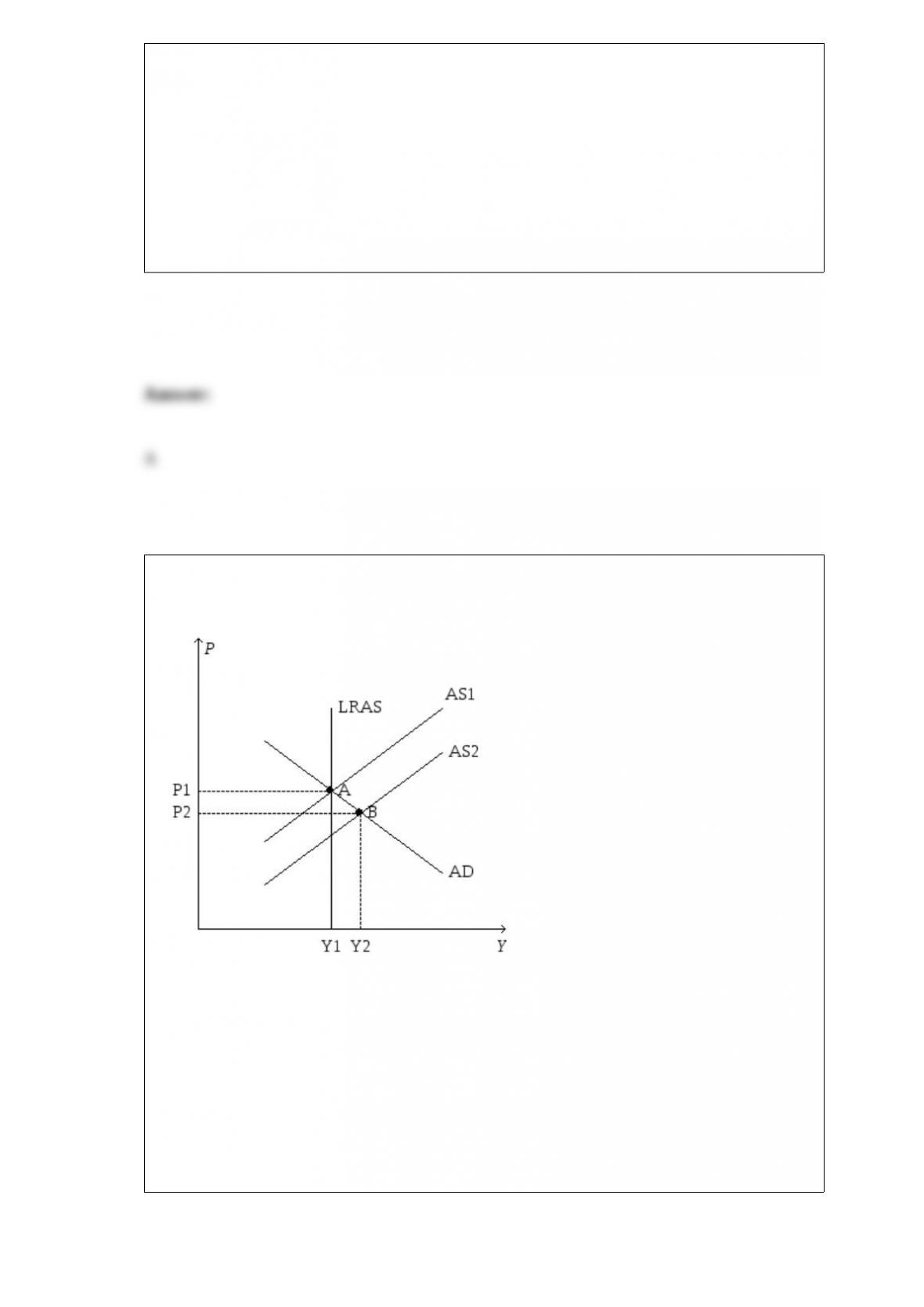
Figure 20-2.
Refer to Figure 20-2. Point B represents
a. a short-run equilibrium and a long-run equilibrium.
b. a short-run equilibrium but not a long-run equilibrium.
c. a long-run equilibrium but not a short-run equilibrium.
d. neither a short-run equilibrium nor a long-run equilibrium.

For any country, if the world price of zinc is higher than the domestic price of zinc
without trade, that country should
a. export zinc, since that country has a comparative advantage in zinc.
b. import zinc, since that country has a comparative advantage in zinc.
c. neither export nor import zinc, since that country cannot gain from trade.
d. neither export nor import zinc, since that country already produces zinc at a low cost
compared to other countries.
If the reserve ratio is 12.5 percent, then $1,000 of additional reserves can create up to
a. $7,000 of new money.
b. $8,000 of new money.
c. $11,500 of new money.
d. $12,500 of new money.

Another term for equilibrium price is
a. dynamic price.
b. market-clearing price.
c. quantity-defining price.
d. balance price.
The rules established under GATT are enforced by the
a. governments of the nations that are involved in GATT.
b. North American Free Trade Association.
c. World Trade Organization.
d. European Union.
The Bureau of Labor Statistics produces data on
a. unemployment.
b. types of employment.
c. length of the average workweek.
d. All of the above are correct.
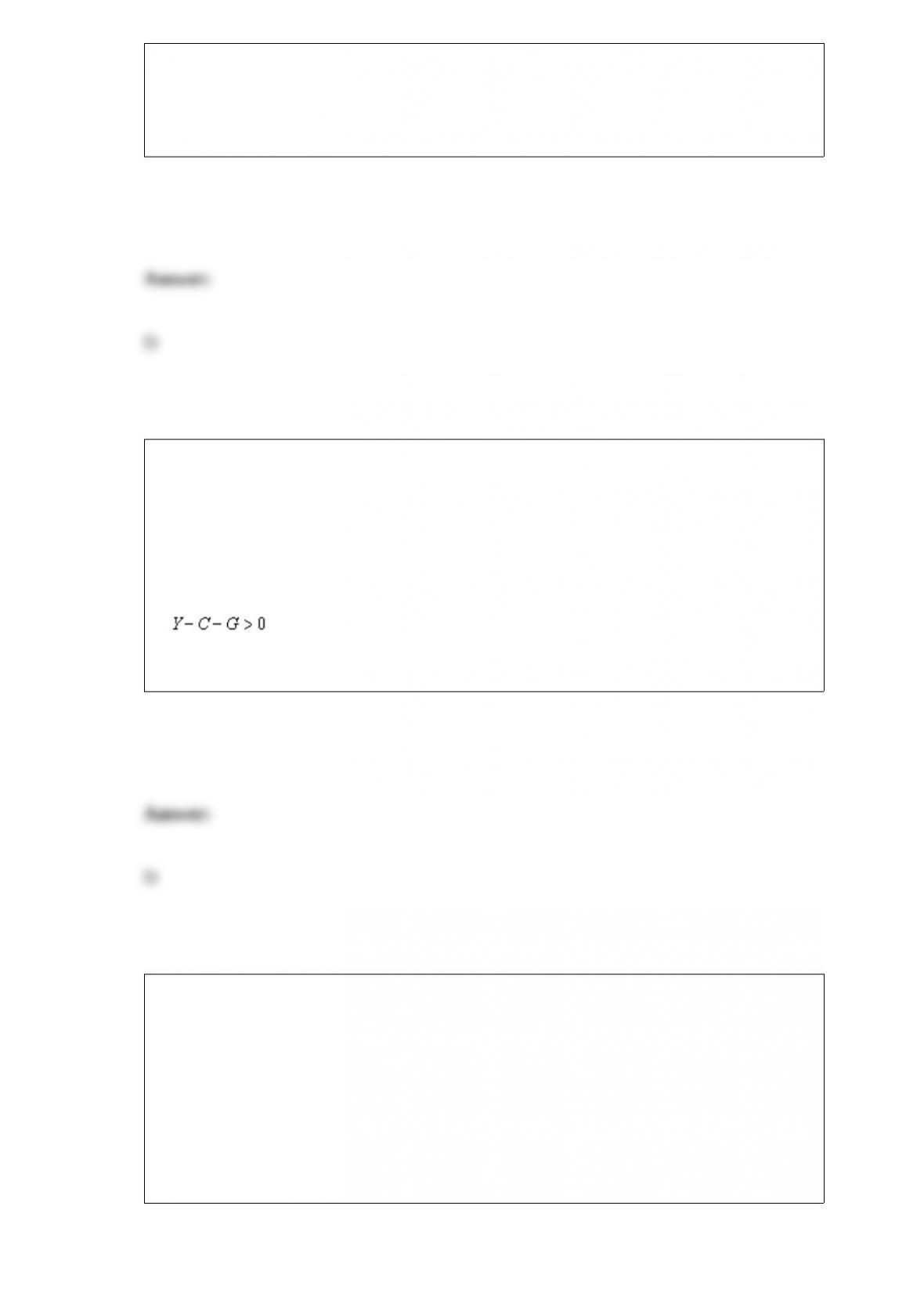
If national saving in a closed economy is greater than zero, which of the following must
be true?
a. Either public saving or private saving must be greater than zero.
b. Investment is positive.
c.
d. All of the above are correct.
Other things the same, an increase in velocity means that
a. the rate at which money changes hands falls, so the price level rises.
b. the rate at which money changes hands falls, so the price level falls.
c. the rate at which money changes hands rises, so the price level rises.
d. the rate at which money changes hands rises, so the price level falls.

Which of the following is not an example of a market?
a. A small town has only one seller of electricity.
b. In the United States, a sick person cannot legally purchase a kidney.
c. In Florida, there are many buyers and sellers of key lime pie.
d. The availability of Internet shopping has expanded the clothing choices for buyers
who do not live near large cities.
Suppose that some people are counted as unemployed when, to maintain unemployment
compensation, they search for work only at places where they are unlikely to be hired.
If these individuals were counted as out of the labor force instead of as unemployed,
then
a. both the unemployment rate and labor-force participation rate would be higher.
b. both the unemployment rate and labor-force participation rate would be lower.
c. the unemployment rate would be lower and the labor-force participation rate would
be higher.
d. the unemployment rate would be higher and the participation rate would be lower.

The overriding reason why households and societies face many decisions is that
a. resources are scarce.
b. goods and services are not scarce.
c. incomes fluctuate with business cycles.
d. people, by nature, tend to disagree.
Taxes are costly to market participants because they
a. transfer resources from market participants to the government.
b. alter incentives.
c. distort market outcomes.
d. All of the above are correct.
Suppose that some people report themselves as unemployed when, in fact, they are

working in the underground economy. If these persons were counted as employed, then
a. both the unemployment rate and labor-force participation rate would be higher.
b. both the unemployment rate and labor-force participation rate would be lower.
c. the unemployment rate would be higher and the labor-force participation rate would
be higher.
d. the unemployment rate would be lower and the labor-force participation rate would
be unaffected.
If expected inflation is constant and the nominal interest rate increases by 3.5
percentage points, then the real interest rate
a. increases by 3.5 percentage points.
b. increases, but by less than 3.5 percentage points.
c. decreases, but by less than 3.5 percentage points.
d. decreases by 3.5 percentage points.
Figure 13-4. On the horizontal axis of the graph, L represents the quantity of loanable
funds in billions of dollars.
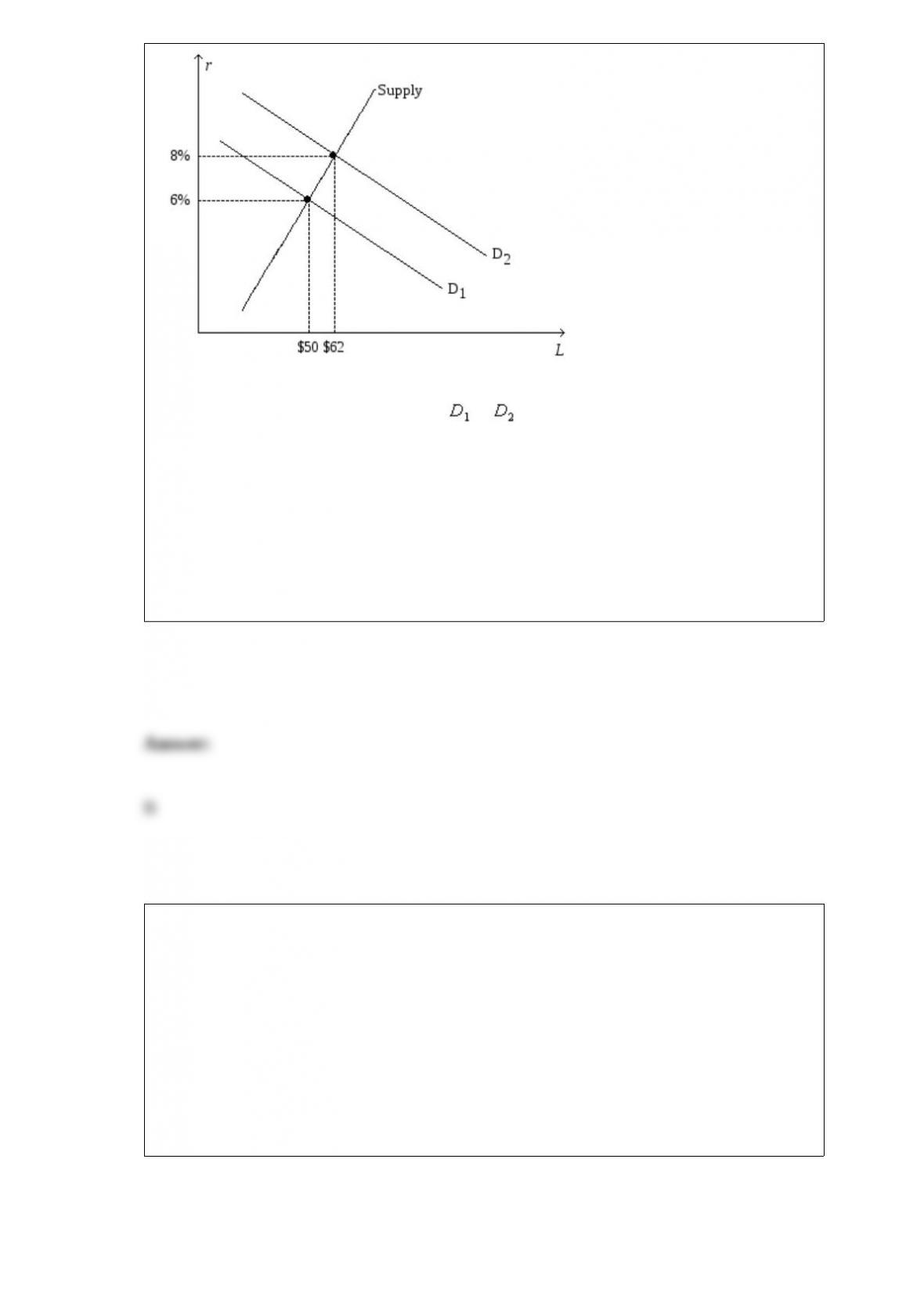
Refer to Figure 13-4. Which of the following events could explain a shift of the
demand-for-loanable-funds curve from to ?
a. The tax code is reformed to encourage greater saving.
b. The tax code is reformed to encourage greater investment.
c. The government starts running a budget deficit.
d. The government starts running a budget surplus.
Which of the following is not an argument by those who oppose tax-law changes to
encourage saving?
a. Saving is not very responsive to changes in the tax rate.
b. Saving is not an important determinant of a nation’s ability to produce output.
c. Reducing the budget deficit instead of changing the tax laws could raise saving.
d. Changes in the tax laws to induce saving would distribute the tax burden less fairly.

Keynes explained that recessions and depressions occur because of
a. excess aggregate demand.
b. inadequate aggregate demand.
c. excess aggregate supply.
d. inadequate aggregate supply.
Which of the following is a principle concerning how people interact?
a. Markets are usually a good way to organize economic activity.
b. Rational people think at the margin.
c. People respond to incentives.
d. All of the above are correct.
The Bureau of Labor Statistics produces data on unemployment
a. weekly.
b. monthly.
c. quarterly.
d. yearly.
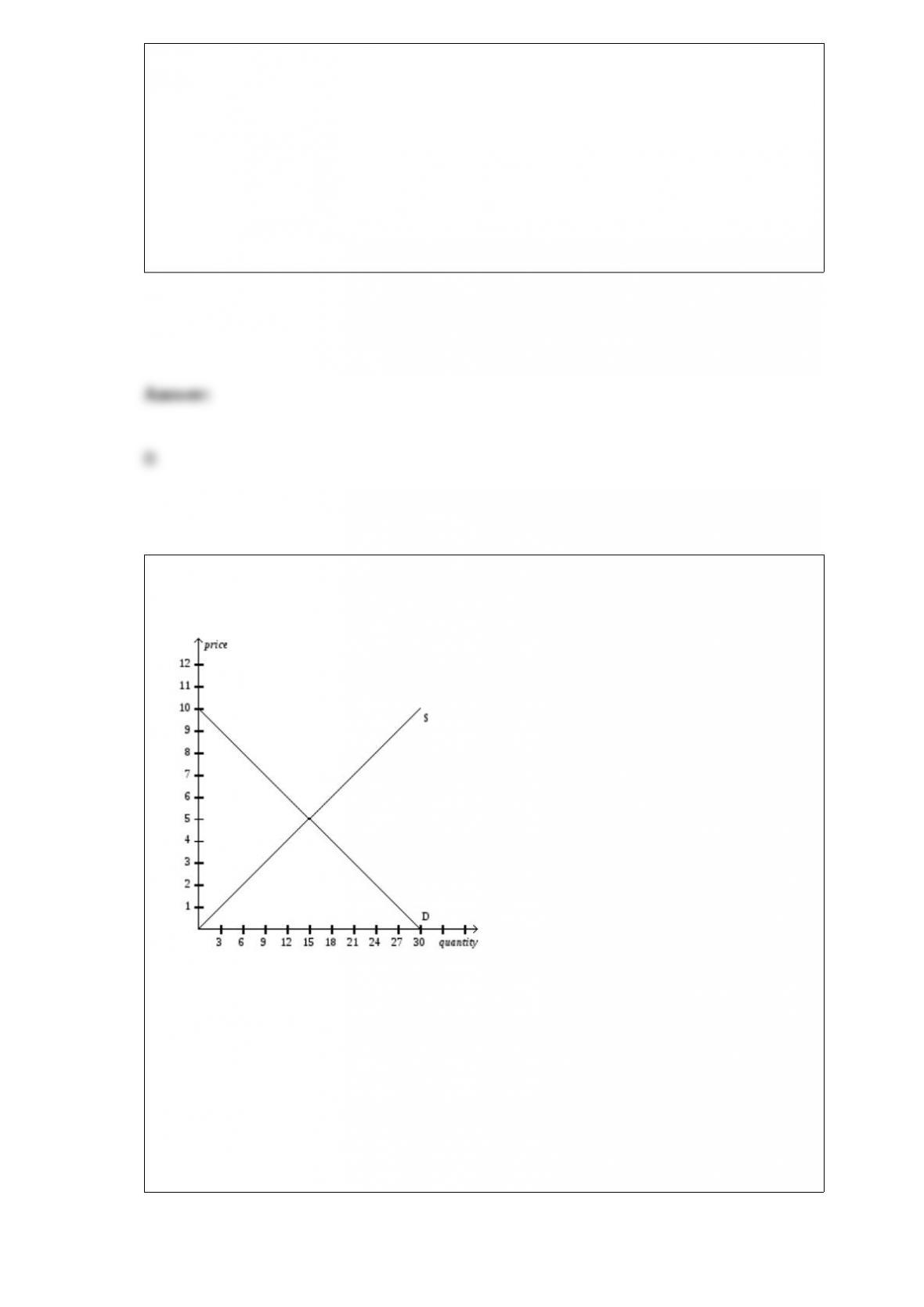
Figure 6-9
Refer to Figure 6-9. At which price would a price floor be nonbinding?
a. $8
b. $7
c. $6
d. $5

An example of a price that changes only infrequently is the price of
a. stocks on the New York Stock Exchange.
b. crude oil.
c. residential real estate.
d. magazines sold at newsstands.
In one day Portal Computer Company made 400 laptops with 1200 hours of labor. What
was its productivity?
a. 1/3 laptop per hour
b. 3 hours per laptop
c. 1200 laptops
d. 400 laptops

If the MPC is 2/3 then the multiplier is
a. 3/2, so a $100 increase in government spending increases aggregate demand by $150.
b. 3/2, so a $100 increase in government spending increases aggregate supply by $150.
c. 3, so a $100 increase in government spending increases aggregate demand by $300.
d. 3, so a $100 increase in government spending increases aggregate supply by $300.
Which of the following statements about nominal GDP and real GDP is correct?
a. Nominal GDP is a better gauge of economic well-being than real GDP.
b. Real GDP is a better gauge of economic well-being than nominal GDP.
c. Real GDP and nominal GDP are equally good measures of economic well-being.
d. Neither nominal nor real GDP provide a measure of economic well-being.
Suppose a tax is imposed on the sellers of fast-food French fries. The burden of the tax
will
a. fall entirely on the buyers of fast-food French fries.
b. fall entirely on the sellers of fast-food French fries.

c. be shared equally by the buyers and sellers of fast-food French fries.
d. be shared by the buyers and sellers of fast-food French fries but not necessarily
equally.
The nominal interest rate tells you
a. how fast the number of dollars in your bank account rises over time.
b. how fast the purchasing power of your bank account rises over time.
c. the number of dollars in your bank account today.
d. the purchasing power of your bank account today.
Table 3-7
Assume that Japan and Korea can switch between producing cars and producing
airplanes at a constant rate.
Hours Needed
to Make 1 Quantity Produced
in 2400 Hours

Refer to Table 3-7. Japan’s opportunity cost of one airplane is
a. 1/5 car and Korea’s opportunity cost of one airplane is 1/3 car.
b. 1/5 car and Korea’s opportunity cost of one airplane is 3 cars.
c. 5 cars and Korea’s opportunity cost of one airplane is 1/3 car.
d. 5 cars and Korea’s opportunity cost of one airplane is 3 cars.
Scenario 5-2
The supply of aged cheddar cheese is inelastic, and the supply of bread is elastic. Both
goods are considered to be normal goods by a majority of consumers. Suppose that a
large income tax increase decreases the demand for both goods by 10%.
Refer to Scenario 5-2. The equilibrium quantity will
a. increase in both the aged cheddar cheese and bread markets.
b. increase in the aged cheddar cheese market and decrease in the bread market.
c. decrease in the aged cheddar cheese market and increase in the bread market.
d. decrease in both the aged cheddar cheese and bread markets.
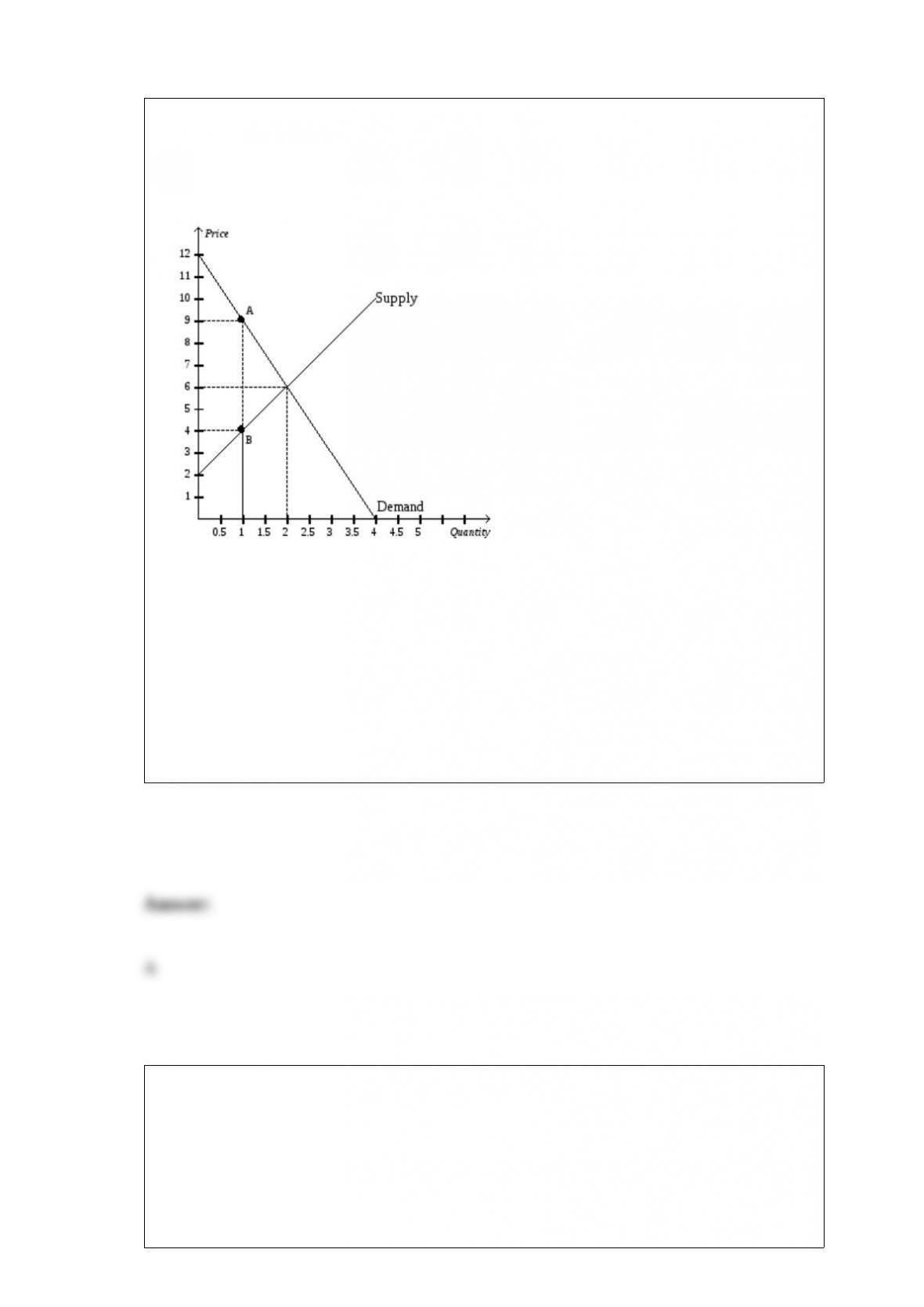
Figure 8-2
The vertical distance between points A and B represents a tax in the market.
Refer to Figure 8-2. Producer surplus without the tax is
a. $4, and producer surplus with the tax is $1.
b. $4, and producer surplus with the tax is $3.
c. $10, and producer surplus with the tax is $1.
d. $10, and producer surplus with the tax is $3.
Suppose foreigners find U.S. goods and services more desirable for some reason other
than a change in the exchange rate. Which policies could be used to offset the resulting
change in output?
a. an increase in the money supply and an increase in taxes
b. an increase in the money supply and a decrease in taxes

c. a decrease in the money supply and an increase in taxes
d. a decrease in the money supply and a decrease in taxes
Suppose the U.S. offered a tax credit for firms that built new factories in the U.S.. Then
a. the demand for loanable funds would shift rightward, initially creating a surplus of
loanable funds at the original interest rate.
b. the demand for loanable funds would shift rightward, initially creating a shortage of
loanable funds at the original interest rate.
c. the supply of loanable funds would shift rightward, initially creating a surplus of
loanable funds at the original interest rate.
d. the supply of loanable funds would shift rightward, initially creating a shortage of
loanable funds at the original interest rate.
In general, as a person includes fewer stocks and more bonds in his portfolio,
a. both risk and expected return rise.
b. risk rises but expected return falls.
c. risk falls, but expected return rises.

d. both risk and expected return fall.
Investment from abroad
a. is a way for poor countries to learn the state-of-the-art technologies developed and
used in richer countries.
b. is viewed by economists as a way to increase growth.
c. often requires removing restrictions that governments have imposed on foreign
ownership of domestic capital.
d. All of the above are correct.
Trade decisions are based on the principle of absolute advantage.

An increase in the money supply causes output to rise in the long run.
The gains from specialization and trade are based on absolute advantage.
The price elasticity of demand is defined as the percentage change in price divided by
the percentage change in quantity demanded.
A production possibilities frontier will be bowed outward if some of the economy’s
resources are better suited to producing one good than another.
Net capital outflow is the purchase of domestic assets by foreign residents minus the
purchase of foreign assets by domestic residents.
Other things the same, an increase in the price level causes the real value of the dollar
to fall in the market for foreign-currency exchange.
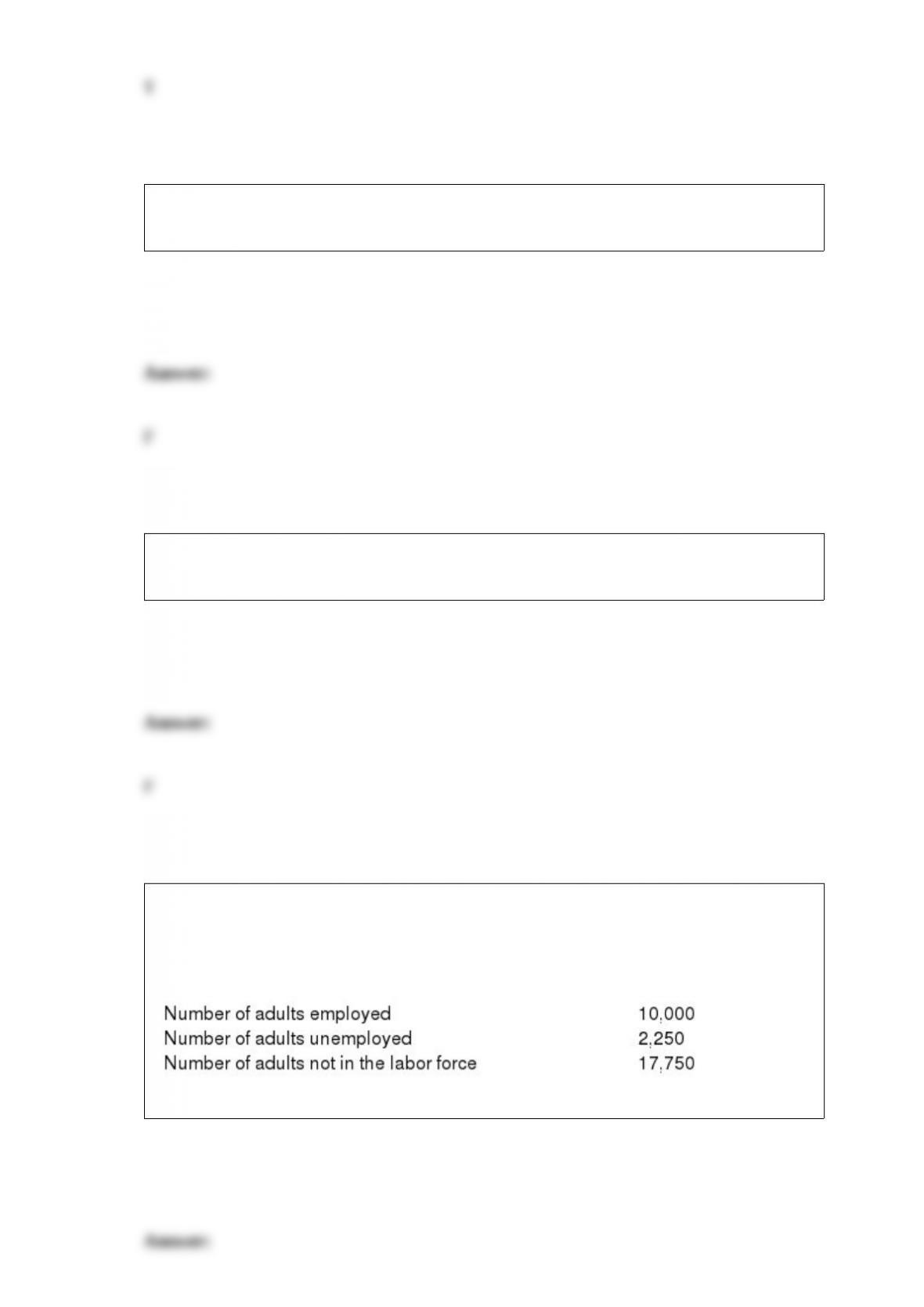
Table 15-5
2010 Labor Data for Tajnia
Refer to Table 15-5. The unemployment rate of Tajnia in 2010 is about 7.5 percent.

Some of a firm’s workers are made worse off by the introduction of a union.
The Bureau of Labor Statistics produces data on unemployment, types of employment,
length of the average workweek, and the duration of unemployment.
The law of demand states that, other things equal, when the price of a good rises, the
quantity demanded of the good falls, and when the price falls, the quantity demanded
rises.

The demand for beer is more elastic than the demand for milk, so a tax on beer would
have a smaller deadweight loss than an equivalent tax on milk, all else equal.
Structural unemployment results when the number of jobs is insufficient for the number
of workers.
Taxes create deadweight losses.
GATT is an example of a successful unilateral approach to achieving free trade.

A tax on a market with elastic demand and elastic supply will shrink the market more
than a tax on a market with inelastic demand and inelastic supply will shrink the
market.
A company that can build a project that will cost $50,000, but returns $52,000 in one
year would make a good decision by turning this project down if the interest rate were 3
percent.
Studies confirm that controlling for other variables such as the percentage of GDP
devoted to investment, poor countries tend to grow at a faster rate than rich countries.

The cost of production plus producer surplus is the price a seller is paid.