Which of the following is consistent with a political and legal framework that
discourages economic growth?
A. The allocation of bank credit by the government rather than by markets
B. A speedy approval process for new businesses
C. Agricultural prices that are allowed to vary according to market conditions
D. Taxation and regulation that are not very burdensome
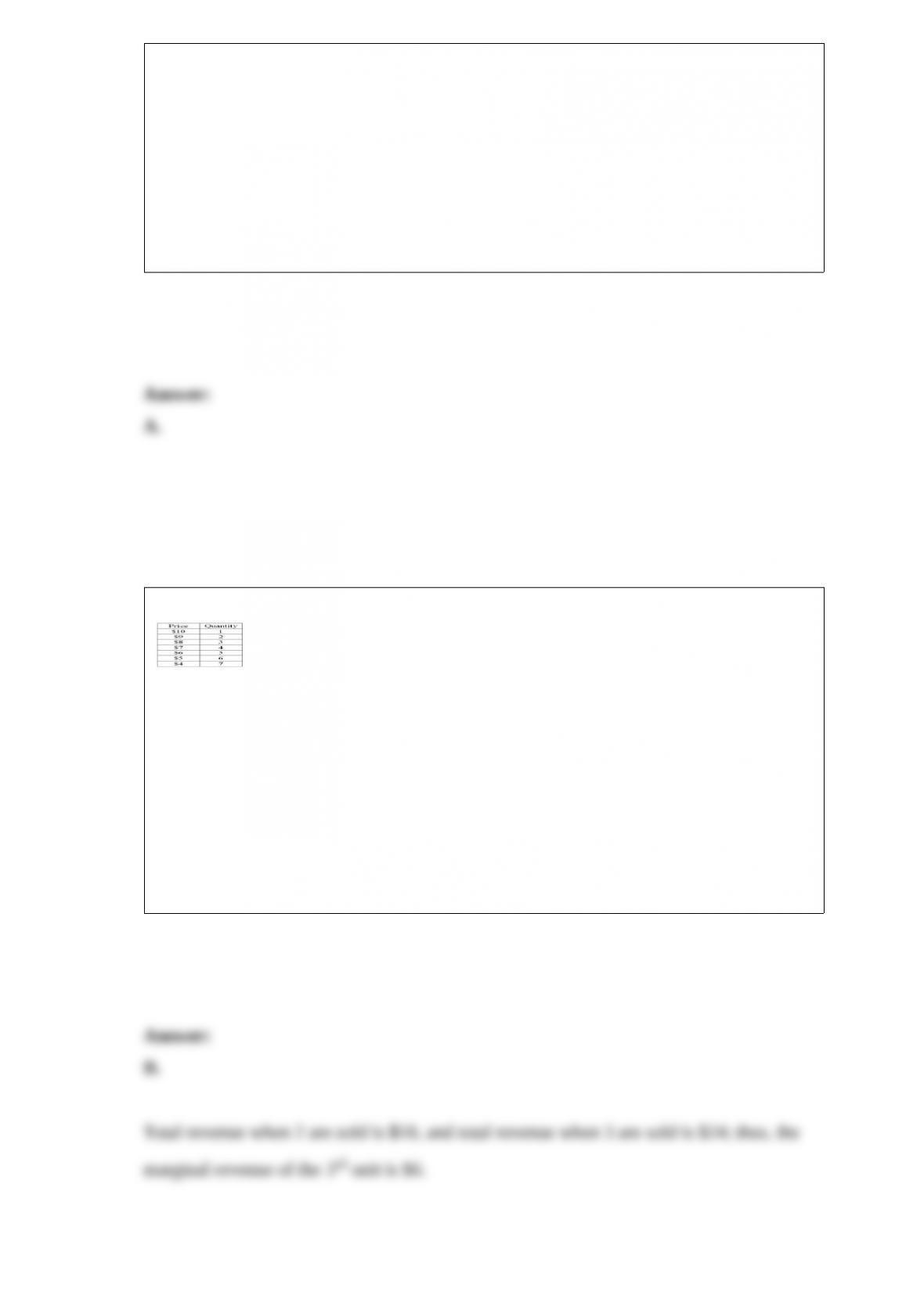
Suppose the table below describes the demand for a good produced by monopolist.
The monopolist’s total revenue from selling 3 units is ______, and the monopolist’s
marginal revenue from selling the 3rd unit is ______.
A. $28; 8
B. $24; 6
C. $52; 1
D. $24; 8

Your classmates from the University of Chicago are planning to go to Miami for spring
break, and you are undecided about whether you should go with them. The round-trip
airfares are $600, but you have a frequent-flyer coupon worth $500 that you could use
to pay part of the airfare. All other costs for the vacation are exactly $900. The most
you would be willing to pay for the trip is $1400. Your only alternative use for your
frequent-flyer coupon is for your trip to Atlanta two weeks after the break to attend your
sister’s graduation, which your parents are forcing you to attend. The Chicago-Atlanta
round-trip airfares are $450. What is the opportunity cost of using the coupon for the
Miami trip?
A. $100
B. $450
C. $500
D. $550
In 2015, Janice Quinn sells a five-year-old car to Used Car, Inc. for $3,000. In the same
year, Used Car, Inc. resells the car to Hilda Goner for $3,500. What is the contribution
of these transactions to GDP in the year 2015?
A. $0
B. $500
C. $3,000
D. $6,500
You have noticed that your next-door neighbor, Mary, always works in the garden, and
her husband, Joe, always walks the dog. You conclude that if Joe and Mary are efficient,
then it must be the case that:
A. Mary has an absolute advantage in gardening.
B. Joe has a comparative advantage in walking the dog.
C. Mary’s opportunity cost of walking the dog is lower than Joe’s.
D. Joe experiences increasing opportunity costs when he gardens, but not when he
walks the dog.
Economies of scale arise from:
A. constant returns to scale.
B. increasing returns to scale.
C. decreasing returns to scale.
D. constant marginal returns to scale.

All of the following would be included in planned aggregate expenditure except:
A. purchases of services provided by government employees.
B. planned changes in inventories.
C. sales to foreigners of domestically-produced goods.
D. social security payments.
Suppose that in most car collisions between cars of unequal size, the smaller car
sustains the most damage and its occupants suffer the most injury. In answering the
following question, assume that, on average, smaller cars generate less air pollution
than larger cars and that every person in the economy drives at least one car. Relative to
driving an average car, driving a larger-than-average car generates:
A. an external cost.
B. an external benefit.
C. neither an external benefit nor an external cost.
D. a prisoner’s dilemma.
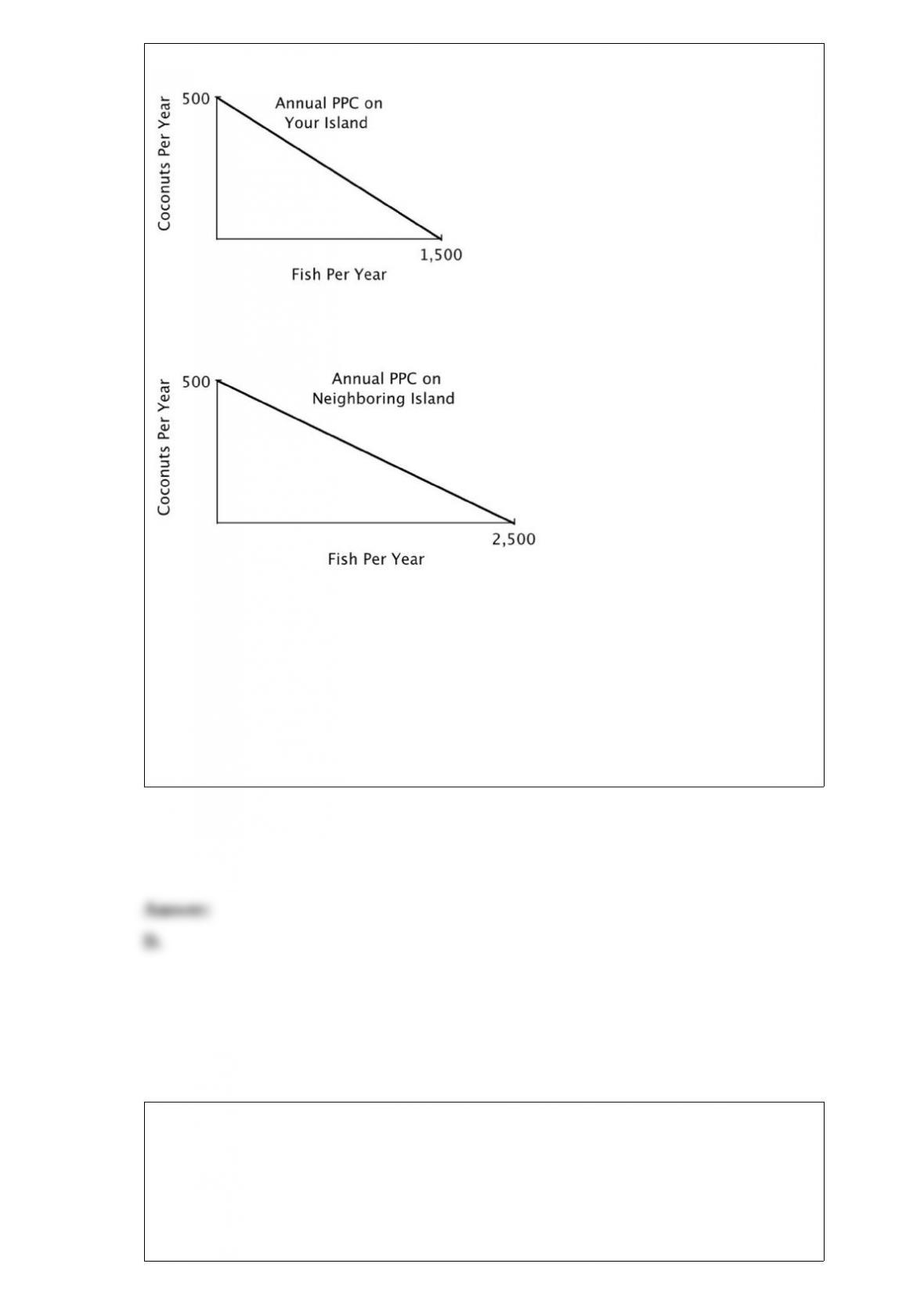
You are the Minister of Trade for a small island country with the following annual PPC:
You are negotiating a trade agreement with a neighboring island with the following
annual PPC:
As soon as you see the other island’s PPC, you realize there are:
A. no gains from trade because your both have the same comparative advantage.
B. no gains from trade because there is no difference in your ability to harvest coconuts.
C. no gains from trade because the other island has an absolute advantage.
D. gains from trade because your island has a comparative advantage in coconuts.
Compound interest is:
A. the payment of interest on the original deposit.
B. the interest rate adjusted for the rate of inflation.
C. the real rate of interest compounded by the rate of inflation.

D. the payment of interest on both the original deposit and all accumulated interest.
Jenny sells lemonade in front of her house in the summer. Several other kids in Jenny’s
neighborhood also run lemonade stands in the summer. The lemonade market in Jenny’s
neighborhood is more likely to be perfectly competitive if:
A. all of the kids advertise heavily.
B. each stand tries to get more customers by offering different varieties of lemonade
and snacks.
C. each lemonade stand sells the same kind of lemonade.
D. some of the neighborhood parents build elaborate booths for their kids’ stands while
some kids sell from makeshift tables.
Suppose that the total expenditures for a typical household in 2010 equaled $5,500 per
month, while the cost of purchasing exactly the same items in 2015 was $6,87 If 2010
is the base year, the CPI for the year 2015 equals:
A. 0.80
B. 1.00
C. 1.20

D. 1.25
Which of the following is a real quantity?
A. The current wages paid to factory workers
B. The cost of a new car
C. The number of tons of steel produced in 2005
D. The current price of a barrel of oil
Amy is thinking about going to the movies tonight. A movie ticket costs $15, and she’ll
have to cancel a $20 dog-sitting job that she would have been willing to do for free. The
opportunity to Amy cost of going to the movies is:
A. $5.
B. $15.
C. $20.
D. $35.
Average total cost is defined as:
A. Total cost divided by total output
B. Total cost divided by price
C. Variable cost divided by total output
D. Variable cost divided by price
Marge is lending Martin $1,000 for one year. The CPI is 1.60 at the time the loan is
made. They expect it to be 1.76 in one year. If Marge and Martin agree that Marge
should earn a 3% real return for the year, the nominal interest rate on this loan should
be ______ percent.
A. 3
B. 7
C. 13
D. 16

When statisticians fail to allow for the possibility that consumers switch from products
with rising prices to those whose prices are stable or falling, the CPI will tend to
______ the rate of inflation.
A. understate
B. precisely measure
C. be unrelated to
D. overstate
Refer to the figure below. The socially optimal quantity of paper is ______ tons per
year.
A. 0
B. 360
C. 150
D. 300
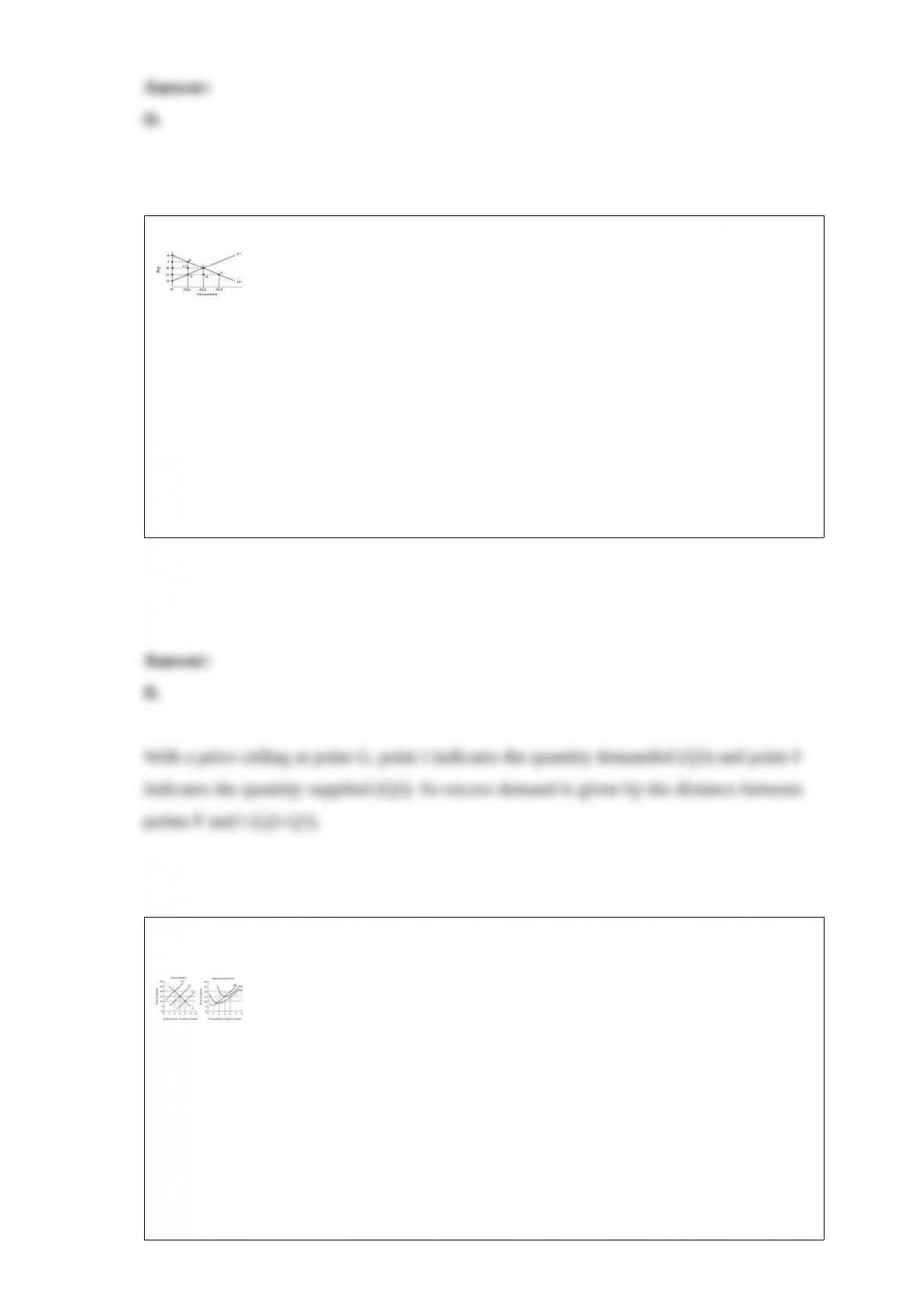
Refer to the figure below.
If a price ceiling were imposed at point G, then excess demand would be measured by
the distance between points:
A. G and I
B. F and I
C. K and I
D. F and K
Assume that all firms in this industry have identical cost curves, and that the market is
perfectly competitive.
If S3 is the market supply curve, then each firm in this market will earn a economic loss
of ______ per week.
A. $1,000
B. $1,500
C. $2,000
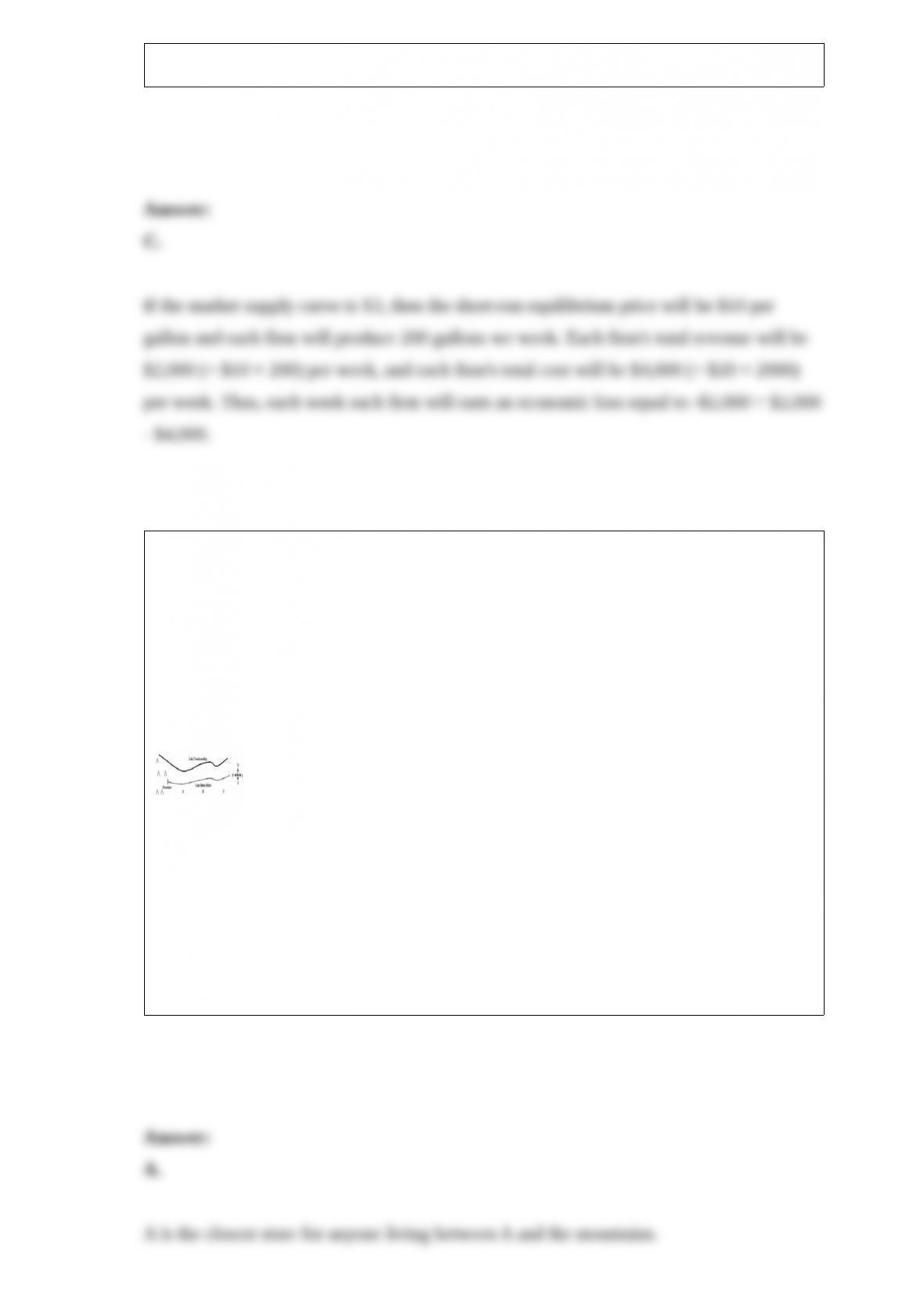
D. $3,000
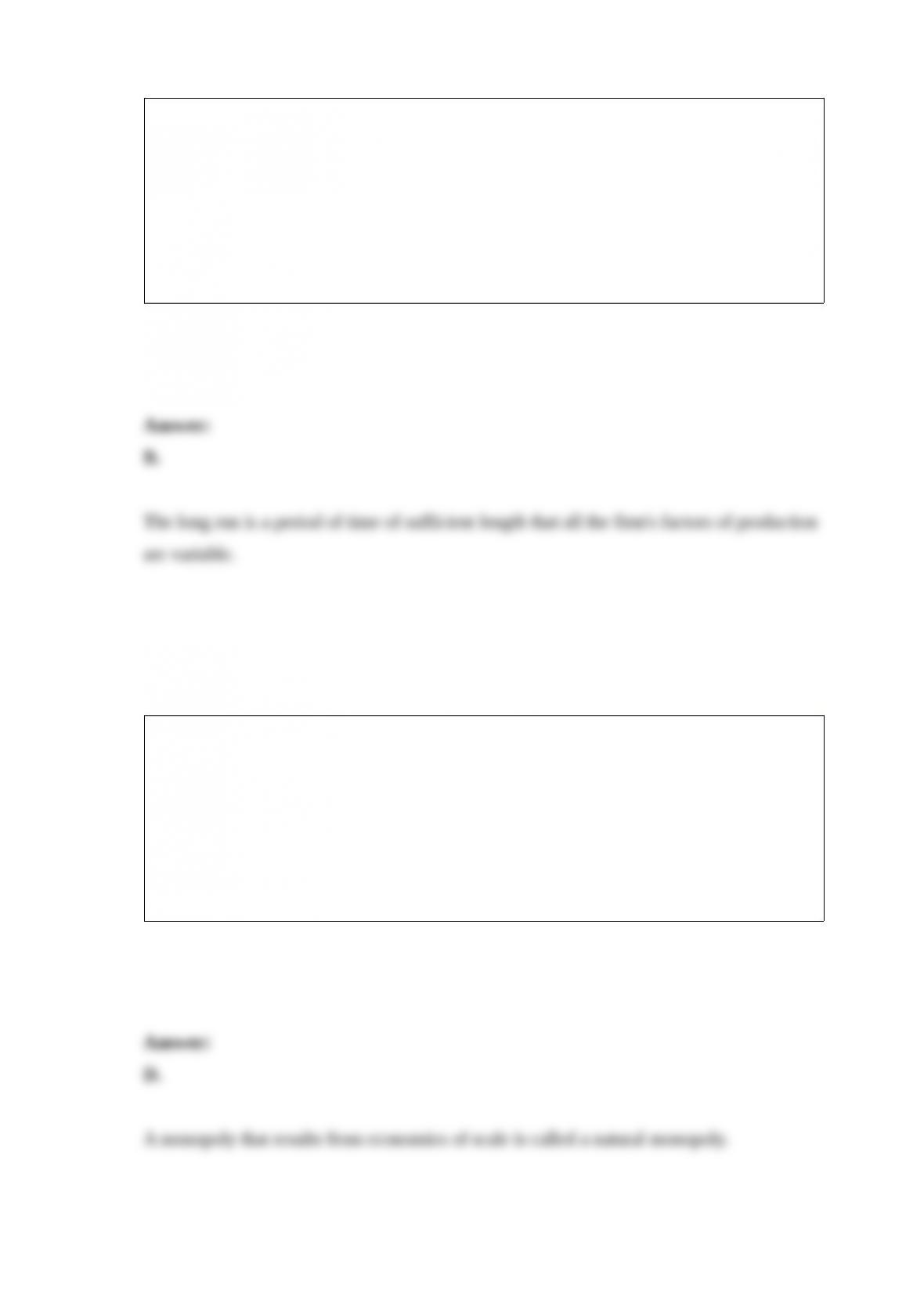
Miniville is an isolated town located on the southern shore of Lake Condescending, a
very large lake. The western edge of Miniville is adjacent to impassable mountains and
there are no towns or businesses for many miles to the east. The 300 residents of
Miniville are evenly distributed along 3 miles of shoreline on the lake, east of the
mountains. Lake Shore Drive, the only street in town, provides access to Miniville’s
homes and businesses. All residents live between the lake and the street; businesses
locate on the other side of the street. Lake Shore Drive is 3 miles long, and the points
labeled A, B, and C are 1, 2, and 3 miles from the western end of Lake Shore Drive,
respectively. All residents of Miniville shop at the store located closest to their homes.
If one store is located at A and the other store is located at B:
A. all of the people living between A and the mountains will shop at the store at A.
B. some, but not all, of the people living east of B will shop at the store at B.
C. exactly half of the people living west of B will shop at the store at B.
D. exactly half of the people living east of B will shop at the store at B.
The long run is best defined as:
A. one year or more.
B. a period of time sufficiently long that all factors of production are variable.
C. the period of time between annual accounting reports.
D. a period of time sufficiently long that at least one factor of production is fixed.
A natural monopoly is a monopoly that arises from:
A. having an exclusive right to operate in a national park.
B. having exclusive control over the natural resources used to produce a good.
C. a firm’s natural desire to maximize its profit.
D. economies of scale.
Suppose you bought a concert ticket from Ticketmaster for $50, but when you got to the
concert scalpers (individuals who re-sell tickets at the event) were selling tickets in the
same seating area as yours for $25. What is probably true?
A. There is excess demand for this concert at the Ticketmaster price.
B. The ticket you bought was under-priced for the market.
C. There is an excess supply of tickets for this concert at the Ticketmaster price.
D. The Ticketmaster price is an equilibrium price.
Educational services provided by public schools are:
A. included in GDP at market prices.
B. included in GDP at cost.
C. excluded from GDP because they are not sold in markets.
D. excluded from GDP because they are intermediate goods.
If the owners of a business are receiving total revenues just sufficient to cover all of
their explicit and implicit costs, then they are:
A. doing better than their next best alternative.
B. earning a normal profit.
C. earning an economic loss.
D. doing worse than their next best alternative.
A patch of edible mushrooms growing wild in a national forest is a ______ good.
A. public
B. private
C. pure public
D. commons
Managers contribute to increased average labor productivity in each of the following

ways except by:
A. developing new products.
B. obtaining financing.
C. assigning workers to jobs.
D. dealing with suppliers.
If workers in one part of the labor market unionize, then all else equal, we would expect
the wages of unionized workers to ______, and the wages of nonunionized workers to
______.
A. rise; fall
B. rise; remain unchanged
C. remain unchanged; fall
D. fall; remain the same
Suppose there are two small island countries: Avarice, which is populated by people
who are completely self-interested, and Altruism, which is populated by people who
have adopted social norms of generosity and cooperation. Suppose residents of each
island often play prisoner’s dilemma games, always matched with a person from the
same island, but not a person who they know or will play with again. If the same
number of games is played on each island, you would expect:
A. the residents of Avarice to have higher average payoffs than the residents of
Altruism.
B. players on both islands to quickly converge to playing their dominant strategies.
C. the residents of Altruism to have higher average payoffs than the residents of
Avarice.
D. players on both islands to quickly converge to playing their dominated strategies.
Curly and Moe are considering living alone or being roommates and splitting the rent
for the next twelve months. If they live alone, they each rent a one bedroom, one bath
apartment for $500 per month, while if they are roommates, they can split a two
bedroom, one bath apartment for $800 per month. The one difficulty they have is that
Moe snores very loudly. Curly estimates the cost of poor sleep due to Moe’s snoring at
$150 per month. Moe could obtain a snore-eliminating device for $50 per month. Curly
and Moe have both taken an economics course and so are willing to apply the Coase
theorem and negotiate. Who will compensate the other?
A. Neither Moe nor Curly has the initial property right, and so neither will compensate
the other.
B. Moe must compensate Curly because Moe is the one who is snoring.
C. Curly must compensate Moe because Curly is the one who is bothered by the
snoring.
D. Either Moe will compensate Curly or Curly will compensate Moe because the
alternative, renting separate apartments, leaves each worse off.
Pepsi One is a close substitute for Diet Coke. When Pepsi introduced Pepsi One, the
price elasticity of demand for Diet Coke ______ and Coke’s ability to raise revenues
through price increases ______.
A. increased; was reduced
B. increased; increased
C. decreased; was reduced
D. had no effect; was reduced
Which of the following is the best example of a pure public good?
A. Cable television
B. A national park
C. National defense
D. Education