
1) Commercial banks monetize claims when they sell securities to Federal Reserve
Banks.
2) in a competitive market, every consumer willing to pay the market price can buy a
product and every producer willing to sell the product at that price can sell it.
3) Commercial bank reserves are an asset to commercial banks but a liability to the
Federal Reserve Bank holding them.
4) A highly progressive tax takes relatively more from the rich than it does from the
poor.
5) Society’s optimal amount of pollution abatement is where society’s marginal benefit
of abatement is zero.
6) Loans made to customers are a liability on a bank’s balance sheet.
7) In the United States since 1970, the poor have gotten poorer and the rich have gotten
richer in both relative and absolute terms.
8) If the substitution effect outweighs the output effect, an increase in the price of a
substitute resource will increase the demand for labor.
9) The interest-rate cost-of-funds curve is perfectly elastic because expected rates of
return on R&D are constant.
10)
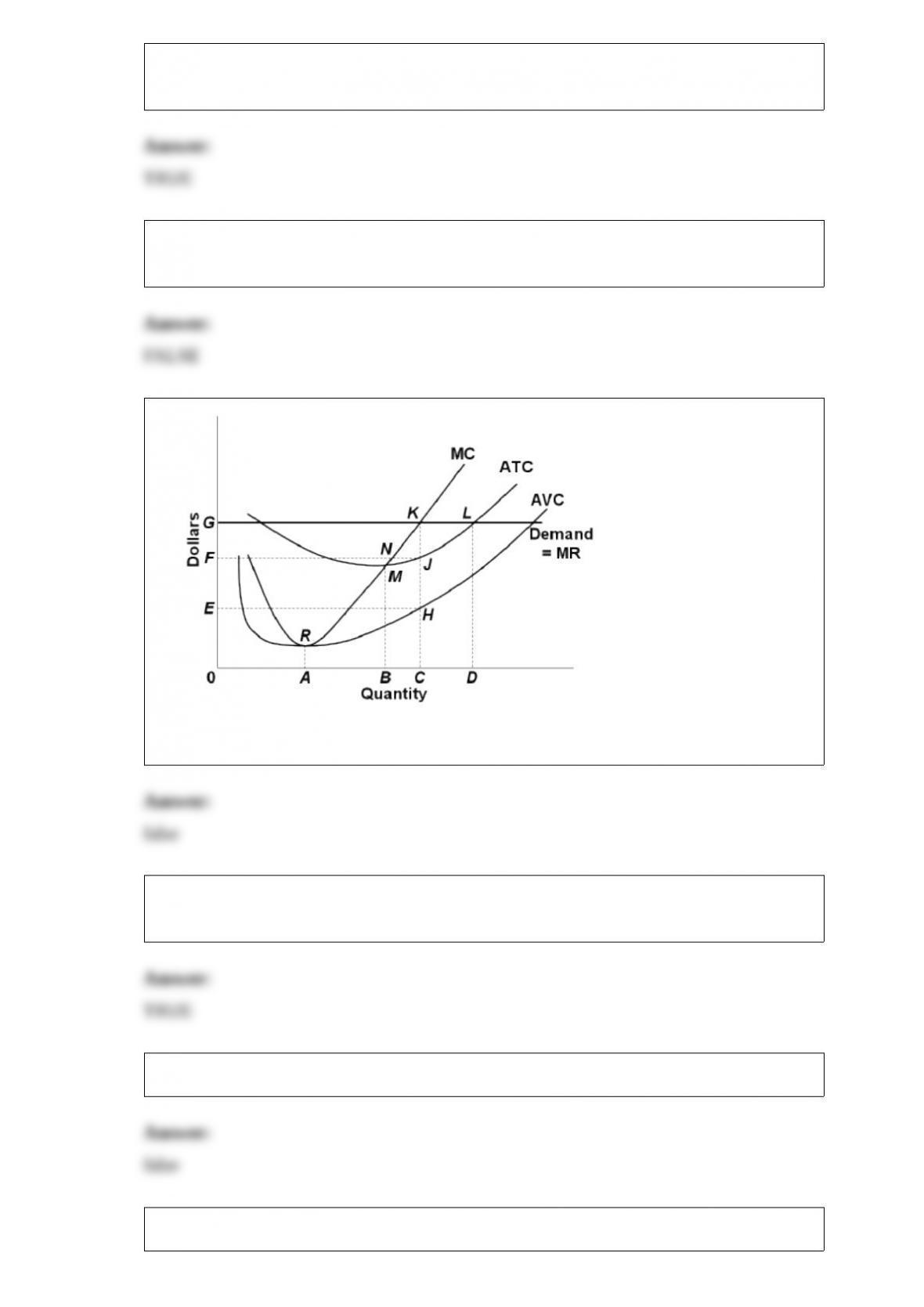
refer to the above diagram. if this firm is producing at the profit-maximizing level of
output in the short run, then it is achieving productive and allocative efficiency.
11) If prices received by farmers decline and prices paid by farmers increase, the parity
ratio will decline.
12) entry into a monopolistically competitive industry is typically blocked.
13) because of the ability to influence price, a pure monopolist can increase price and
increase volume of sales simultaneously.
14) illegal immigrants overall contribute more in taxes than they receive in services
from state and local governments.
15) Productive inputs capable of replacing or renewing themselves if harvested at
moderate rates are known as:
A.renewable natural resources.
B.natural capital.
C.non-renewable natural resources.
D.fossil fuels.
16)
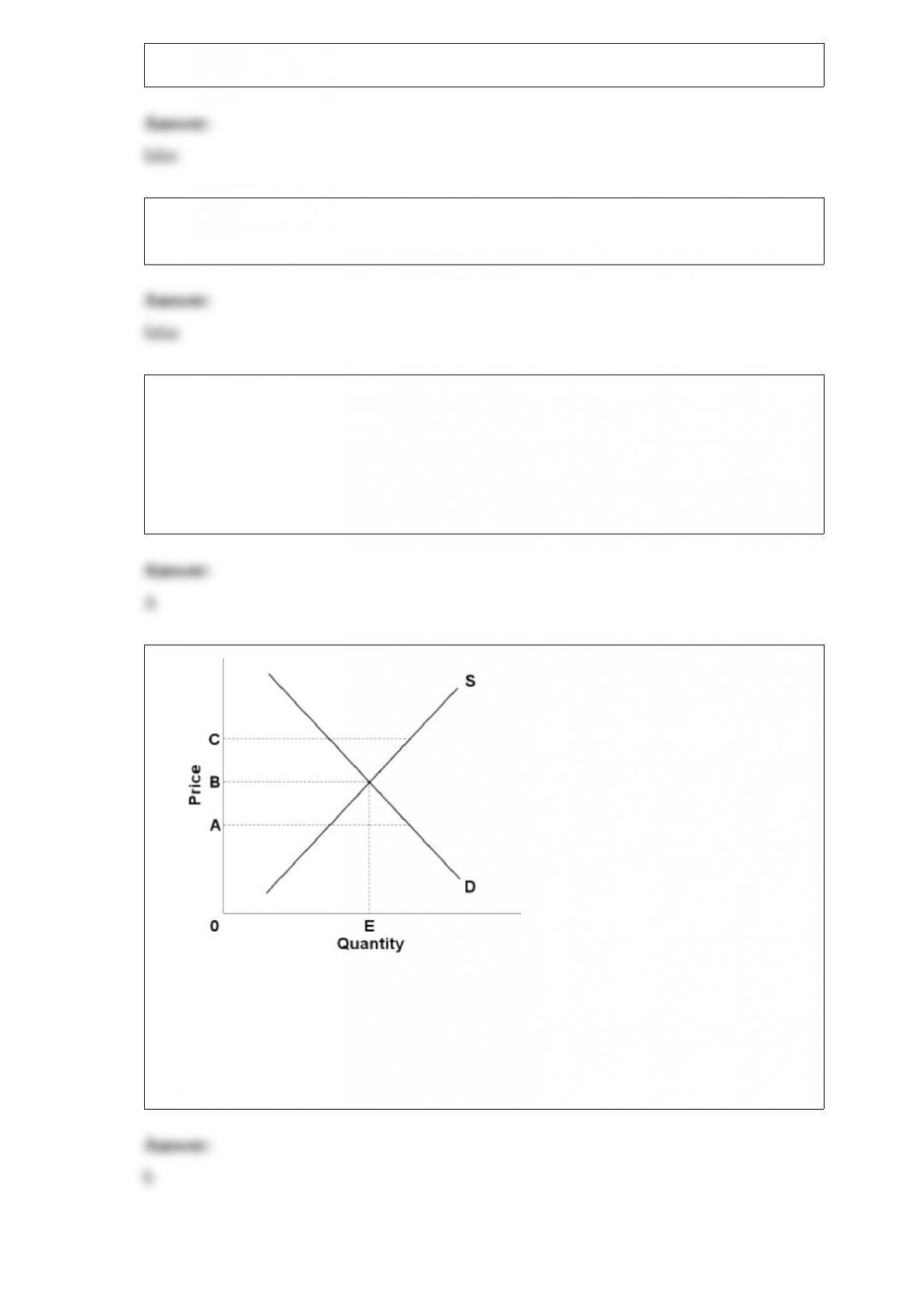
refer to the above diagram. a government price support program to aid farmers is best
illustrated by:
a.quantity e.
b.price c.
c.price a.
d.price b.

17) the twin problems of the u.s. health care industry are:
a.rapidly rising costs and unequal access to health care.
b.declining quality of health care and the duplication of specialized equipment at
hospitals.
c.declining per capita spending on health care and the moral hazard problem.
d.the decline in the number of family physicians and the failure to vaccinate children.
18) suppose that the price of peanuts falls from $3 to $2 per bushel and that, as a result,
the total revenue received by peanut farmers changes from $16 to $14 billion. thus:
a.the demand for peanuts is elastic.
b.the demand for peanuts is inelastic.
c.the demand curve for peanuts has shifted to the right.
d.no inference can be made as to the elasticity of demand for peanuts.
19) Because the Federal government typically provides disaster relief to farmers, many
farmers do not buy crop insurance even through it is federally subsidized. This
illustrates:
A.the adverse selection problem.
B.the moral hazard problem.
C.a failure of the market for externalities.
D.the existence of positive externalities.
20) allocative efficiency is achieved when the production of a good occurs where:
a.p = minimum atc.
b.p = mc.
c.p = minimum avc.
d.total revenue is equal to tfc.
21) Stock options as a form of payment are designed to:
A.evade the equal-pay-for-equal work provisions of the Federal antidiscrimination law.
B.boost the overall earnings of minimum wage workers.
C.offset monopsony.
D.address the principal-agent problem.

22) Which of the following statements is false?
A.Studies show that developing nations that have relied on import restrictions to protect
domestic industries have had higher growth rates than similar nations pursuing more
open economic policies.
B.The United States Constitution forbids individual states from levying tariffs.
C.The high tariffs of the Smoot-Hawley Act of 1930 and the retaliation they caused
worsened the Great Depression.
D.The European Union has enhanced prosperity in Western Europe.
23) average fixed cost:
a.equals marginal cost when average total cost is at its minimum.
b.may be found for any output by adding average variable cost and average total cost.
c.graphs as a u-shaped curve.
d.declines continually as output increases.
24) other things equal, an increase in a consumer’s money income:
a.shifts her indifference curves rightward because she can now satisfy more of her
wants.
b.shifts her budget line rightward because she can now purchase more of both products.
c.will be subject to the substitution effect, but not the income effect.
d.will not alter the location of consumer equilibrium.
25) The general sales tax is regressive because:
A.the incidence of the tax is on sellers rather than buyers.
B.tax rates are constant and incomes are variable.
C.lower income families save a smaller percentage of their incomes than do higher
income families.
D.tax rates decrease as consumer spending increases.
26) price elasticity of demand is generally:
a.greater in the long run than in the short run.
b.greater in the short run than in the long run.
c.the same in both the short run and the long run.
d.greater for “necessities” than it is for “luxuries.”
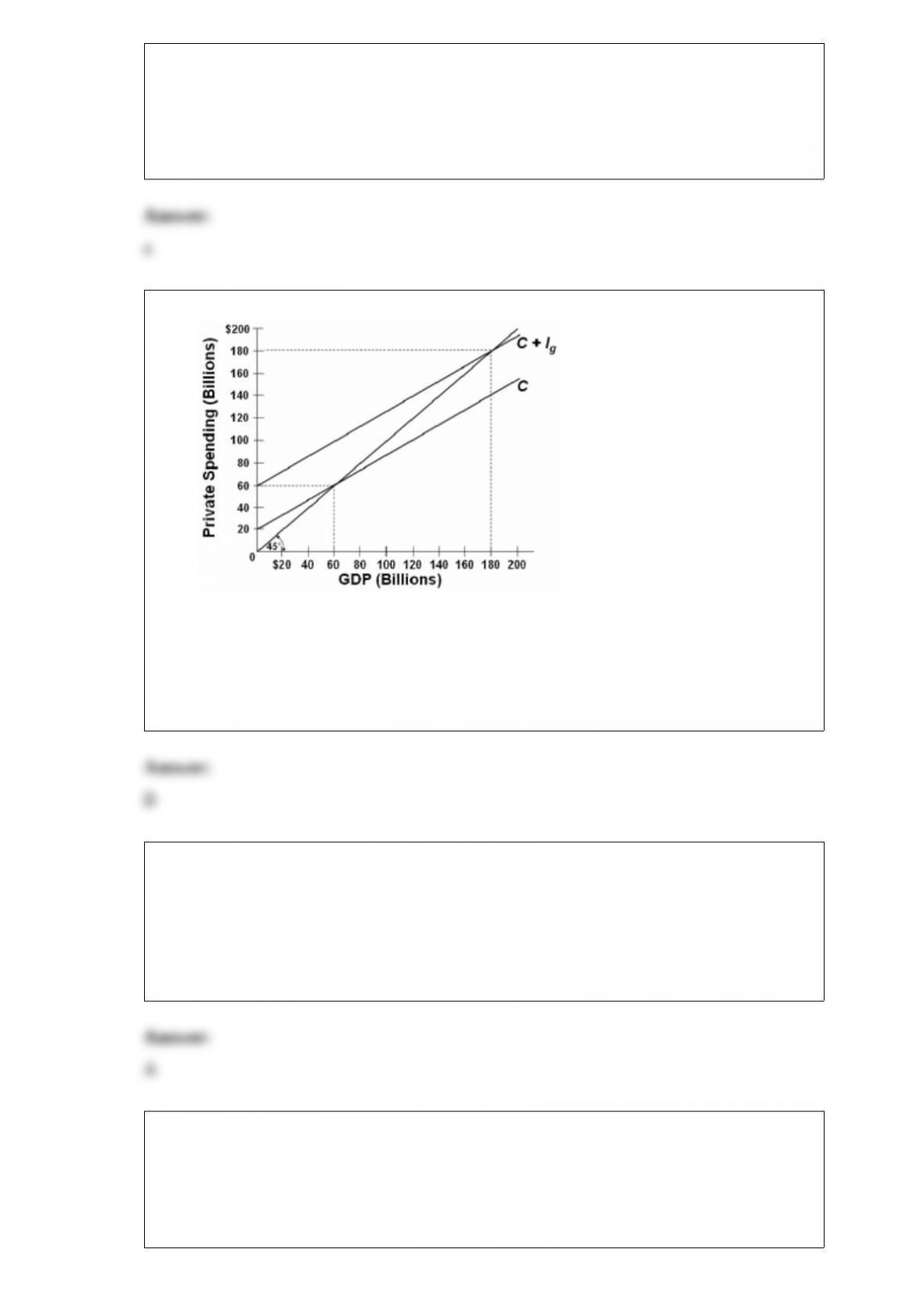
27)
Refer to the above diagram for a private closed economy. The equilibrium GDP is:
A.$60 billion.
B.$180 billion.
C.between $60 and $180 billion.
D.$60 billion at all levels of GDP.
28) Narrow, specifically designated expenditures that are included in more
comprehensive legislation are known as:
A.earmarks.
B.logrolls.
C.benefits-received allocations.
D.progressive expenditures.
29) a positive statement is one which is:
a.derived by induction.
b.derived by deduction.
c.subjective and is based on a value judgment.
d.objective and is based on facts.
30) (consider this) according to the consider this box about hypothetical countries
slogo, sumgo, and speedo, small differences in __________ make for large differences
in _________ over several decades, assuming the same growth of population for each
country.
a.inflation rates; unemployment rates
b.unemployment rates; economic growth rates
c.economic growth rates: real gdp per capita
d.tax rates; real gdp per capita
31) How did the Federal Reserve act to restore confidence and keep loans flowing
during the 2007 mortgage debt crisis?
32) Explain the reasoning behind the inverted-U theory of R&D expenditures.
33) What is the point of the Petition of Candlemakers, 1845? How is the point made?
34) What factors have contributed to growing inequality in incomes in the United
States?
35) Why is the difference between the actual and expected rates of inflation important
for explaining inflation?
36) Which is the most volatile component of total spending? What four factors
contribute to the volatility of this component of total spending?
37) Explain the probable incidence of a general sales tax imposed by a state.
38) Suppose an economys real GDP is $125 billion in year 1 and $130 billion in year 2.
What is the growth rate of its GDP?