Value marginal product (VMP) is
a. a measure of additional revenue minus additional cost as a result of additional output.
b. the price of the product multiplied by the additional output resulting from an
additional factor unit employed.
c. the marginal revenue of the product divided by the additional output resulting from
an additional factor unit employed.
d. the value of an additional unit of product as measured in terms of additional factor
cost.
e. the total value of the total output of a firm divided by the total quantity of output.
Which of the following is true for a monopsony?
a. It cannot buy additional units of a factor without increasing the price it pays for the
factor.
b. It can buy additional units of a factor without increasing the price it pays for the
factor.
c. The supply of labor it faces is the industry supply of labor.
d. a and c
e. b and c
A PPF is more likely to be a downward-sloping curve that is bowed outward than a
downward-sloping straight line because most resources are
a. better suited for the production of some goods than others.
b. used efficiently.
c. relatively cheap at low levels of output.
d. used to produce consumption goods.
In every economy people vie for the economy’s rationing device, a process called
a. competition.
b. entrepreneurship.
c. marginal benefit.
d. positive economics.
A shortage in the bread market can cause the price of bread to rise.
a. True
b. False
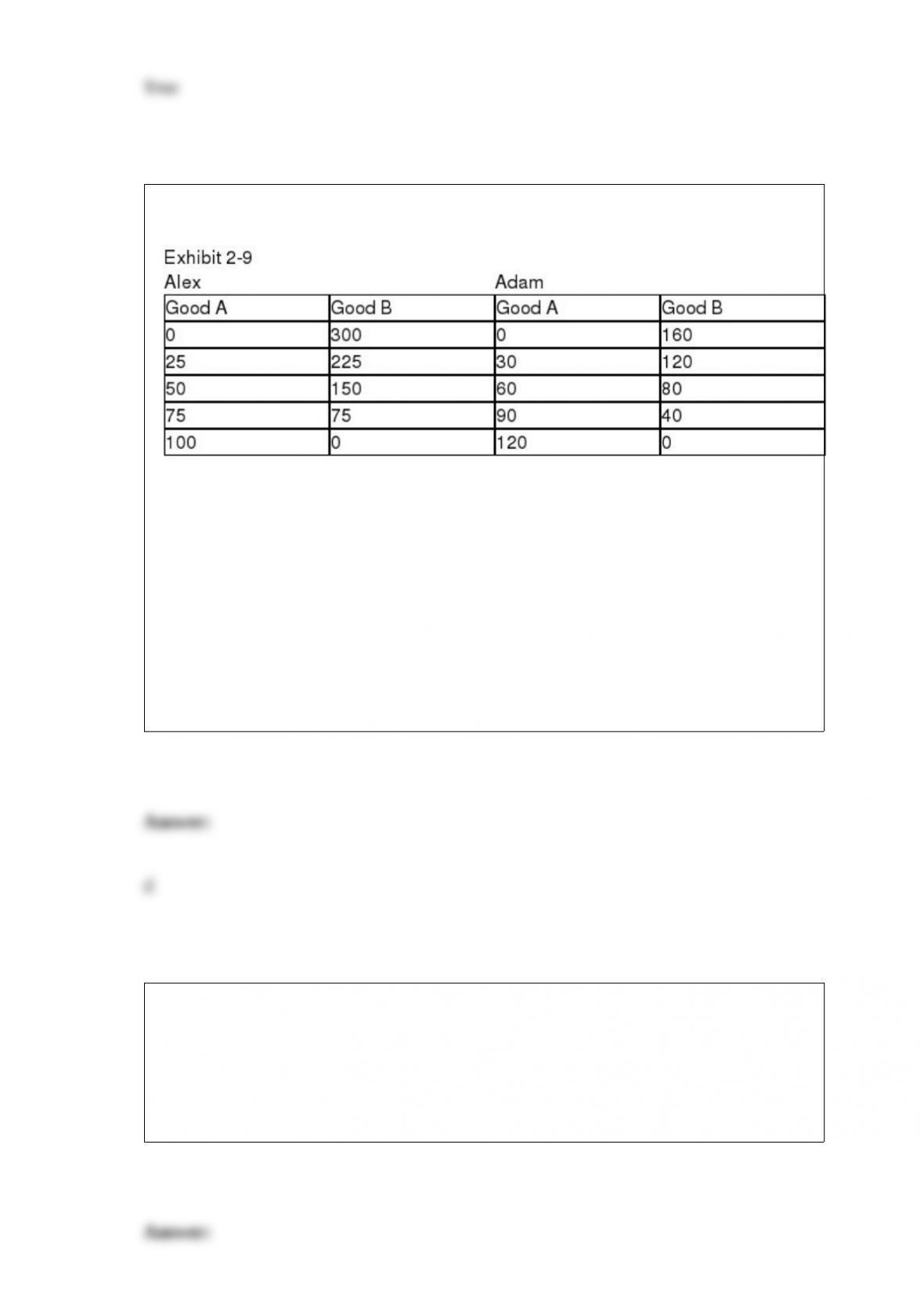
For Adam, the opportunity cost of producing one unit of good A is ____________
unit(s) of good B.
a. 3.00
b. 0.33
c. 0.75
d. 1.33
Economist David Ricardo argued that land rent was high because grain prices were
high.
a. True
b. False

The price elasticity of demand tends to be higher for goods
a. for which the consumer spends a high percentage of his or her income.
b. for which the consumer spends a low percentage of his or her income.
c. that are in abundant supply.
d. that are in scarce supply.
Cross elasticity of demand measures consumer responsiveness to a change in the price
of one good, in terms of the quantity demanded of some other good.
a. True
b. False
A person who lives in a good-climate city says, “It’s expensive to live here, but at least
the climate is free.” In terms of a theory advanced in the textbook, this person has either
forgotten or is unaware that
a. New York City is not a good-climate city and it is expensive to live there. In other
words, not all good-climate cities are expensive and not all bad-climate cities are cheap.

b. part of the reason it’s expensive to live in the city is because of the good climate.
c. good-climate cities have more outdoor entertainment entities and activities and
thereforepeople have to pay higher taxes to support those entities and activities.
d. there is a sunshine tax in most of the country – the more hours of sunshine a day, the
higher the tax.
e. none of the above