
1) which of the following statements is most accurate about the effects of migration?
a.migration generally benefits the mover, but there is a net efficiency loss to the world.
b.migration generally benefits everyone in both the origin and destination nation.
c.migration generally benefits the mover and creates a net efficiency gain for the world.
d. remittances cause the gains from immigration to be distributed unevenly.
2) According to age-earnings data,
A.lower educated workers have similar earnings at age 65 as higher educated workers.
B.investments in education result in higher earnings.
C.high earnings are due to motivation and innate ability, rather than education.
D.there is no clear relationship between education and worker productivity.
3) the primary economic advantage of the european union (eu) to its members is that:
a.the tax structures of each participating nation have been made nearly identical.
b.each nation is free to formulate its own antitrust and agricultural policies.
c.participating nations must all use a common currency.
d.the reduction of trade barriers permits producers to achieve mass-production
economies.
4) the production possibilities curve shows:
a.the various combinations of two goods that can be produced when society employs all
of its scarce resources.
b.the minimum outputs of two goods that will sustain a society.
c.the various combinations of two goods that can be produced when some resources are
unemployed.
d.the ideal, but unattainable, combinations of two goods that would maximize consumer
satisfactions.
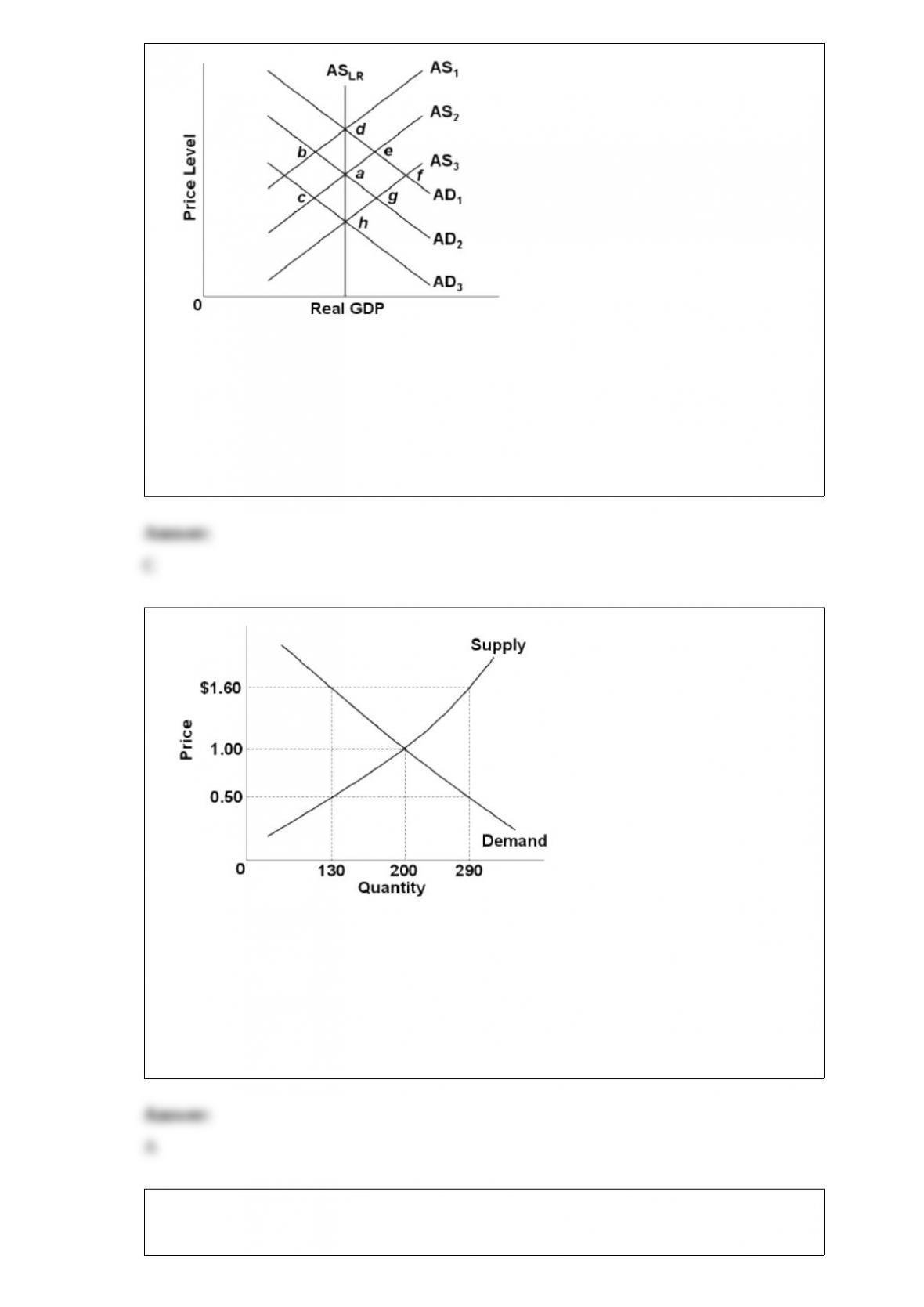
5)
Refer to the above figure and assume the economy initially is in equilibrium at point a.
In the new classical theory, an unanticipated increase in aggregate demand from AD2 to
AD1 would move the economy:
A.directly from a to d
B.from a to b to d
C.from a to e to d
D.directly from a to f
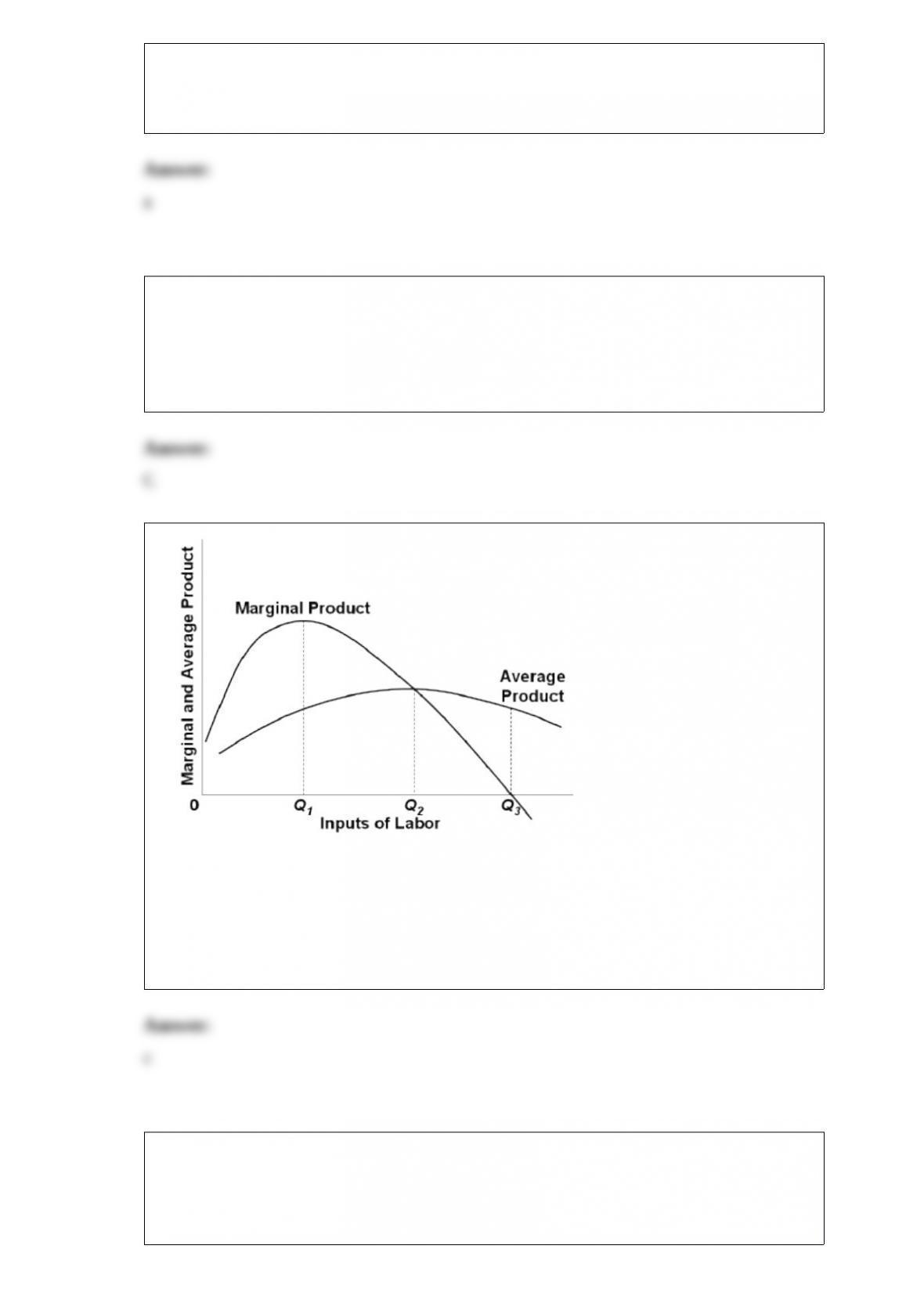
6)
Refer to the above diagram showing the domestic demand and supply curves for a
specific standardized product in a particular nation. If the world price for this product is
$.50, this nation will experience a domestic:
A.shortage of 160 units, which it will meet with 160 units of imports.
B.shortage of 160 units, which will increase the domestic price to $1.60.
C.surplus of 160 units, which it will export.
D.surplus of 160 units, which will reduce the world price to $1.00.
7) the law of demand states that:
a.price and quantity demanded are inversely related.
b.the larger the number of buyers in a market, the lower will be product price.
c.price and quantity demanded are directly related.
d.consumers will buy more of a product at high prices than at low prices.
8) Banks create money when they:
A.allow loans to mature.
B.accept deposits of cash.
C.buy government bonds from households.
D.sell government bonds from households.
9)
refer to the above diagram, where variable inputs of labor are being added to a constant
amount of property resources. the total output of this firm will cease to expand:
a.if a labor force in excess of q1 is employed.
b.if a labor force in excess of q2 is employed.
c.if a labor force in excess of q3 is employed.
d.only if the marginal product curve becomes negative at all levels of output.
10) if a nation’s real gdp is growing by 5 percent per year, its real gdp will double in
approximately:
a.22 years.
b.20 years.

c.14 years.
d.8 years.
11) the marginal rate of substitution:
a.may increase or decrease on a given indifference curve, depending on whether the
substitution or the income effect is dominant.
b.increases as one moves southeast along an indifference curve.
c.is constant at all points on the budget line.
d.declines as one moves southeast along an indifference curve.
12) Bank panics:
A.occur frequently in fractional reserve banking systems.
B.are a risk of fractional reserve banking, but are unlikely when banks are highly
regulated and lend prudently.
C.cannot occur in a fractional reserve banking system.
D.occur more frequently when the monetary system is backed by gold.
13) Suppose that Marlen Fisher has legal protection against anyone producing and
selling a fishing lure identical to his unique-action “MarFish” lure, whatever the
competitor might name the lure. This legal protection is most likely to be a:
A.trademark.
B.restraining order.
C.patent.
D.copyright.