
You explain to your roommate Surya, who makes beaded headbands, about an
economic theory which asserts that consumers will purchase more of a product at lower
prices than they will at higher prices. She contends that the theory is incorrect because
over the past two years she has lowered the price of her headbands and yet has seen a
decrease in sales. How would you respond to Surya?
A) Surya is right; she has evidence to back her claim. The theory must be erroneous.
B) Surya is making the mistake of assuming that correlation implies causation.
C) I will explain to her that she is making the error of reverse causality: it is the
decrease in demand that has caused her to lower her prices.
D) I will explain to her that there are some omitted variables that have contributed to a
decrease in her sales such as changes in income.
Table 14-5
Ming and Henri each
run one of the two dry cleaning facilities in the town of Scaraby. Both consider offering
free pickup and delivery services. Table 14-5 shows the payoff matrix containing the
expected quarterly profits for each firm. Does Henri have a dominant strategy? If yes,
what is it?
A) Yes, Henri’s dominant strategy is to not offer free pickup and delivery.
B) Yes, Henri’s dominant strategy is to offer free pickup and delivery.
C) No, Henri does not have a dominant strategy – his best outcome depends on what
Ming does.
D) Yes, Henri’s dominant strategy is to wait and see what Ming does first.

Which of the following would increase the unemployment rate?
A) a law making it illegal to work more than 35 hours per week
B) a cut in unemployment compensation
C) an increase in unemployment insurance payments
D) a decrease in the minimum wage
The rule of 70 states that
A) it takes an economy 70 years to double its real GDP.
B) the number of years it takes an economy to double in size is 70 divided by the
growth rate.
C) the number of years it takes an economy to double in size is the growth rate times
70.
D) the number of years it takes an economy to double in size is the growth rate divided
by 70.

In a closed economy, public saving is equal to which of the following? (Y = GDP, C =
Consumption,
G = Government purchases, T = Taxes, and TR = Transfers)
A) Y – C – T
B) Y – G – T
C) T – G – TR
D) Y – C – T + TR
In economics, the total amount received for selling a good or service is referred to as
A) revenue.
B) profit.
C) capital gains.
D) factor payments.
In economics, the term “equity” means
A) everyone has an equal standard of living.
B) the hardest working individuals consume all they want.
C) only elected officials have high standards of living.

D) economic benefits are distributed fairly.
Economic efficiency is defined as a market outcome in which the marginal benefit to
consumers of the last unit produced is equal to the marginal cost of production, and in
which
A) the sum of consumer surplus and producer surplus is at a maximum.
B) economic surplus is minimized.
C) the sum of the benefits to firms is equal to the sum of the benefits to consumers.
D) the sum of consumer surplus and producer surplus is minimized.
Which of the following explains why talented major league baseball players command
much higher salaries than neurosurgeons?
A) because the total value of baseball games is much higher than the total value of
neurosurgery
B) because it takes far more skill and training to be a major league baseball player than
to be a neurosurgeon
C) because the supply of talented major league baseball players is relatively low
compared to the supply of neurosurgeons. Therefore, major league baseball players
exert far more market power than neurosurgeon.
D) because the supply of talented major league baseball players is low relative to its
demand compared to the supply of neurosurgeons. Therefore, adding another player
yields far greater marginal benefit than adding another neurosurgeon.
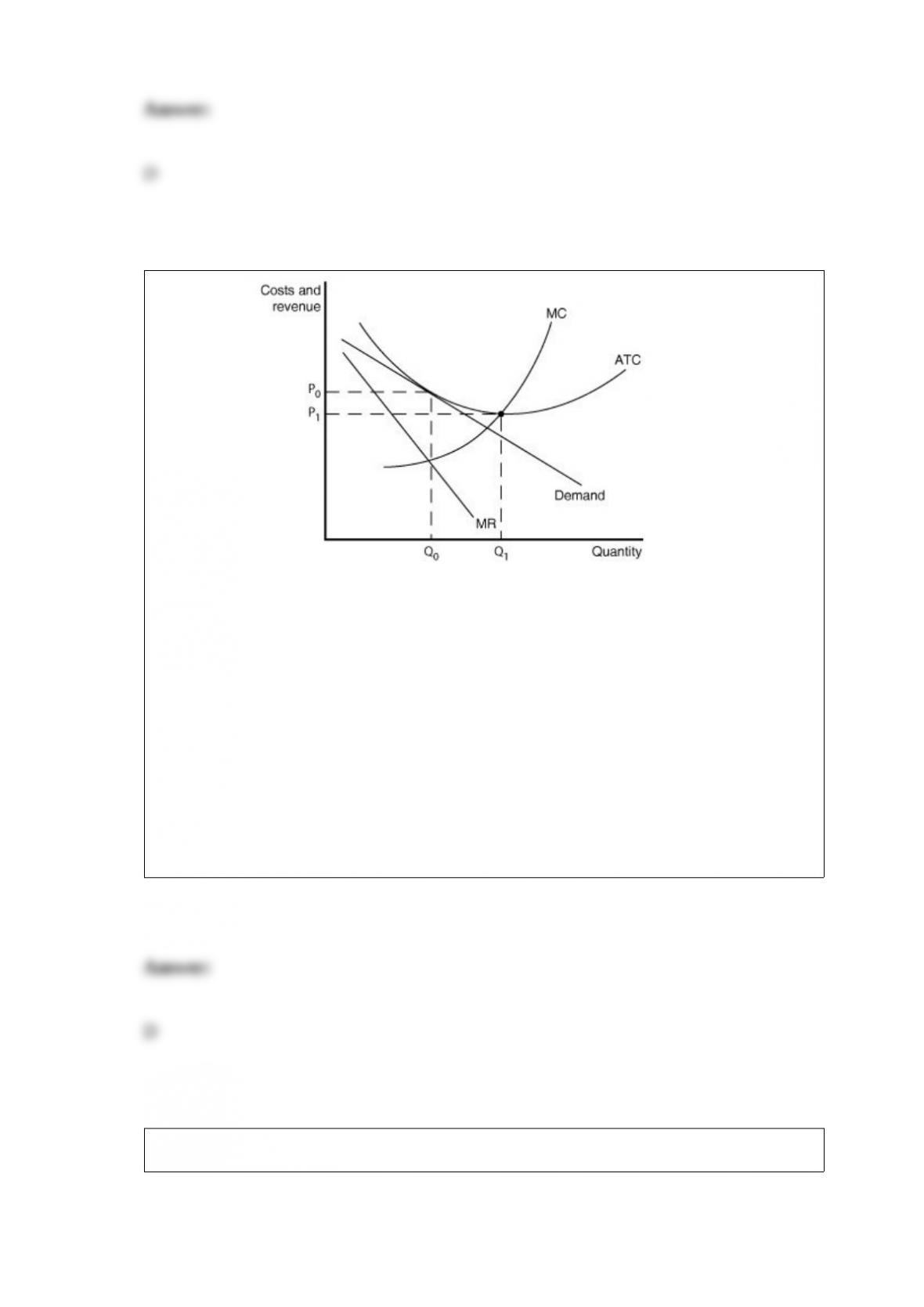
Figure 13-14 Figure 13-14
illustrates a monopolistically competitive firm.
Which of the following statements describes the firm depicted in the diagram?
A) The firm is making no economic profit and will exit the industry.
B) The firm is suffering an economic loss by producing at Q0 but will break even it
increases its output to Q1.
C) The firm achieves productive efficiency by producing at Q0.
D) The firm is in long-run equilibrium and is breaking even.
Table 4-4
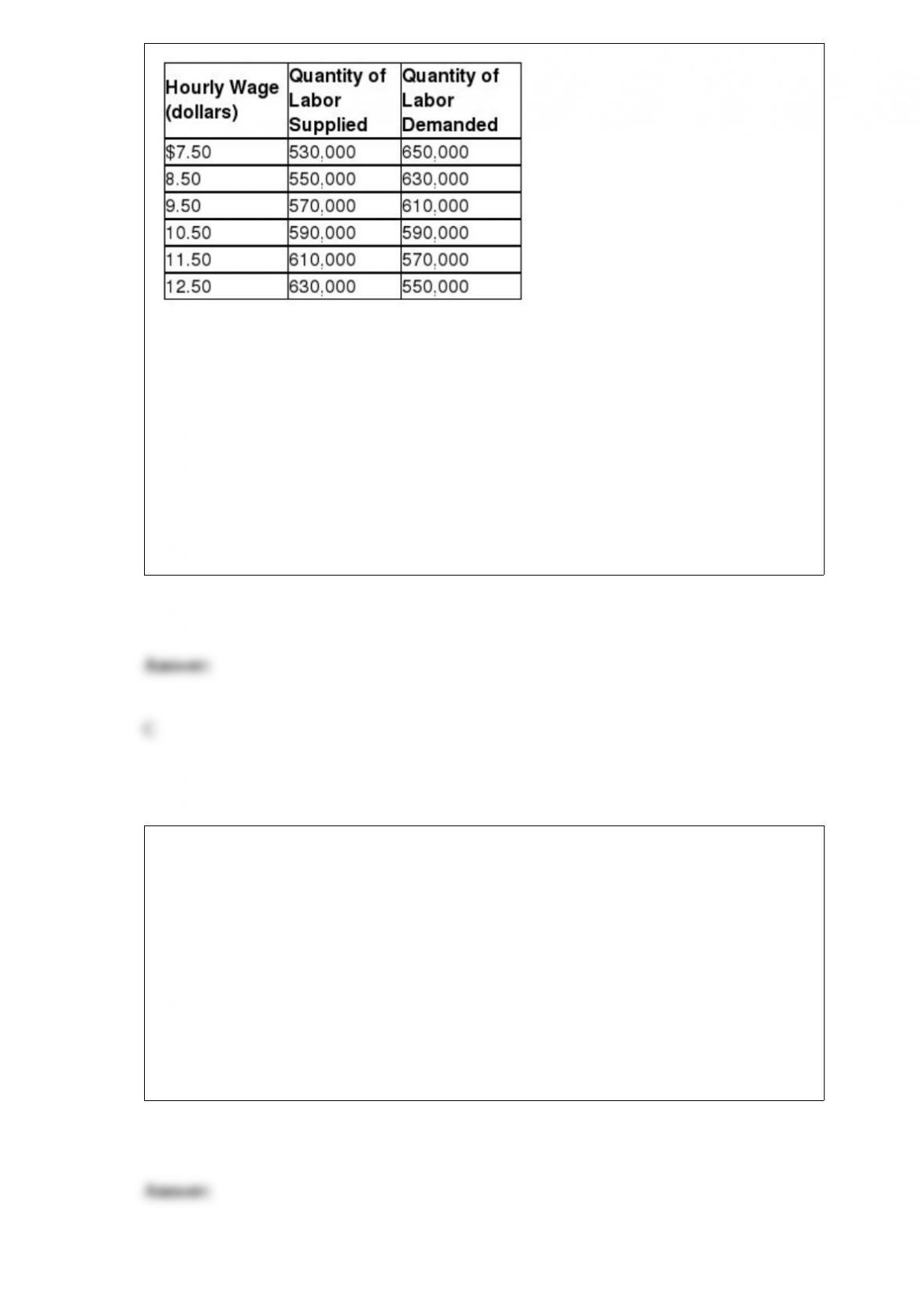
Table 4-4 shows the demand and supply schedules for labor market in the city of Pixley.
If a minimum wage of $12.50 an hour is mandated, what is the quantity of labor
supplied?
A) 80,000
B) 550,000
C) 630,000
D) 1,180,000
If actual inflation is less than expected inflation, what is the relationship between the
actual real wage and the expected real wage?
A) The actual real wage is lower than the expected real wage.
B) The actual real wage is higher than the expected real wage.
C) The actual real wage is equal to the expected real wage.
D) The relationship between the actual real wage and the expected real wage cannot be
predicted.
If the Federal Reserve targets the interest rate and the money demand curve shifts to the
left, then the Fed
A) cannot maintain the interest rate target.
B) can maintain the interest rate target, but at a lower quantity of the money supply.
C) can maintain the interest rate target, but at a higher quantity of the money supply.
D) can maintain the interest rate target with no change in the money supply.
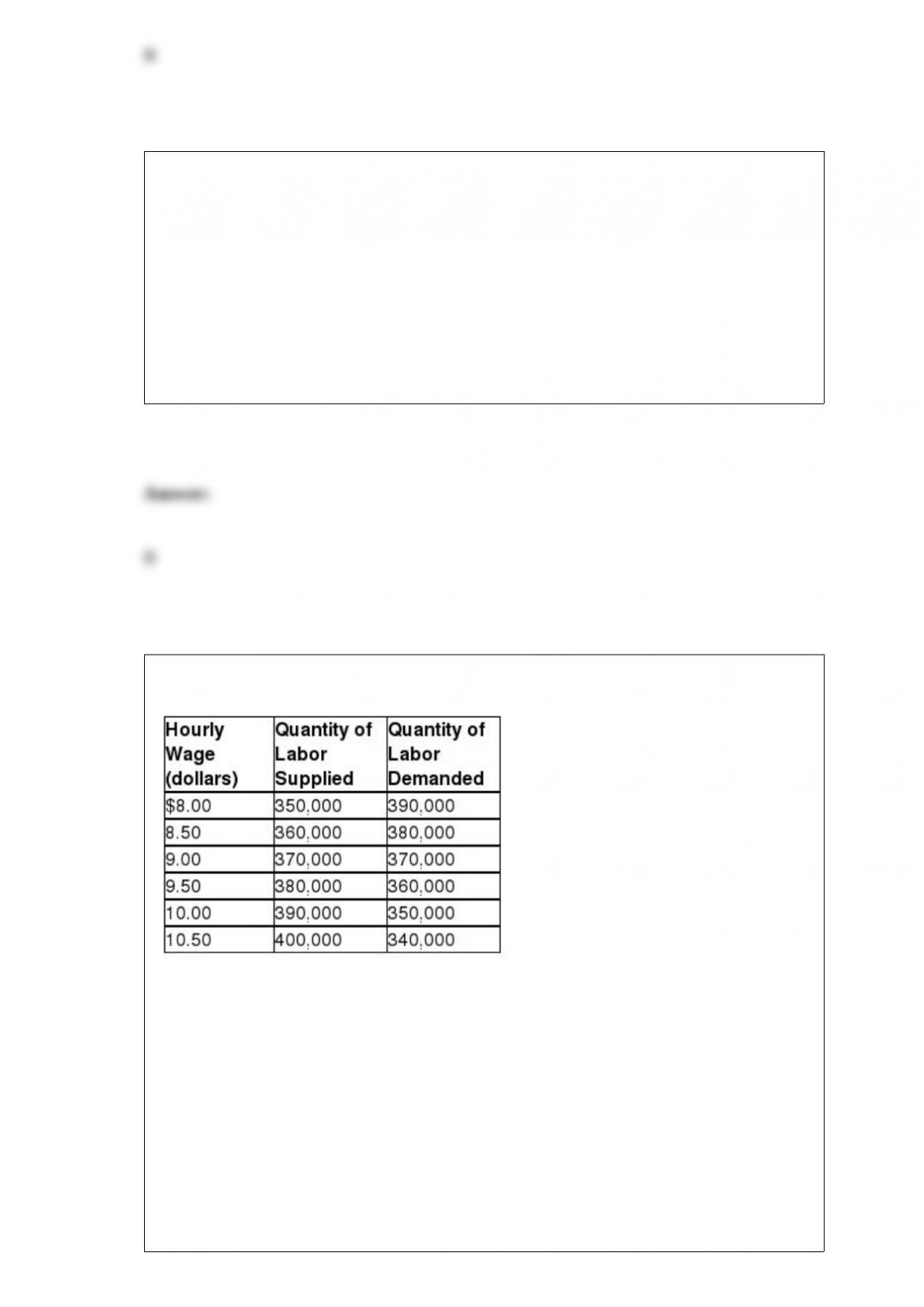
Table 4-8
Table 4-8 shows the demand and supply schedules for the low-skilled labor market in
the city of Westover.
If a minimum wage of $10.50 an hour is mandated, what is the quantity of labor
supplied?
A) 400,000
B) 370,000
C) 340,000
D) 60,000
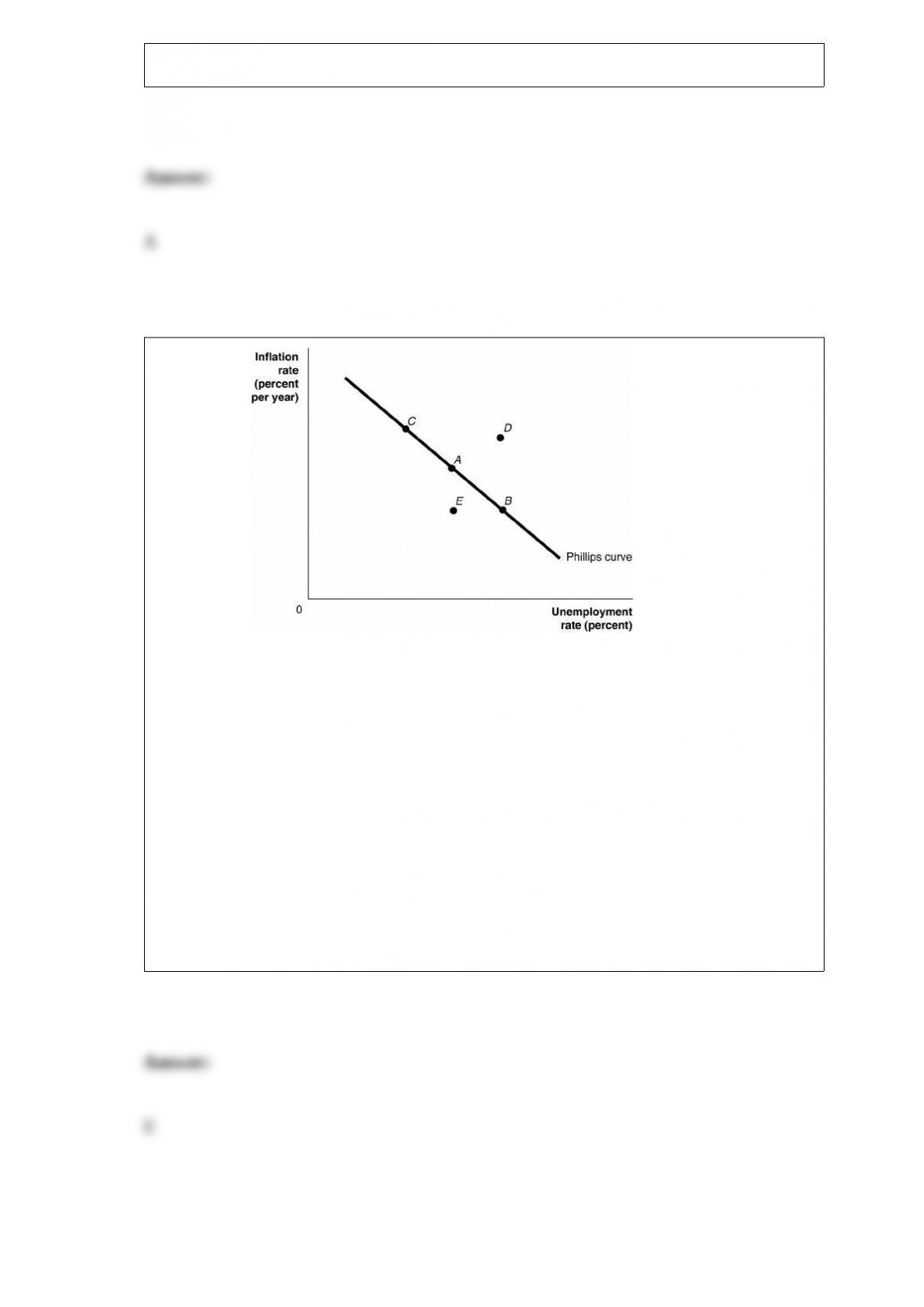
Figure 17-1
Suppose that the economy is currently at point A, and the unemployment rate at A is the
natural rate. What policy would the Federal Reserve pursue if it wanted the economy to
move to point C in the long run?
A) Buy treasury bills.
B) Sell treasury bills.
C) Lower the discount rate.
D) Increase the money supply.
E) No policy will move the economy to point C in the long run.

Which of the following is not an explanation for the revival in the growth of
productivity starting in the mid-1990s?
A) Information and communication innovations are increasingly geared toward
improving business processes and not consumer products.
B) Faster computers have sped up data processing.
C) Internet use has increased the efficiency of how firms buy and sell to each other and
to consumers.
D) Cell phones and wireless Internet access have increased worker flexibility.
Consider the following economic agents:
a. the government
b. consumers
c. producers Who, in a modern mixed economy, decides what goods and services will
be produced with the scarce resources available in that economy?
A) the government
B) producers
C) consumers
D) consumers and producers
E) the government, consumers and producers