
If Luke can bake bread at a lower opportunity cost than Jason, and Jason can produce
paintings at a lower opportunity cost than Luke, it follows that
a. Lukehas a comparative advantage in paintings and Jason has a comparative
advantage in baking bread.
b. BothLuke and Jason have a comparative advantage in baking bread.
c. BothLuke and Jason have a comparative disadvantage in producing paintings.
d. Lukehas a comparative advantage in baking bread and Jason has a comparative
advantage in producing paintings.
e. There is not enough information to answer the question.
For a perfectly competitive firm,
a. VMP > MRP.
b. VMP < MRP.
c. VMP = MRP.
d. There is not enough information to answer the question.
A winner-take-all market

a. is one in which the top producer or performer in the market earns significantly more
than others in the same market.
b. applies to the sports market and the entertainment market, exclusively.
c. the top producer earns all of the profits in that market.
d. a and b
e. b and c
There is a flexible exchange rate system and only two countries in the world, the United
States and Mexico. If the inflation rate in the United States rises relative to the inflation
rate in Mexico, it follows that
a. the dollar will appreciate and the peso will depreciate.
b. both the dollar and the peso will appreciate, although the peso will appreciate before
the dollar appreciates.
c. the dollar will depreciate and the peso will appreciate.
d. both the dollar and the peso will depreciate, although the peso will depreciate before
the dollar depreciates.
e. There is not enough information to answer the question.

The purchasing power parity theory predicts that changes in the relative price levels of
two countries will affect the exchange rate in such a way that
a. one unit of a nation’s currency will buy more foreign goods than it did before the
change in the relative price levels.
b. one unit of a nation’s currency will buy fewer foreign goods than it did before the
change in the relative price levels.
c. one unit of a nation’s currency will continue to buy the same amount of foreign goods
as it did before the change in the relative price levels.
d. the percentage of depreciation in one currency equals the percentage of appreciation
in the other currency.
Asymmetric information exists when
a. both parties to an exchange have all relevant facts about that exchange.
b. a good that is either nonrivalrous or nonexcludable is being sold on a market.
c. the two parties to an exchange differ in what they know about the good being
exchanged.
d. neither party to an exchange is knowledgeable about the quality of the good being
exchanged.
The Herfindahl index measures the

a. average market share of the firms in an industry.
b. total market share of the four largest domestic firms in an industry.
c. total market share of the four largest firms worldwide in an industry.
d. degree of concentration in an industry.
e. degree of competition among the four largest firms in an industry.
One difference between a perfectly competitive firm and a monopoly firm is
a. a perfectly competitive firm maximizes profit by producing the quantity of output at
which MR = MC, and the monopoly firm does not.
b. a monopoly firm is resource allocative efficient, and a perfectly competitive firm is
not.
c. the monopoly firm charges the highest per-unit price for its product, and the perfectly
competitive firm does not.
d. the demand curve and the marginal revenue curve are the same for the perfectly
competitive firm, but they are not the same for the monopoly firm.
e. c and d

Research by H. Gregg Lewis shows that over the period 1929-1979,
a. the average wage of union members was 10 to 15 percent higher than that of
comparable nonunion labor.
b. the average wage of union members was 10 to 15 percent lower than that of
comparable nonunion labor.
c. labor unions increased productivity.
d. labor unions decreased productivity.
e. none of the above
In long run equilibrium, the monopolistic competitor will most likely
a. be earning zero economic profit.
b. be operating at the lowest point on its average total cost curve.
c. charge a price that is equal to marginal revenue.
d. charge a price that is equal to marginal cost.
e. c and d
There are two goods in the economy, apples and bread. The relative price of apples has

increased. This could be due to
a. an increase in the absolute price of apples, ceteris paribus.
b. a decrease in the absolute price of bread, ceteris paribus.
c. a decrease in the absolute price of apples, ceteris paribus.
d. an increase in the absolute price of bread, ceteris paribus.
e. a and b
Refer to Exhibit 22-13.What dollar amounts go in blanks (K) and (L), respectively?
Exhibit 22-13 Quantity of Output (Q) Total Fixed Cost (TFC) Average Fixed Cost
(AFC) Total Variable Cost
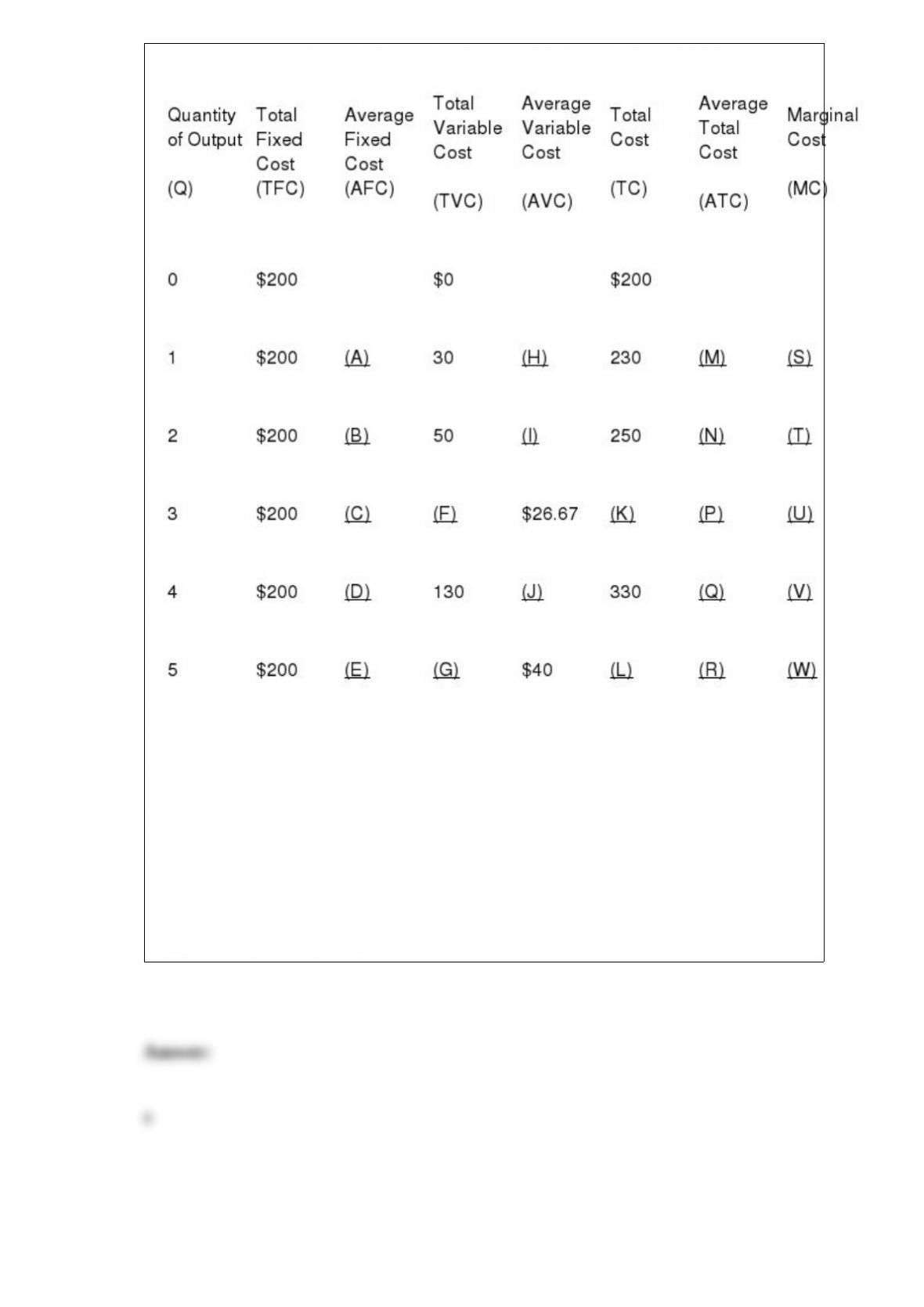
a. $280; $400
b. $28; $40
c. $260; $360
d. $50; $400
e. There is not enough information to answer this question.

An “interlocking directorate” is
a. an arrangement whereby the leaders of a union are also in the top management of the
business with which the union is dealing.
b. selling to a retailer on the condition that the retailer not carry any rival products.
c. an arrangement whereby the sale of one product is dependent on the purchase of
some other product.
d. an arrangement whereby the directors of one company sit on the board of directors of
another company in the same industry.
Refer to Exhibit 22-13.What dollar amounts go in blanks (C) and (D), respectively?
Exhibit 22-13 Quantity of Output (Q) Total Fixed Cost (TFC) Average Fixed Cost
(AFC) Total Variable Cost
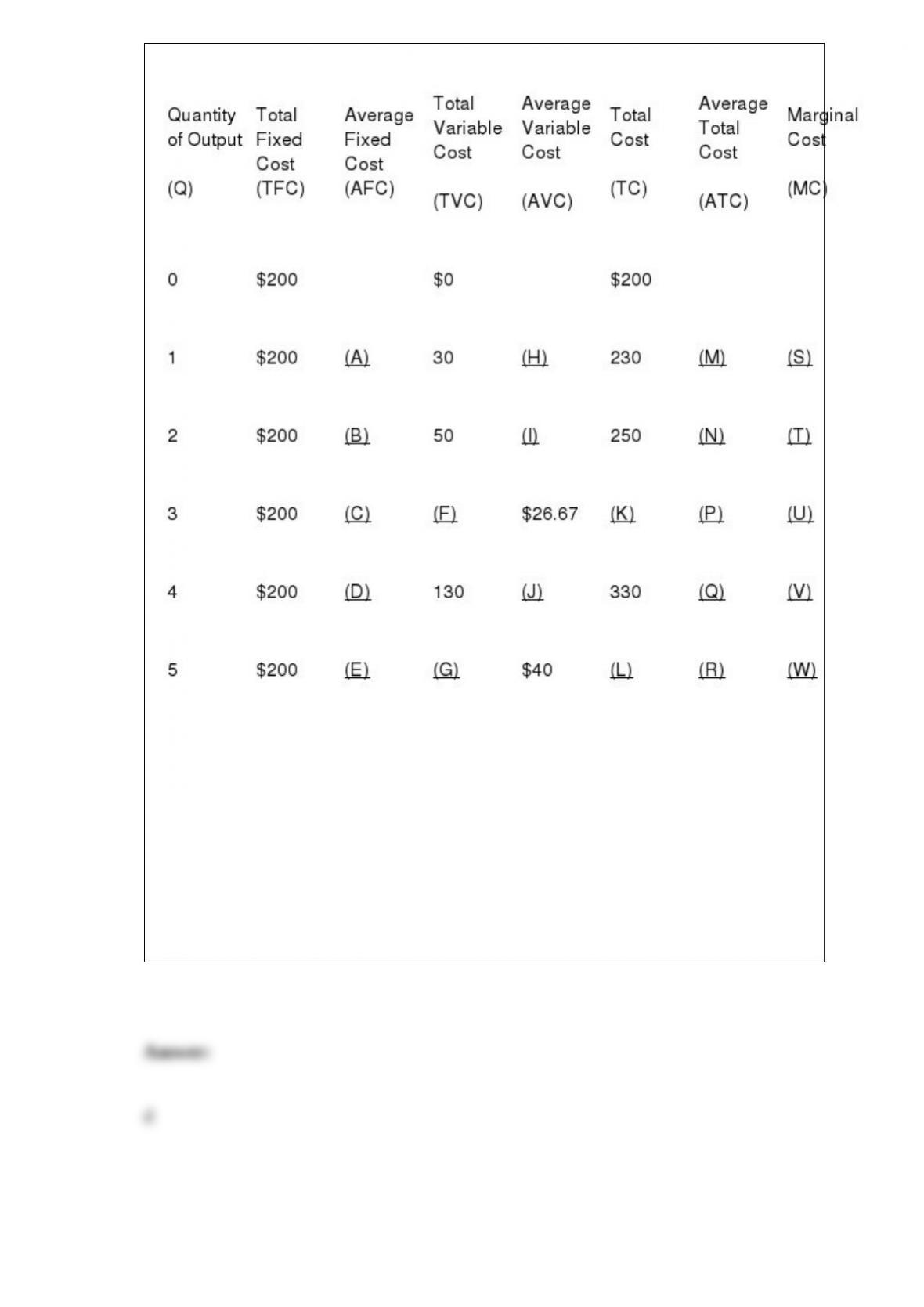
a. $100; $50
b. $25; $68
c. $200; $200
d. $66.67; $50
e. There is not enough information to answer this question.

If the price elasticity of demand for a given product is 7, this means that
a. the percentage change in quantity demanded is 7 times the percentage change in
price.
b. if quantity demanded fell by 1 percent, price would fall by 7 percent.
c. if price was raised 7 percent, quantity demanded would fall by 7 percent.
d. if price was raised 7 percent, quantity demanded would rise 7 percent.
e. none of the above
In the long run, new firms will enter a monopolistic competitive industry until
a. minimum average total cost is achieved.
b. all firms are incurring losses.
c. economic profits in the industry are zero.
d. a and b