
The natural rate of unemployment in the United States since 1950 has averaged
between ______ and ______ percent.
A) 0; 1
B) 1; 3
C) 5; 6
D) 10; 15
The simple investment function shows that investment ______ as ______ increases.
A) decreases; the interest rate
B) increases; the interest rate
C) decreases; government spending
D) increases; government spending
According to the sticky-price model:
A) all firms announce their prices in advance.
B) all firms set their prices in accord with observed prices and output.

C) some firms set their prices according to the aggregate supply equation.
D) some firms announce their prices in advance, and some firms set their prices in
accord with observed prices and output.
In a small open economy, starting from a position of balanced trade, if the government
increases the income tax, this produces a tendency toward a trade ______ and ______
net capital outflow.
A) deficit; negative
B) surplus; positive
C) deficit; positive
D) surplus; negative
According to the Phillips curve, firms raise prices when output is _____ the natural
level of output or, equivalently, when the unemployment rate is _____ the natural rate
of unemployment.
A) above; above
B) above; below
C) below; below

D) below; above
For a firm facing financing constraints on its investment spending, the most important
determinant of how much it invests is the:
A) firm’s expected future profitability.
B) firm’s current profitability.
C) interest rate.
D) firm’s cost of capital.
A competitive, profit-maximizing firm hires labor until the:
A) marginal product of labor equals the wage.
B) price of output multiplied by the marginal product of labor equals the wage.
C) real wage equals the real rental price of capital.
D) wage equals the rental price of capital.

If a dollar bought 1,000 Chilean pesos ten years ago and 1,500 lire now, and inflation
for that period was 25 percent in the United States and 100 percent in Chile, then:
A) the purchasing-power parity theory is correct.
B) traveling in Chile today costs about the same as it did ten years ago.
C) traveling in Chile is cheaper now than it was ten years ago.
D) traveling in Chile is more expensive now than it was ten years ago.
Provide specific examples from the 2008″2009 financial crisis of each of the five stages
of a financial crisis:
a. asset-price booms and busts,
b. insolvencies of financial institutions,
c. falling confidence in the financial system,
d. credit crunch,
e. recession.
Demand deposits are funds held in:
A) currency.
B) certificates of deposit.
C) checking accounts.
D) money markets.
An increase in the money supply shifts the ______ curve to the right, and the aggregate

demand curve ______.
A) IS; shifts to the right
B) IS; does not shift
C) LM: shifts to the right
D) LM; does not shift
The rate of labor-augmenting technological progress (g) is the growth rate of:
A) labor.
B) the efficiency of labor.
C) capital.
D) output.
Assume that an economy is initially at the natural rate of unemployment.
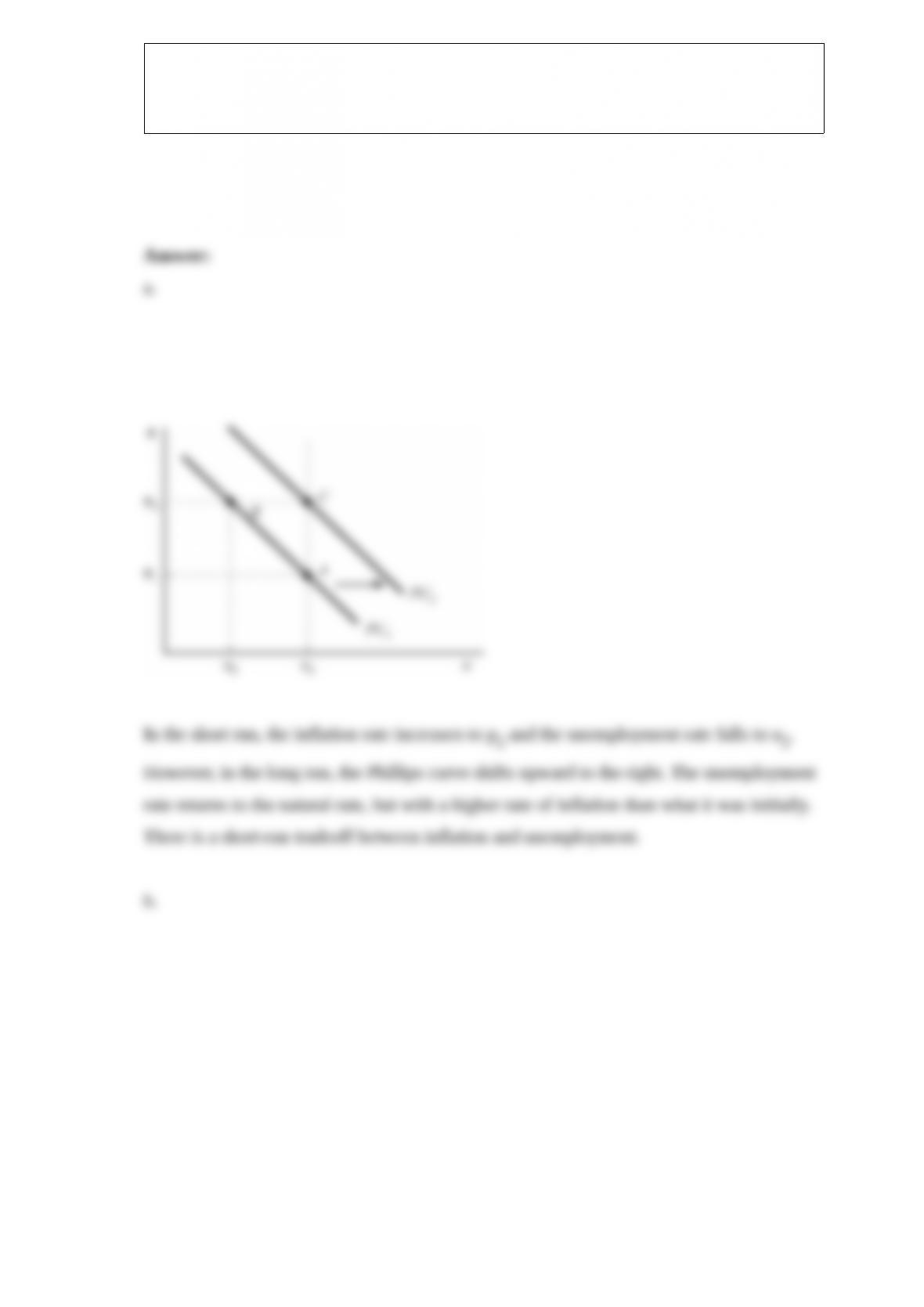
a. Use a Phillips curve diagram to illustrate graphically how the inflation rate and
unemployment rate respond both in the short run and in the long run to an unexpected
expansionary monetary policy.
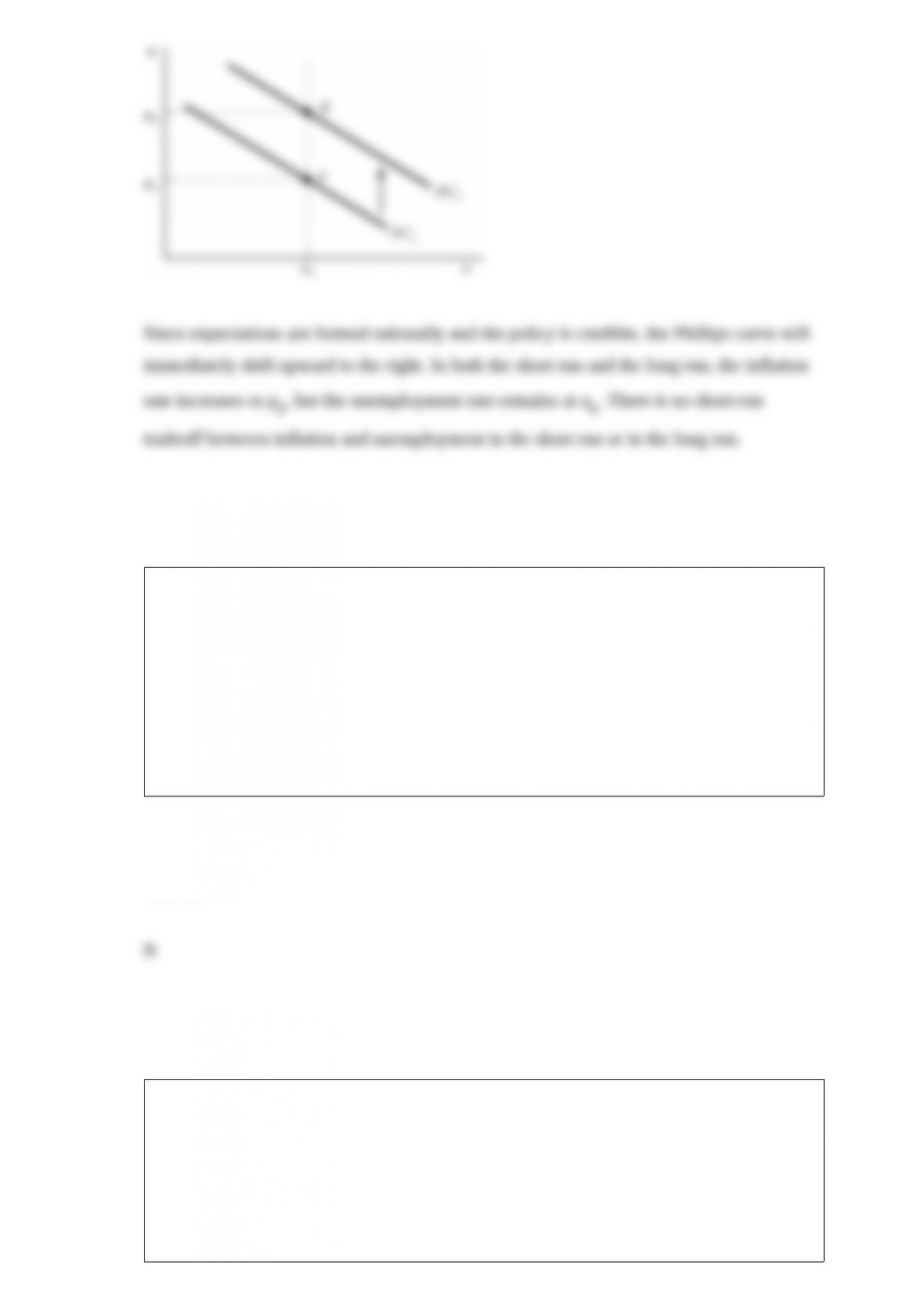
b. Use a Phillips curve diagram to illustrate graphically how the inflation rate and
unemployment rate respond both in the short run and in the long run to the
announcement of a credible plan of expansionary monetary policy when people have
rational expectations.
A policy that increases the job-finding rate _____ the natural rate of unemployment.
A) will increase
B) will decrease
C) will not change
D) could either increase or decrease
A time-inconsistency problem in macroeconomic policy can occur when the
policymaker:
A) is made to follow a strict and an inflexible rule.
B) has discretion in the short run but follows a rule in the long run.

C) has discretion to act as it seems best in each situation, based on his or her own
knowledge and experience.
D) has no discretion.
A consumer spending excessively today, intending to start saving for retirement
tomorrow, but deciding to continue spending when tomorrow arrives is an example of:
A) an income effect offsetting a substitution effect.
B) time-inconsistent preferences.
C) spending out of permanent income, but not out of transitory income.
D) an intertemporal budget constraint.
The reason that the income response to a fiscal expansion is generally less in the IS“LM
model than it is in the Keynesian-cross model is that the Keynesian-cross model
assumes that:
A) investment is not affected by the interest rate whereas in the IS“LM model fiscal
expansion raises the interest rate and crowds out investment.
B) investment is not affected by the interest rate whereas in the IS“LM model fiscal
expansion lowers the interest rate and crowds out investment.
C) investment is autonomous whereas in the IS“LM model fiscal expansion encourages

higher investment, which raises the interest rate.
D) the price level is fixed whereas in the IS“LM model it is allowed to vary.
At long-run equilibrium in the dynamic model of aggregate demand and aggregate
supply, the demand and supply shocks, et and ut, equal _____ and current inflation, pt,
equals _____.
A) 0; 0
B) 0; pt ” 1
C) pt; 0
D) r
If total investment (measured in billions of current dollars) equals $741, business fixed
investment is $524, and residential fixed investment is $222, then inventory investment
is:
A) $5.
B) “$5.
C) $15.

D) “$15.
Stabilization policy refers to policy actions aimed at:
A) reducing the severity of short-run economic fluctuations.
B) equalizing incomes of households in the economy.
C) maintaining constant shares of output going to labor and capital.
D) preventing increases in the poverty rate.
To increase the monetary base, the Fed can:
A) conduct open-market purchases.
B) conduct open-market sales.
C) raise the interest rate paid on reserves.
D) lower the required reserve ratio.

The formula for steady-state consumption per worker (c*) as a function of output per
worker and investment per worker is:
A) c* = f(k*) ” dk*.
B) c* = f(k*) + dk*.
C) c* = f(k*) ÷ dk*.
D) c* = k* ” df(k)*.
The supply of loanable funds is equivalent to:
A) national saving.
B) private saving.
C) public saving.
D) investment.

A toy manufacturer accumulates inventories because of the uncertainty of the demand
for their product at Christmas and the desire not to lose any potential sales. This is an
example of the ______ motive for holding inventories.
A) production smoothing
B) inventories as a factor of production
C) stock-out avoidance
D) work in process
Credit card balances are included in:
A) M1 only.
B) M2 only.
C) both M1 and M2.
D) neither M1 nor M2.
Assume that an economy described by the Solow model is in a steady state with output
and capital growing at 3 percent, and labor growing at 1 percent. The capital share is
0.3. The growth-accounting equation indicates that the contributions to growth of
capital, labor, and total factor productivity are:

A) 0 percent, 1 percent, and 2 percent, respectively.
B) 0.3 percent, 0.7 percent, and 2 percent, respectively.
C) 0.9 percent, 0.7 percent, and 1.4 percent, respectively.
D) 1.8 percent, 0.3 percent, and 0.9 percent, respectively.
If the rate of separation is 0.02 and the rate of job finding is 0.08 but the current
unemployment rate is 0.10, then the current unemployment rate is ______ the
equilibrium rate, and in the next period it will move ______ the equilibrium rate.
A) above; toward
B) above; away from
C) below; toward
D) below; away from
Exhibit: Policies Influence Real Exchange Rate
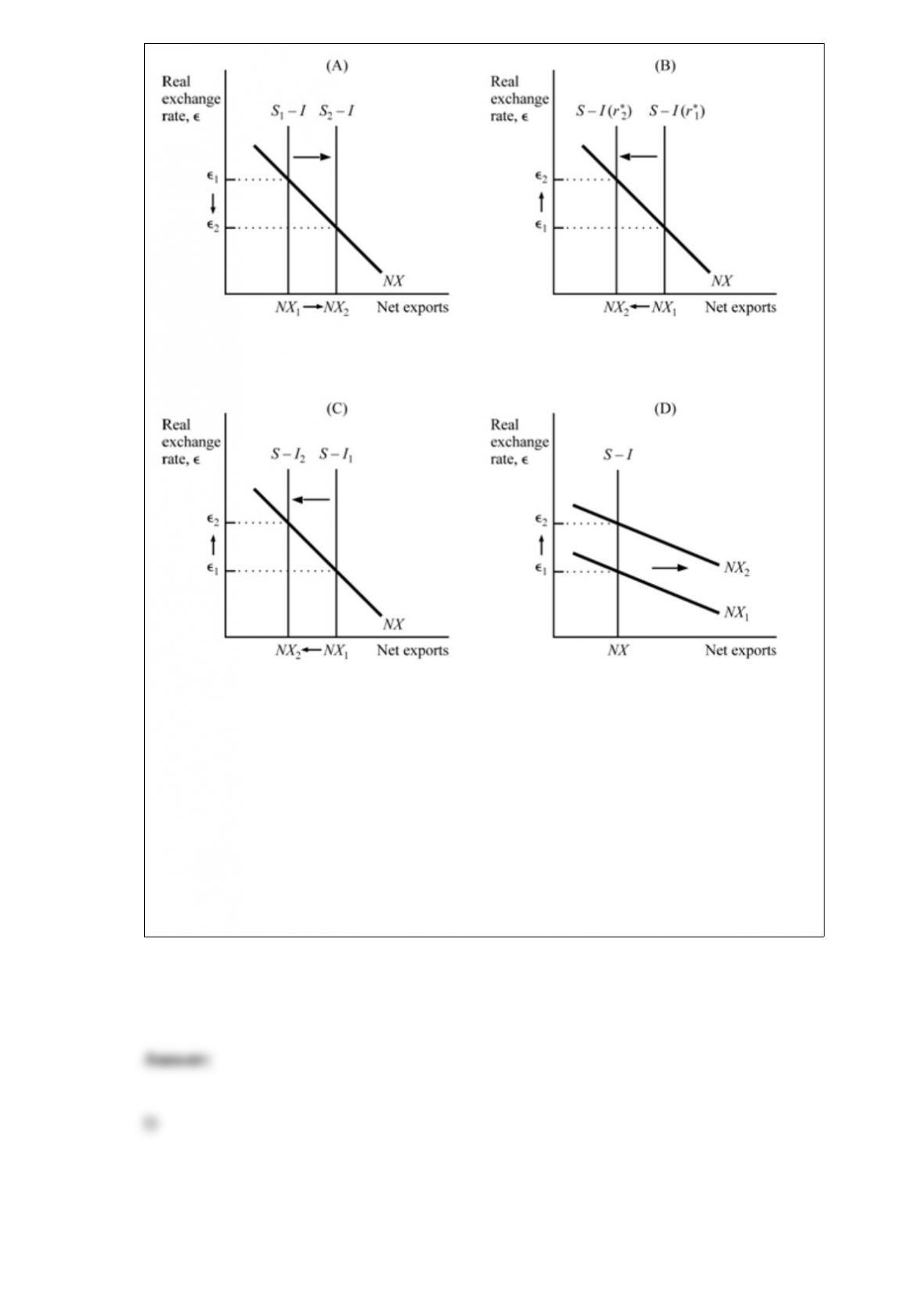
(Exhibit: Policies Influence Real Exchange Rate) Which of the panels illustrates the
impact on the real exchange rate of protectionist trade policies?
A) (A)
B) (B)
C) (C)
D) (D)
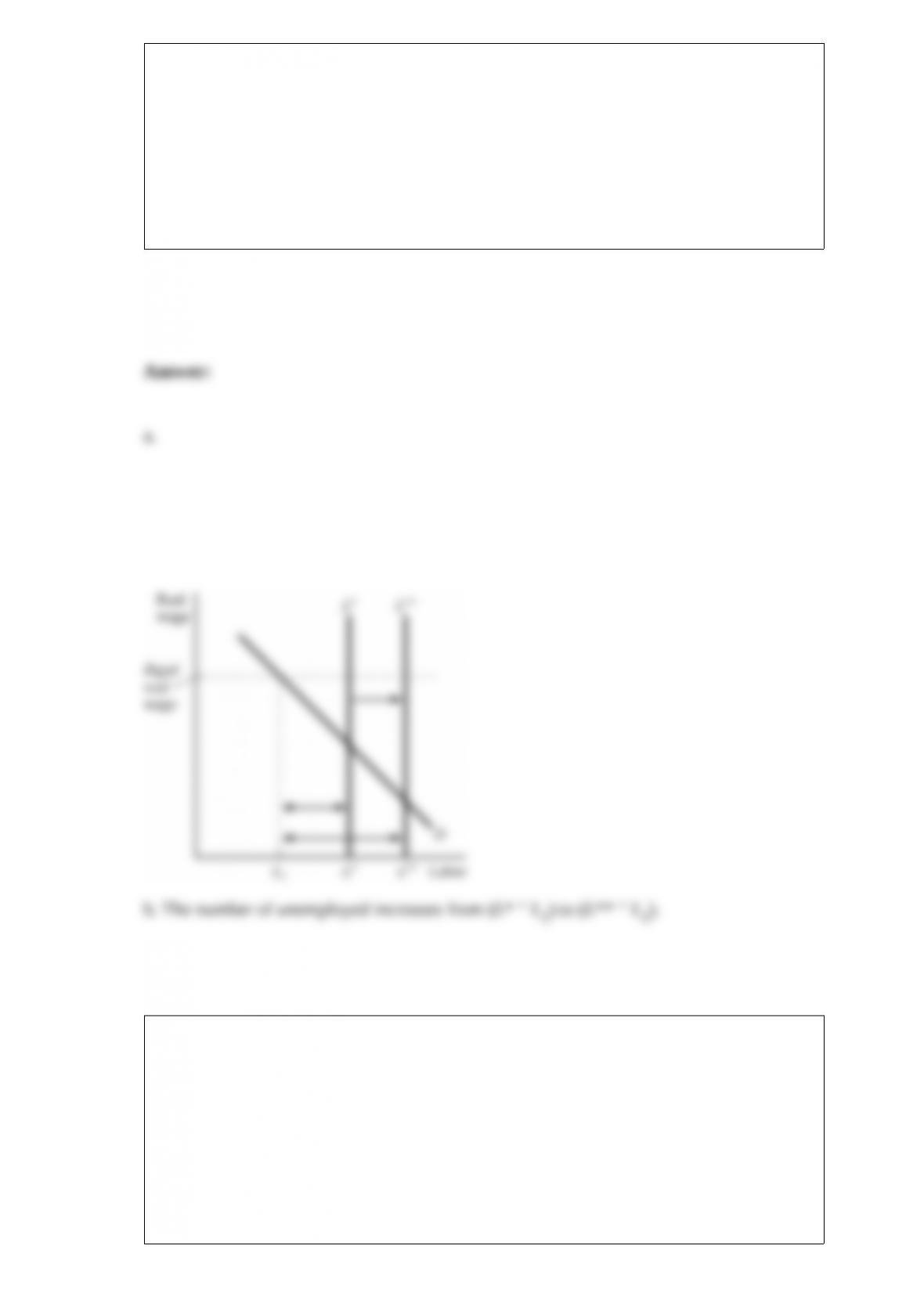
Assume that the real wage in an economy is held above equilibrium.
a. Graphically illustrate how an increase in the supply of labor will change the number
of unemployed workers. Be sure to label the axes and the quantities of labor hired
before and after the increase in the labor supply.
b. Explain in words what happens to the number of unemployed as a result of this
change.
The economic response to the overnight reduction in the French money supply by 20
percent in 1724,
A) confirmed the neutrality of money because no real variables were affected by this
nominal change.
B) confirmed the quantity theory by leading to an immediate 20 percent reduction in the
price level.

C) confirmed that money is not neutral in the short run because both output and prices
dropped.
D) contradicted Okun’s law because decreases in output were not associated with
increases in unemployment.
All of the following transactions that took place in 2009 would be included in GDP for
2009 except the purchase of a:
A) book printed in 2009, entitled The Year 3000.
B) 2001 Jeep Cherokee.
C) year 2010 calendar printed in 2009.
D) ticket to see the movie 2001.
In the Solow growth model the saving rate determines the allocation of output between:
A) saving and investment.
B) output and capital.
C) consumption and output.
D) investment and consumption.