
The benefit to buyers of participating in a market is measured by
a. the price elasticity of demand.
b. consumer surplus.
c. the maximum amount that buyers are willing to pay for the good.
d. the equilibrium price.
Suppose that in a country people gain more confidence in the banking system and so
hold relatively less currency and more deposits. As a result, bank reserves will
a. decrease and the money supply will eventually decrease.
b. decrease and the money supply will eventually increase.
c. increase and the money supply will eventually decrease.
d. increase and the money supply will eventually increase.
Welfare economics is the study of
a. the well-being of less fortunate people.
b. welfare programs in the United States.

c. how the allocation of resources affects economic well-being.
d. the effect of income redistribution on work effort.
An increase in quantity supplied
a. results in a movement downward and to the left along a fixed supply curve.
b. results in a movement upward and to the right along a fixed supply curve.
c. shifts the supply curve to the left.
d. shifts the supply curve to the right.
One economist has argued that rent control is “the best way to destroy a city, other than
bombing.” Why would an economist say this?
a. He fears that low rents will cause low-income people to move into the city, reducing
the quality of life for other people.
b. He fears that rent control will benefit landlords at the expense of tenants, increasing
inequality in the city.
c. He fears that rent controls will cause a construction boom, which will make the city
crowded and more polluted.
d. He fears that rent control will eliminate the incentive to maintain buildings, leading

to a deterioration of the city.
A judge requires Harry to make a payment to Sally. The judge says that Harry can pay
her either $10,000 today or $11,000 two years from today. Of the following interest
rates, which is the lowest one at which Harry would be better off paying $11,000 two
years from today?
a. 2 percent
b. 3 percent
c. 4 percent
d. 5 percent
Figure 4-11
Firm A Firm B
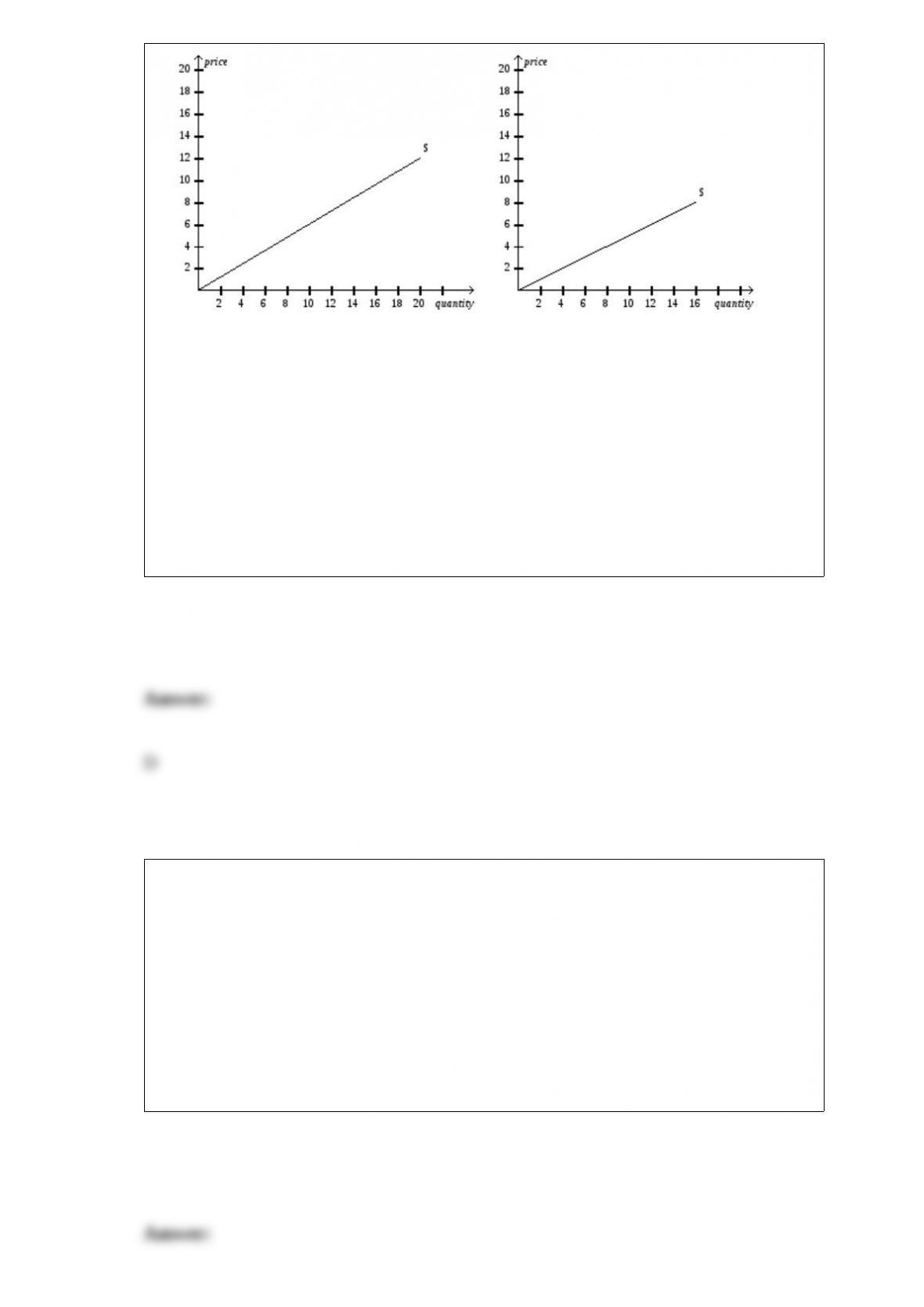
Refer to Figure 4-11. If these are the only two sellers in the market, then the market
quantity supplied at a price of $6 is
a. 2 units.
b. 10 units.
c. 12 units.
d. 22 units.
About what percent of total world trade is accounted for by countries that belong to the
World Trade Organization?
a. 54 percent
b. 72 percent
c. 89 percent
d. 97 percent

When inflation rises, firms make
a. more frequent price changes. This raises their menu costs.
b. more frequent price changes. This reduces their menu costs.
c. less frequent price changes. This raises their menu costs.
d. less frequent price changes. This reduces their menu costs.
Diversifying
a. increases the standard deviation of the value of a portfolio indicating its risk has
increased.
b. increases the standard deviation of the value of a portfolio indicating its risk has
decreased.
c. decreases the standard deviation of the value of a portfolio indicating its risk has
increased.
d. decreases the standard deviation of the value of a portfolio indicating its risk has
decreased.

Over the last 100 years which of the following had growth rates higher than that of the
United States?
a. the United Kingdom
b. India
c. Mexico
d. None of the above is correct.
At which interest rate is the present value of $168.54 two years from today equal to
$150 today?
a. 4 percent
b. 5 percent
c. 6 percent
d. None of the above would give a present value within a cent of $162.24.
Changes in the price of oil
a. can only lead to recessions.

b. have not contributed much to output fluctuations in the United States.
c. change the economy principally by changing aggregate demand.
d. created both inflation and recession in the United States in the 1970s.
Which of the following would make the equilibrium real interest rate decrease and the
equilibrium quantity of loanable funds increase?
a. The demand for loanable funds shifts right.
b. The demand for loanable funds shifts left
c. The supply of loanable funds shifts right.
d. The supply of loanable funds shifts left.
Long-term bonds are
a. riskier than short-term bonds, and so interest rates on long-term bonds are usually
lower than interest rates on short-term bonds.
b. riskier than short-term bonds, and so interest rates on long-term bonds are usually
higher than interest rates on short-term bonds.
c. less risky than short-term bonds, and so interest rates on long-term bonds are usually

lower than interest rates on short-term bonds.
d. less risky than short-term bonds, and so interest rates on long-term bonds are usually
higher than interest rates on short-term bonds.
Suppose that real interest rates in the U.S. rise relative to real interest rates in other
countries. This increase would make foreigners
a. more willing to purchase U.S. bonds, so U.S. net capital outflow would fall.
b. more willing to purchase U.S. bonds, so U.S. net capital outflow would rise.
c. less willing to purchase U.S. bonds, so U.S. net capital outflow would fall.
d. less willing to purchase U.S. bonds, so U.S. net capital outflow would rise.
When an economy is operating inside its production possibilities frontier, we know that
a. there are unused resources or inefficiencies in the economy.
b. all of the economy’s resources are fully employed.
c. economic growth would have to occur in order for the economy to move to a point on
the frontier.
d. in order to produce more of one good, the economy would have to give up some of
the other good.

When income increases the slope of an individual’s demand curve, the demand curve
a. turns positive.
b. becomes undefined.
c. remains negative.
d. becomes infinite.
The first number in any ordered pair is
a. the x-coordinate.
b. the y-coordinate.
c. the vertical location of the point.
d. the slope.

When a country allows trade and becomes an importer of a good,
a. consumer surplus and producer surplus both increase.
b. consumer surplus and producer surplus both decrease.
c. consumer surplus increases and producer surplus decreases.
d. consumer surplus decreases and producer surplus increases.
Denise values a stainless steel dishwasher for her new house at $500. The actual price
of the dishwasher is $650. Denise
a. buys the dishwasher, and on her purchase she experiences a consumer surplus of
$150.
b. buys the dishwasher, and on her purchase she experiences a consumer surplus of
$-150.
c. does not buy the dishwasher, and on her purchase she experiences a consumer surplus
of $150.
d. does not buy the dishwasher, and on her purchase she experiences a consumer
surplus of $0.
A significant example of a temporary tax cut was the one announced in 1992 by
President George H. W. Bush. The effect of that tax cut on consumer spending and
aggregate demand was
a. zero.
b. likely smaller than if the cut had been permanent.
c. likely about the same as if the cut had been permanent.
d. likely larger than if the cut had been permanent.
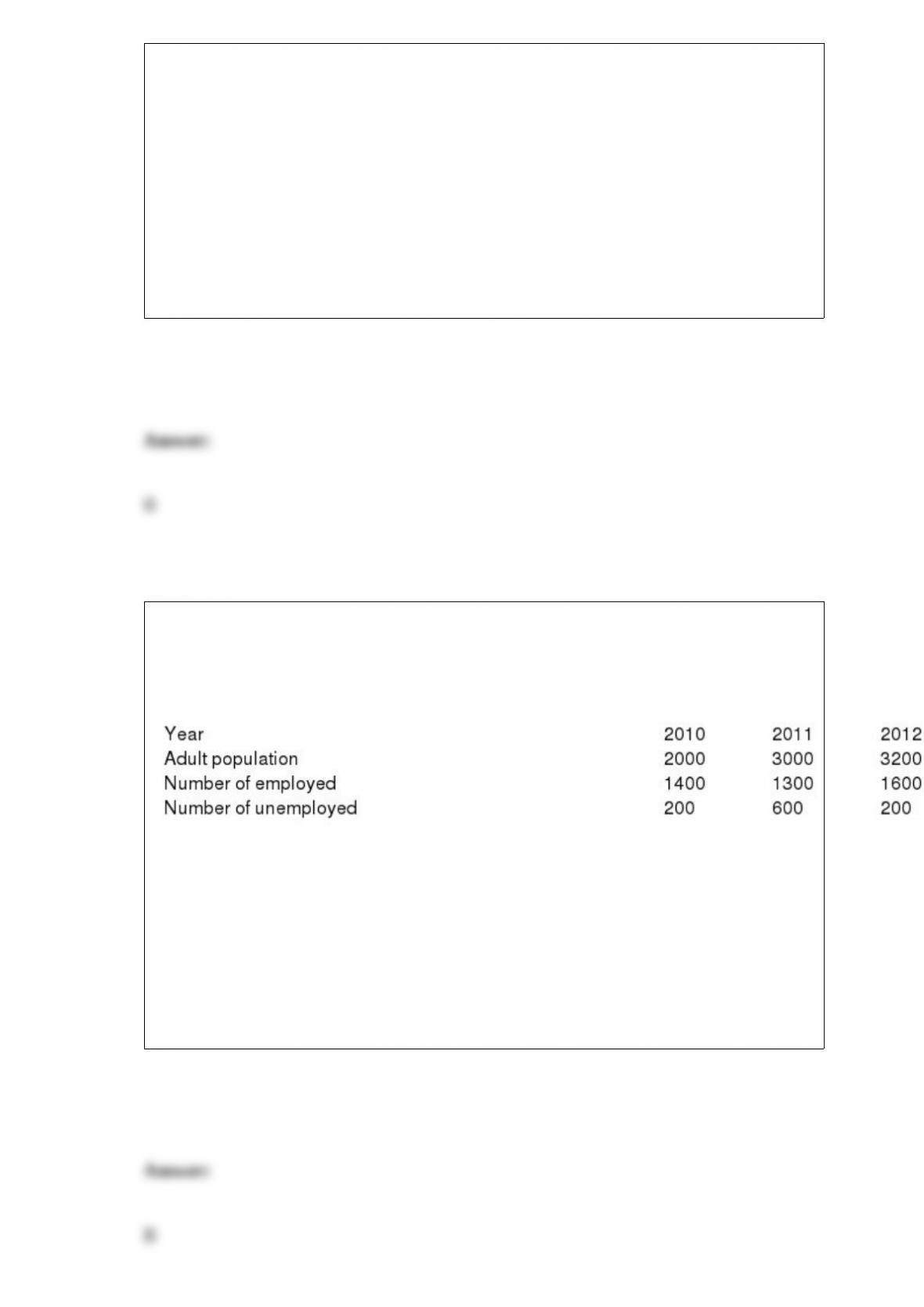
Table 15-1
Labor Data for Aridia
Refer to Table 15-1. The labor force of Aridia
a. increased from 2010 to 2011 and increased from 2011 to 2012.
b. increased from 2010 to 2011 and decreased from 2011 to 2012.
c. decreased from 2010 to 2011 and increased from 2011 to 2012.
d. decreased from 2010 to 2011 and decreased from 2011 to 2012.

If the quantity of loanable funds supplied exceeds the quantity of loanable funds
demanded,
a. there is a surplus and the interest rate is above the equilibrium level.
b. there is a surplus and the interest rate is below the equilibrium level.
c. there is a shortage and the interest rate is above the equilibrium level.
d. there is a shortage and the interest rate is below the equilibrium level.
Some, but not all, government economists are employed within the administrative
branch of government. Which of the following government agencies employs
economists outside of the administrative branch?
a. the Department of Labor
b. the Department of the Treasury
c. the Congressional Budget Office
d. the Council of Economic Advisers
As the price level rises

a. people are more willing to lend, so interest rates rise.
b. people are more willing to lend, so interest rates fall.
c. people are less willing to lend, so interest rates fall.
d. people are less willing to lend, so interest rates rise.
Which of the following would not shift the supply curve for mp3 players?
a. an increase in the price of mp3 players
b. a decrease in the number of sellers of mp3 players
c. an increase in the price of plastic, an input into the production of mp3 players
d. an improvement in the technology used to produce mp3 players
Other things the same, if the expected return on U.S. assets increased, the
a. supply of dollars in the market for foreign-currency exchange shifts right.
b. supply of dollars in the market for foreign-currency exchange shifts left.
c. demand for dollars in the market for foreign-currency exchange shifts right
d. demand for dollars in the market for foreign-currency exchange shifts left.

The Bureau of Labor Statistics is part of the U.S. Department of
a. the Treasury.
b. Commerce.
c. Labor.
d. the Interior.
In 2009 President Obama and Congress increased government spending. Some
economists thought this increase would have little effect on output. Which of the
following would make the effect of an increase in government expenditures on
aggregate demand smaller?
a. the interest rate falls and aggregate supply is relatively flat
b. the interest rate falls and aggregate supply is relatively steep
c. the interest rate rises and aggregate supply is relatively flat
d. the interest rate rises and aggregate supply is relatively steep