Taxes on polluting emissions are
a. more efficient than direct controls.
b. used by all economic societies.
c. less effective than direct regulations.
d. easily enforced through the criminal justice system.
Fixed cost increases when output rises.
a. True
b. False
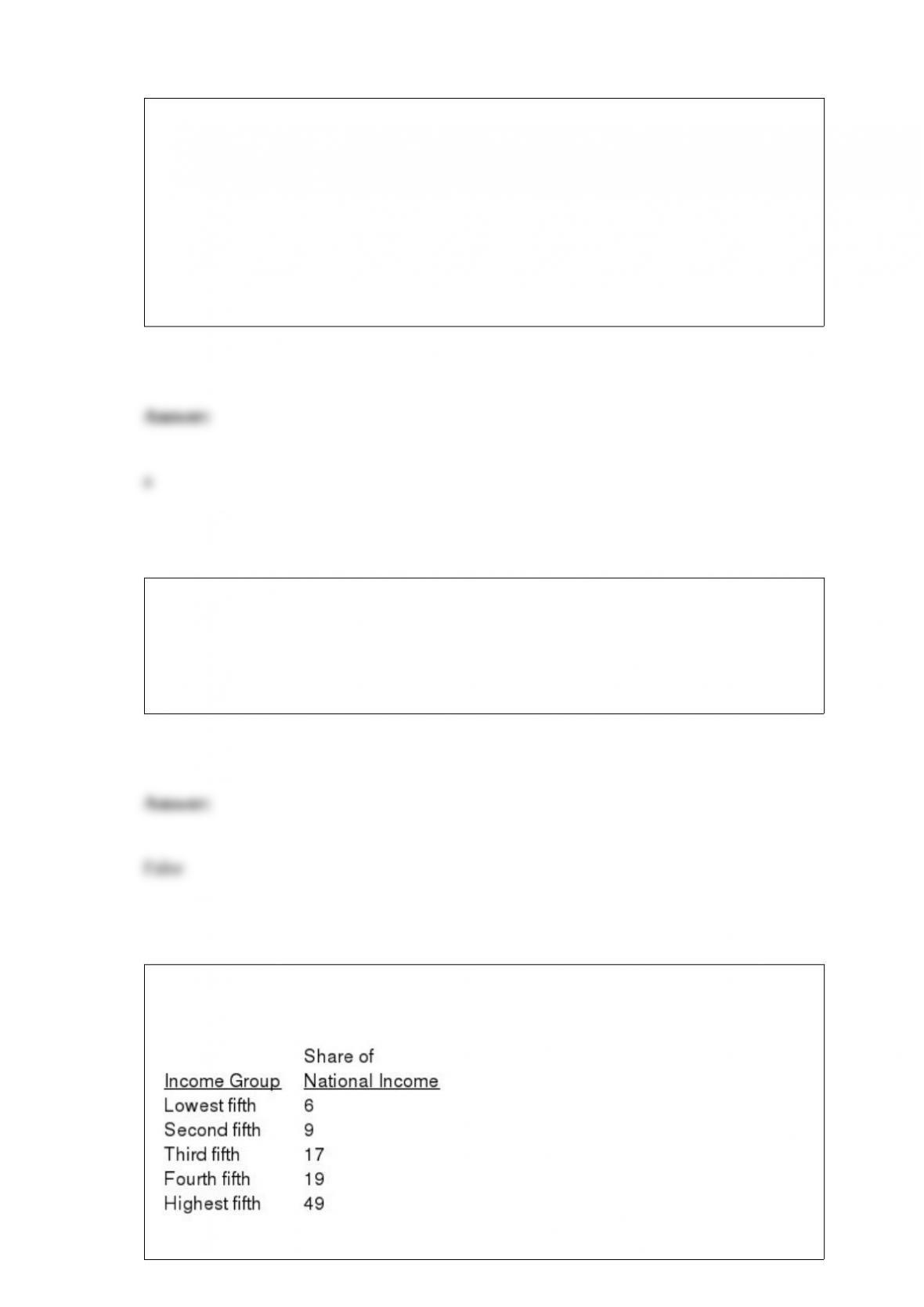
Table 21-1

Consider the economy described by the income distribution in Table 21-1. From this
table, we can conclude that the poorest 60 percent of the population earns
a. 15 percent of the income.
b. 17 percent of the income.
c. 32 percent of the income.
d. 68 percent of the income.
With a negative income tax, the larger the difference between the break-even income
level and the guaranteed level,
a. the greater the tax rate (by definition).
b. the greater the incentive to work.
c. the smaller the number of people eligible to receive benefits.
d. the more inequitable the resulting distribution of income will be.
If significant economies of scale are present, large firms will be much more efficient
producers than small firms.
a. True
b. False

Anthony Downs, in The Economic Theory of Democracy, argues that voters choose to
remain “rationally ignorant” when they vote in elections, knowing relatively little about
the candidates or the issues. What economic principle would you invoke to explain this
behavior?
a. public good theory
b. moral hazard
c. the cost of information
d. risk aversion
Comparing the United States to other economies, the United States is one of the ____
economy in the world.
a. most government-supervised
b. most privatized
c. most government-owned
d. least privatized

An advantage emission taxes and permits have over direct controls is that the former
a. work well even if pollution output cannot be accurately measured.
b. can respond quickly to new information about the dangers of particular pollutants.
c. make it in firms’ interests to reduce pollution in the most efficient manner possible.
d. reduce pollution to zero.
Oligopolists use advertising as a way of differentiating their products.
a. True
b. False
Total fixed cost
a. varies with the level of output.
b. has a downward-sloping curve.
c. has an upward-sloping curve.
d. is constant at all levels of output.
One reason why nations trade is because
a. trading provides opportunities to earn profits.
b. the rate of interest is not the same in all countries.
c. resources are not equally distributed to all nations.
d. some nations like to build one thing while others like to build another.
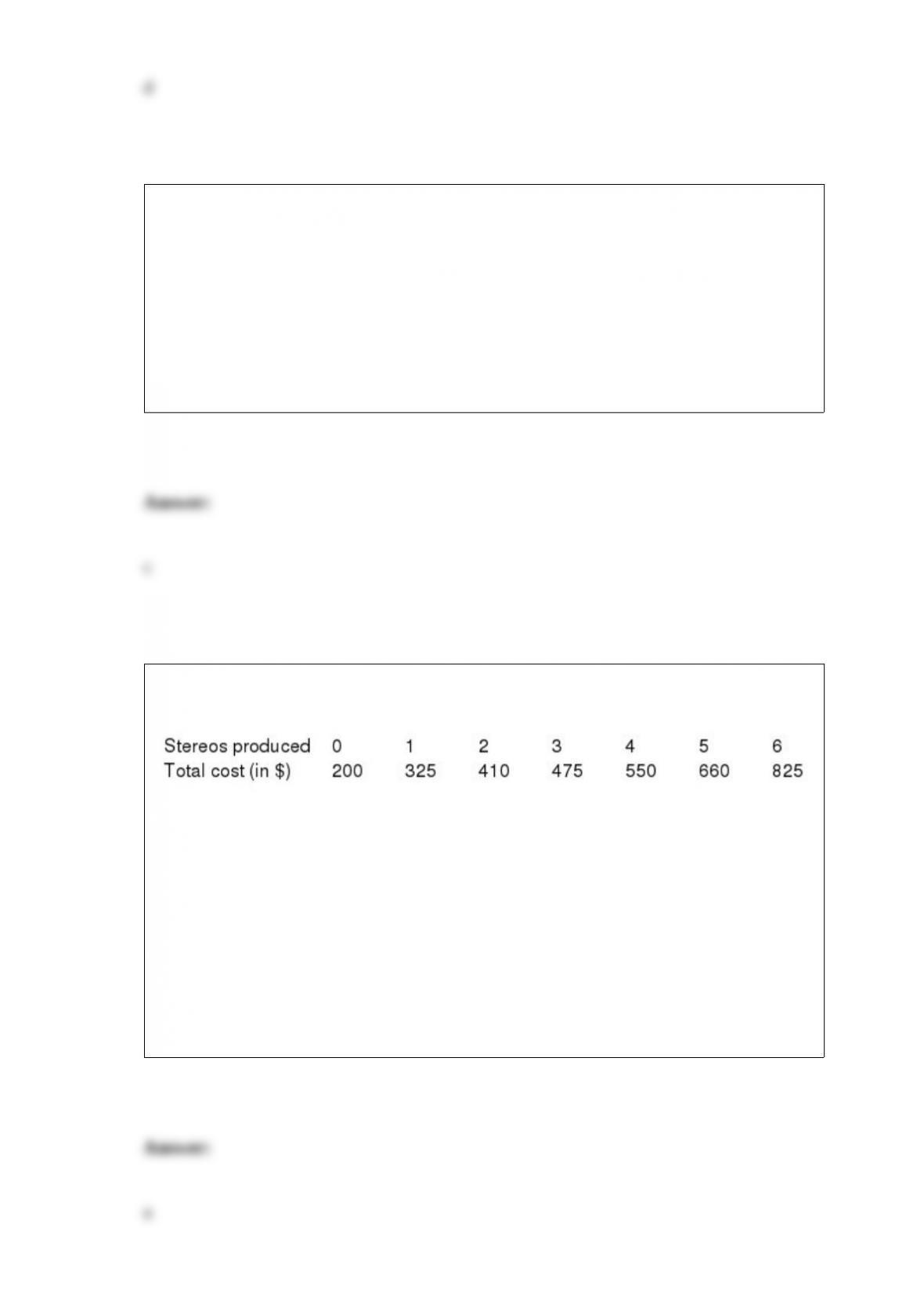
Table 7-5
Table 7-5 shows short-run total cost figures for a stereo manufacturer. The short-run
average variable cost of producing five stereos is
a. $92.
b. $110.
c. $132.
d. $460.

A change in the price of one good, such as staples, may affect the quantity demanded of
another good, such as rubber bands.
a. True
b. False
Most economic activity in the United States is carried out by monopolies.
a. True
b. False
When government defines and enforces property rights, this is an example of
government as
a. referee.
b. regulator of business.
c. buyer of goods and services.
d. tax collector.
e. redistributor.

The typical total profit graphical presentation is shown as
a. a square.
b. a rectangle.
c. a hill, or mound.
d. an S curve.
A quota brings a more serious misallocation of resources than a tariff.
a. True
b. False
Figure 18-2

Figure 18-2 shows the widget market before and after an excise tax is imposed. The
revenue collected by the tax is ____.
a. $8,000
b. $50,000
c. $100,000
d. $150,000
A straight-line demand curve has an elasticity that becomes smaller as we move from
left to right along the schedule.
a. True
b. False
Goods are distributed efficiently if everyone gets an equal share of each good.

a. True
b. False
Perfectly competitive markets have absolutely no drawbacks.
a. True
b. False
The United States is one of the least marketized economies in the world.
a. True
b. False