
The production function shows
A) the total cost of producing a given quantity of output.
B) the maximum output that can be produced from each possible quantity of inputs.
C) the technology used to produce output.
D) the incremental output gained by improving the production process.
What is always true at the quantity where a firm’s average total cost equals average
revenue?
A) The firm’s revenue is maximized.
B) The firm’s profit is maximized.
C) The firm breaks even.
D) Marginal cost equals marginal revenue.
An increase in the government budget surplus will shift the ________ curve for
loanable funds to the ________ and the equilibrium real interest rate will ________.
A) supply; right; fall
B) supply; left; rise
C) demand; right; rise

D) demand; left; fall
A normal rate of return refers to the ________ that investors must earn on the funds
they invest in a firm, expressed as a percentage of the amount invested.
A) minimum amount
B) maximum amount
C) total amount
D) profit
When considering changes in tax policy, economists usually focus on
A) the average tax rate.
B) the marginal tax rate.
C) people’s willingness to pay taxes.
D) people’s ability to pay taxes.

If the marginal cost of producing a television is constant at $200, then a firm should
produce this item
A) only if the marginal benefit it receives is greater than $200 plus an acceptable profit
margin.
B) as long as the marginal benefit it receives is just equal to or greater than $200.
C) as long as its marginal cost does not rise.
D) until the marginal benefit it receives reaches zero.
If a U.S. firm produces cars in Mexico, that production should count towards
A) U.S. GNP.
B) Mexico’s GNP.
C) U.S. GDP.
D) It will not affect either U.S. GNP or U.S. GDP.
If real GDP per capita doubles between 2005 and 2020, what is the average annual
growth rate of real GDP per capita?
A) 4.7%

B) 10.5%
C) 15%
D) 21%
A situation where a member of Congress votes to approve a bill in exchange for
favorable votes from other members on other bills is called
A) rent seeking.
B) logrolling.
C) regulatory capture.
D) special interest legislation.
If, between 2003 and 2013, the economy’s real GDP grew from $20 billion to $40
billion, what was the average annual growth rate in the economy?
A) 3%
B) 7%
C) 20%
D) 100%
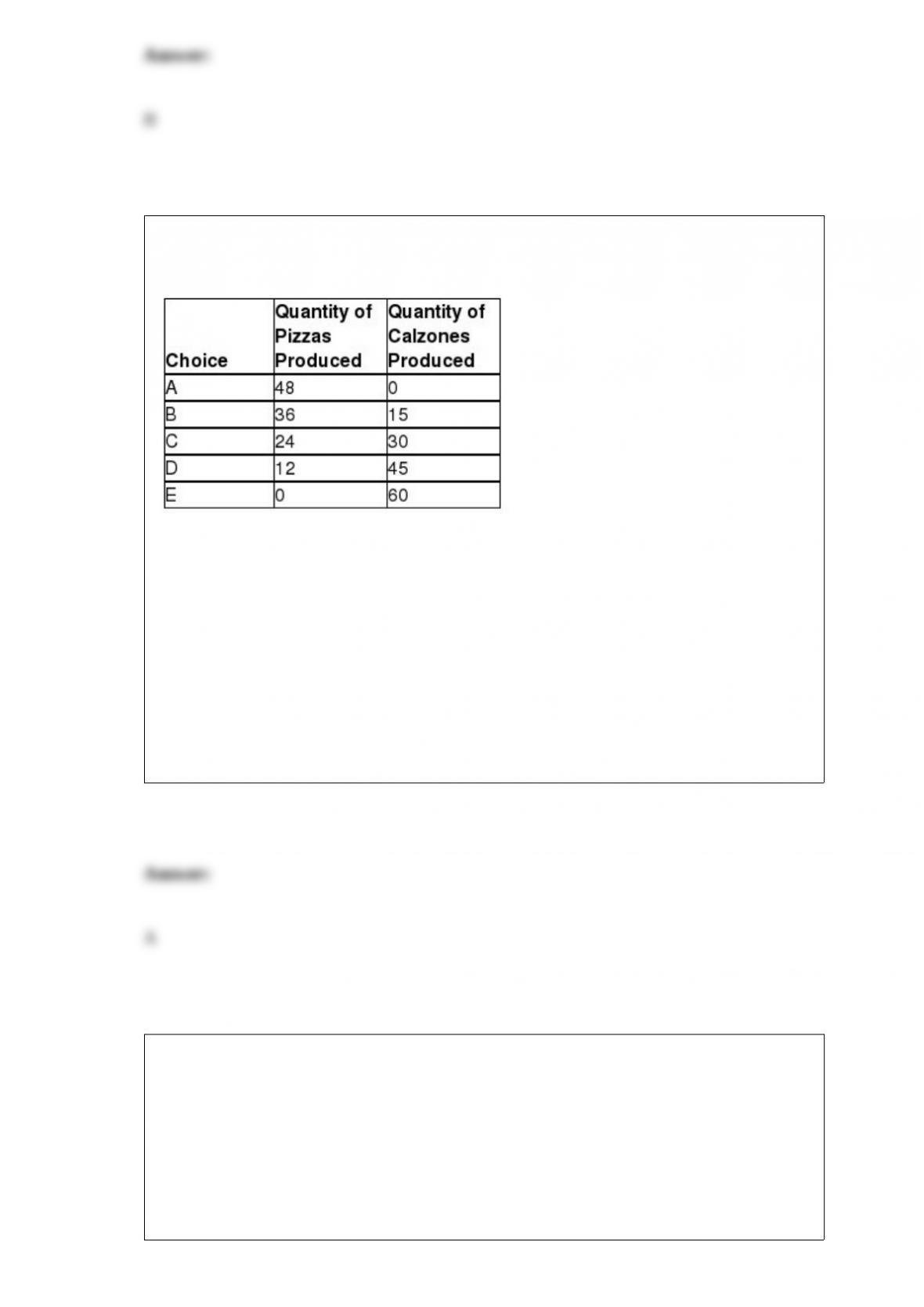
Table 2-1
Production choices for Tomaso’s Trattoria
Assume Tomaso’s Trattoria only produces pizzas and calzones. A combination of 24
pizzas and 30 calzones would appear
A) along Tomaso’s production possibilities frontier.
B) inside Tomaso’s production possibilities frontier.
C) outside Tomaso’s production possibilities frontier.
D) at the horizontal intercept of Tomaso’s production possibilities frontier.
Between 2013 and 2014, the CPI of a small nation rose from 182 to 185. If household
incomes rose by 3% during that period of time, which of the following is true?
A) The purchasing power of household income rose between 2013 and 2014.
B) The purchasing power of household income fell between 2013 and 2014.
C) The purchasing power of household income remained constant between 2013 and

2014.
D) The CPI cannot be used to determine how the purchasing power of household
income changes over time.
An asset is
A) anything of value owned by a person or a firm.
B) a payment by a corporation to its shareholders.
C) a nonmonetary opportunity cost.
D) anything owed by a person or a firm.
In October 2013, General Motors (GM) posted a price-earnings ratio of 10.13. If the
price of the stock at that time was $36 per share, which of the following must have been
true?
A) GM’s revenues that month were $364.68 million.
B) GM’s earnings per share was $3.55.
C) GM’s coupon payment was $36 per year.
D) GM’s dividend yield for the year was 36.5%.
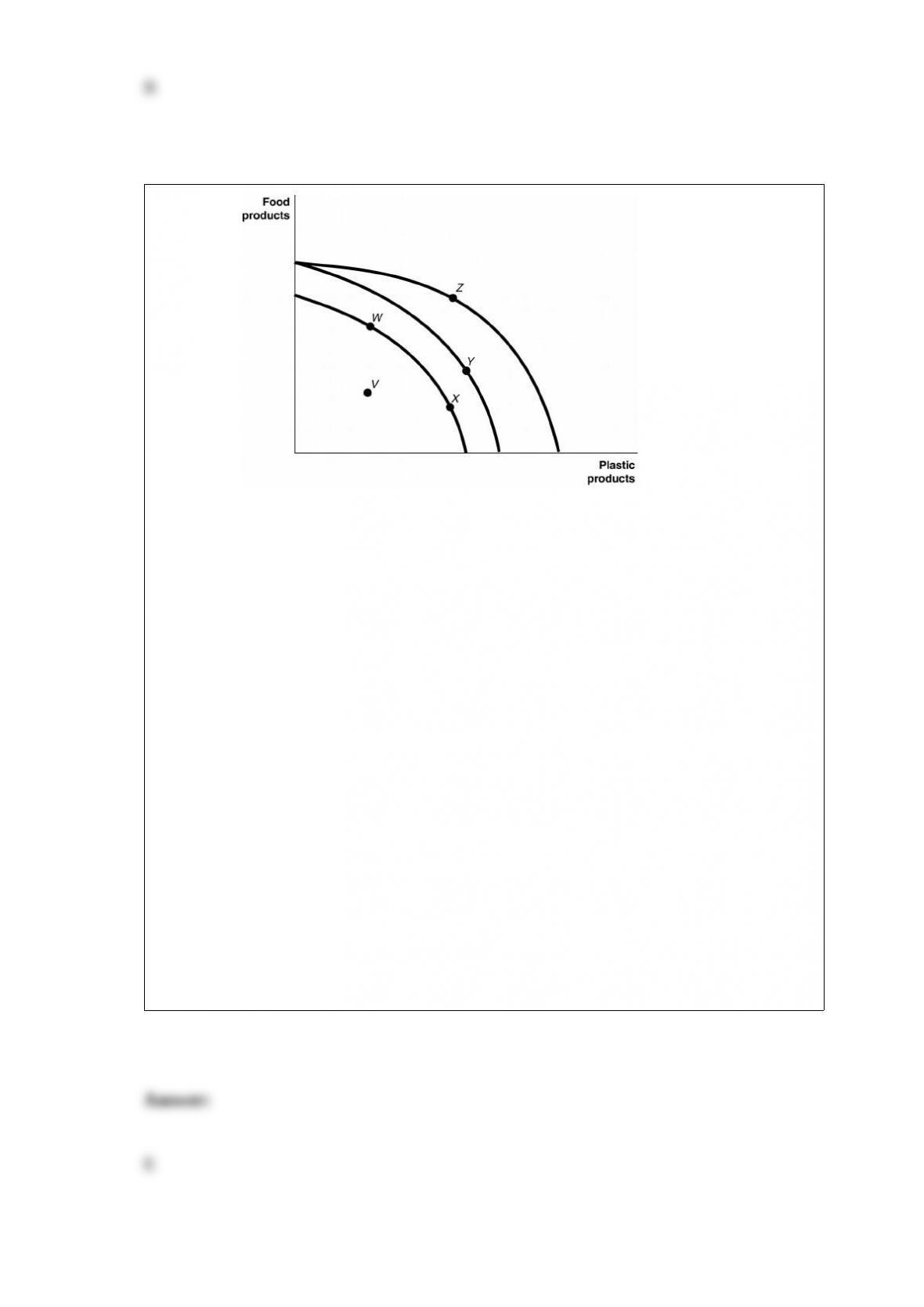
Figure 2-4
Figure 2-4 shows various points on three Different production possibilities frontiers for
a nation.
Consider the following events:
a. a decrease in the unemployment rate
b. an increase in a nation’s money supply
c. an influx of immigrant workers Which of the events listed above could cause a
movement from X to Z?
A) a, b and c
B) a and b only
C) a and c only
D) a only
E) c only

All of the following can be used to compute average profit except
A) marginal profit minus marginal cost.
B) total profit divided by quantity.
C) average revenue minus average total cost
D) price minus average total cost.
If the market price is $40 in a perfectly competitive market, the marginal revenue from
selling the fifth unit is
A) $8.
B) $20.
C) $40.
D) $200.
You are given the following market data for Venus automobiles in Saturnia.
Demand: P = 35,000 – 0.5Q
Supply: P = 8,000 + 0.25Q
where P = Price and Q = Quantity. a. Calculate the equilibrium price and quantity.
b. Calculate the consumer surplus in this market.

c. Calculate the producer surplus in this market.