
1) Hiring the least-costly combination of resources ensures that profits will be
maximized.
2) public goods are characterized by nonrivalry and nonexcludability.
3) The higher the interest rate, the larger will be the amount of money demanded for
transaction purposes.
4) a market that is achieving allocative efficiency must also be achieving productive
efficiency.
5) If government decreases its purchases by $20 billion and the MPC is 0.8, equilibrium
GDP will decrease by $100 billion.
6) The paradox of voting is that under majority voting rules the median-voter decides
the election outcome.
7) supply refers to the amount of a product that a producer will offer in the market at
some particular price.

8) illegal immigrants overall contribute more in taxes than they receive in services from
state and local governments.
9) Monetarists say that fiscal policy, such as a tax cut, will only affect the level of real
GDP if it entails a change in the supply of money.
10) economic growth can be shown as a movement from a point on one production
possibility curve to a point on a curve located farther from the origin.
11) Statistical discrimination is also known as occupational discrimination.
12) The “real” factors in the real-business cycle theory include resource availability and
technology.
13) The equilibrium price level and level of real output occur where:
A.real output is at its highest possible level.
B.export equal imports.
C.the price level is at its lowest level.
D.the aggregate demand and supply curves intersect.
14) Plastic cards that contain computer chips that store account balances are known as:
A.credit cards.
B.smart cards.
C.debit cards.
D.E-cards.
15) A decrease in aggregate demand will cause a greater decline in real output the:
A.less flexible is the economy’s price level.
B.more flexible is the economy’s price level.
C.steeper is the economy’s AS curve.
D.larger is the economy’s marginal propensity to save.
16) rivalry and excludability are the main characteristics of:
a.capital goods.
b.private goods.
c.public goods.
d.consumption goods.
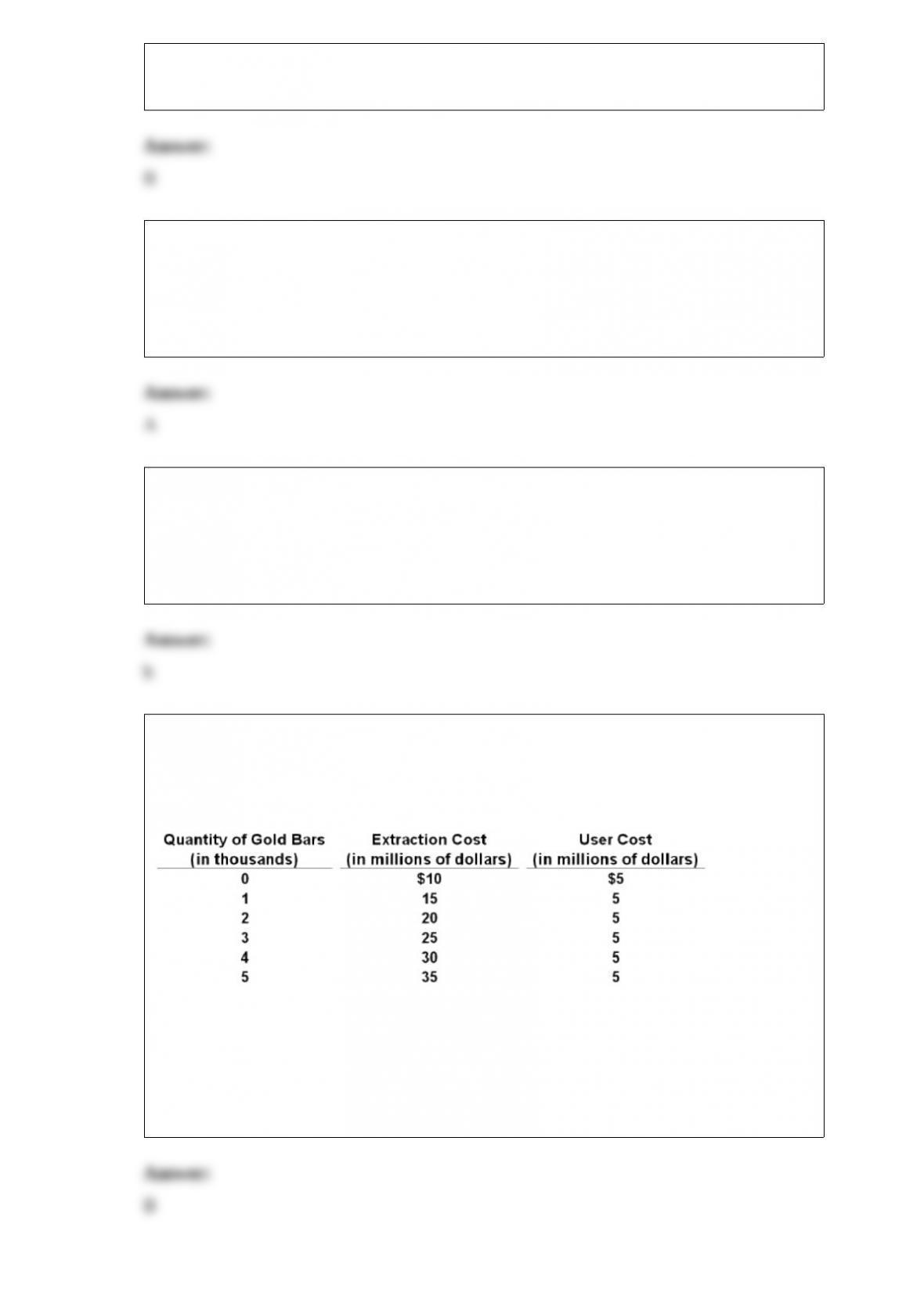
17) The table below shows the quantity of gold bars (Qb) in thousands, the extraction
cost for each thousand bars (in millions of dollars), and user cost of each thousand bars
(in millions of dollars) facing the OZ Mining Company this year.
If the price of a bar of gold is $30,000 this year, how many bars (in thousands) should
OZ extract and sell?
A.2
B.3
C.4
D.5
18) A basic criticism of supply-side economics is that:
A.empirical research clearly shows that incentives to work and invest vary directly with
marginal tax rates.
B.lower taxes will increase aggregate supply much more than they will increase
aggregate demand.
C.lower taxes will increase aggregate demand much more than they will increase
aggregate supply.
D.higher taxes will reduce incentives to work, invest, and innovate.
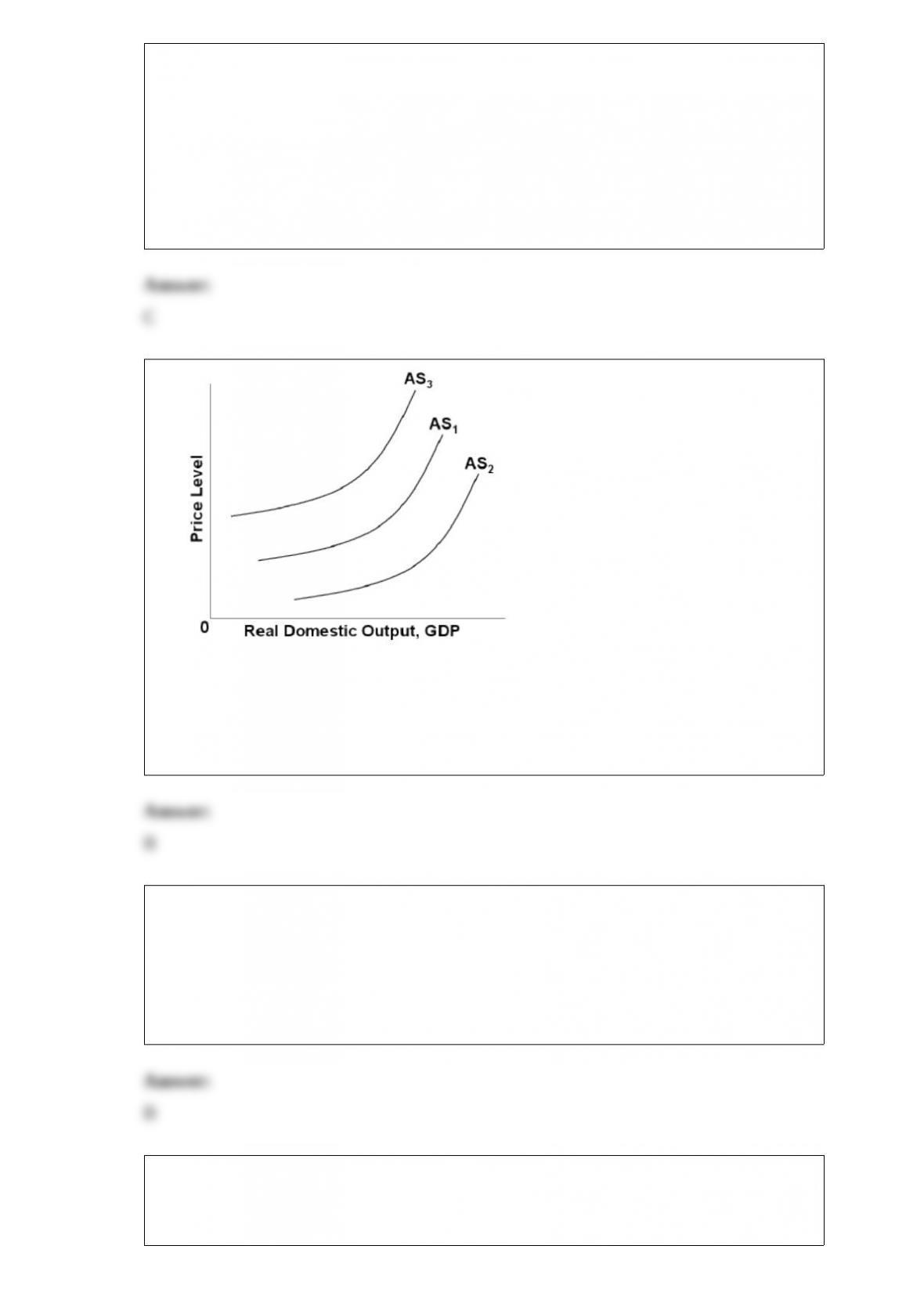
19)
In the above diagram, a shift from AS1 to AS3might be caused by a(n):
A.increase in productivity.
B.increase in the prices of imported resources.
C.decrease in the prices of domestic resources.
D.decrease in business taxes.
20) Many countries remain poor because they currently are poor. This statement
summarizes the:
A.infrastructure problem.
B.vicious circle of poverty.
C.capricious universe view.
D.problem of capital flight.
21) setup corporation buys $100,000 of sand, rock, and cement to produce ready-mix
concrete. it sells 10,000 cubic yards of concrete at $30 a cubic yard. the value added by
setup corporation is:
a.$300,000.
b.$100,000.
c.$200,000.
d.zero dollars.
22) determine, other things equal, the effects of a given change in a determinant of
demand or supply for product x upon (1) the demand (d) for, or supply (s) of, x, (2) the
equilibrium price (p) of x and (3) the equilibrium quantity (q) of x.
refer to the above. a reduction in the number of firms producing x will:
a.increase d, increase p, and increase q.
b.increase s, decrease p, and increase q.
c.decrease s, increase p, and decrease q.
d.decrease s, decrease p, and increase q.
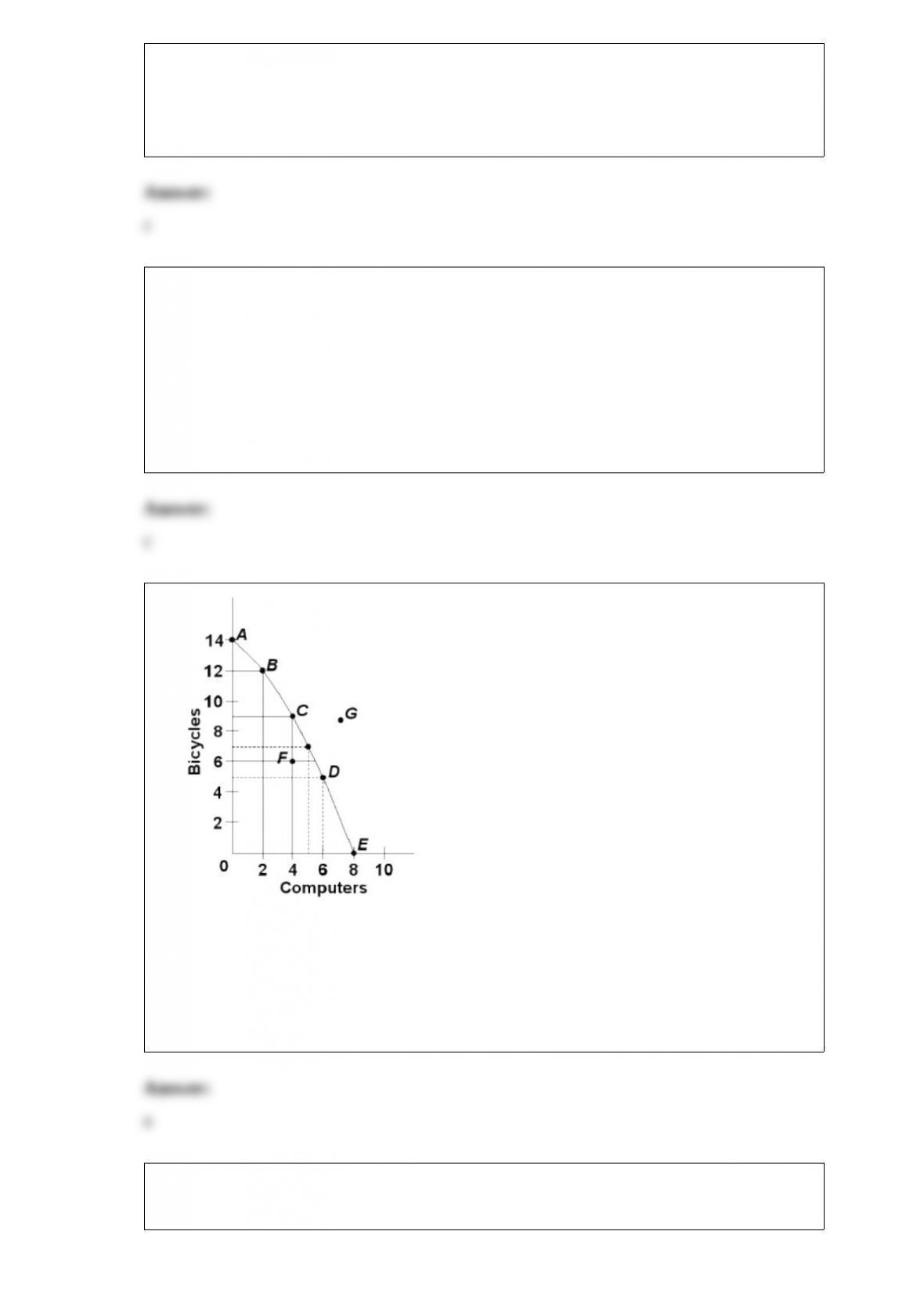
23)
refer to the above diagram. if society is currently producing 9 units of bicycles and 4
units of computers and it now decides to increase computer output to 6, the cost:
a.will be 4 units of bicycles.
b.will be 2 units of bicycles.
c.will be zero because unemployed resources are available.
d.of doing so cannot be determined from the information given.
24) What do wages and wage rates mean in economics? How do they differ from labor
earnings?
25) Describe two reasons why businesses hesitate to change prices.
26) Offer a skeptical perspective on the long-term economics of the recent productivity
acceleration.
27) What are the sources of increasing returns and economies of scale of the recent
productivity acceleration experienced in the U.S.?
28) Explain how market failures such as the lack of property rights affect extraction of
resources by business firms.
29) Use the features of the competitive model to explain why the entry of generic drugs
can reduce the price of a medication by 30 to 40 percent.
30) Define the four basic types of trade barriers.
31) Assuming the basic purpose is to raise additional revenue, should government levy
an excise tax on cigarettes whose demand is highly inelastic or on a product whose
demand is highly elastic? Are there any other reasons to levy such a tax?
32) (Consider This) Use a pizza pie analogy to discuss the tradeoff between income
equality and economic efficiency.