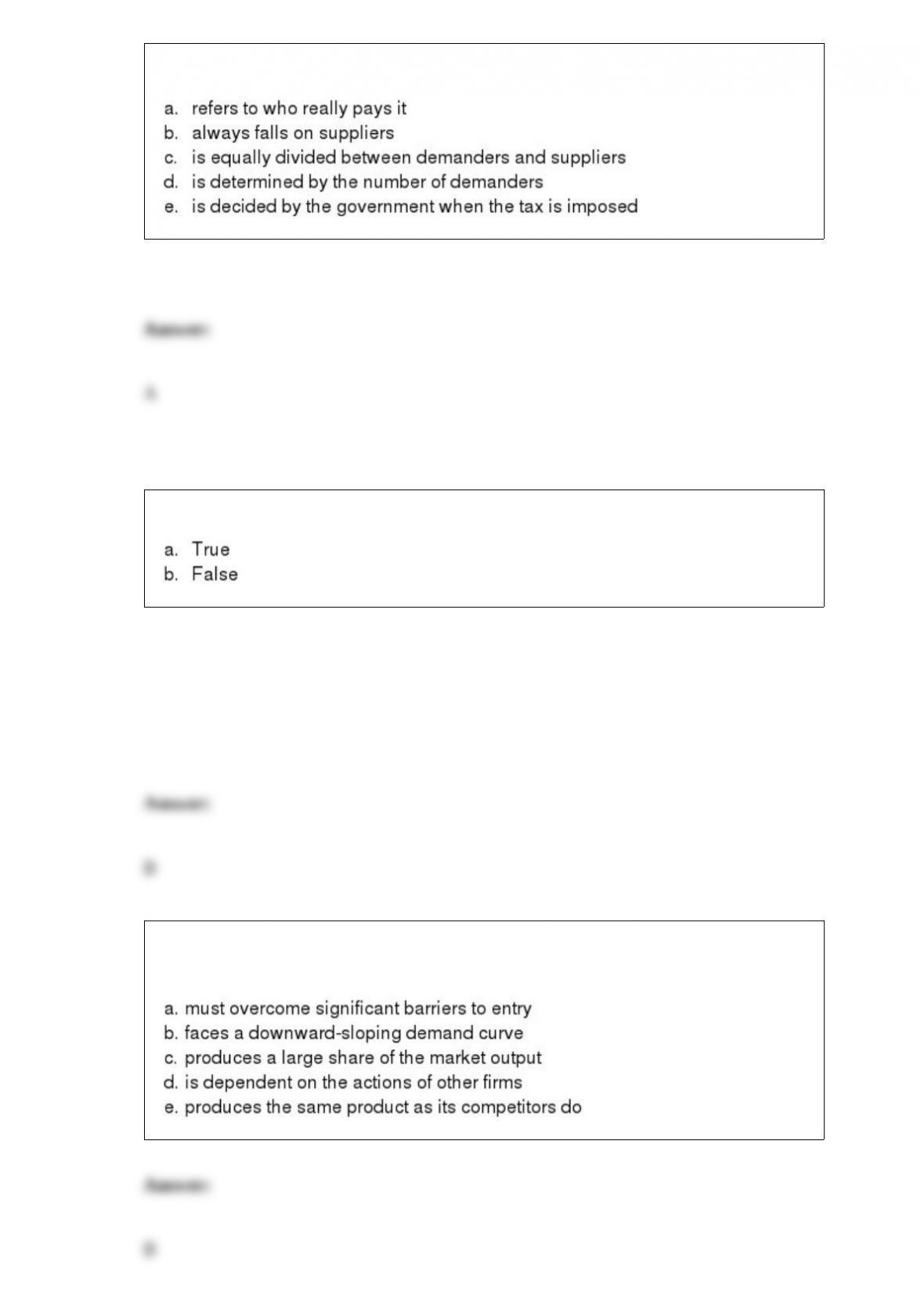
The incidence of an excise tax
A bank can only fail if it is not in good financial health.
A firm in a monopolistically competitive market is similar to a monopolist in the sense
that it

We expect a rise in transfer payments when
a. the needs of the poor receive more publicity
b. taxes rise
c. GDP rises and inflation soars
d. the retirement age remains unchanged over time
e. recessions occur
An example of a capital good is
a. food produced by U.S. farmers in 2008
b. the car that your friend drives to school
c. a house owned and occupied by a family
d. the rent your friend paid last year for a college apartment
e. a share of General Electric Company stock
A financial institution’s leverage ratio is defined as:
a. Profit / Revenue.
b. Total Assets / Shareholders’ Equity.
c. Shareholders’ Equity / Total Assets.
d. Value of Delinquent Loans / Value of All Loans.
e. Total Debt / Total Revenue.

Suppose the marginal propensity to consume is 0.80 and equilibrium GDP resulting
from a change in investment spending falls by -$500 billion. What must have been the
initial change in investment spending
a. $100 billion
b. -$100 billion
c. $500 billion
d. -$500 billion
e. -$400 billion
If income increases by $10,000, government purchases are fixed at $1,000, investment
spending is fixed at $2,000, net exports are fixed at $500, and the marginal propensity
to consume is 0.70, by how much does aggregate expenditure increase?
a. $700
b. $2,000
c. $7,000
d. $1,000
e. $1,400
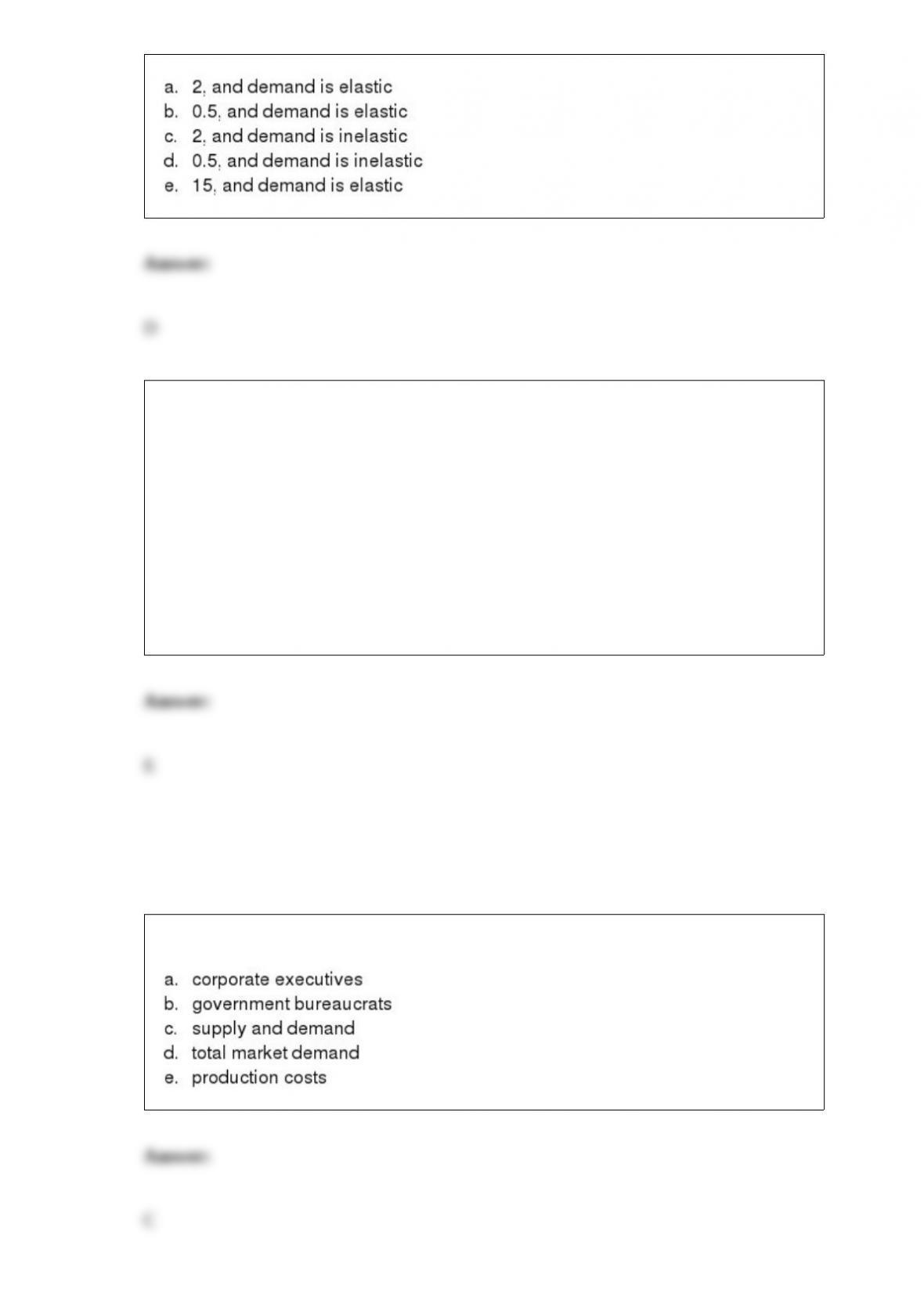
If the price of food falls by 10 percent and the quantity sold increases by 5 percent, then
the price elasticity of demand in that range equals
As the economy goes through an expansion,
a. fluctuations in GDP become more severe
b. unemployment finally stabilizes
c. investment stabilizes
d. the classical model becomes a better predictor
e. unemployment falls.
In a market system, prices are determined by

Everything else equal, an increase in the demand for labor will
a. increase the real wage rate, employment, and real output
b. reduce the real wage rate, employment, and real output
c. increase the real wage rate but decrease employment and real output
d. reduce the real wage rate but increase employment and real output
e. increase the real wage rate and employment, but leave real output unchanged