
When a binding price ceiling is imposed on a market,
a. price no longer serves as a rationing device.
b. the quantity supplied at the price ceiling exceeds the quantity that would have been
supplied without the price ceiling.
c. all buyers benefit.
d. All of the above are correct.
Four years ago Ollie deposited some money into an account. He earned 5 percent
interest on this account and now it has a balance of $303.88. About how much money
did Ollie deposit into his account when he opened it?
a. $210
b. $220
c. $240
d. $250
A country has $30 billion of domestic investment and net capital outflows of -$20
billion. What is the country’s saving?
a. -$50 billion

b. -$10 billion
c. $10 billion
d. $50 billion
Other things the same, continued increases in technology lead to
a. continued increases in the price level and real GDP.
b. continued increases in the price level but not continued increases in real GDP.
c. continued increases in real GDP but not continued increases in the price level.
d. None of the above are correct.
Other things equal, the deadweight loss of a tax
a. decreases as the size of the tax increases.
b. increases as the size of the tax increases, but the increase in the deadweight loss is
less rapid than the increase in the size of the tax.
c. increases as the size of the tax increases, and the increase in the deadweight loss is
more rapid than the increase in the size of the tax.
d. increases as the price elasticities of demand and/or supply increase, but the
deadweight loss does not change as the size of the tax increases.
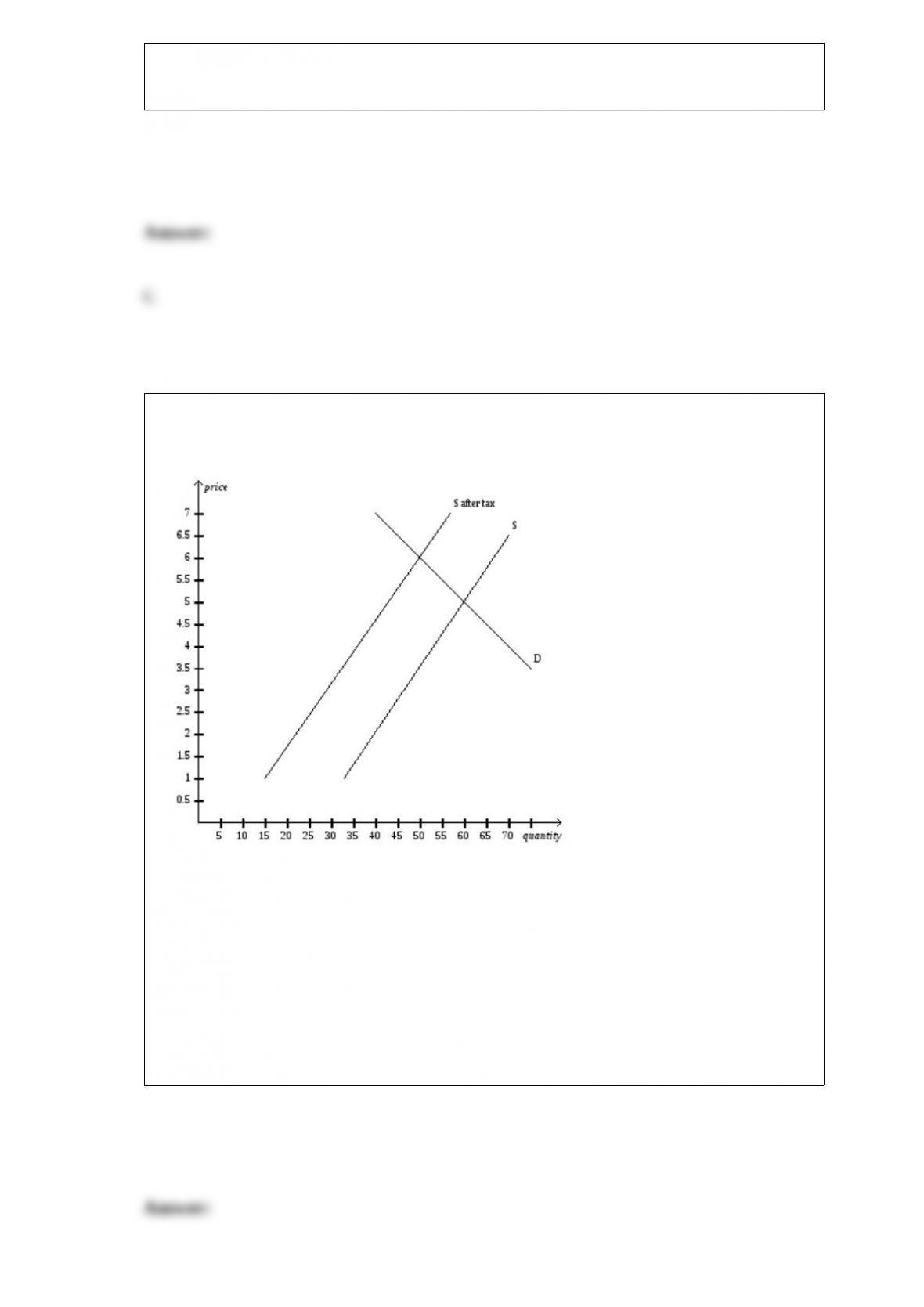
Figure 6-18
Refer to Figure 6-18. The price paid by buyers after the tax is imposed is
a. $2.50.
b. $3.50.
c. $5.00.
d. $6.00.

Demand is said to be unit elastic if quantity demanded
a. changes by the same percent as the price.
b. changes by a larger percent than the price.
c. changes by a smaller percent than the price.
d. does not respond to a change in price.
In a certain economy, when income is $100, consumer spending is $60. The value of the
multiplier for this economy is 3. It follows that, when income is $101, consumer
spending is
a. $60.60.
b. $60.67.
c. $61.33.
d. $63.00.

Ralph Nader’s book Unsafe at Any Speed caused Congress to require
a. safety glass in all new cars.
b. seat belts in all new cars.
c. air bags in all new cars.
d. stricter drunk driving laws in all states.
Microeconomics is the study of
a. how money affects the economy.
b. how individual households and firms make decisions.
c. how government affects the economy.
d. how the economy as a whole works.
Figure 4-22
Panel (a) Panel (b)
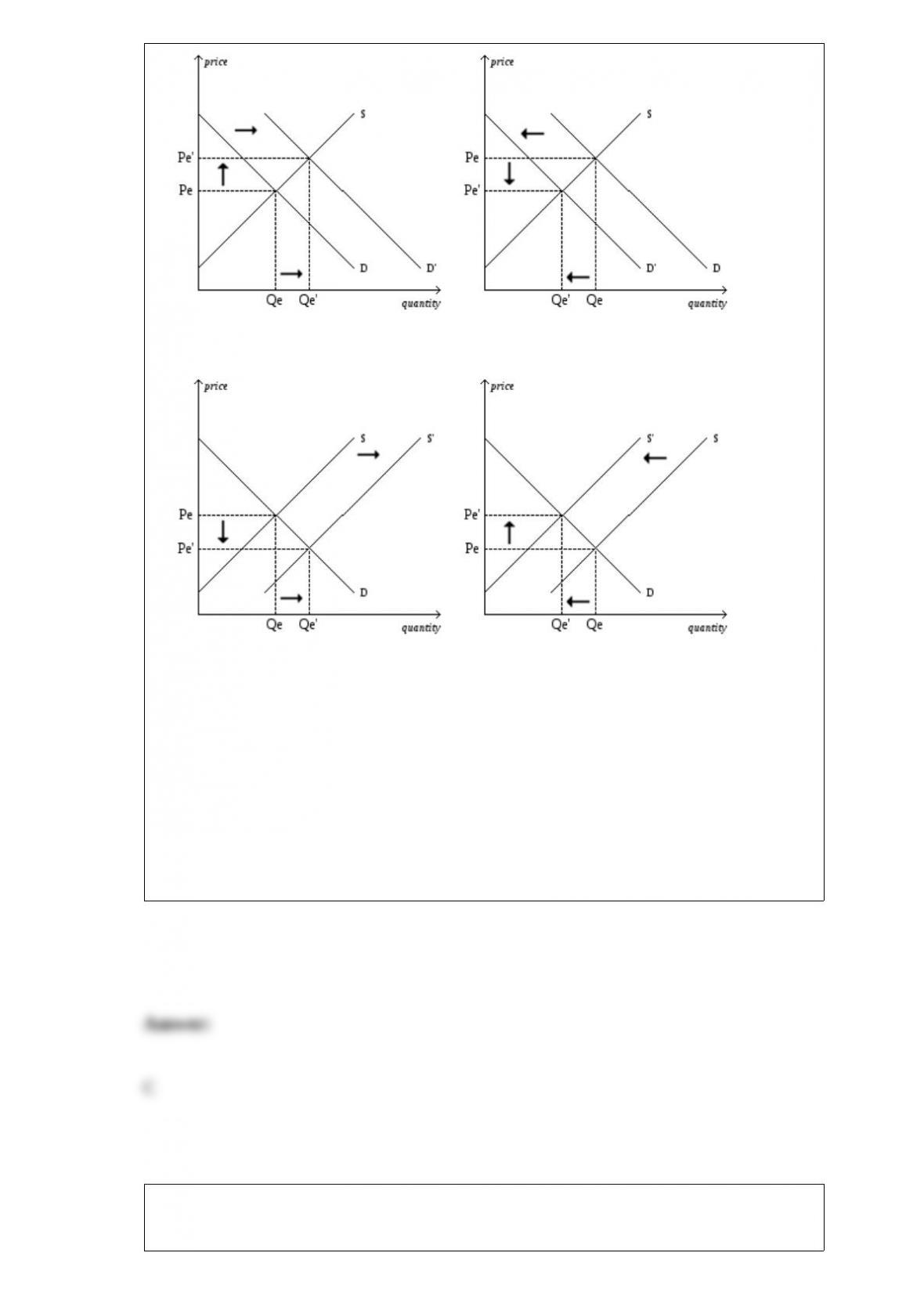
Panel (c) Panel (d)
Refer to Figure 4-22. Which of the four panels illustrates an increase in quantity
demanded?
a. Panel (a)
b. Panel (b)
c. Panel (c)
d. Panel (d)
Which of the following is not correct?

a. If the inflation rate exceeds the nominal interest rate, then the purchasing power of an
interest-earning deposit falls over time.
b. If there is deflation, then the purchasing power of an interest-earning deposit rises by
more than the nominal interest rate over time.
c. The higher the rate of inflation, the smaller the increase in the purchasing power of an
interest-earning deposit.
d. The purchasing power of an interest-earning deposit can increase or decrease over
time, but it cannot stay the same.
When the Fed conducts open-market sales,
a. it sells Treasury securities, which increases the money supply.
b. it sells Treasury securities, which decreases the money supply.
c. it auctions term loans, which increases the money supply.
d. it auctions term loans, which decreases the money supply.
Allen Steel Company is considering whether to build a new mill. If the interest rate
rises,
a. the present value of the returns from the mill will fall, so Allen will be less likely to
build the mill.

b. the present value of the returns from the mill will fall, so Allen will be more likely to
build the mill.
c. the present value of the returns from the mill will rise, so Allen will be less likely to
build the mill.
d. the present value of the returns from the mill will rise, so Allen will be more likely to
build the mill.
The Economy in 2008
In the first half of June 2008 the effects of a housing and financial crisis and an increase
in world prices of oil and foodstuffs were affecting the economy.
Refer to The Economy in 2008. In the short-run the effects of the housing and
financial crises
a. raise both inflation and the unemployment rate.
b. raise the inflation rate and reduce the unemployment rate.
c. reduce the inflation rate and raise the unemployment rate.
d. reduce both the inflation rate and the unemployment rate.
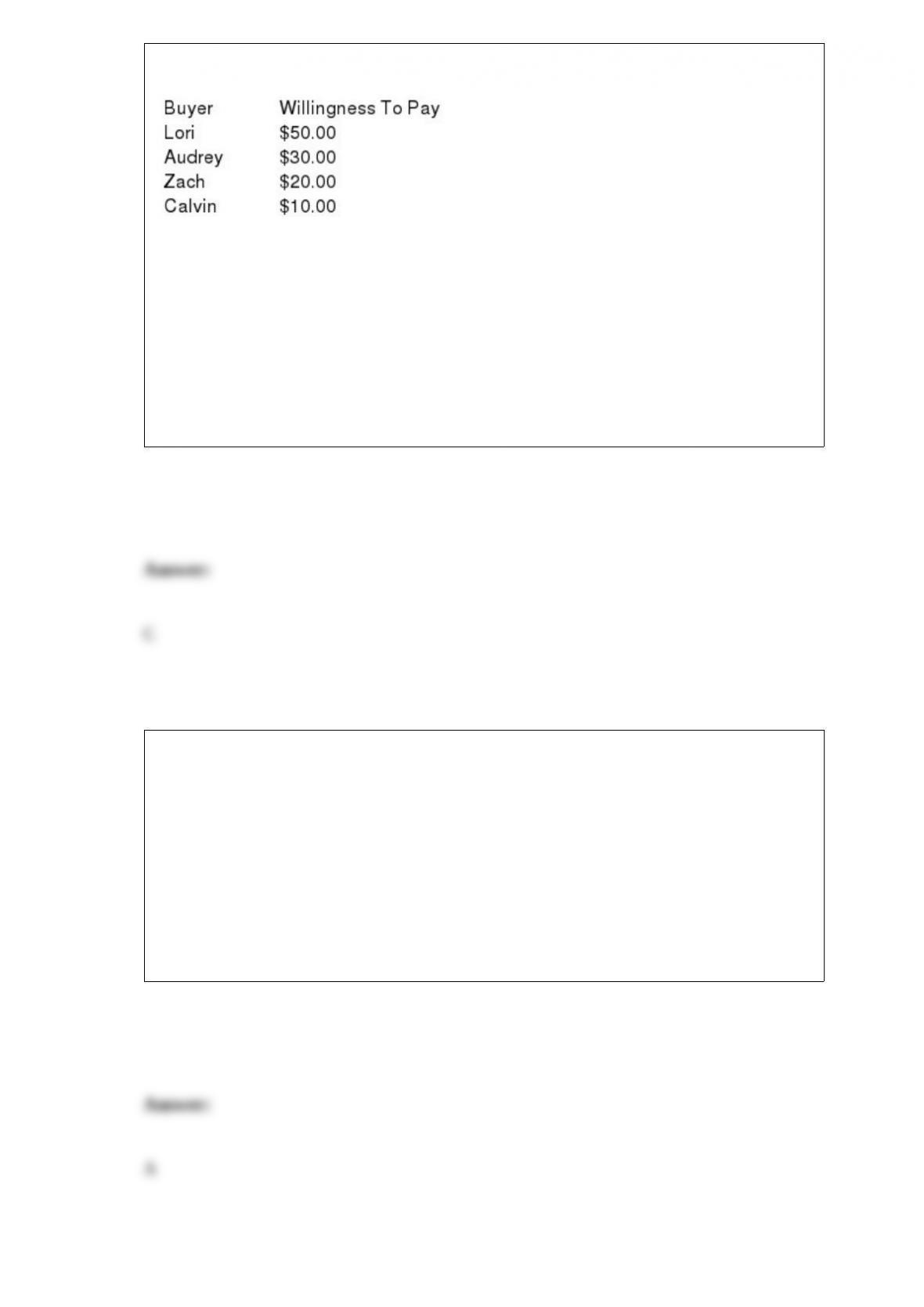
Table 7-1
Refer to Table 7-1. If price of the product is $30, then the total consumer surplus is
a. $-10.
b. $-6.
c. $20.
d. $30.
If the reserve requirement is 10 percent and banks desire to hold no excess reserves,
when a bank receives a new deposit of $100,
a. it must increase its required reserves by $10.
b. its total reserves initially increase by $10.
c. it will be able to make new loans up to a maximum of $10.
d. None of the above is correct.
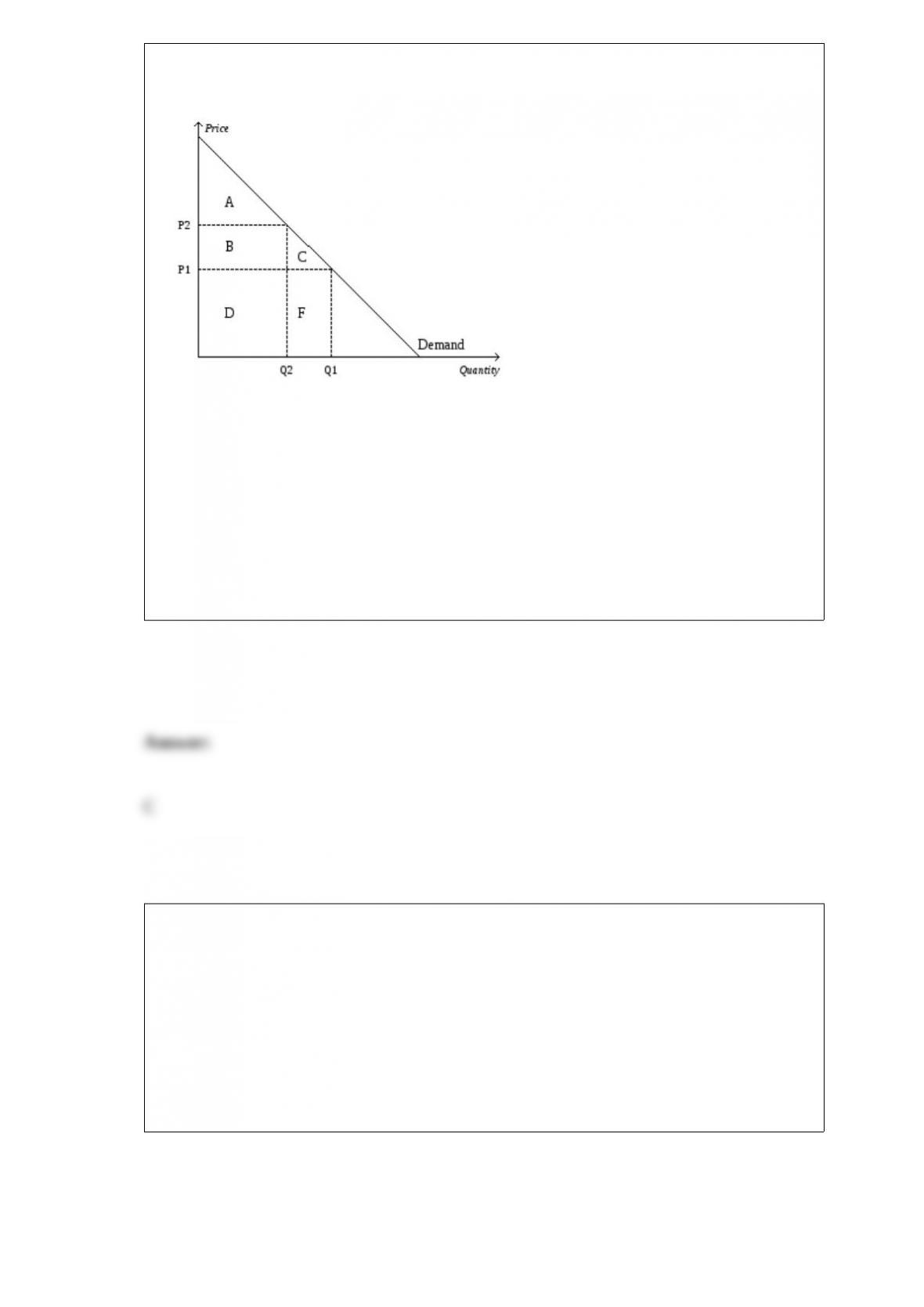
Figure 7-2
Refer to Figure 7-2. When the price is P1, consumer surplus is
a. A.
b. A+B.
c. A+B+C.
d. A+B+D.
A large and sudden movement of funds out of a country is called
a. arbitrage.
b. capital flight.
c. crowding out.
d. capital mobility.

If a tax is levied on the sellers of a product, then the supply curve will
a. shift up.
b. shift down.
c. become flatter.
d. not shift.
If Congress instituted an investment tax credit, the interest rate would
a. rise and saving would rise.
b. fall and saving would fall.
c. rise and saving would fall.
d. fall and saving would rise.

Suppose there is a surplus in the money market.
a. This could have been created by an increase in the money supply. The value of
money will rise.
b. This could have been created by an increase in the money supply. The value of
money will fall.
c. This could have been created by a decrease in the money supply. The value of money
will rise.
d. This could have been created by a decrease in the money supply. The value of money
will fall.
The present value of a future payment to be received in three years is $1,000. If the
interest rate is 5%, what is the amount that will be paid in three years?
a. $1,150.00
b. $1,157.63
c. $1,215.51
d. $1,250.00
The efficient markets hypothesis implies that

a. building a portfolio based on a published list of the “most respected” companies is
likely to produce a better-than-average return.
b. if a stock rose in price last year, it is likely to rise in price this year.
c. managed mutual funds should generally outperform indexed mutual funds.
d. None of the above are correct.
How is the burden of a tax divided?
(i) When the tax is levied on the sellers, the sellers bear a higher proportion of the tax
burden.
(ii) When the tax is levied on the buyers, the buyers bear a higher proportion of the tax
burden.
(iii) Regardless of whether the tax is levied on the buyers or the sellers, the buyers and
sellers bear an equal proportion of the tax burden.
(iv) Regardless of whether the tax is levied on the buyers or the sellers, the buyers and
sellers bear some proportion of the tax burden.
a. (i) and (ii) only
b. (iv) only
c. (i), (ii), and (iii) only
d. (i), (ii), and (iv) only

Total revenue will be at its largest value on a linear demand curve at the
a. top of the curve, where prices are highest.
b. midpoint of the curve.
c. low end of the curve, where quantity demanded is highest.
d. None of the above is correct.
Minimum-wage laws dictate
a. the exact wage that firms must pay workers.
b. a maximum wage that firms may pay workers.
c. a minimum wage that firms may pay workers.
d. both a minimum wage and a maximum wage that firms may pay workers.
Which of the following is true?
a. Efficiency refers to the size of the economic pie; equality refers to how the pie is
divided.

b. Government policies usually improve upon both equality and efficiency.
c. As long as the economic pie continually gets larger, no one will have to go hungry.
d. Efficiency and equality can both be achieved if the economic pie is cut into equal
pieces.
Other things the same, as the price level decreases it induces greater spending on
a. both net exports and investment.
b. net exports but not investment.
c. investment but not net exports.
d. neither net exports nor investment.
If in some year real GDP was $5 trillion and the GDP deflator was 200, what was
nominal GDP?
a. $2.5 trillion
b. $10 trillion
c. $40 trillion
d. $100 trillion

Which of the following events could explain an increase in interest rates together with
an increase in investment?
a. The government runs a larger deficit.
b. The government institutes an investment tax credit.
c. The government replaces the income tax with a consumption tax.
d. None of the above is correct.
Table 10-1
The table below contains data for country A for the year 2010.
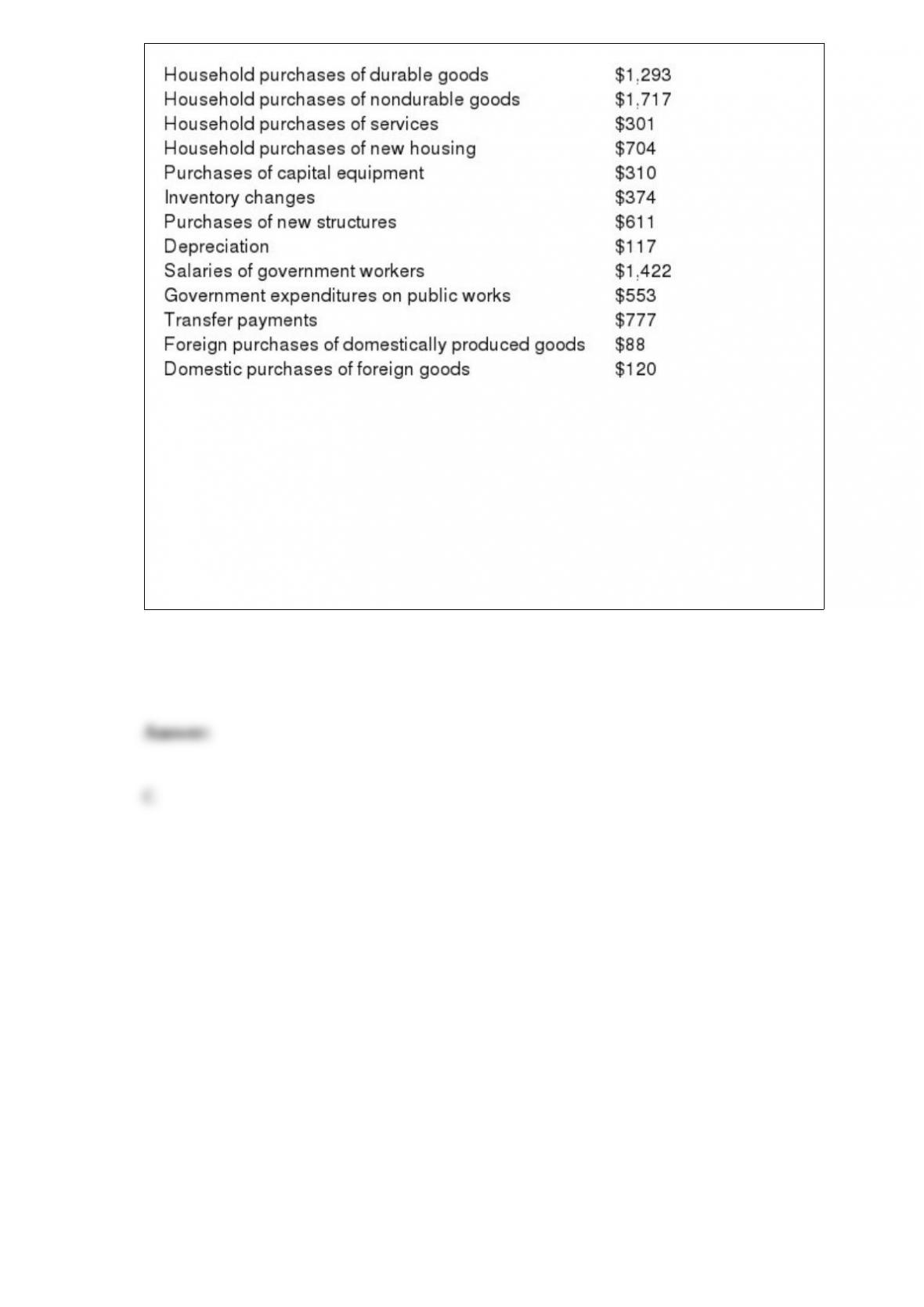
Refer to Table 10-1. What was country A’s GDP in 2010?
a. $6359
b. $7136
c. $7253
d. $8147