1) the united states was less open to international trade between:
a.1890 and 1910
b.1930 and 1950
c.1890 and 1950
d.1950 and 2013
2) in response to the international debt problem, the united states set up a special fund
in 1986 to help make up for lost oil revenues. under the plan, the united states would
make more money available as world oil prices fell. this plan was designed to help:
a.argentina
b.saudi arabia
c.mexico
d.brazil
3) a country with a high debt/export ratio and a high debt service/export ratio would
likely be considered as an attractive place in which to invest by foreign residents.
a.true
b.false
4) important trading partners of the united states include canada, mexico, japan, and
china.
a.true
b.false
5) as an economy opens up to international trade, domestic prices:
a.become lower
b.become more aligned with international prices
c.stabilize
d.none of the above; what will happen cannot be predicted
6) if bank of america receives repayment for a loan it made to a mexican firm, the u.s.
capital account would register an inflow.
a.true
b.false
7) the monetary approach contends that, under a fixed exchange rate system, policies
that increase the supply of money relative to the demand for money lead to a trade
surplus.
a.true
b.false
8) when a nation requires fewer resources than another nation to produce a product, the
nation is said to have a:
a.absolute advantage in the production of the product
b.comparative advantage in the production of the product
c.lower marginal rate of transformation for the product
d.lower opportunity cost of producing the product
9) figure 2.2 illustrates trade data for canada. the figure assumes that canada attains
international trade equilibrium at point c.
figure 2.2. canadian trade possibilities
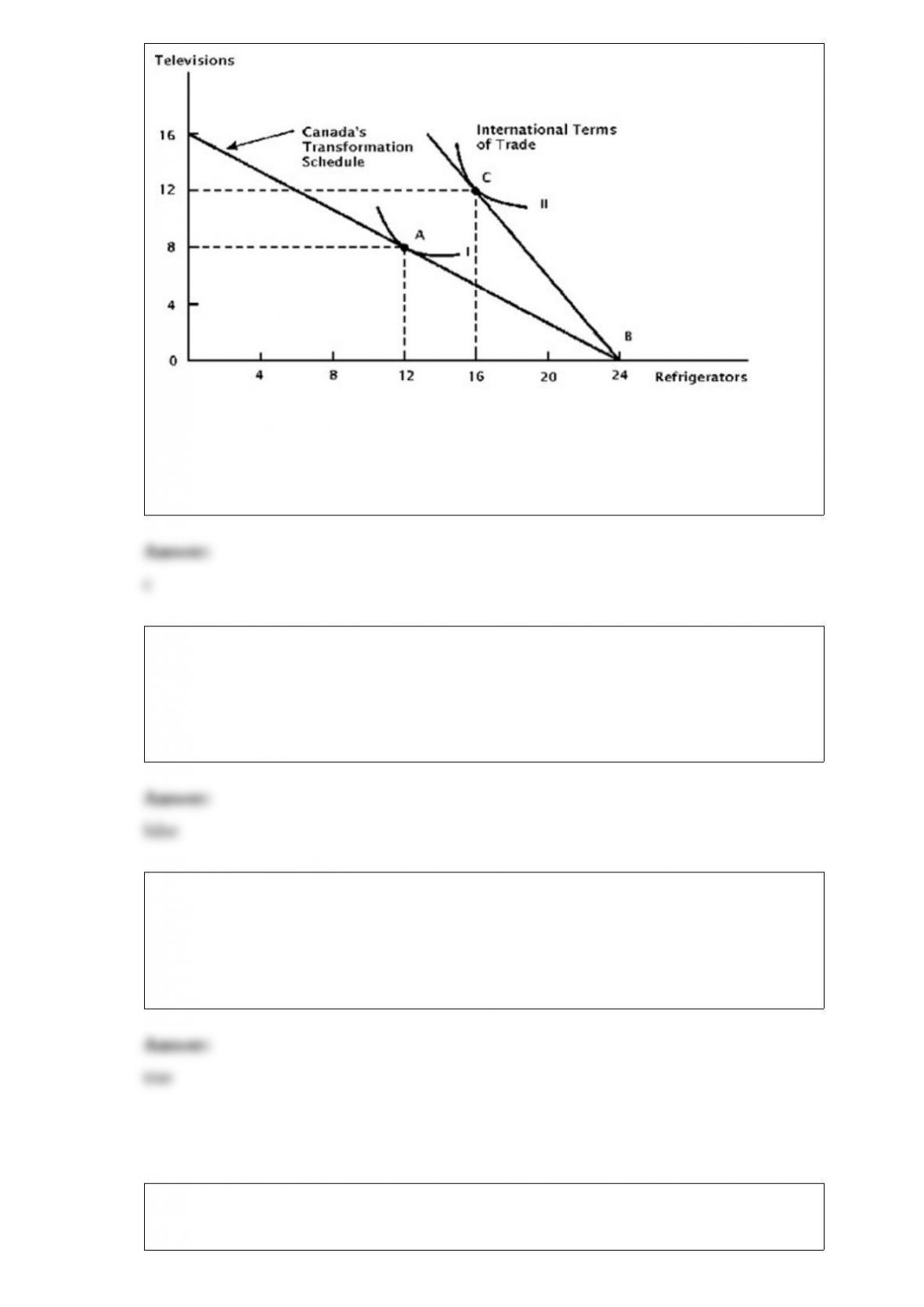
consider figure 2.2. in the absence of trade, canada would produce and consume:
a.8 televisions and 16 refrigerators
b.12 televisions and 16 refrigerators
c.8 televisions and 12 refrigerators
d.12 televisions and 8 refrigerators
10) although j. s. mill recognized that the region of mutually beneficial trade is bounded
by the cost ratios of two countries, it was not until david ricardo developed the theory of
reciprocal demand that the equilibrium terms of trade could be determined.
a.true
b.false
11) when cartel members agree to restrict output to increase the price of their product, a
single member of the cartel has an economic incentive to violate the agreement by
increasing its output so as to increase profits.
a.true
b.false
12) opening the economy to international trade tends to lessen inflationary pressures at
home.
a.true
b.false
13) according to researchers at the federal reserve, the loss of jobs associated with a
deficit in the current account tends to be:
a.offset by the increase of jobs associated with a surplus in the capital account
b.reinforced by the decrease of jobs associated with a surplus in the capital account
c.a threat to the level of employment for the economy as a whole
d.of no long-run economic consequence for workers who lose their jobs
14) an increase in the trade-weighted value of the dollar indicates a dollar appreciation
relative to the currencies of its major trading partners and a worsening of u.s.
international competitiveness.
a.true
b.false
15) if mexico dollarizes its economy, it essentially
a.allows the federal reserve to be its lender of last resort
b.accepts the monetary policy of the federal reserve
c.ensures that its business cycle was identical to that of the u.s.
d.abandons its ability to run governmental balanced budgets
16) because the ricardian theory of comparative advantage was based only on a nation’s
supply conditions, it could only determine the outer limits within which the equilibrium
terms of trade would lie.
a.true
b.false
17) during the 1980s and 1990s, the united states negotiated free-trade agreements with
israel, mexico, and canada.
a.true
b.false
18) in the balance-of-payments statement, statistical discrepancy is treated as part of the
merchandise trade account because merchandise transactions are generally the most
frequent source of error.
a.true
b.false