
Prior to the 1930s, the majority of dollars spent by government was spent at the state
and local levels.
Retained earnings are sufficient to finance a firm’s rapid expansion in a high-growth
economy.
The tax multiplier is calculated as “one minus the government purchases multiplier.”
The short-run supply curve for a perfectly competitive firm is that part of the firm’s
marginal cost curve that lies above the minimum point of its average variable cost
curve.

If the Gini coefficient for Cartland is 1, it means that income distribution is perfectly
equal in this society.
If consumers believe the price of hybrid vehicles will decrease in the future, this will
cause the demand for hybrid vehicles to decrease now.
Corporations are legally owned by their shareholders.
If production displays constant returns to scale, then all economies of scale have been
exhausted.

If some monopolistically competitive firms exit their market after suffering short-run
losses, the demand curves of remaining firms will shift to the right.
If marginal cost is above the average variable cost, then average variable cost is
decreasing.
One of the main sources of comparative advantage is internal economies.
If a country produces only two goods, it is possible to have an absolute advantage in the
production of both those goods.

If average total cost is falling marginal cost must also be falling.
The voting paradox suggests that the “voting market,” as represented by elections,
A) leads to a superior outcome in representing consumer preferences compared to the
private market for goods and services.
B) may often lead to an inefficient outcome in representing consumer preferences
compared to the private market for goods and services.
C) is no different from the private market for goods and services in terms of
representing consumer preferences.
D) may not lead to an efficient outcome but certainly leads to a more equitable outcome
in terms of distributing goods and services.
A firm will break even when
A) P = ATC.
B) P > ATC.
C) P < AVC.
D) P = AVC.

If the implied exchange rate between Big Mac prices in the United States and Poland is
2.13 zlotys per dollar, but the actual exchange rate between the United States and
Poland is 3.16 zlotys per dollar, which of the following would you expect to see?
A) an appreciation of the dollar
B) an increase in the demand for zlotys
C) an increase in the demand for dollars
D) Both A and C are correct.
The proponents of rational expectations and monetarism think that the Federal Reserve
should adopt
A) an inflation target.
B) a monetary aggregate target.
C) a constant monetary growth rule.
D) an interest rate target.
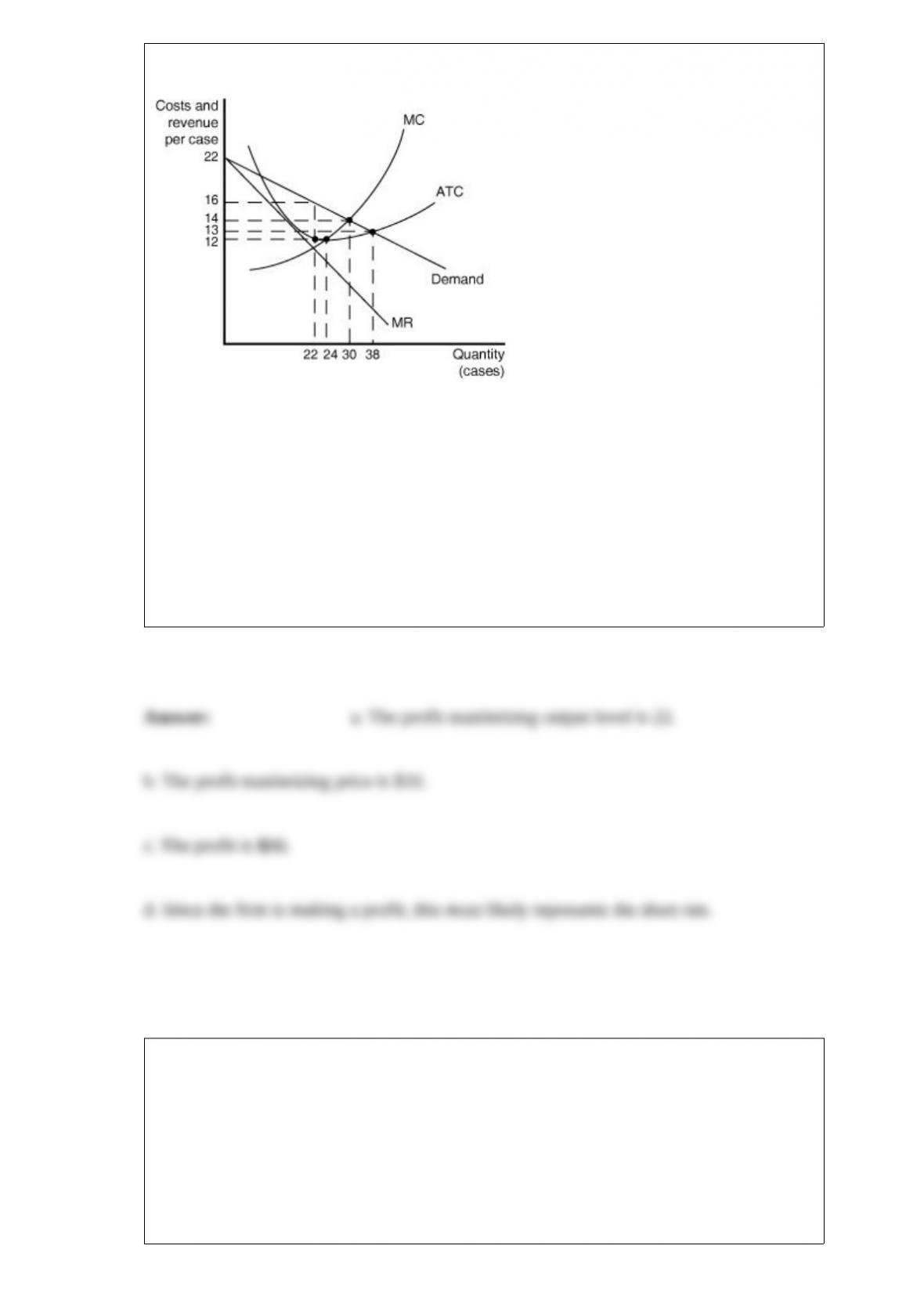
Figure 13-10
Figure 13-10 shows cost and demand
curves for a monopolistically competitive producer of iced tea.
Answer the following questions.
a. What is the profit-maximizing output level?
b. What is the profit-maximizing price?
c. At the profit-maximizing output level, how much profit will be realized?
d. Does this graph most likely represent the long run or the short run? Why?
The United States abandoned the ________ because the government wanted to rapidly
expand the money supply in response to the Great Depression.
A) gold standard
B) Bretton Woods system
C) managed float
D) floating exchange rate system
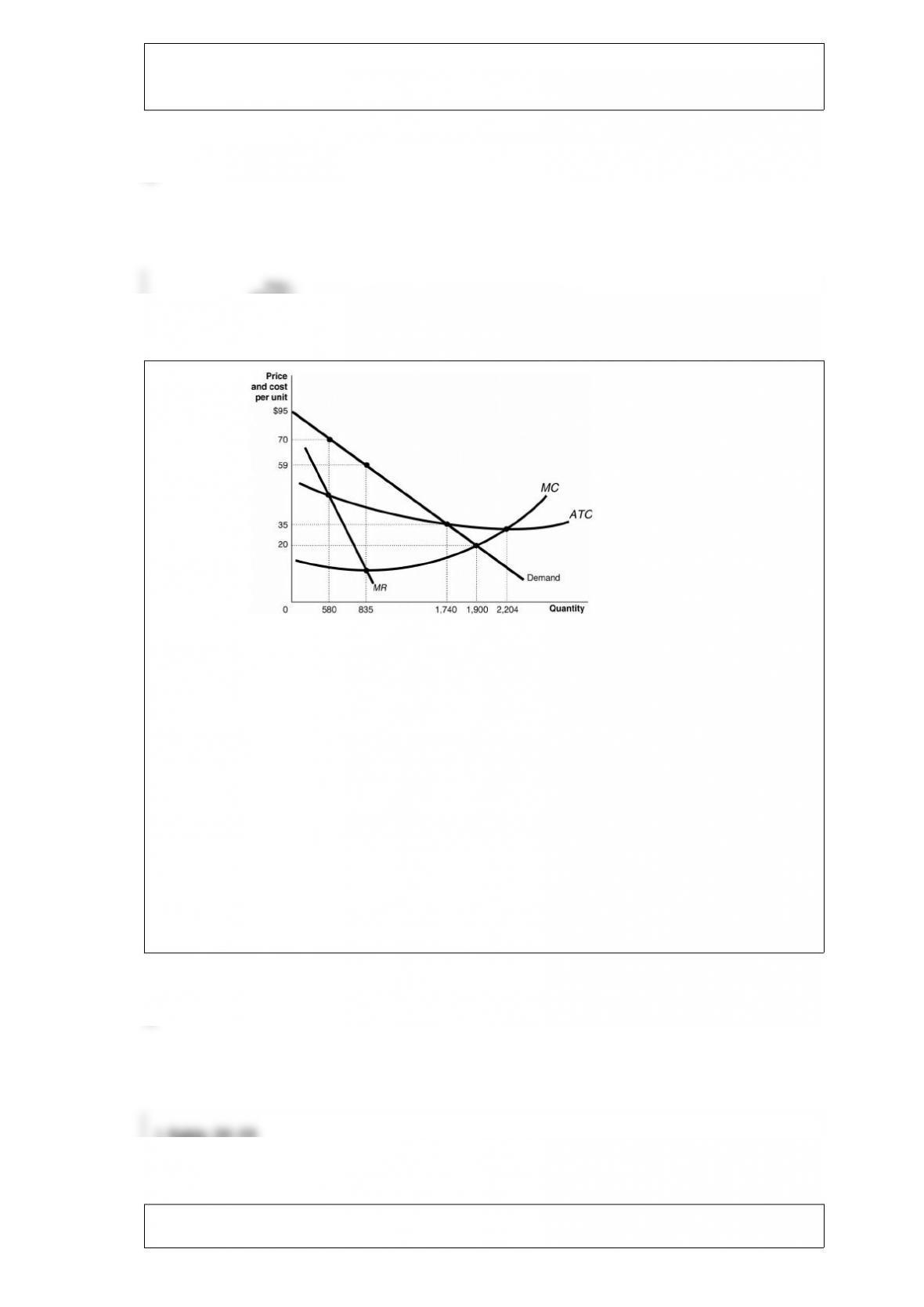
Figure 15-1
Which of the following statements about the firm depicted in the diagram is true?
A) The fact that this firm is a natural monopoly is shown by the continually declining
long-run average total cost as output rises.
B) The fact that this firm is a natural monopoly is shown by the continually declining
market demand curve as output rises.
C) The fact that this firm is a natural monopoly is shown by the continually declining
marginal revenue curve as output rises.
D) The fact that this firm is a natural monopoly is shown by the fact that marginal cost
lies below the long-run average total cost where the firm maximizes its profits.
) Table 20-19
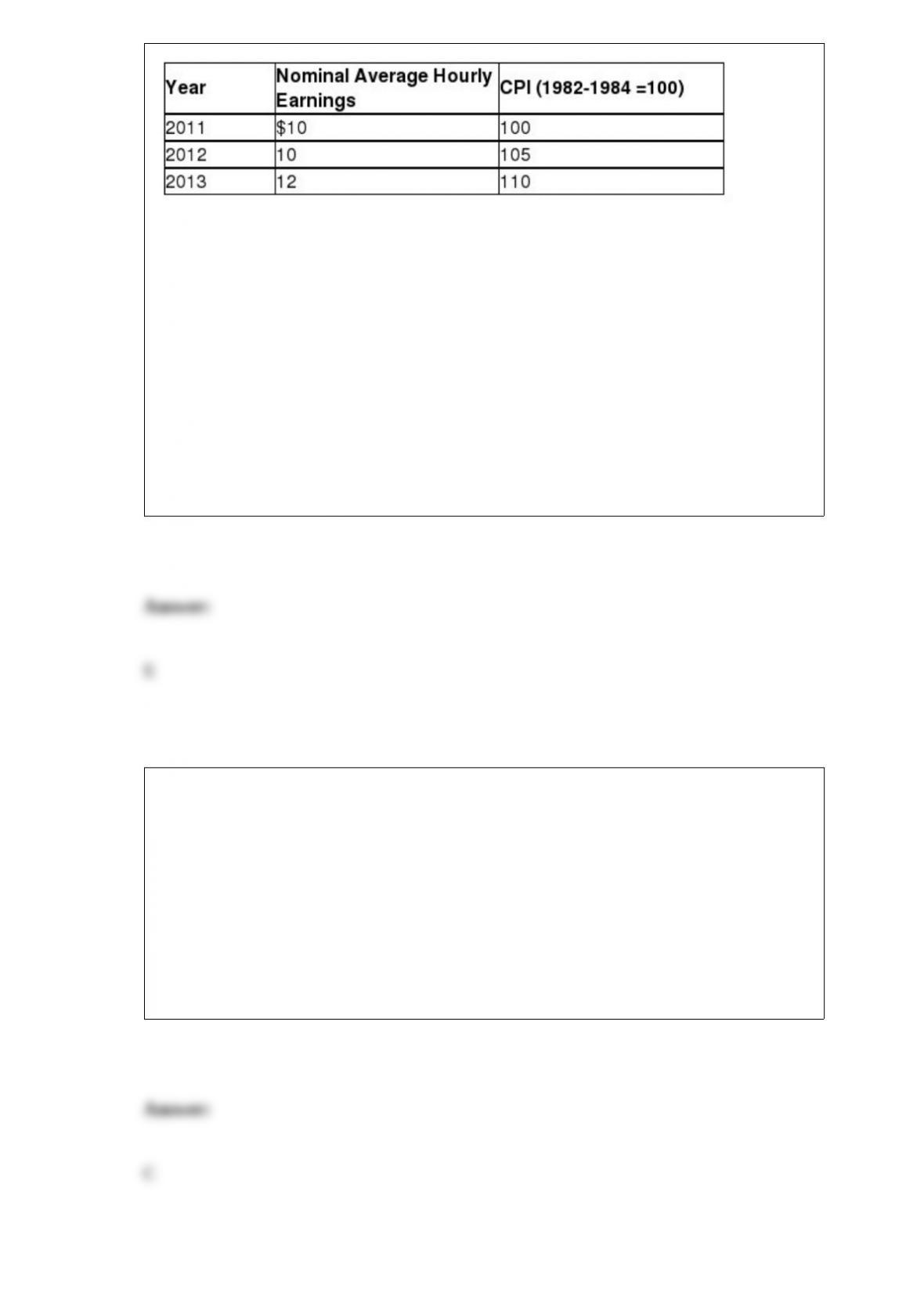
Looking at the table above, what is the rate of growth of the average price level from
2011 to 2012?
A) 1%
B) 2%
C) 3%
D) 4%
E) 5%
Which of the following would cause both the equilibrium price and equilibrium
quantity of oysters (assume that oysters are a normal good) to decrease?
A) an increase in consumer income
B) an oil spill that sharply reduces oyster output
C) a decrease in consumer income
D) a technological advancement in the production of oysters

In the United States in 2012, the percentage of people with private health insurance was
about
A) 17%.
B) 29%.
C) 74%.
D) 83%.
Which of the following is a drawback to having a common currency across countries, as
in the European Union?
A) A common currency increases barriers to trade across countries, reducing
opportunities for economic growth.
B) With a common currency, individual countries are no longer able to run independent
monetary policies.
C) Having a common currency implies that the prices of goods across countries must
always be the same, regardless of consumer preferences for goods across countries.
D) None of the above is a drawback to a common currency.
When a grocery store accepts your $5 bill in exchange for bread and milk, the $5 bill
serves as a
A) medium of exchange.

B) unit of account.
C) store of value.
D) standard of deferred payment.
Consider the following pairs of items:
a. shampoo and conditioner
b. iPhones and earbuds
c. a laptop computer and a desktop computer
d. beef and pork
e. air-travel and weed killer Which of the pairs listed will have cross-price elasticity of
zero?
A) a and b only
B) c only since most people cannot do without computers
C) e only
D) none of the pairs listed
If the percentage change in the quantity of teapots demanded is greater than the
percentage change in the price of teapots, then
A) the price elasticity of demand for teapots is greater than 1 in absolute value.
B) the demand for teapots is unit-elastic.
C) the price elasticity of demand for teapots is equal to zero.
D) the price elasticity of demand for teapots is less than 1 in absolute value.
What is meant by “excess capacity”? How does it relate to consumer utility?
Suppose a doctor can earn an additional $10,000 in revenue per year from keeping her
office open on Saturdays. What must the additional cost of keeping the office open on
Saturdays be to make this decision economically rational?
Define a partnership.
Why would a higher tax rate lower the government purchases multiplier? What does the
tax rate have to do with the government purchases multiplier?
Describe the differences (in sign and relative magnitude) between the government
purchases multiplier and the tax multiplier.
What is “tax incidence”? What determines tax incidence in a competitive market?
Suppose you obtain a fixed rate mortgage during a period of relatively high inflation.
During the next ten years, inflation falls. Are you a winner or a loser due to inflation?
Explain why.
What is a market economy?