
1) the consumer demand curve for a product is downsloping because marginal utility is
constant when price declines.
2) The U.S. poverty rate was considerably lower in 2006 than in 1960.
3) A change in the reserve ratio will affect both the amount of the banking system’s
excess reserves and the multiple by which the system can lend on the basis of excess
reserves.
4) Currently over 90 percent of all workers in the United States are covered by Social
Security.
5) Fiscal policy is complicated by political considerations and political motivations.
6) Weak property rights encourage faster extraction than would otherwise maximize the
long-term stream of profits.
7) Per capita energy use in the United States has remained fairly constant since 1980.
8) it is possible for a consumer’s indifference curves to intersect.
9) The theory that R&D expenditures as a percentage of firms’ sales first rise, reach a
peak, and then fall with increases in industry concentration is called the inverted-U
theory of R&D.
10) if the price level doubled in a 23-year period, we can conclude that the average
annual rate of inflation over that period was about 3 percent.
11) The marginal productivity theory of income distribution holds that all resources are
paid according to their marginal contribution to society’s output.
12) How do entrepreneurs differ from “other innovators?”
A.entrepreneurs bear risk; “other innovators” do not.
B.”other innovators” bear risk; entrepreneurs do not.
C.entrepreneurs only invent; “other innovators” find new markets for inventions.
D.entrepreneurs develop entirely new products; “other innovators” focus on product
improvements.
13) Which one of the following is not a shortcoming of the aggregate expenditures
model?
A.failure to show price level changes
B.failure to allow for ‘self-correction” of the economy
C.failure to account for cost-push inflation
D.failure to account for cyclical unemployment
14) which list provides, in order, examples of a private good, a public good, and a
quasi-public good?
a.national defense, a national park, an automobile
b.an automobile, national defense, a national park
c.a national park, an automobile, national defense
d.national defense, an automobile, a national park
15) In the U.S. balance of payments account for a certain year, a positive number in the
financial account means a:
A.net buildup of assets held by the U.S.
B.net reduction in the ownership of assets by U.S. interests.
C.buildup of total foreign debt.
D.reduction of total foreign debt.
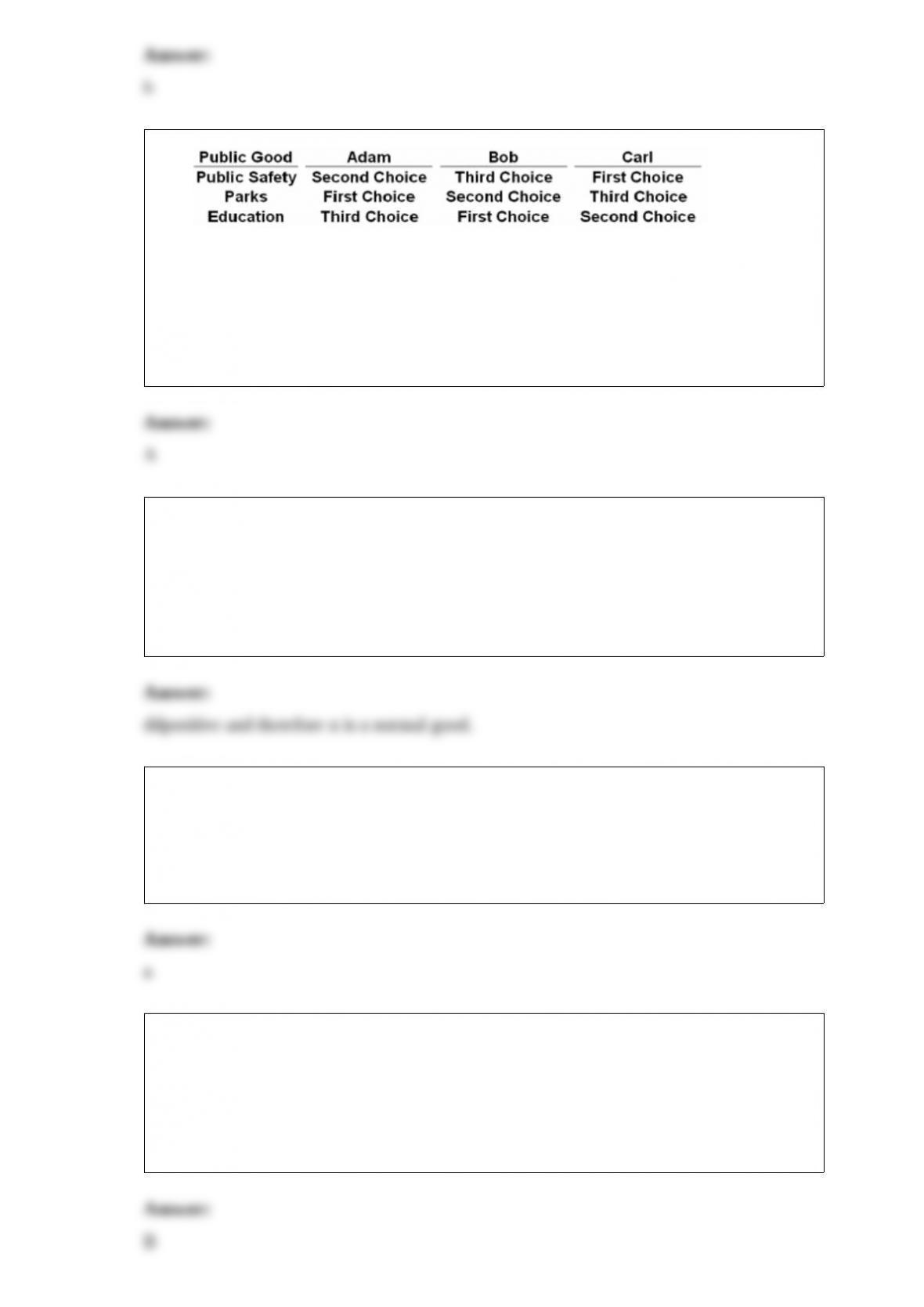
16) the following total utility data for products l and m. assume that the prices of l and
m are $3 and $4 respectively and that the consumer’s income is $18.
refer to the above data. what level of total utility does the consumer realize in
equilibrium?
a.87 utils
b.114 utils
c.51 utils
d.58 utils
17) which of the following is not an important source of revenue for the federal
government?
a.corporate income taxes
b.property taxes
c.payroll taxes
d.personal income taxes
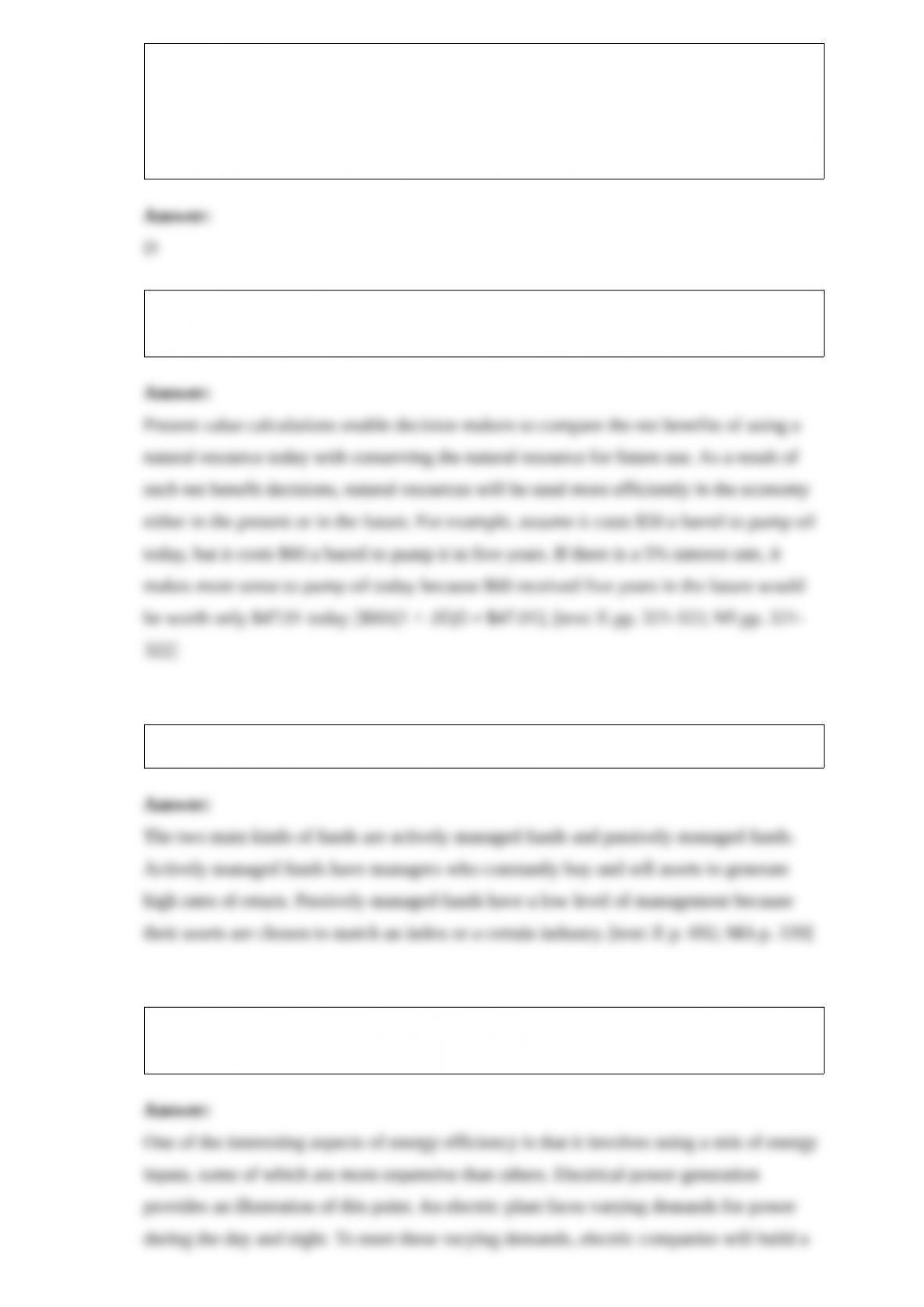
18)
Refer to the above table. The outcomes of the three possible sets of paired-choice
majority votes illustrate the:
A.paradox of voting.
B.inefficiency of logrolling.
C.principal-agent problem.
D.the benefits of majority rule.
19) assume that a 4 percent increase in income in the economy produces an 8 percent
increase in the quantity demanded of good x. the coefficient of income elasticity of
demand is:
a.negative and therefore x is an inferior good.
b.negative and therefore x is a normal good.
c.positive and therefore x is an inferior good.
20) which of the following is an example of a public good?
a.a fireworks display
b.a hotdog
c.a barbeque grill
d.a personal computer
21) Viewed through the aggregate expenditures model, the U.S. recession of 2001
resulted mainly from:
A.a fall in the average propensity to save.
B.insufficient aggregate expenditures.
C.reduced government spending.
D.increased taxes.
22) When the economy is at full employment:
A.one cannot generalize in comparing the actual and the standardized budgets.
B.the standardized budget will show a surplus and the actual budget will show a deficit.
C.the actual budget will show a surplus and the standardized budget will show a deficit.
D.the actual and the standardized budgets will be equal.
23) Explain how present value calculations are used to evaluate future possibilities in
the case of oil. Give an example using a present value calculation.
24) Distinguish between the two main kinds of mutual funds.
25) Use the case of electrical power generation to explain why the energy resource
inputs that are used are sometimes low-cost and other times high-cost.
26) Describe the importance and major features of the Sherman Act of 1890.
27) What are the marginal propensity to consume (MPC) and marginal propensity to
save (MPS)? How are the two concepts related? How are the two concepts related to the
consumption and saving functions?
28) Is the tax structure of the United States progressive at the Federal level, the state
and local level, and combined? How do transfer payments affect the distribution of
income?
29) Why study the economics of agriculture in the United States? Give five reasons.
30) Explain the probable incidence of a general sales tax imposed by a state.
31) What is the relationship between marginal cost and the supply curve for the purely
competitive firm?
32) Define the velocity of money. Explain the monetarist view with regard to the
stability of velocity.